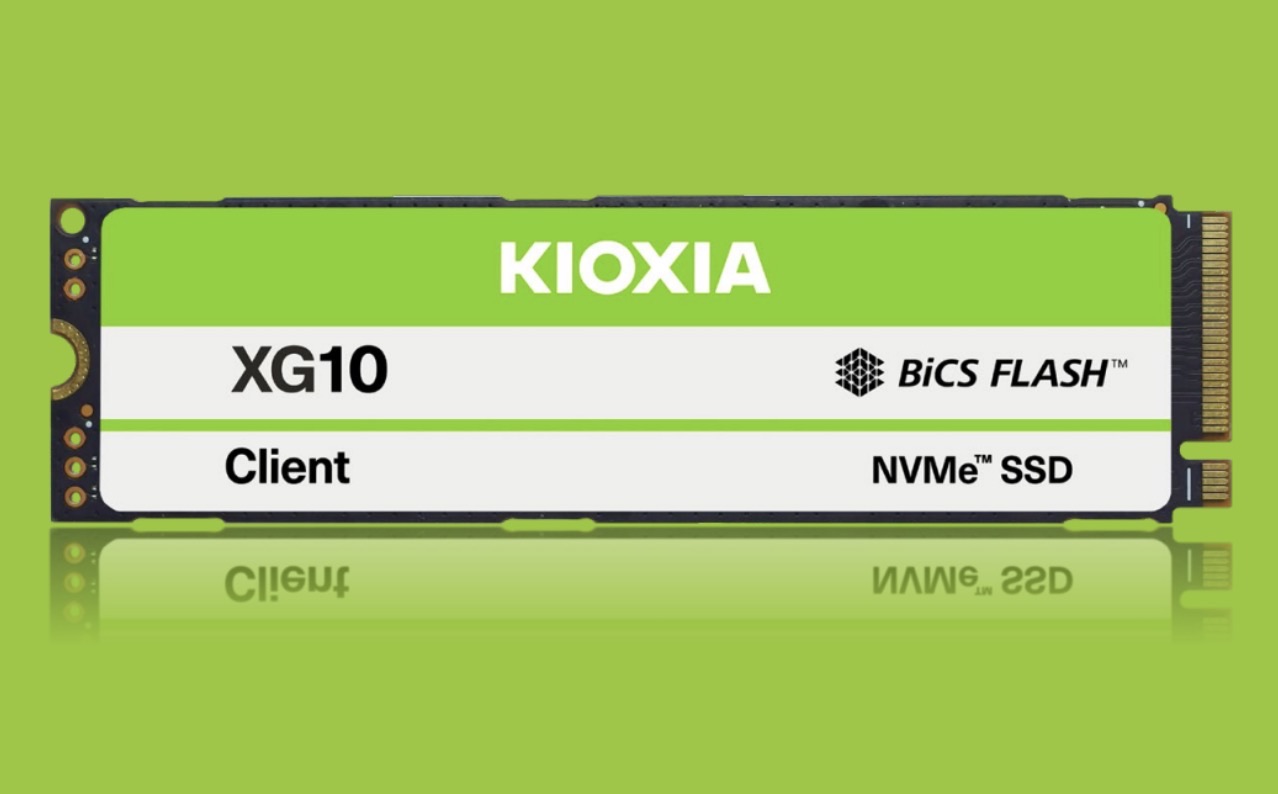
Kioxia has a new high-end client SSD family. The Kioxia XG10 Series moves the M.2-based XG line to PCIe Gen5. This generation has capacities up to 4TB, and sequential performance figures of up to 14GB/s sequential reads and 12GB/s sequential writes, making for a big generational change. For context, we previously reviewed the KIOXIA XG8 2TB PCIe Gen4 NVMe SSD. XG10 is the follow-on performance client line.
Kioxia XG10 Series PCIe Gen5 SSDs Announced
Kioxia is positioning the XG10 as a performance client SSD for PC OEMs, high-end PCs, gaming systems, AI PCs, and workstations. That places it above the recently announced KIOXIA BG8 Series, which brought PCIe 5.0 to a more mainstream client SSD segment, and above the KIOXIA EG7 M.2 SSD line, which is aimed more at value systems. The new XG10 updates the older XG8 line with a newer interface.
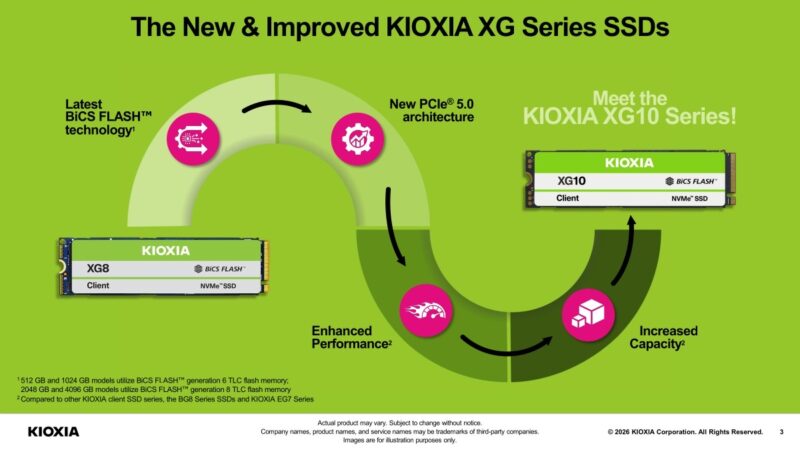
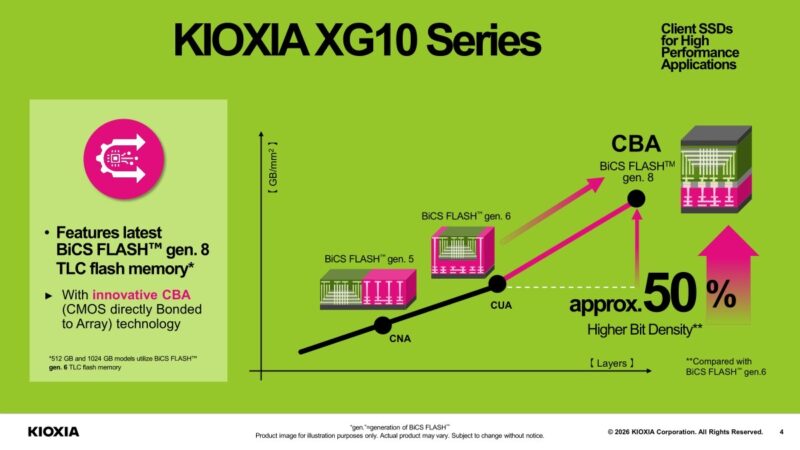
One nuance is that not every capacity uses the same NAND generation. Kioxia says the 512GB and 1TB XG10 models use BiCS FLASH generation 6 TLC NAND, while the 2048GB and 4096GB models use BiCS FLASH generation 8 TLC NAND with CBA, or CMOS directly Bonded to Array, technology.
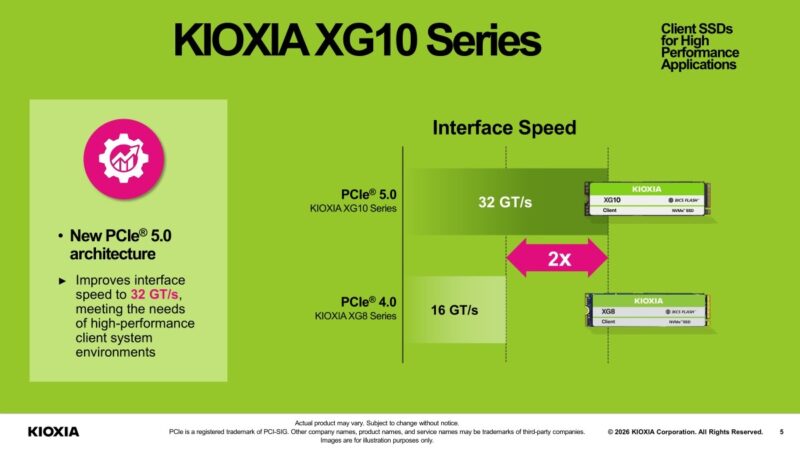
From an interface perspective, the big change is PCIe 5.0. While the XG8 was a PCIe Gen4 x4 NVMe SSD, the XG10 moves to PCIe Gen5 x4, effectively doubling the interface bandwidth.
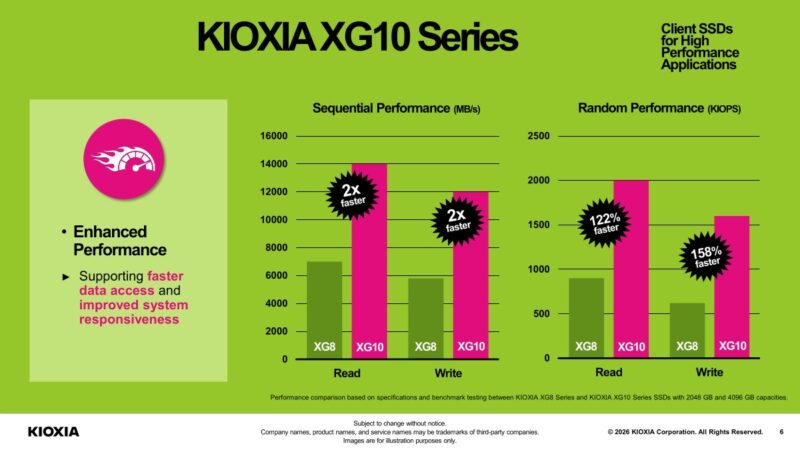
Performance figures from the media kit show the XG10 achieving up to 14GB/s in sequential reads, 12GB/s in sequential writes, 2M random read IOPS, and 1.6M random write IOPS. Kioxia’s comparison is against the XG8 at 2TB and 4TB capacities, so this is most relevant to the larger XG10 models.
Another major difference between Kioxia’s other current client SSD swimlanes is the controller design. Both the EG7 and BG8 use 4-channel DRAM-less controller designs with Host Memory Buffer support. As a higher-end drive, the XG10 moves to an 8-channel SoC design with DRAM, which is what we would expect from the performance-oriented member of the family.
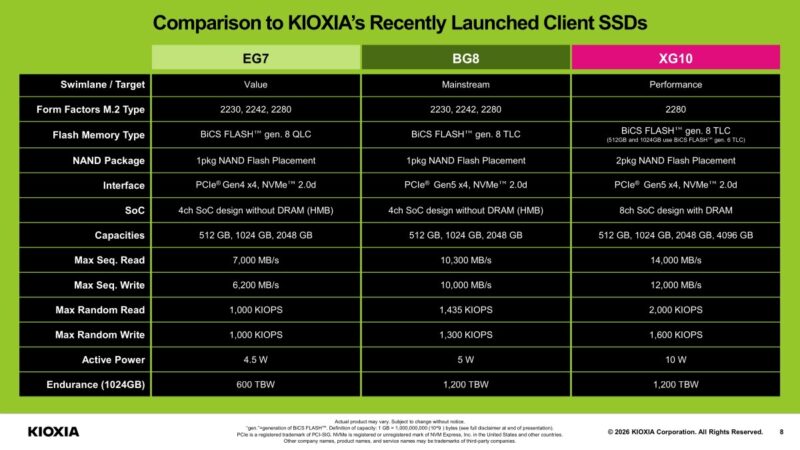
Other features include Self-Encrypting Drive support based on TCG Opal 2.02. Active power is listed at 10W, which is higher than the 5W figure for BG8 and 4.5W for EG7 in Kioxia’s comparison table. That higher active power figure is worth noting because PCIe 5.0 M.2 SSDs can be more sensitive to cooling and system airflow than many PCIe 4.0 drives.
Final Words
Kioxia now has a full client SSD stack. There is the EG7, a value-oriented QLC option. Then there is a level-up to the BG8, which is the mainstream PCIe 5.0 TLC option. Now the XG10 is the performance TLC option with DRAM and up to 4TB of capacity. That segmentation makes sense, especially as OEMs start moving more systems to PCIe 5.0 storage. Hopefully, we get one soon to test.