

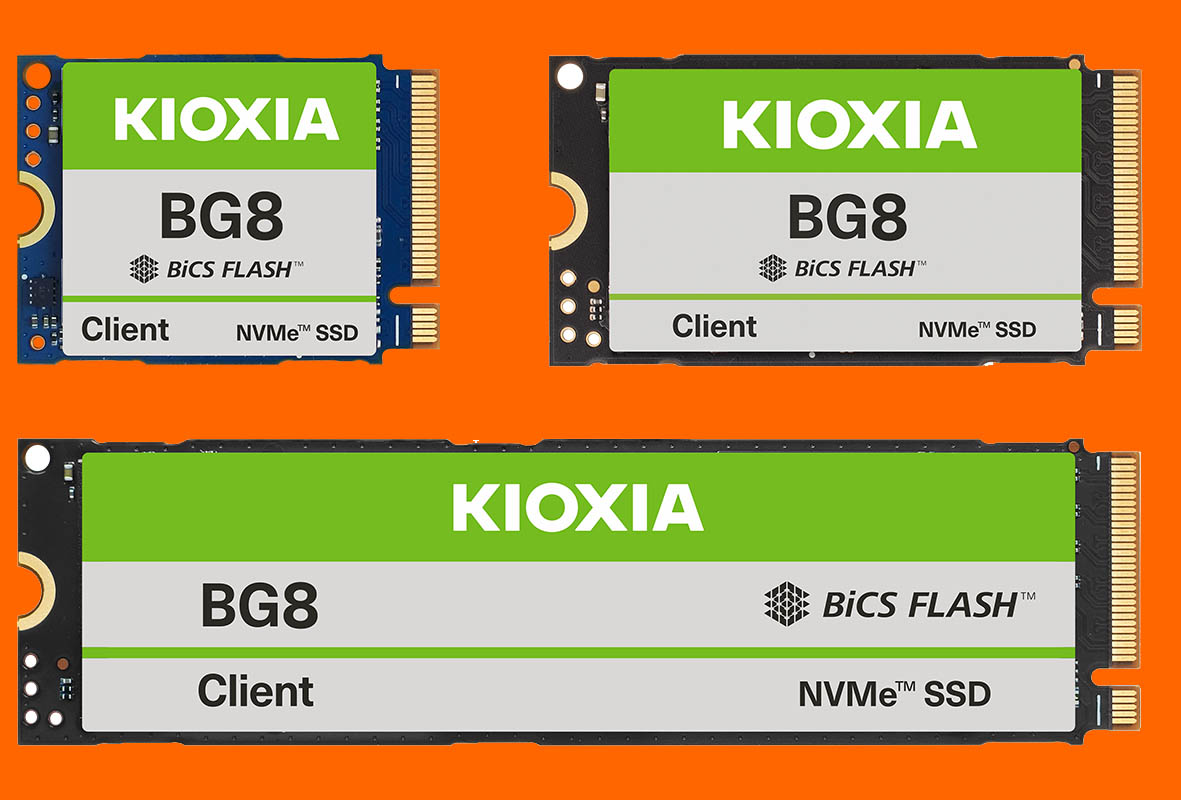
The Kioxia BG8 series of SSDs arrives roughly one year after the Kioxia BG7, bringing PCIe 5.0 connectivity to the mainstream client SSD segment. Like its predecessor, the BG8 series is intended for OEM deployments in laptops and desktops rather than retail channels. The new generation continues to leverage Kioxia’s BiCS FLASH Generation 8 TLC NAND with CBA (CMOS directly Bonded to Array) technology, with the goal of delivering substantial performance gains while maintaining a DRAM-less architecture.
Kioxia BG8 Series Brings PCIe 5.0 to Mainstream Client SSDs
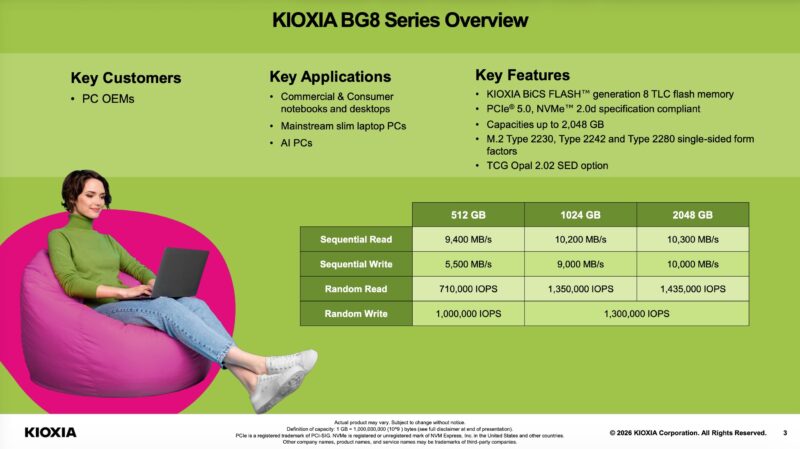
The headline improvement with the BG8 is the move from a PCIe Gen4 to PCIe Gen5 x4 interface, doubling the theoretical bandwidth between the host and the drive controller. Kioxia claims the BG8 series will deliver 10,300 MB/s peak sequential read and 10,000 MB/s peak sequential write performance, representing 47% and 67% improvements, respectively, over the BG7 series. Random performance also sees meaningful gains: up to 1.4 million IOPS for reads (44% higher) and 1.3 million IOPS for writes (30% higher).
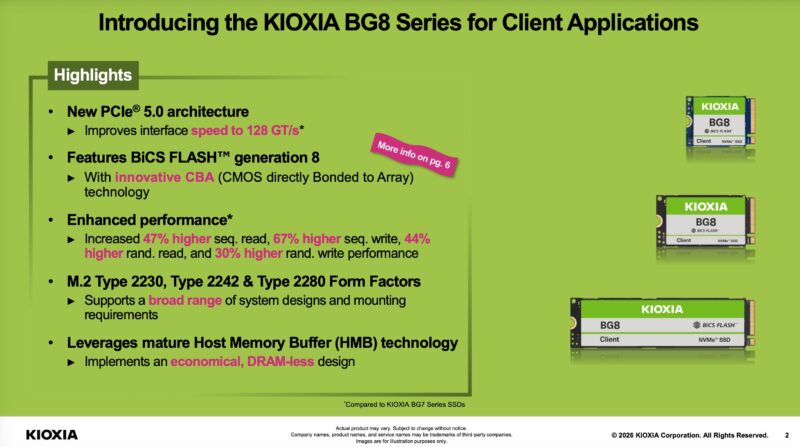
The BG8 maintains the DRAM-less design of previous generations, relying on Host Memory Buffer (HMB) technology to utilize host system memory for mapping tables. This approach reduces component costs and power consumption while delivering performance that Kioxia positions as sufficient for mainstream client workloads. The trade-off is typical of this segment: lower BOM cost in exchange for some performance headroom compared to DRAM-equipped SSDs.
Form factor flexibility remains a key feature. The BG8 ships in M.2 Type 2230, 2242, and 2280 form factors, covering everything from compact handhelds and ultraportables (2230) to mainstream laptops and desktops (2280). The inclusion of 2242 addresses devices like the Xsight Labs E1 DPU and other embedded or specialty systems that use this intermediate length.
Kioxia BG8 Specifications
The BG8 series uses Kioxia’s BiCS FLASH Generation 8 TLC NAND with CBA technology, which bonds the CMOS logic layer directly to the memory array for higher bit density. This is the same generation of NAND flash memory used in the BG7 series, meaning that Kioxia is changing out the controller while leaving the storage itself unchanged. Consequently, the bulk of the performance gains are coming from scenarios where the NAND is not a bottleneck, in particular writing against the pSLC cache.
| Specification | Kioxia BG8 | Kioxia EG7 | Kioxia BG7 |
|---|---|---|---|
| Interface | PCIe Gen5 x4, NVMe 2.0d |
PCIe Gen4 x4, NVMe 2.0d |
PCIe Gen4 x4, NVMe 2.0d |
| Capacities | 512 GB, 1024 GB, 2048 GB | 512 GB, 1024 GB, 2048 GB | 256 GB, 512 GB, 1024 GB, 2048 GB |
| NAND | BiCS 8 TLC | BiCS 8 QLC | BiCS 8 TLC |
| Max Sequential Read | 10,300 MB/s | 7,000 MB/s | 7,000 MB/s |
| Max Sequential Write | 10,000 MB/s | 6,200 MB/s | 6,000 MB/s |
| Max Random Read | 1.4M IOPS | 1.0M IOPS | 1.0M IOPS |
| Max Random Write | 1.3M IOPS | 1.0M IOPS | 1.0M IOPS |
| Active Power | 5W | 4.5W | ~5W |
| Endurance (1024GB) | 1,200 TBW | 600 TBW | Not specified in launch materials |
| Encryption | TCG Opal 2.0 SED Optional | ||
| Form Factors | M.2 2230, 2242, 2280 | ||
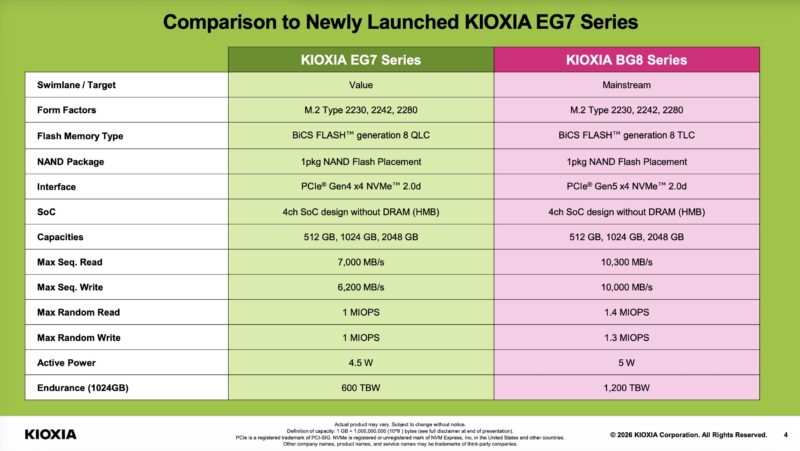
This marks the second Kioxia drive to be introduced this week based on BiCS 8, positioning the TLC-based BG8 as a mainstream drive versus the also-new entry-level Kioxia EG7 series, which uses BiCS 8 QLC NAND. In regards to performance, this gives the BG8 a leg up in almost every respect, as the EG7 only offers up to 7,000 MB/s read and 6,200 MB/s write speeds with lower write endurance as well (600 TBW vs 1,200 TBW for the BG8 at 1TB). The EG7 is positioned as a value option where peak performance matters less than the cost per gigabyte, while the BG8 targets mainstream systems that benefit from PCIe 5.0 bandwidth and higher write endurances.
Market Positioning and Target Applications
Kioxia explicitly positions the BG8 for PC OEM customers in commercial and consumer notebooks, as well as desktop systems. The DRAM-less architecture with mature HMB implementation is designed to balance performance, power consumption, and cost—critical factors for high-volume OEM deployments.
The 5W rated active power draw is consistent with mainstream client SSDs, though real-world efficiency will depend heavily on workload patterns. DRAM-less designs typically show greater variance in sustained performance under heavy loads compared to their DRAM-equipped counterparts, but for typical client usage (boot, application launch, light multitasking), the HMB approach has proven adequate in previous generations.
Security-conscious deployments can opt for Self-Encrypting Drive (SED) models compliant with TCG Opal 2.0, though availability may vary by region and OEM configuration.
Final Words
The Kioxia BG8 represents a logical evolution of the company’s mainstream client SSD line. Moving to PCIe Gen5 while maintaining the DRAM-less architecture is a calculated bet that OEMs will value the interface bandwidth even in cost-sensitive segments. The performance improvements over BG7 are meaningful on paper, particularly the 67% sequential write gain and 30-44% random I/O improvements.
Whether these gains translate to noticeable real-world benefits depends on workload characteristics. For typical client usage, boot times, application launches, and file transfers, the BG7 was already competent. The BG8’s advantages will likely matter most in scenarios with sustained sequential transfers or mixed random workloads where the Gen5 bandwidth and improved controller can flex.
The timing is notable: with Kioxia sampling to OEMs now with shipments expected from Q2 2026, the BG8 arrives as PCIe 5.0 platforms become more mainstream in both Intel and AMD ecosystems. Kioxia is not trying to compete with high-end enthusiast SSDs here; this is about bringing Gen5 connectivity to the volume market, where cost and power efficiency drive decisions.
We expect to see BG8 drives appear in OEM systems throughout 2026. When we encounter one in a review unit, we will be able to benchmark actual performance against Kioxia’s claims and compare it to both the BG7 and competing Gen5 offerings in the mainstream segment.

If that doubled endurance isn’t a huge screwup at their marketing dept., that’s a pretty big deal, and quite surprising. I’m am not aware of any fundamental changes in the tech that would produce that result.
Note that the doubled endurance is for TLC NAND versus QLC NAND. QLC innately has lower endurance, so nothing about this is unusual.
Ah, I missed that. But that’s another minor oddity then. Most warranties for TLC drives these days quote 600 writes. 1200 is unusual. Just as most QLCs quote less than 600.
Tough times without 3DXpoint. Is 1GB dram is so expensive?