

Intel this week is expanding its 2026 mobile processor lineup with the release of the Core Series 3 processors, Intel’s lower-power, lower-cost offshoot of their flagship Core Ultra Series 3 (Panther Lake) silicon. Codenamed “Wildcat Lake”, the Series 3 processors are aimed at the budget and low-power computing markets, with Intel scaling down all of its latest generation CPU technologies for a lower-end chip. The end result is a family of mobile chips with all of Intel’s latest-generation features and manufacturing technologies, but comprising a lot less silicon overall – delivering a piece of Panther Lake at a lower price point.
Intel’s Ultra/non-Ultra bifurcation of their consumer Core chips has been going on for a few generations now, with Intel having established its non-Ultra branding for its budget parts. But in a welcome change of pace, Core Series 3 is the first time where Intel is not just recycling old silicon and throwing a newer model number on it. Whereas Intel filled out its Core Series 1 and Series 2 lineups with chips based on Intel’s years-old Raptor Lake-U silicon, for Core Series 3 the entire platform is getting an overhaul, bringing with it Intel’s latest architectures. As a result, the Core Series 3 is finally going to live up to what the Core Series of chips should have always been: budget versions of Intel’s contemporary technologies.
In terms of product positioning, these new budget chips will by and large replace the 15-Watt U-series chips from Intel’s 13th and 14th Gen Core families, along with the Core Series 1 and Series 2. While Intel has offered newer U series chips as recently as the Core Ultra Series 2 family (Arrow Lake/Lunar Lake), these SKUs were only a replacement in terms of target power, not in terms of cost. Which is why Raptor Lake-U has hung on for so long: the equipment used for the Intel 7 process is long paid off and the chips were cheap to make, all to the delight of price-conscious OEMs and consumers.
Meanwhile, Intel never did release U-series SKUs for Core Ultra Series 3 (Panther Lake), despite the new chip’s energy efficiency. So there has been a significant gap in Intel’s product offerings in regards to both pricing and power consumption that have yet to be filled.
Now with Wildcat Lake, Raptor Lake-U can finally start shuffling off to the silicon retirement home.
Wildcat Lake: Panther Lake Goes on a Diet
With regard to hardware design and specifications, there is no two ways about it: the Wildcat Lake silicon at the heart of the Core Series 3 family is designed to be a relatively cheap chip to make. Intel has not provided any official figures on die size or transistor count, but based on the size of the die relative to the 35mm x 25mm package size alone, this is not going to be a huge die. And we would expect nothing less from Intel: because this is built on their 18A process, the transistor density alone is a massive step up from Intel 7, snowballing all of the gains from the Intel 3 and 4 nodes that this lineup of chips skipped.
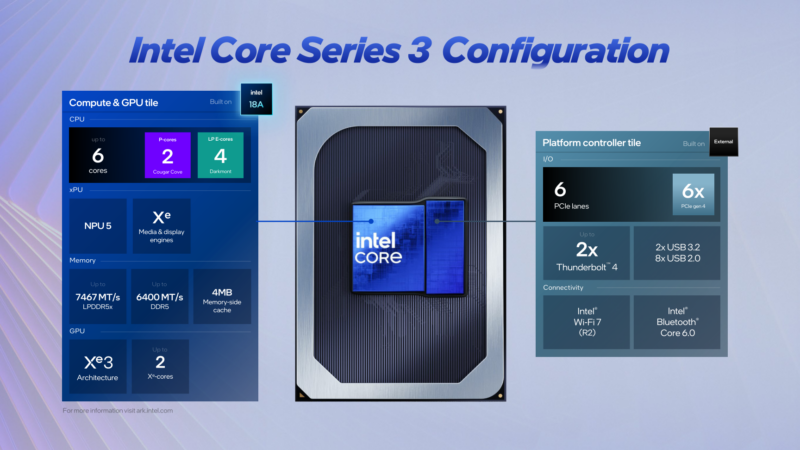
Intel has also done away with any kind of advanced packaging for the budget chip. Wildcat Lake is a two-die solution, just like the Raptor Lake-U silicon it replaces. Intel has consolidated the contents of Panther Lake’s compute and GPU tiles on to a single 18A chiplet, aptly named the Compute & GPU tile, which serves as the heart of the chip. The remaining die is a scaled-down Platform Controller tile made at an external (non-Intel) fab, which contains all of the chip’s I/O, including Thunderbolt 4 connectivity.
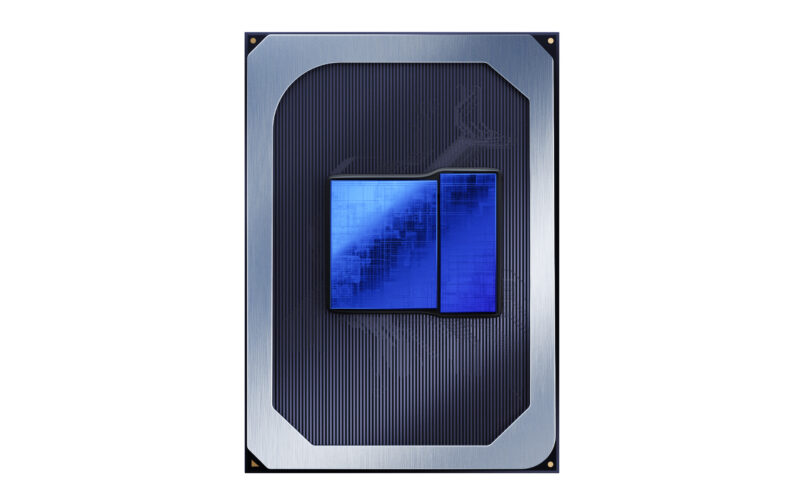
The two dies are then housed on a traditional (and budget-friendly) organic substrate, with the dies laid down on it using conventional flip-chip packaging. This mirrors Raptor Lake-U, which similarly had a CPU die and then a PCH co-located on the chip package as well. Though in the case of Wildcat Lake, Intel has moved the PCH directly next to the CPU tile and is using the newer UCIe standard to connect them. Which, even without advanced packaging, should shave off a bit of power consumption between the dies by not having to throw data as far.
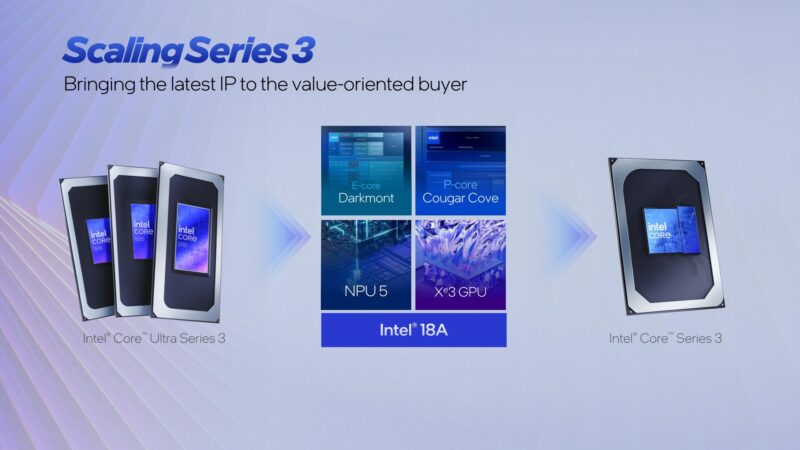
Architecturally, Wildcat Lake checks all the boxes for Intel’s current-generation architectures. In basically all respects this is a scaled down version of Panther Lake, incorporating smaller implementations of Intel’s Cougar Cove P-cores, Darkmont LP E-cores, NPU 5, memory controller, native Thunderbolt 4 support, and Xe3 architecture graphics. So from a features standpoint, Wildcat Lake is effectively at parity with Panther Lake.
Relative to its bigger brother then, Wildcat Lake is lighter on resources and on power consumption. The full chip ships with just 6 CPU cores – 2 P cores and then a single 4 core cluster of LP E-cores. Intel’s U-series chips have long contained just 2 P cores, so this is not a significant change there, but it is a notable drop in E-cores compared to high-end Raptor Lake-U chips, which shipped with up to 8 E-cores.
The net result is that while Wildcat Lake should deliver on some pretty significant single-threaded performance gains version Intel’s older U-series chips thanks to the higher IPC of the Cougar Cove P-cores, multithreaded performance gains are going to be a mixed bag at best. Then again, the recent success of Apple’s A18 Pro-based MacBook Neo lineup has served to greatly underscore how much more important single-threaded performance is to a responsive laptop (once you get past a few CPU cores, at least).
Meanwhile on the GPU side of matters, the chip incorporates just two of Intel’s Xe3 architecture Xe cores. This is the same GPU configuration as Intel’s lowest-end Core Ultra Series 3 chips, and while it is not going to satisfy any gamers, it is plenty performant for desktop use.
According to Intel’s Ark, the company has done some feature trimming that warrants a note, however: the chip lacks VVC video decoding, and the chip is not DirectX 12 Ultimate compliant – indicating that it lacks ray tracing support. Neither of these cuts are surprising, as VVC is currently a seldom used codec that has some very real licensing costs, and ray tracing is a GPU feature that really only benefits gaming. But do not be surprised if the chip does not even boot future high-end games. On the plus side, Intel has retained both AV1 decoding and encoding features, so the rest of the Xe media hardware remains intact.
Finally, Wildcat Lake also comes with a lower performing version of Intel’s NPU5 as well. As far as we know it is feature identical, but the peak performance of the NPU is down from 50 TOPS on Panther Lake to 17 TOPS here. The biggest impact of which is going to be that it means that the Core Series 3 chips do not meet Microsoft’s requirements for Copilot+ functionality, which calls for a minimum NPU performance of 40 TOPS. What the real-world impact of that limitations may be (for users that use the NPU) remains to be seen. None the less, this is a major step up from the NPU-less Raptor Lake-U chips that Wildcat Lake replaces.
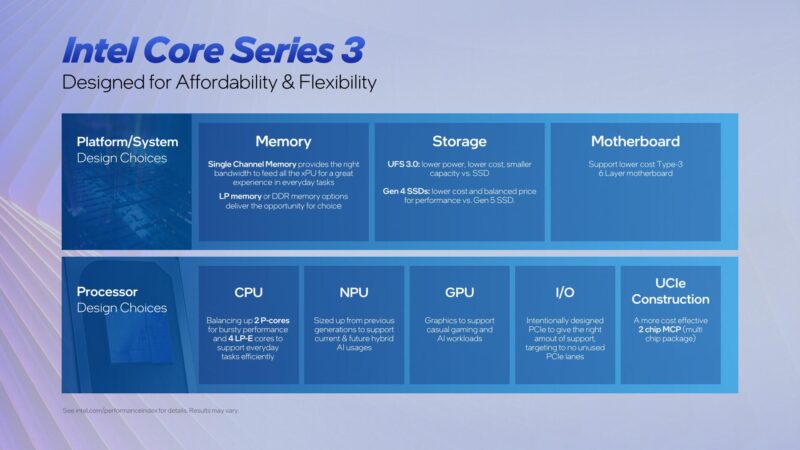
Rounding out the package, Wildcat Lake also has more limited memory support than Panther Lake. Both DDR5 and LPDDR5X are supported here, giving system vendors all sorts of options for removable and soldered-down memory at speeds up to DDR5-6400 or LPDDR5X-7467. However, the chip only features a single channel (64-bit) memory bus, making for about half as much memory bandwidth as Panther Lake. This is a notable departure from previous U-series Intel chips, which have always offered two memory channels. The true impact of this change remains to be seen. But at least compared to the Raptor Lake-U chips it replaces, Wildcat Lake does support much higher LPDDR5X clockspeeds, which will help to offset the overall memory bandwidth loss.
This will also impact the total amount of memory that Wildcat Lake systems can ship with. With half the memory channels comes half the capacity, leading to the platform maxing out at 48GB of LPDDR5X or 64GB of DDR5. Not that anyone will be shipping a budget system with so much memory in the current environment, but it is a limitation that may rear its head towards the end of the platform’s life.
The rest of the chip’s I/O options are similarly downsized. There are just 6 PCIe lanes for connecting additional devices. Intel offers full bifurcation here, so all 6 lanes can go to different devices, otherwise system vendors will have to pick between a single x4 device or a trio of x2 devices.
And for system vendors who do not opt to equip their Core Series 3 laptops with an M.2 NVMe SSD, Intel is also offering UFS 3.0 storage for a more traditional integrated/soldered-down storage option.



If this was a normal year, then it’d be interesting to see how these compare to the Alder Lake N100 family. They’re a bit more power-hungry and presumably a few dollars more expensive, but with a bit more I/O (6x PCIe 4.0 vs 9x PCIe 3.0) and P cores.
Unfortunately, with RAM and SSD prices being what they are, there’s really no point in buying low-end CPUs to save a couple bucks. Or buying anything, really.
The Jetson Orin Nano is not fast, but it runs CUDA, which is important when developing embedded solutions that involve AI and GPU processing. Maybe the software stack for Xe is catching up. Maybe there is only a benchmark and nothing like CUDA for developers.
At the same time, I think the success of the MacBook Neo shows the market for low-power compute using state-of-the-art silicon manufacturing nodes includes much more than mobile phone. For this reason the Intel announcement seems a good one.
@Scott: They might be more than a few dollars more expensive since the IO chiplet is made by TSMC and not Intel.
It’s not a directly exciting part; but it is very nice to see a low-end part that appears to mostly sacrifice die area rather than be phoned in from years in the past.
“With half the memory channels comes half the capacity, leading to the platform maxing out at 48GB of LPDDR5X or 64GB of DDR5. Not that anyone will be shipping a budget system with so much memory in the current environment, but it is a limitation that may rear its head towards the end of the platform’s life.”
It’s plausible that WCL could support one of the quad-rank 128 GB CQDIMMs that were recently announced.
If WCL and its refresh (rumored to add another 2 P-cores) are on the market for 4+ years, we’ll probably also see 96 GB UDIMMs, 192 GB CQDIMMs, and other developments. Putting way too much memory in your Wildcat Lake system will be possible if you have the money.
ARM is the FUTURE!!!!