

Core Series 3 Performance Expectations
Quickly thumbing through Intel’s performance claims, the company is primarily comparing Wildcat Lake to the Raptor Lake-U chips it replaces. With the reduction in E-cores, the bulk of the gains are coming from the faster P-cores, and thus largely benefitting lightly-threaded workloads. Intel is citing a 25% improvement in Cinebench 2026 ST, a 30% improvement in WebXPRT 5, etc.
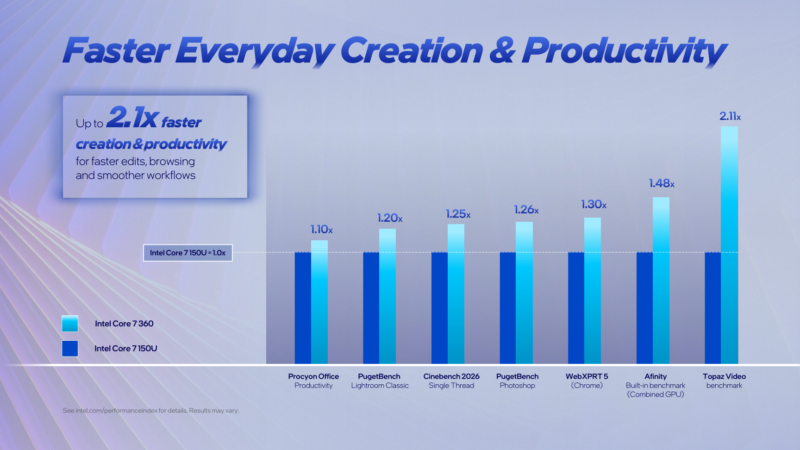
AI performance gains in particular are much higher. Though this seems to largely be a function of the vastly newer GPU architecture in Wildcat Lake.
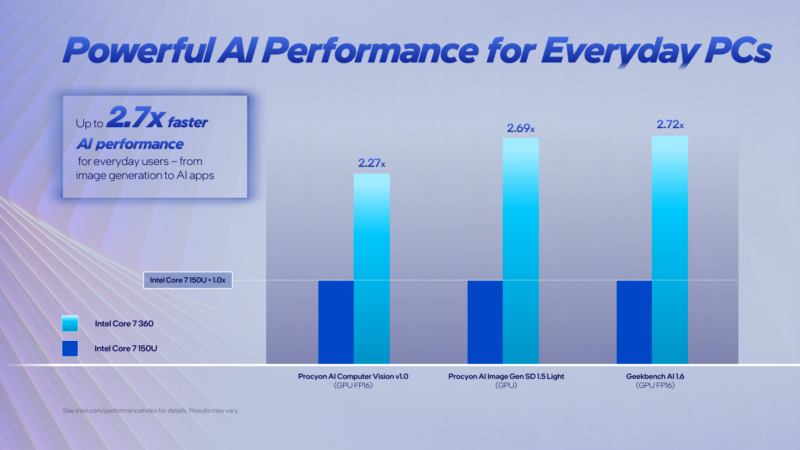
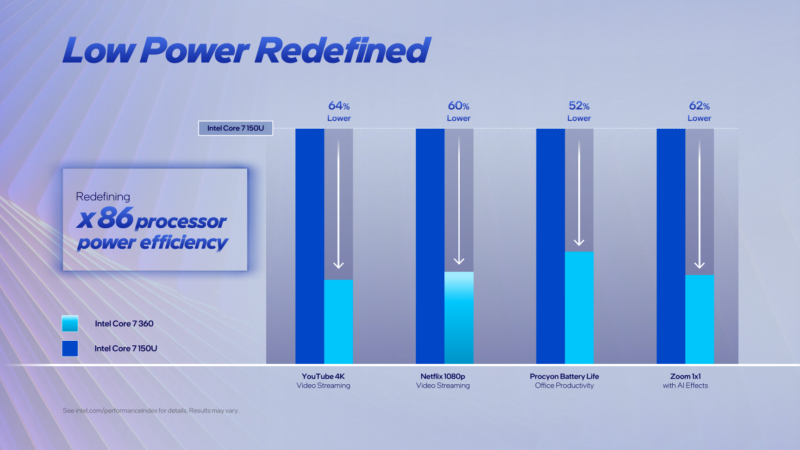
Intel does have a slide with some power figures, as well. Which is arguably one of the more interesting aspects of the chip since it is both a massive leap from Raptor Lake-U in terms of technologies, and it integrates many of Intel’s power optimization technologies that were pioneered for Panther Lake. The end result is that Intel is promoting the chip as having over 50% reduced power consumption in various light-to-medium workloads, with an overall battery life in office productivity workloads of 12.5 hours. At this point – and with the budget nature of most Core Series 3 machines – the rest of the platform is likely having a larger impact on power consumption, especially without the use of high efficiency variable refresh rate panels.
Wildcat Lake for Edge
As well as serving as Intel’s new platform for budget and low-power client computing, Intel will also be using the Wildcat Lake platform as their next-generation low-power (mainstream) edge platform.
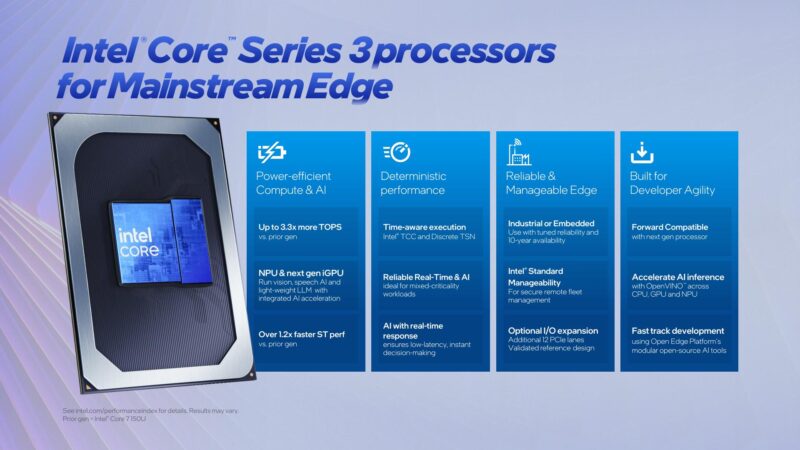
The hardware is all the same as above, so there are not any exclusive performance-boosting features that are not available on the client chip. But as with the client chip’s AI performance, Intel believes that the chip is well-positioned for AI workloads at the edge. Alongside the chip’s much newer GPU architecture and the performance gains that come from it, the addition of an NPU further boosts the competitiveness of the chip in the edge market.
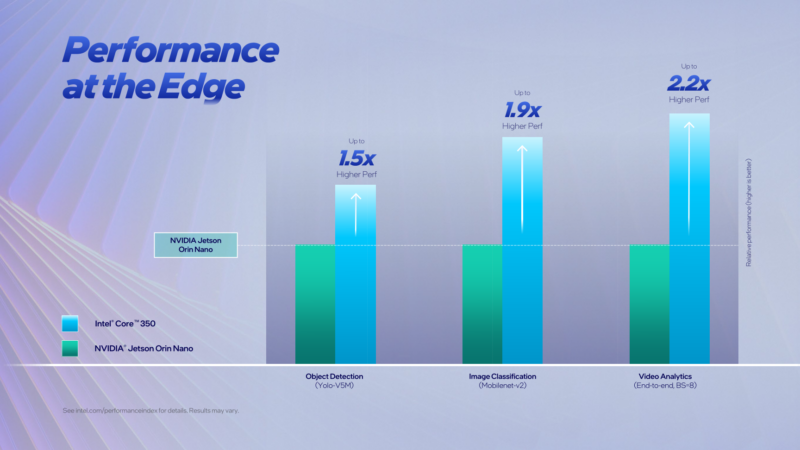
Notably, this is the first time I have ever seen Intel position a product against NVIDIA’s Jetson Orin Nano. Which I am not sure says more about Intel’s product, or how Intel views the Jetson lineup as a competitor.
Core Series 3 Chip SKUs
Altogether, Intel is going to be offering 7 chip SKUs based on the Wildcat Lake hardware. 6 of these will be for the client and edge markets, while the 7th (Core 5 305) is exclusively for the edge market.
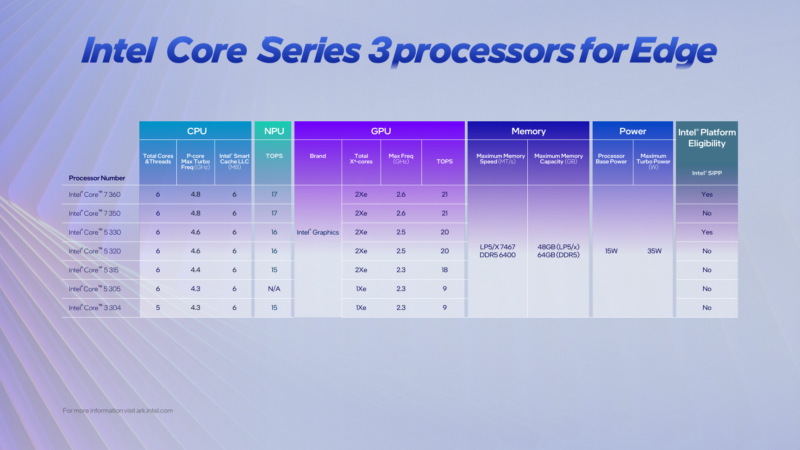
Notably, the top 5 SKUs – from the Core 7 360 down to the Core 5 315 – are fully-enabled Wildcat Lake parts with all of the CPU and GPU cores available. So these parts are differentiated entirely on price and clockspeeds, with the 315 set to deliver around 92% of the CPU performance and 88% of the GPU performance as the top SKU based on those clockspeed differences.
Below that, we have the edge-only Core 5 305, which is also the only chip SKU to ship without an enabled NPU (and is where Intel is presumably sending chips with failed NPUs). And at the very bottom of the stack is the entry-level Core 3 304, which keeps the NPU but gives up a P-core and an Xe GPU core. We will have to see how benchmarks play out, but the performance gap between this and the Core 5 315 is likely to be significant: losing half of the chip’s P-cores and half of its Xe cores is going to come with some significant performance ramifications.
Otherwise, all of these chips are identical with regards to memory support and their official power needs. All seven SKUs are rated for a TDP/base power of 15 Watts, while the maximum turbo power is 35 Watts (down from 55W for Panther Lake).
Core Series 3: Launching Now with More Devices to Come
While Intel’s non-Ultra hardware does not come with the same pomp as their high-end chip launches, the launch of the Core Series 3 is none the less an important one for Intel, and in some respects on par with Panther Lake itself.
Besides the usual market trends of budget hardware shipping an outside number of units, this marks an important update in Intel’s hardware ecosystem, finally replacing Raptor Lake-U in Intel’s product stack and bringing with it all of the architectural and manufacturing innovations of the last half-decade. It also means that Intel will finally be able to transition (most of) the rest of its consumer hardware off of the company’s Intel 7 process node, which has been capacity constrained for over a year at this point. Consequently, this is a launch that is significant on multiple levels, even if it is for chips that will primarily be going into cheap laptops.
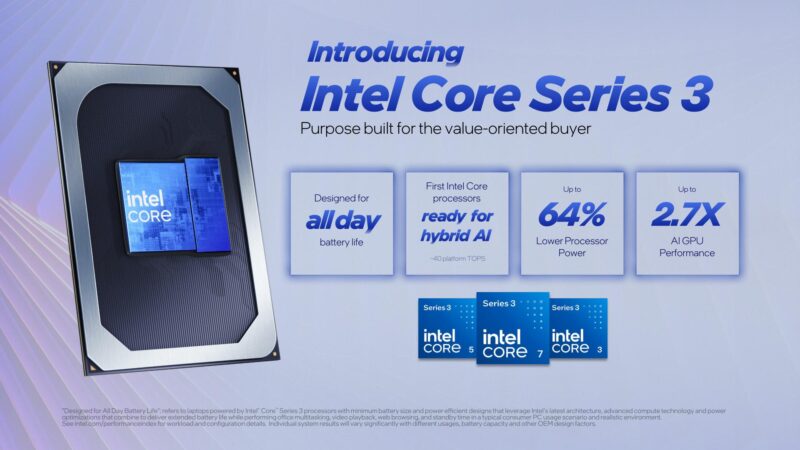
Speaking of which, according to Intel, Core Series 3 devices are starting to roll out now. Though from the sounds of things, the bulk of Series 3 laptops are going to arrive a bit later in the year – a pretty typical launch pattern for a new Intel processor. With Computex coming up in just a month and a half, I would expect to see OEMs eager to show off both their latest Panther Lake and Wildcat Lake wares.



If this was a normal year, then it’d be interesting to see how these compare to the Alder Lake N100 family. They’re a bit more power-hungry and presumably a few dollars more expensive, but with a bit more I/O (6x PCIe 4.0 vs 9x PCIe 3.0) and P cores.
Unfortunately, with RAM and SSD prices being what they are, there’s really no point in buying low-end CPUs to save a couple bucks. Or buying anything, really.
The Jetson Orin Nano is not fast, but it runs CUDA, which is important when developing embedded solutions that involve AI and GPU processing. Maybe the software stack for Xe is catching up. Maybe there is only a benchmark and nothing like CUDA for developers.
At the same time, I think the success of the MacBook Neo shows the market for low-power compute using state-of-the-art silicon manufacturing nodes includes much more than mobile phone. For this reason the Intel announcement seems a good one.
@Scott: They might be more than a few dollars more expensive since the IO chiplet is made by TSMC and not Intel.
It’s not a directly exciting part; but it is very nice to see a low-end part that appears to mostly sacrifice die area rather than be phoned in from years in the past.
“With half the memory channels comes half the capacity, leading to the platform maxing out at 48GB of LPDDR5X or 64GB of DDR5. Not that anyone will be shipping a budget system with so much memory in the current environment, but it is a limitation that may rear its head towards the end of the platform’s life.”
It’s plausible that WCL could support one of the quad-rank 128 GB CQDIMMs that were recently announced.
If WCL and its refresh (rumored to add another 2 P-cores) are on the market for 4+ years, we’ll probably also see 96 GB UDIMMs, 192 GB CQDIMMs, and other developments. Putting way too much memory in your Wildcat Lake system will be possible if you have the money.
ARM is the FUTURE!!!!