

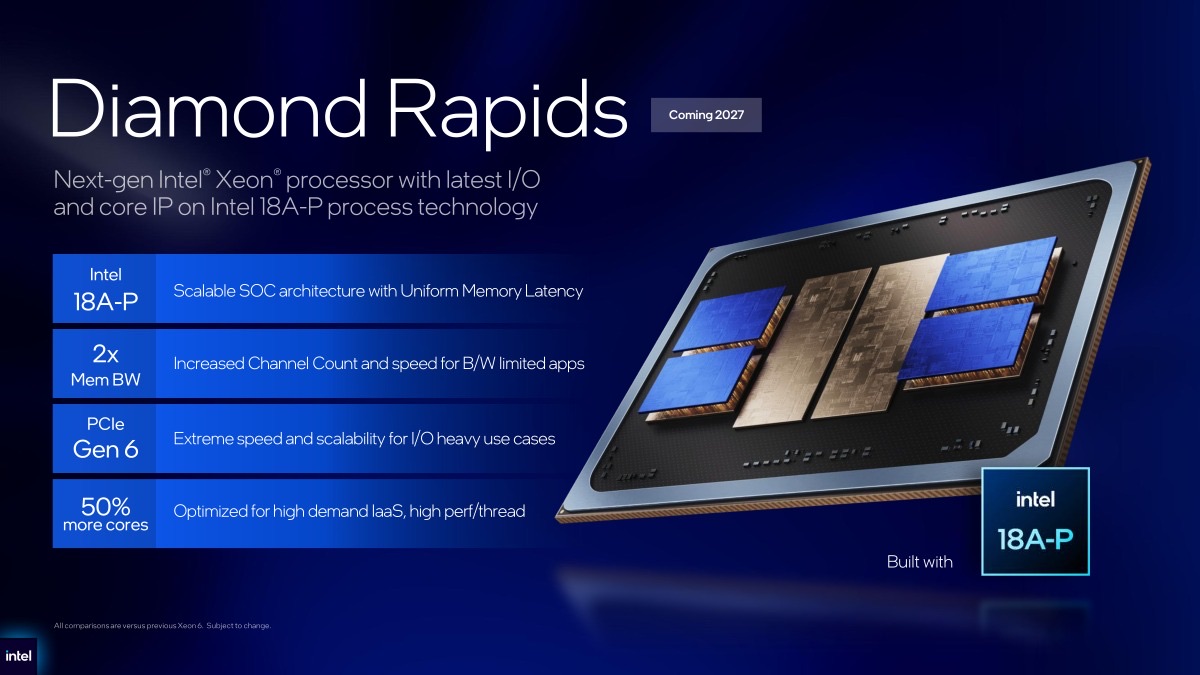
Intel revealed the Diamond Rapids roadmap at Computex 2026, confirming the next-generation Xeon 7 processor will arrive in 2027. Diamond Rapids will not support Hyper-Threading, with that feature expected to return in the next-generation Coral Rapids platform. Still, it appears as though AMD will be competing with NVIDIA Vera and Xeon 6+ in 2026 rather than Diamond Rapids/ Xeon 7.
Diamond Rapids Roadmap Details
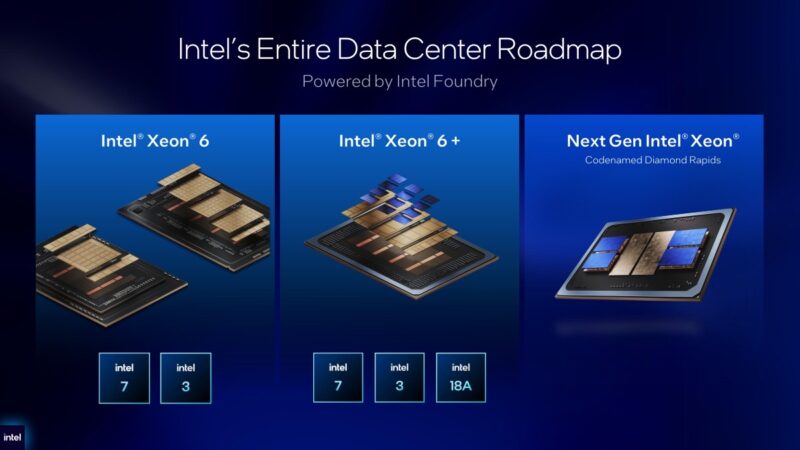
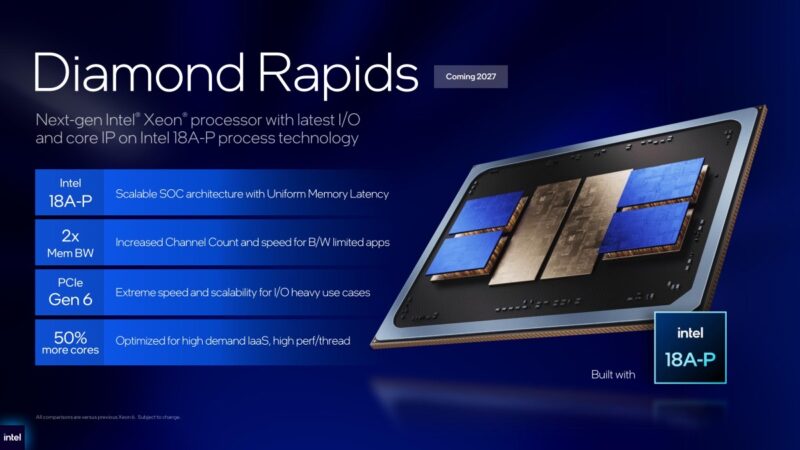
Intel’s Computex 2026 Xeon roadmap showed the Xeon 7 “Diamond Rapids” platform arriving in 2027 on Intel 18A-P process technology. This is the next-generation 18A P-core chip after the 18A E-core chip, Clearwater Forest, that was launched at Computex.
Key upgrades include double the memory bandwidth (16 channels and faster DDR5), PCIe Gen 6 support, and roughly 50 percent more cores than the Xeon 6. Intel highlighted a scalable system-on-chip architecture with uniform memory latency and increased channel count for bandwidth-limited applications.
Hyper-Threading will not be available on Diamond Rapids. Intel has said that it is an important feature that it expects to come back in the next-generation Coral Rapids platform. Intel has been pushing single-core performance hard on its desktop silicon as it moved away from Hyper-Threading. That same architectural work should translate into genuinely competitive per-core performance for data center workloads. Single-core performance on Diamond Rapids will be really interesting when the platform ships. Until then, it remains a key feature due to its software licensing and the performance-per-die area it delivers.
Diamond Rapids is not launching as many platforms as were expected a year ago. We broke the news that Intel removed its 8-channel Diamond Rapids offering from its roadmap in our Substack a few months ago.
Final Words
Diamond Rapids arrives at a crowded moment for the server CPU market. Intel is betting on process technology gains and single-core performance to compete against AMD’s expanding EPYC portfolio, NVIDIA’s Vera entry with millions of CPUs attached in AI clusters, Arm bringing out its AGI CPU, Qualcomm rumored to get into the market, as well as hyper-scalers who keep releasing new designs. Intel has one major advantage, though. It will use Intel Foundry 18A for production, helping address bottlenecks that other players will face as they compete for TSMC wafers. It will be interesting to see how Intel’s Xeon 7 fares in the market when it is released.
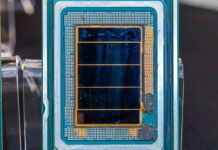
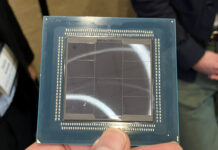

The centered IO dies are kind of weird if that marketing graphic resembles the final product. Why have two of them arranged like? Mainly about the long side of one IO die connecting the long side of the other IO die. Just seems wasteful when that could done on the narrow edge and permit another set of CPU chiplets to be connected. That’d allow Intel do double the number of cores which they are still playing catchup. I know there needs to be IO pads to support 16 channels of memory but you would think that Intel would simply spin off that aspect of IO off to its own die as well since that would not need any sort of leading edge node.
They might be using two identical IO dies with some sort of fabric connecting them in order to make the dies smaller. And with this, they could also very easily make CPUs which are half the size, both in terms of cores and IO, by using a single IO die instead of the pair.
key updates include avx10.2,APX and cxl 3.0.