

Power Consumption
In terms of power, we have the 1.6kW 80Plus Titanium level power supplies. These are actually the lowest wattage power supplies offered in this server. There are also dual 2kW and dual 2.6KW PSUs which can be important when one wants to add multiple GPUs or accelerators to a server like this.
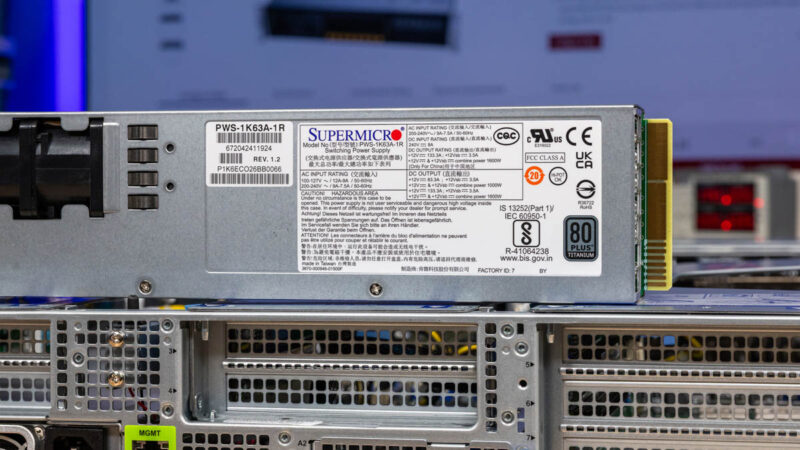
In terms of power consumption, we were generally in the 1.2kW to 1.3kW at maximum power at the wall, so we still had headroom in the 1.6kW PSUs.
STH Server Spider: Supermicro Hyper SuperServer SYS-222HA-TN
In the second half of 2018, we introduced the STH Server Spider as a quick reference to where a server system’s aptitude lies. Our goal is to start giving a quick visual depiction of the types of parameters that a server is targeted at.
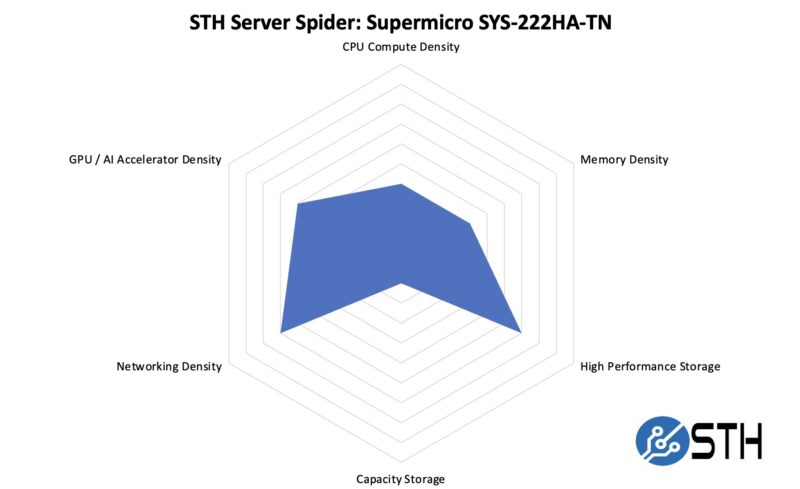
This server offers a lot of flexibility. Depending on the configuration, you can get this server to have very dense I/O. What is also interesting is that with the capability to run four GPUs in 2U it is actually quite a dense GPU platform as 8 GPUs in 4U would be a dense air-cooled GPU server these days. Again, this is a bit forward looking, but we are going to get more into PCIe GPUs next week in platforms like this.
Final Words
We have been reviewing Supermicro’s Ultra line and now its Hyper line of 2U Intel Xeon servers for many generations. In fact, we have also used them to host STH over the years. One nice aspect is that they are very configurable while also using many standard parts that one can swap. For example, if you need more PCIe lanes somewhere, it is often just finding a MCIO cable of the correct length. The Intel Xeon 6900P series offers a lot of connectivity, and this is one of the platforms that seeks to maximize the utilization of that connectivity while still fitting in a 2U form factor.
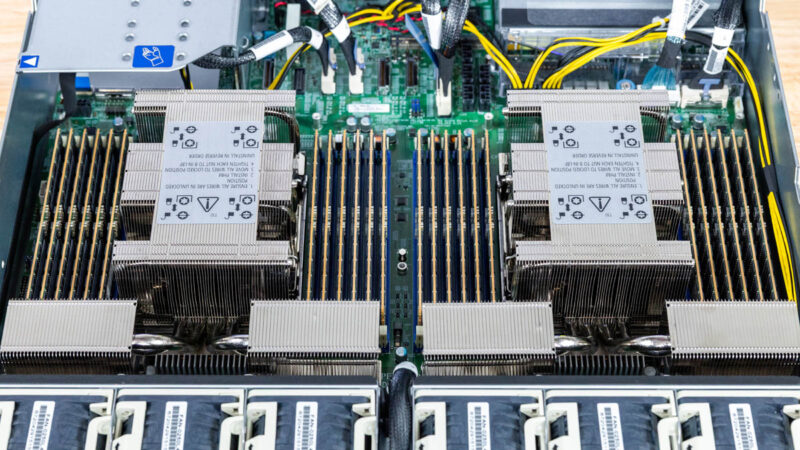
Overall, with plenty of cores, built-in Intel Xeon acceleration, and the ability to add many different types of cards into the system this is an extremely flexible server that performed exactly as we expected. Perhaps that is all you can ask of a machine.



I dislike when companies reuse their marketing keywords and the features introduced in the prior usage no longer seem to apply.
Example: “Hyper” (as used by SuperMicro) used to mean ‘enterprise (safe server) overclocking’, now it seems to mean: better front and rear I/O, PCIe 5.0 NVMe SSDs, and AIOM.NICs.
It doesn’t seem to include what was mentioned in this STH article: “Supermicro Hyper-Speed Server BIOS”.
Not STH’s fault.