

SPECworkstation 3.0.2 Storage Benchmark
SPECworkstation benchmark is an excellent benchmark to test systems using workstation-type workloads. In this test, we only ran the Storage component, which is fifteen separate tests.
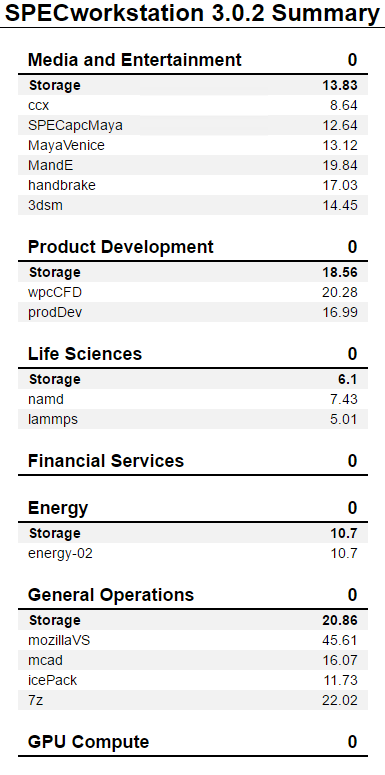
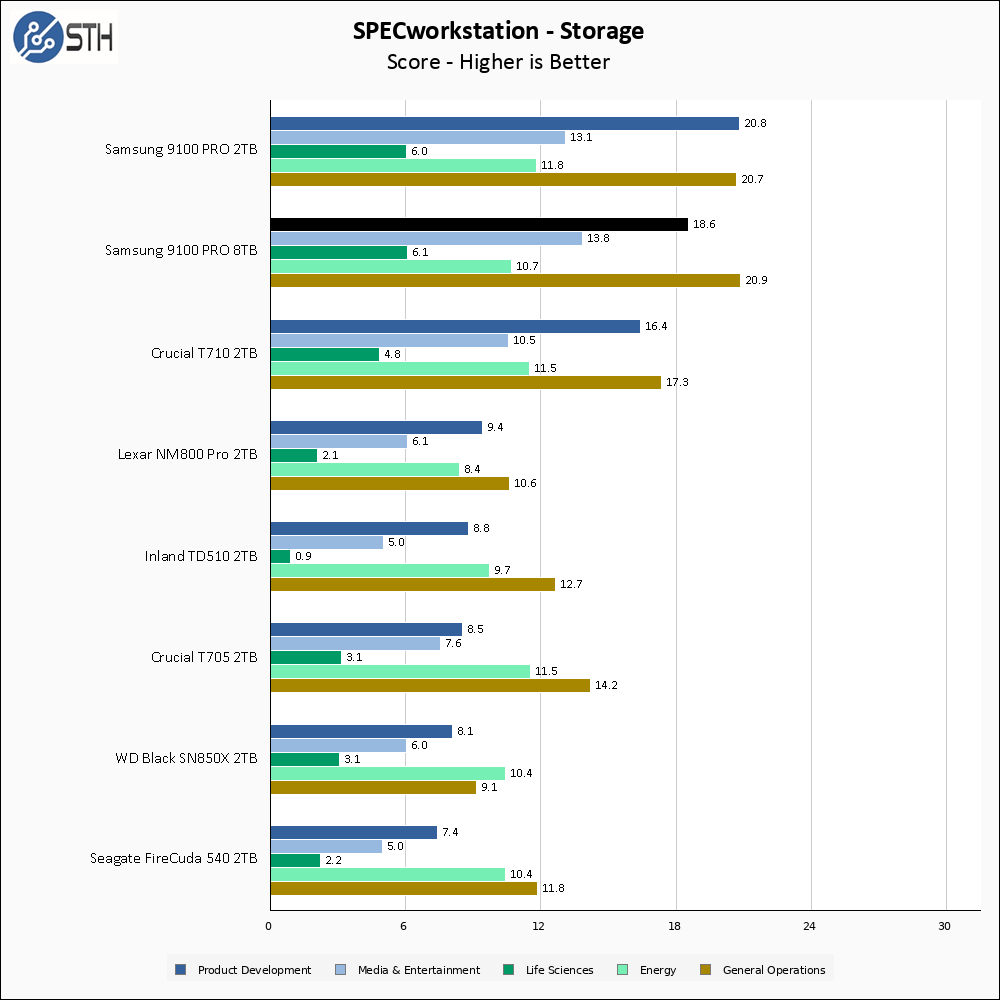
When I first reviewed the Samsung 9100 PRO, its results in SPECworkstation were so far above previous non-Optane drives that it felt like the 9100 PRO was playing a different sport than the rest of my test drives. Then the Crucial T710 came along and was also very impressive, though not quite as crazy. Now comes the 9100 PRO 8TB, and the trend continues. SPECworkstation results are impressive to say the very least. While product development score gives the original 2TB drive a modest edge, much of this test favors the larger drive. Since the 9100 PRO was already largely the uncontested SPEC winner on my charts, the 8TB drive now sits comfortably at the top with its 2TB brother. If you judge a drive based on how it performs in SPEC, then look no further than the Samsung 9100 PRO line.
Sustained Write Performance
This is not necessarily a benchmark so much as trying to catch the post-cache write speed of the drive. While I am filling the drive with data to the 85% mark with ten simultaneous write threads, I monitor the drive for the write performance to dip to the lowest steady point and grab a screenshot.
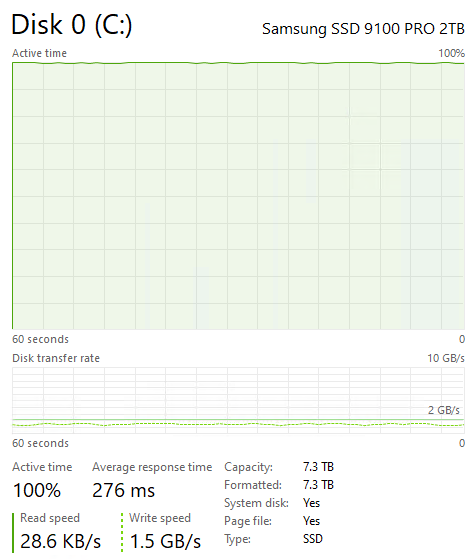
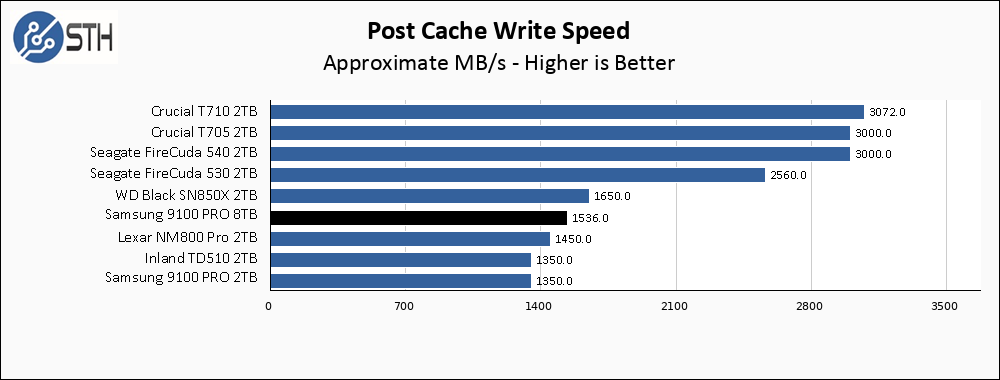
This result was the most surprising one in the original 2TB 9100 PRO review, and here it is again. In every other test the Samsung drive trades blows or outright wins when compared to the Crucial T710 or T705, but longterm sustained write performance is obviously not what the 9100 PRO line is tuned for. That said, 1.5 GB/s is fine enough performance and represents a small improvement over the 2TB version of the drive.
A Funny Quirk
Very keen eyed users might have noticed a small quirk on some of my result graphics.
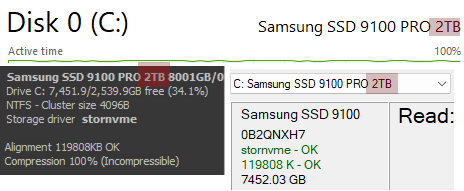
During testing, my drive consistently identified itself as the Samsung SSD 9100 PRO 2TB, despite most assuredly being an 8TB drive. After some additional troubleshooting done after this review went live, I have isolated the issue down to a software issue on my test environment. The drive correctly identifies itself as 8TB, this was only a bug on my test bench itself and the drive is unaffected. I am leaving this note here just to explain the visual discrepancy in the pictures.
Temperatures
We monitored the idle and maximum temperature during testing with HWMonitor to get some idea of the thermal performance and requirements of the drive.
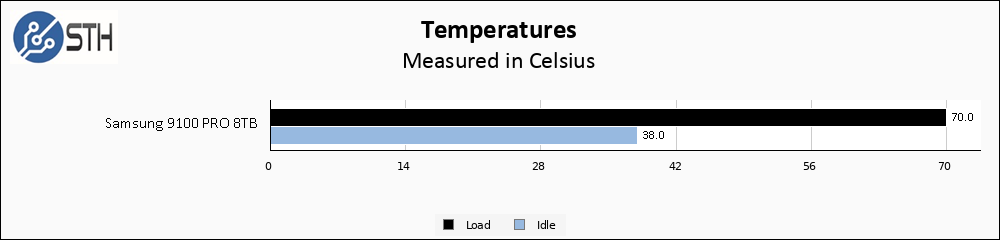
I was quite surprised by the thermal performance for the 9100 PRO. While the drive did eventually reach a fairly high temperature, it took a long time to get there and a heatsink easily controlled it. I would wager that a great many users would not need a heatsink on this 9100 PRO. With that said, anyone with a warmer case or low-airflow environment around their drives might be better served with a heatsink.
Final Words
The Samsung 9100 PRO 8TB launches today, September 2nd, for a MSRP of $1000 without a heatsink and $1020 with one. These are expensive, but high performance and very high capacity drives. There is almost zero competition for Gen5 8TB drives, while Gen4 8TB drives come in close to the $600-700 mark.
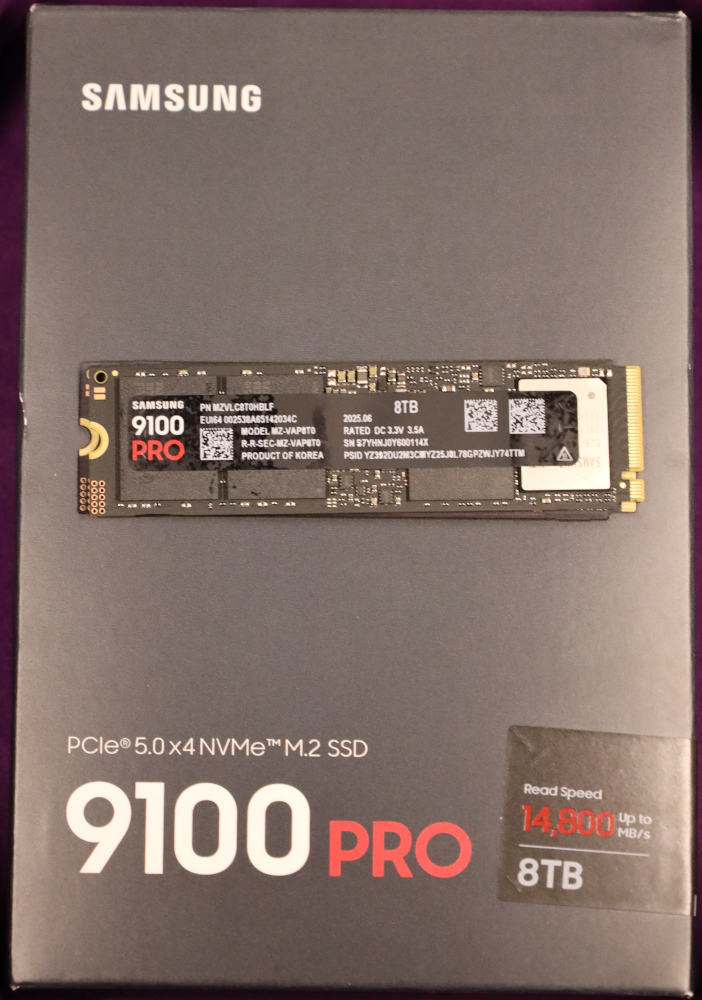
It really comes down to a simple question. Do you need 8TB of SSD space? If so, do you need the fastest 8TB M.2 drive money can buy? If your answer to both of those questions is yes, then the Samsung 9100 PRO 8TB represents your only option today. If you are OK with a slower drive you can get the same capacity at Gen4 for a significant discount, or if you are OK with lesser capacity you can get better performance per dollar at the 4TB or 2TB capacity points. But if you need both capacity and speed, this Samsung drive is king.
Where to Buy
Here is an Amazon affiliate link to the drive if you want to check current pricing or buy one.

Samsung 9100 PRO 8TB SSD
Hallo please send me a quote for this samsung SSD plus an external housing please
It’s about tree fiddy.
So if I want sustained writes I should go enterprise or the T705. Good to know.
@Culbrelai
Keep in mind my screenshot was written during an operation where I take the drive from 0% to 85% full. In the case of this drive, I write nearly 7TB of data to it.
If you want sustained writes, and your definition of sustained writes is 500+ GB files written as fast as the drive can write, then the Crucial T710 or T705 are faster.
If you’re writing anything less than 500GB, the difference will be negligible. The 9100 wrote the first TB, or more, at 4+ GB/s, which is as fast as I can generate the random data I use to populate the drive.
I balked at the price until I checked nand flash spot prices (of course Samsung uses in-house nand but it’s still a way to do some napkin math). These 8tb drives are just going to be expensive until nand wafer prices come down.
Thanks for the review. Since this is a double-sided drive, I’m particularly interested in the thermal aspects. What sort of case & cooling setup did you use? Did the CPU cooler provide any direct airflow onto the SSD?
Also, do you have any idea whether the monitoring software was reporting NAND or controller temperature? I’d guess it’s the NAND temperature, since that’s the more heat-sensitive of the two (but usually also cooler).
In the future, I would appreciate seeing a dedicated thermal test, as many other sites usually do.
> So if I want sustained writes I should go enterprise or the T705.
@Culbrelai , it depends on what you’re trying to do. For something like a sustained database workload, skip right past consumer SSDs and get a server SSD for mixed or write-intensive workloads. Those are optimized to reduce tail latencies in a way that you generally don’t see among any consumer SSDs.
Another thing about consumer SSDs is that the size of the SLC buffer is proportional to the amount of free space. In the 4 GB 9100 Pro, it looks to be a quarter of the free space, which check out if you consider that it’s TLC (i.e. 3 bits per cell) and thus 4x as dense as SLC. This means you can fill an empty drive to 25% at full speed, but if you’re starting with a half-full drive, then you can only add another 1 GB (if we’re talking about the 8 GB model), before it throttles back to the steady-state write performance.
> The 9100 wrote the first TB, or more, at 4+ GB/s, which is as fast as I can generate the random data I use to populate the drive.
@Will Taillac , I highly doubt the drive does any sort of block-level de-duplication. That’s the only reason I can see why you’d need to use non-repeating random data. I’d just replay the same block of pre-generated random data. Maybe you could try doubling the size of your write buffer and adding a random offset, but I’d be shocked if it made any difference.
It’s storage, It stores data. If you’re going to review something like this at least do it properly.
“Across the 9100 PRO line all drives are equipped with a LPDDR4X DRAM cache at 1GB per 1TB of drive capacity.” should be: “Across the 9100 PRO line all drives are equipped with an LPDDR4X DRAM cache at 1GB per 1TB of drive capacity.”
@Cyclographer
In the past – think Sandforce era drives – some SSDs have used inline compression to improve performance. I’m honestly not sure if any drives out there nowadays still do that kind of thing, but I use random data just to be sure. Actually, I use 10 separate threads generating random data simultaneously, causing the data to get interwoven as it’s written.
My ability to generate data hasn’t been a huge limitation for the most part, and eventually my test bench will probably get upgraded and be able to push more data.
As for thermal testing, generally speaking drives report their controller temperatures. I do have a FLIR camera which I pull out and use to ensure the self-reported drive temperature is fairly accurate; I’ve caught drives in the past where the reported temperature was wildly different than reality. That’s never been a problem with a Samsung drive thus far, though. I let the drive get up to temperature during the initial random data drive write, operating on an open-frame test bench without a heatsink. If a drive stays cool, let’s say under 60C, then I might just leave it that way for all testing. Once a drive makes it to 70-80C though, I try to observe throttling behavior if I can just for my own knowledge, and then apply my MSI motherboard’s built-in heatsink. I also have a fan I can direct at the drive/heatsink if needed. In the 9100 PRO’s case, the drive only barely made it to 70C, so I marked the temperature and then applied my heatsink for the rest of testing. With the heatsink I don’t think I broke 50C for the rest of testing.
> As for thermal testing, generally speaking drives report their controller temperatures.
On Linux, the 990 Pro reports three temperatures: Composite and two “Sensor” temperatures (1 and 2), which appear to be the NAND and controller, respectively. It seems clear to me that the Composite temperature reflects Sensor 1, which I believe is the NAND temperature.
With NAND being far more temperature-sensitive, I would expect drives to give you the NAND temperature, if you get only one. However, I can’t argue with any results you’ve gathered by either FLIR or external temperature probe.
> I’ve caught drives in the past where the reported temperature was wildly different than reality.
So, the reported value matched neither the NAND nor the controller? Was it somewhere in between the two? Was the drive in a steady-state, at the time, to rule out the effect of any temporal smoothing?
> In the 9100 PRO’s case, the drive only barely made it to 70C
That is pretty hot, for a NAND temperature. A lot of drives will start to throttle around there. Controllers usually have a higher throttling point (my 990 Pro reports a throttling temperature of 85 C, for the controller).
Thanks for the reply!