

QNAP QSW-M7308R-4X Management
Something that was very notable with this switch is that, unlike some bigger brand 100GbE half-width switches, it comes with a QSS web management interface. That makes it much easier for SMBs and home users to integrate.
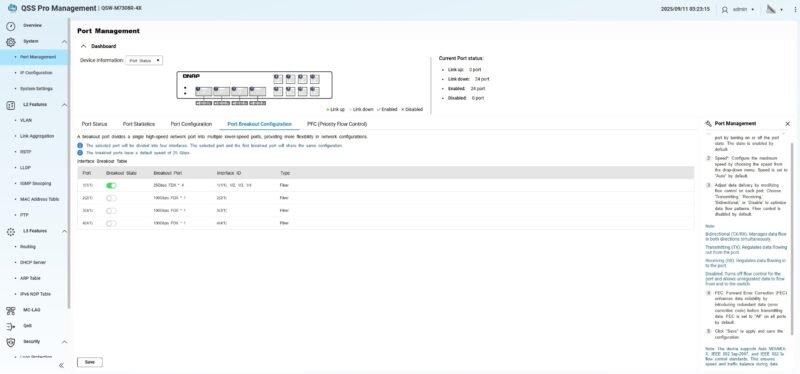
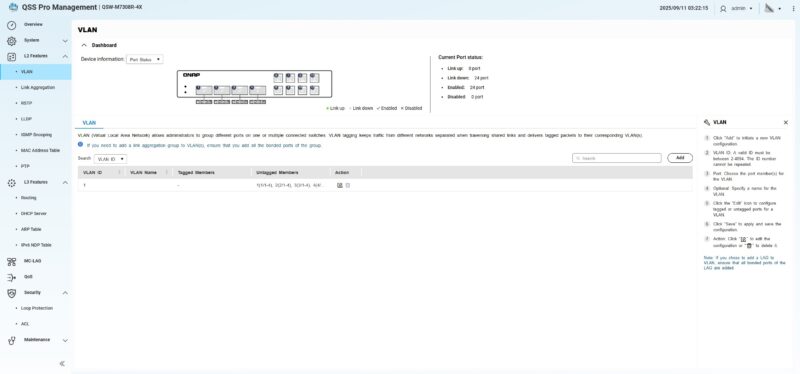
In there, we can do our typical features like breaking out the QSFP28 ports to 25GbE and setting VLANs.
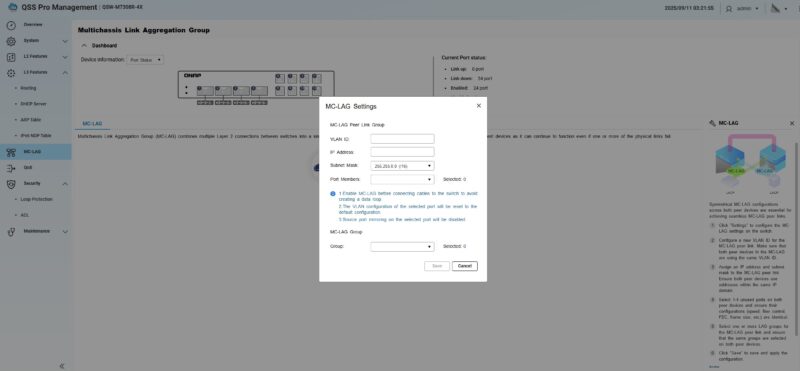
We can also setup MC-LAG.
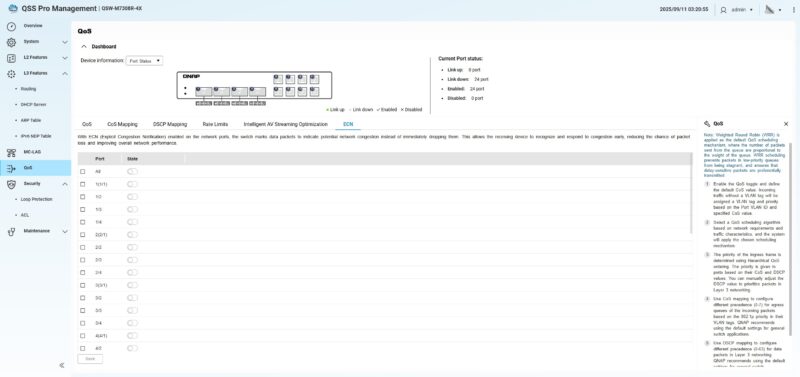
With 100GbE especially, doing RDMA networking is more common. This has an easy interface for PFC.
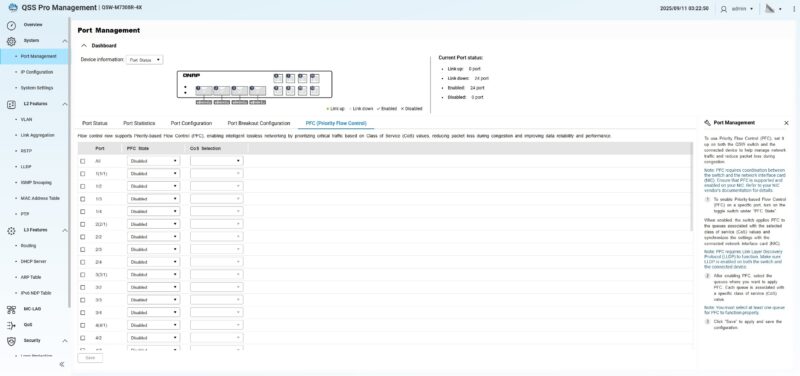
It also does for ECN. Something you might see is that on the right side there are fairly detailed in-context help guides for the screen you are looking at. We have many users who just want a CLI and will see all of this as fluff. For others who will have perhaps this switch and then maybe a lower-speed PoE switch in their networks, the web GUI is more accessible. Having the in-context help is excellent.
You can even do some routing in the platform.
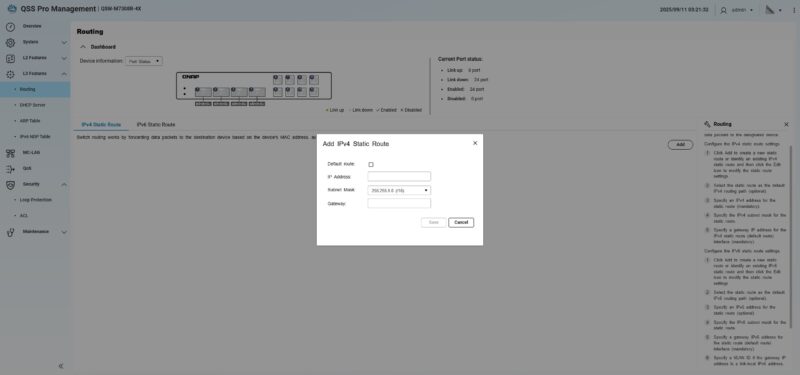
As a quick note, although features like that in-context help are present, this interface is considerably different from the web management we saw in the QNAP QSW-M3216R-8S8T 16-port 10GbE Managed Switch Review, and there is a lot more you can do here.
Next, let us get to the performance.
QNAP QSW-M7308R-4X Performance
In terms of performance, we actually tested this switch some time ago, so it is still using our iperf3 setup instead of the Keysight CyPerf setup we are using on our new gateway reviews. We might be getting a big test chassis soon, and perhaps this is one to revisit if/ when we do. Doing multiple 100GbE links is expensive.
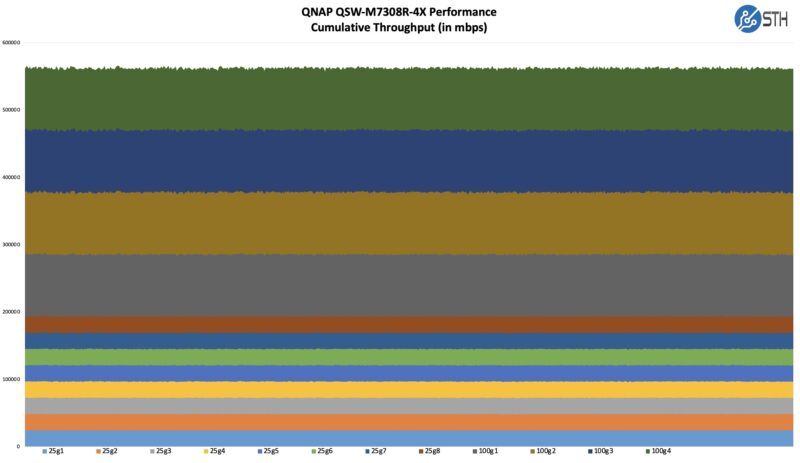
Performance was fairly good from this switch and about what we would expect. Hopefully, this is an area we can improve our testing on, but we are certainly seeing solid speeds despite this being a lower-cost 25GbE/ 100GbE switch.
QNAP QSW-M7308R-4X Power Consumption and Noise
At idle, without any optics plugged in, we saw power consumption in the 27-28W range. Noise is only 38dBa, which is really good for this class of switch. We have seen many 10GbE switches that are louder than this unit.
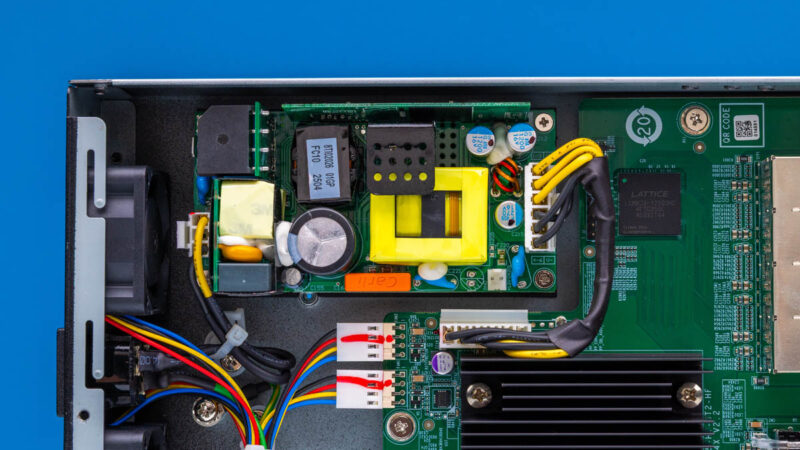
QNAP says this can utilize a maximum of 55.153W, which we did not get to in our testing, but that usually requires higher power optics instead of DACs. Still, if you took 27W to 55W (or even to be safe 65W) that is awesome. Two of these in 1U is roughly 1A at 120V maximum, which means it is actually a good solution for even low-cost colocation as well.
Final Words
This was a switch that we first saw at Computex in June of 2023 and that we were very excited about. For around $999 this has 600Gbps of ports, for about $1.67/ Gbps. Or on a price per Gbps basis, it would be like a $13.33 8-port 1Gbps switch.
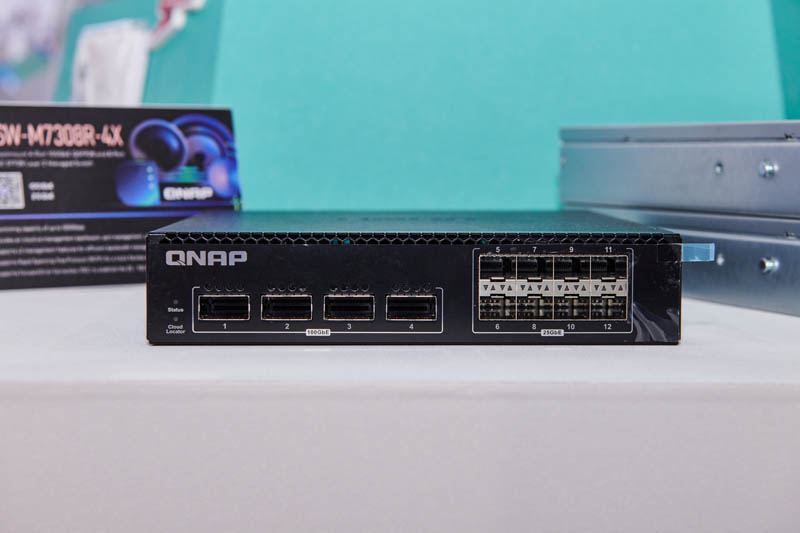
As a half-width switch, you can put it alongside a QNAP QSW-M3216R-8S8T in a rack for example and get 1U with lots of port diversity. Being able to break out the QSFP28 ports is also a nice feature, since for many environments where you just need a low-power and low-cost 25GbE switch, this can be useful.
We might end up buying a second one of these for the lab, but it faces stiff competition from switches like the MikroTik CRS504-4XQ-IN, MikroTik CRS510-8XS-2XQ-IN, and MikroTik CRS520-4XS-16XQ-RM. Given that the MikroTik CRS812 DDQ 400GbE offers over 2.5x the performance with higher speed ports at only $295 more (or less) that may end up being a better option now, but that is not a half-width switch, nor is it as quiet as the QNAP.
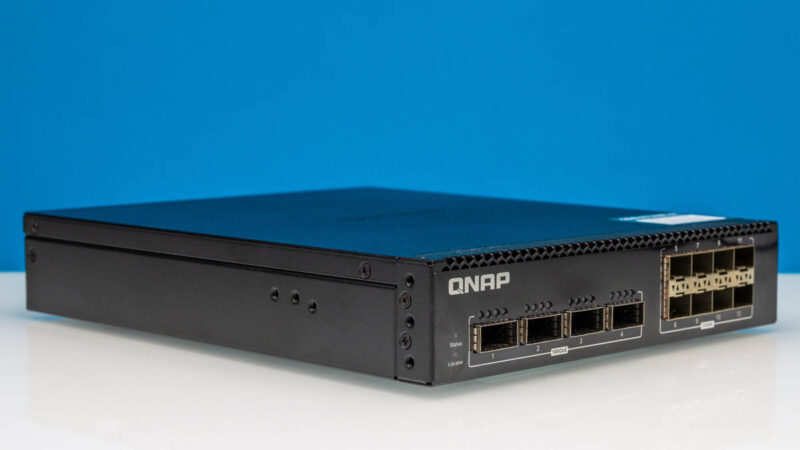
Overall, this has worked well for us. Something that we were not expecting is that this has a totally different web management interface compared to the QSW-M3216R-8S8T. On the other hand, since this is a relatively quiet and compact 25GbE/100GbE option, that web management makes it very accessible compared to many of the cheap used 25GbE switches out there.
Where to Buy
If you just want to find these online, here is an Amazon affiliate link and a B&H Photo affiliate link.

So does it have CLI at all?
Manual does not tell…
It should have something, since it has serial console; but it could be only a very limited CLI to stand up Web UI :-(
I tend to avoid Web-only switches, since all Web UIs usually get obsolete way before switch itself. I’ve a few switches which are impossible to manage via Web anymore due to need for IE6 ;-) or for pre-TLS1.3 crypto etc. They still can be managed via SSH.
Qnap is the absolute worst switch I have ever purchased as a “managed” device. I bought a QSW-M408-2C, which was sold for “parts” on ebay because it was missing a screw on the heatsink internally, like someone forgot to attach one, and the second got loose and rattling around inside. I added a screw, fixed it, but that should have told me what to expect. I bought it *cheap* for $75usd, but it was a 4-port 10g switch with 8 ports 1g poe.
Next I get into it, set it up, and realize I can’t move the management ip to any other vlan than vlan 1, which is NOT my management vlan like any sane network engineer would do. Finally I logged into the serial console port, and it dropped me in as root, which better or worse – cool! I could tinker with linux, but the management interface is still lame as hell, and I note the version shipped is rather old. So I update it…
After update, the console changes to some lame non-root shell cli that is absolutely worthless – the only thing I can do is see the management ip from it. Literally nothing else. What?!
I email support to ask wtf, and they tell me this is normal, and when asked about the silly management vlan only working on vlan1, they tell me yes they’ve had complaints (go figure), and tell me new versions of the switch would be fixed, but this *might* not get the update. It was only about 1.5yr old at the time – might?
Long story long, it never got the update, my switch is still about useless, lacp doesn’t even work right in a channel, and it’s literally abandonware less than 2 years out of box. Thanks for the fish.
I’ll NEVER buy anything QNAP again.
The MikroTik CRS812 DDQ 400GbE is absolutely perfect in terms of both price and functionality. The only downside is that it generates more noise than the QSW-M7308R-4X. I wonder if anyone has tested its exact noise level.
@michael: ServeTheHome article clocked 39-41dba idle and 48-49 dbA loaded:
https://www.servethehome.com/mikrotik-achieves-400gbe-in-our-mikrotik-crs812-8ds-2dq-2ddq-rm-review-keysight-cyperf-arm-marvell/3/
Looks like with the separate management board and the Prestera ASIC this could be driven with standard switchdev modules from standard Linux, provided the topology is somewhat normal. DentOS (if that is still a thing) would probably support this natively.
I bought this switch approx. this summer and now I’m thinking how I can get rid of it without too much of a loss.
WebUI is weird, it resembles more of a home router UI rather than a switch. You can’t see what ports has something plugged in but down and which just empty, you can’t get stats from the sfp module from the ui (other than temperature, which is also hidden somewhere in the menus), you can’t say if you have a fibre or dac plugged in from any of the main pages (it is hardcoded to return “fibre”), only way to tell them apart is to find if it reports temperature.
Module compatibility is not great. None of mine 10G or 25G fibre modules worked (I have smf from three different vendors, but not from qnap compat list), with 100G modules – qnap-coded works, but my default finisar cwdm4 doesn’t. And it’s worse as you can’t get any diagnostic information and support said they have explicit directive not to take cases about unsupported modules.
About CLI – answer is “yesn’t” – there is serial port (Cisco style rs232 over rj45) that can’t do anything unless you search for password generator for qnap qsw4.x – then you will get stock Marvell lua cli and then you can get a shell too.
And that is a shame as I liked hardware a lot, I’d replace my mikrotik crs504 with this one, if it won’t be about software. In theory it should be possible to port ONiE to it, but that probably would take too much effort.
@John:
DENT is still around; but i can’t find support for the Marvel Prestera 98DX7324.
I also can’t confirm it’s supported by mainlilne switchdev.
Is it compatible with one of similar models listed at
https://dent.dev/ecosystem/hardware-compatibility/
No experience with DENT, but it’s a CLI ;-)
@is39, Prestera 98DX73xx is Aldrin3. It seems that DENT supports only Aldrin2 according to your link.
I don’t know about mainline switchdev, but marvell’s github repo for switchdev got archived before Aldrin3 support was added (and that I think it want dent is using)
Civiloid, Thanks!
This platform is also not really cheap for what it offers.
It’s cheap enough if it would work well and have CLI.
If i need to work to get CLI for it, I’d rather start with cheaper Chinese models; or with Mikrotik (which is also not too cheap).
I’d also prefer Broadcom to Prestera, but i doubt we’d see cheap consumer/SOHO Broadcom switches anytime soon.