

NVIDIA RTX Spark Platform: What’s New
With our GB10 refresher complete, let us talk about what is new (or at least different) with the RTX Spark platform. Although it uses the same/similar silicon at its core, NVIDIA is introducing major feature differences between its DGX Spark/GB10 platform and its new RTX Spark N1X platform.
| NVIDIA RTX Spark Key Specs | |||
| RTX Spark N1X 20-core | RTX Spark N1X 18-core | GB10 (DGX Spark, etc) | |
| CPU Cores | 10x Arm Cortex-X295 10x Arm Cortex-A725 |
9x Arm Cortex-X295 9x Arm Cortex-A725 |
10x Arm Cortex-X295 10x Arm Cortex-A725 |
| P-Core Max Clockspeed | 4.0-4.1GHz | 3.9GHz | 3.9-4.0GHz |
| E-Core Max Clockspeed | 2.8GHz | 2.8GHz | 2.8GHz |
| GPU Cores | 6144 (48 SMs) | 5120 (40 SMs) | 6144 (48 SMs) |
| GPU Architecture |
RTX Blackwell
|
||
| Memory Interface |
256-bit LPDDR5X
|
||
| Max Memory Speed |
LPDDR5X-9400
|
LPDDR5X-8533 | |
| Max Memory Bandwidth |
300GB/sec
|
273GB/sec | |
| cTDP |
45-80W
|
140W | |
| Chip |
GB10/N1X
|
||
| Process Node |
TSMC 3nm
|
||
First off, NVIDIA is releasing two SKUs under the RTX Spark N1X banner. The first is a fully enabled SKU with all of the SoC’s functional blocks and cores enabled. In effect, this is equivalent to the GB10 chips that we have seen in Linux mini-PCs thus far. The P-cores have a slightly nebulous maximum clock speed of 4.0 to 4.1GHz, since one group of five cores tops out at 4.0GHz while the second tops out at 4.1GHz. Elsewhere, the efficiency cores top out at 2.8GHz.
Meanwhile, the company is also offering a slightly cut-down salvage SKU, which it calls the RTX Spark N1X 18-core or 5120 GPU Core, differentiated by its CPU and GPU core counts. On the CPU side, this version of the chip loses one P-core and one E-core, leaving 9 of each. Meanwhile, on the GPU side, the cut is more significant, with NVIDIA reducing the 48SM Blackwell GPU to a 40SM (5120-core) configuration. The 18-core version also trims a bit off its CPU P-core clock speeds, dropping to 3.9GHz. Consequently, the full 20-core version should lead on all performance metrics, including single-threaded CPU workloads.
The RTX Spark N1X does benefit from newer memory, however. While DGX Spark/GB10 boxes shipped with LPDDR5X-8533, RTX Spark N1X hardware ships with faster LPDDR5X-9400 memory, pushing MediaTek’s memory controller as fast as it can go. As a result, RTX Spark boxes have an extra 27GB/second of memory bandwidth, or 10% more than Linux boxes.
On the other hand, GB10’s TDP has been dialed down for the RTX Spark N1X. Whereas the Linux boxes used a 140W chip, RTX Spark N1X systems will use TDPs between 45W and 80W, depending on the specific vendor configuration. Since most of these launch devices will be laptops, this is not too surprising. That said, it creates some interesting performance ramifications.
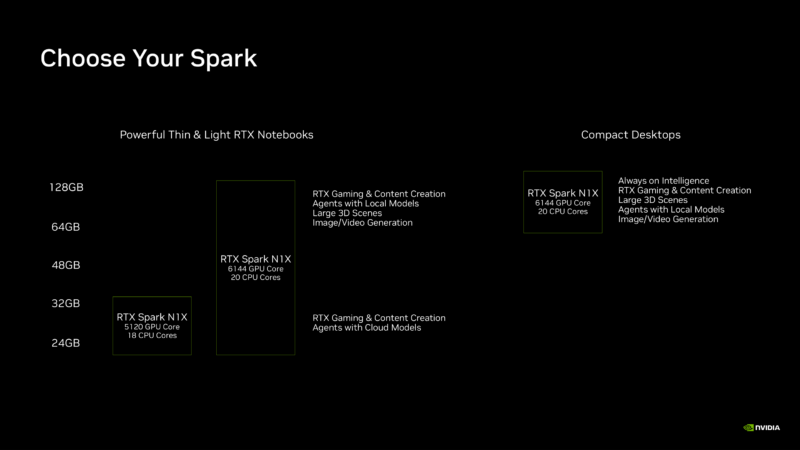
The 18-core N1X can be paired with either 24GB or 32GB of memory. To go any higher than that, it will need to be the full 20-core chip. Meanwhile, mini-PCs and other desktops based on the chip can only use the 20-core part, and those must come with at least 64GB of memory, mirroring NVIDIA’s recent extension down for GB10 Linux systems, which can now start being sold with 64GB of memory.
On that note, as this is a unified memory design with that memory pool shared by the CPU cores and the GPU, NVIDIA is laying out how memory can be split between the two. The GPU’s minimum memory reservation is always 4GB, regardless of the system’s total memory. Meanwhile, the defaults and maximum vary with memory size. 24GB systems can reserve up to 8GB for the GPU (default: 8GB), 32GB systems can reserve up to 16GB (default: 14GB), 64GB systems can reserve up to 48GB (default: 30GB), and finally 128GB systems can reserve up to 96GB (default: 62GB).
A further distinction between RTX Spark and DGX Spark/GB10 is I/O. Whereas NVIDIA requires all GB10 Linux systems to be built with a ConnectX-7 NIC for high-speed networking, RTX Spark N1X does not. Instead, NVIDIA seems to require all RTX Spark systems, laptop and desktop, to ship with three 40Gbps USB-C ports. This effectively replaces the ConnectX-7 NIC in the system topology, especially since GB10 lacks native USB4 support, meaning it must come from a third-party controller on the PCIe bus.
Wi-Fi 7 support is also once again a mandate here, with MediaTek supplying a Wi-Fi 7 plus Bluetooth 5.4 radio.
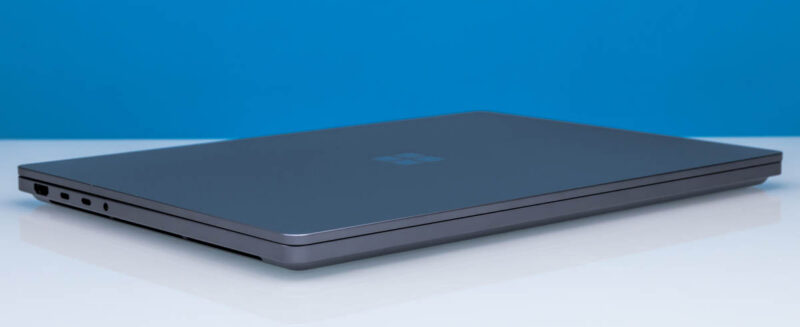
For laptops in particular, NVIDIA is also controlling which designs and displays are allowed. For now, at least, all RTX Spark N1X laptops need to be premium, thin-and-light designs with an aluminum chassis. Meanwhile, displays need to be 14 to 16 inches, and except for Microsoft’s Surface Laptop Ultra, all laptops need a tandem OLED display.
The release of the RTX Spark N1X platform also means that GB10’s NPU is finally getting some attention. While it has been in the chip all along, there has been no real need for it in GB10 Linux boxes, as those were all high-performance mini-PCs. But with RTX Spark laptops, the NPU plays a role as a low-power inference accelerator, similar to the NPUs in SoCs from other vendors. At 55 TOPS this NPU is not going to be significantly different from those other NPUs, but it helps to ensure the power efficiency of GB10 in a laptop as well as allowing the chip to support Microsoft’s current client AI offerings (Copilot+ and otherwise).
Finally, while not a hardware feature in and of itself, x86 compatibility will be far more important for RTX Spark than it was for DGX Spark, where the entire software stack was AArch64 to begin with. RTX Spark devices will be relying on Microsoft’s Prism x86 emulator for Arm. This is the same emulator the company has used to provide x86 compatibility on Qualcomm Snapdragon X devices. In recent months, Microsoft has added AVX2 instruction set compatibility to the emulator, which is a significant improvement from earlier versions. It is all but critical to making RTX Spark devices viable for gaming, as games increasingly require advanced vector instructions. Though NVIDIA and Microsoft are still working with anti-cheat vendors to get the final holdouts working on Windows-on-Arm, as they require loading kernel-mode drivers that cannot be emulated.
NVIDIA RTX Spark Launch: 7 Laptops, Starting at $2599
Finally, let us take a brief look at the RTX Spark N1X device launch lineup. For the first wave of Windows devices, NVIDIA has teamed up with 6 OEMs, all of whom launched their laptops this week.
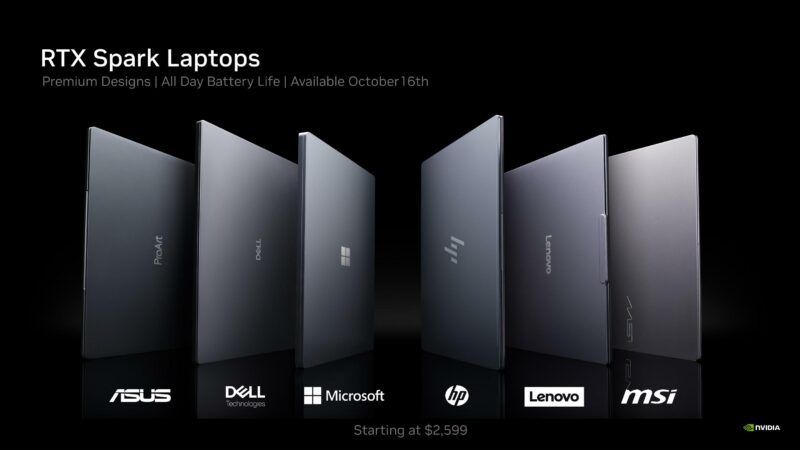
This includes not only Microsoft but also Dell, HP, Lenovo, MSI, and ASUS, the last of which is actually releasing two laptop models.
All of these laptops are quite similar in design, given NVIDIA’s size and material requirements. All of them are primarily aimed at content creators or developers, though some also push gaming.
Lenovo is notably making its RTX Spark laptop a Yoga design, a 2-in-1 with a 360-degree hinge. Similarly, MSI’s Prestige N16 Flip AI+ is also a 2-in-1 thanks to a 360-degree hinge.
Launching into an already packed laptop market, these RTX Spark laptops will primarily compete on a mix of memory capacity and energy efficiency. On the former, the logic is the same as it has been for any other GB10 system to date: 128GB of unified memory gives you plenty of GPU memory for AI and other workloads, for a fraction of the price of a multi-GPU setup with a similar amount of memory. For laptops in particular, the difference is even more extreme: NVIDIA’s most powerful laptop-grade dGPUs currently top out at just 24GB of VRAM, so an RTX Spark laptop can have up to four times as much VRAM as a traditional laptop with a discrete RTX Pro GPU.
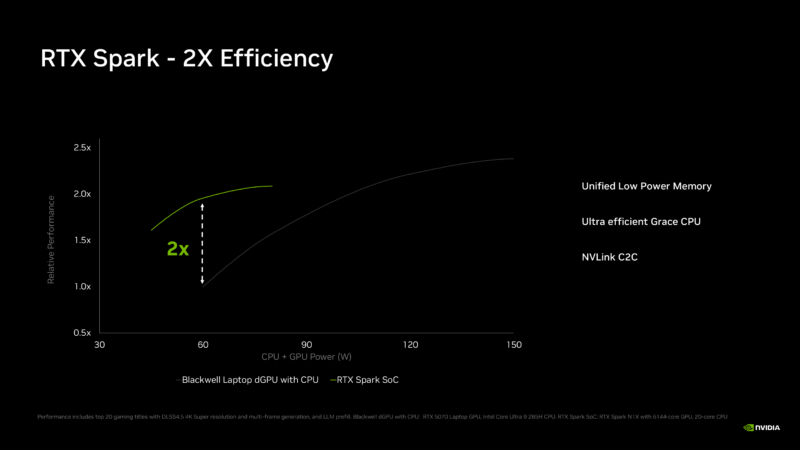
As for energy efficiency, the 45 to 80 Watt TDP of RTX Spark N1X is quite a bit lower than the cumulative TDPs of a CPU and dGPU in a high-end laptop. NVIDIA’s mobile GPUs can go as high as 175 Watts, with the nearest equivalent to the RTX Spark, the RTX Pro 3000 Blackwell, sitting in the 60W to 140W range. Consequently, RTX Spark laptops will have far lower peak power consumption than using a discrete GPU. However, the trade-off is that performance will be lower as well, as that lower TDP puts a hard cap on performance scaling and clock speeds.
Meanwhile, the first desktops based on RTX Spark N1X are due next month. So far, the only desktop PC announced has been Microsoft’s Surface RTX Spark Dev Box, which will retail for $6000.
Final Words
RTX Spark N1X’s/GB10’s Windows homecoming has been a long time coming, but it is finally here. As NVIDIA’s most powerful Arm laptop SoC to date, it will primarily compete with Apple’s M-series Pro chips and AMD’s Strix Halo chips. All three of which share similar memory controller configurations as well as lofty performance ambitions.
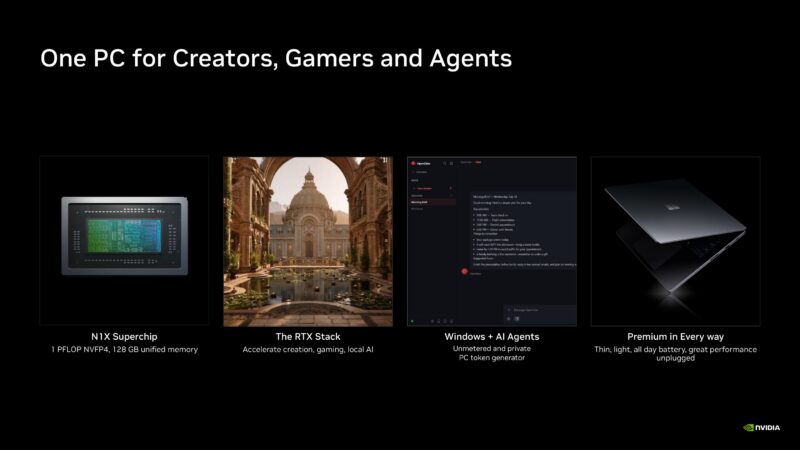
Amidst the larger supply shortages and booming demand for computer parts, high-end PCs have been one of the few segments to flourish in this environment. This is not to say that they have not been impacted by the resulting price hikes (if anything, it has been exacerbated), but it has proven a resilient market, in part because of the local AI inference capabilities of these powerful SoCs. In that respect, the RTX Spark N1X is an opportunity for NVIDIA to branch out with its GB10 silicon platform, as while AI inference still plays a big role here in how these resulting systems are being promoted, unlike the DGX Spark and other GB10 Linux boxes, it is not the only use case. NVIDIA and partners can (and are) also pushing RTX Spark boxes for content creation and even gaming.
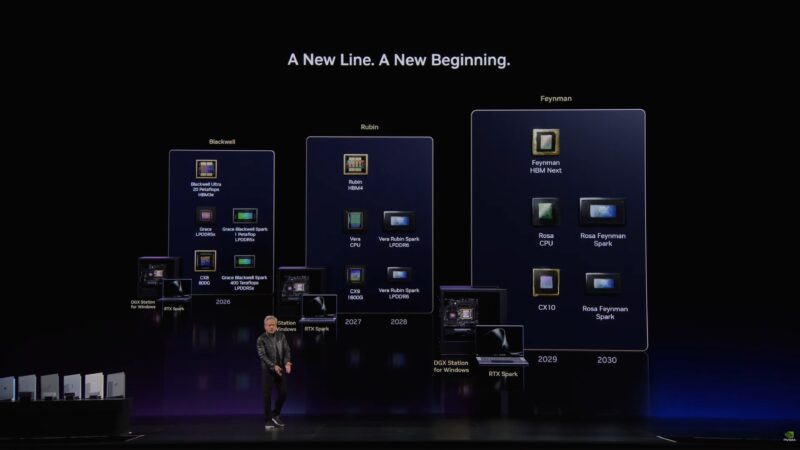
Ultimately, if everything goes well, the RTX Spark N1X will be the tip of the iceberg for NVIDIA’s Windows SoC ambitions. The company’s most recent hardware roadmap calls for launching an additional, lower-performance (400 TFLOPs) Spark chip this year, though NVIDIA said nothing about it during this week’s launch. After that, NVIDIA plans to launch additional RTX Spark chips in 2028 and 2030, based on its Vera Rubin and Rosa Feynman architectures, respectively. Vera cores sound very exciting in a device like this.



After long time being block for access to x86 share, Nvidia back to x86 realms…. Ehm sorry…. Windows realms for precision.
Ironically just to save Windows in the world of AI development ecosystem.