

Solidigm Storage on Parade
Besides their own wares, MiTAC was also showcasing some of their partners’ wares in their booth for the trade show. On the CPU side of matters, everything we saw happened to be AMD-powered in some fashion, be it systems using current-generation processors or slated to use the forthcoming EPYC Venice. There is a good reason for that. MiTAC also had some storage options on display, including high-performance, high-capacity, or a mix of both.
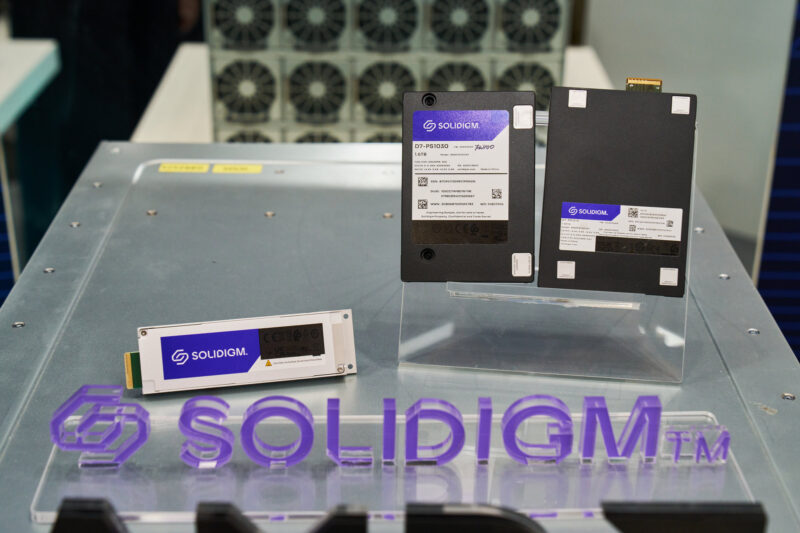
On the high-performance front, the company had some of Solidigm’s D7-PS1010 SSDs on display. These are Solidigm’s fastest read-optimized PCIe Gen5 drives, rated to achieve up to 14.5GB/sec sequential reads and 9.3GB/sec sequential writes. We reviewed these drives back in September, and they are wicked fast. There were both the D7-PS1010 (1DWPD) and D7-PS1030 (3DWPD) versions at the show.
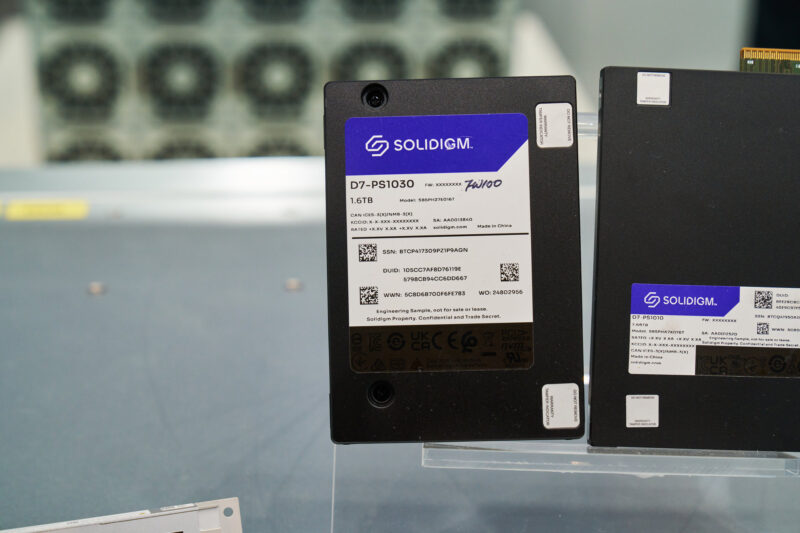
Solidigm offers the drives in all three major form factors: U.2, E3.S, and even E.1S. The trade-off is that the fast drives are not very large, with capacities maxing out at just 15.36TB each. These are for a different segment of the market than the high-capacity, but slower drives.
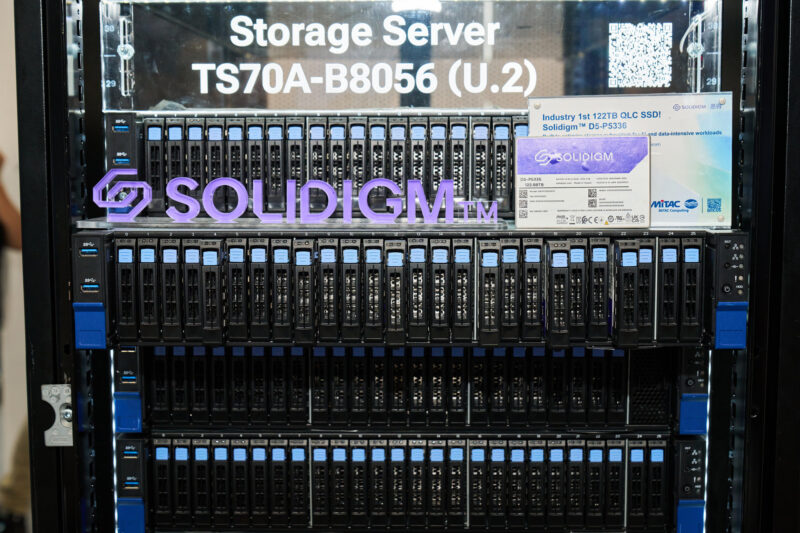
For those who need a higher-capacity drive rather than a faster one, MiTAC also offers Solidigm’s D5-P5336 SSDs.
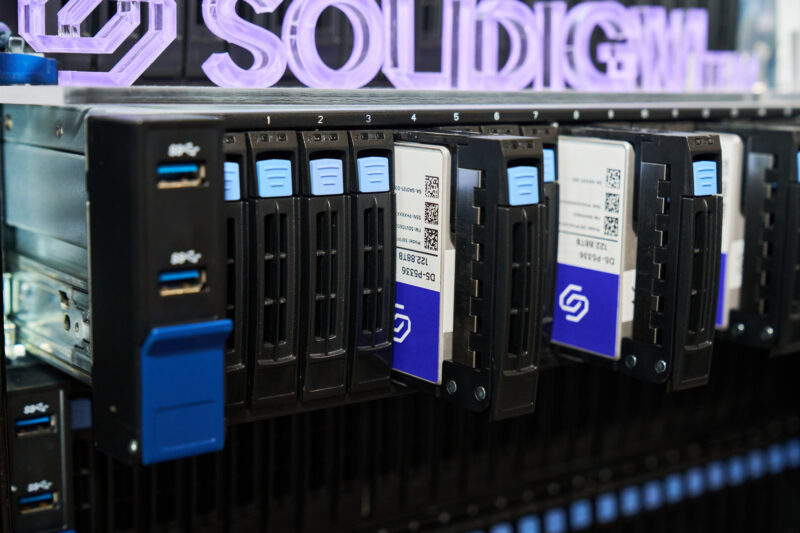
What these drives lack in performance (capping out at PCIe Gen4 speeds), they more than make up for in capacity, with the largest capacity drives topping out at 122TB each. Backing these drives is parent company SK hynix’s 192L QLC NAND, which they stuff into these drives to achieve their high capacities. This makes the drives even more read-focused than the high-performance D7 drives, as we saw first-hand when we reviewed the D5-P5336 last summer.
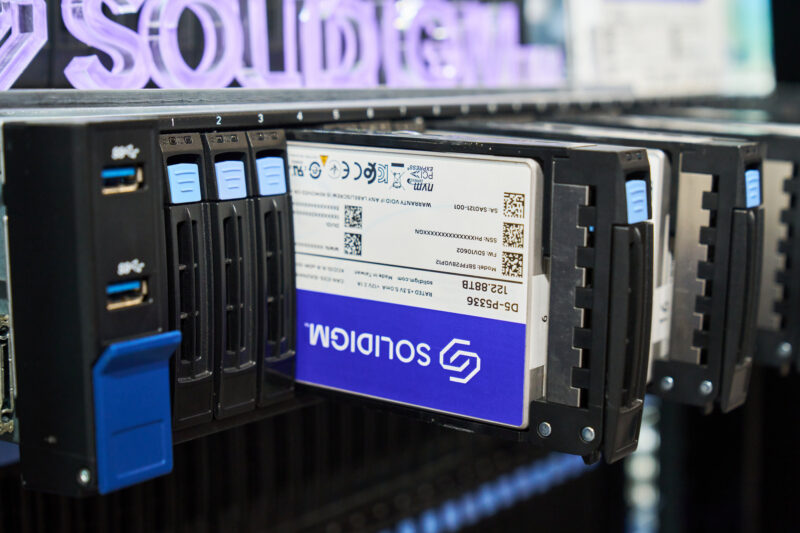
With MiTAC offering whole server-scale and rack-scale storage solutions, the company can cram an immense amount of storage into a single rack. The company’s TS70A-B8056 2U storage servers offer 26 U.2 bays, allowing a single server to house 3.17PB of storage, and multiple servers can be installed in a single rack.
The Fun One MiTAC CX1-395: A Ryzen AI Max mini-PC
Finally, away from the racks of servers and giant 8U boxes, MiTAC also had a little bit of hardware on display on the other end of the spectrum. The company has been developing its own AMD-powered desktop workstations, the Agent Builder AI Station lineup, which spans from multi-GPU desktops to small-form-factor PCs. The latter was on display at the show, where the company showcased the CX1-395.
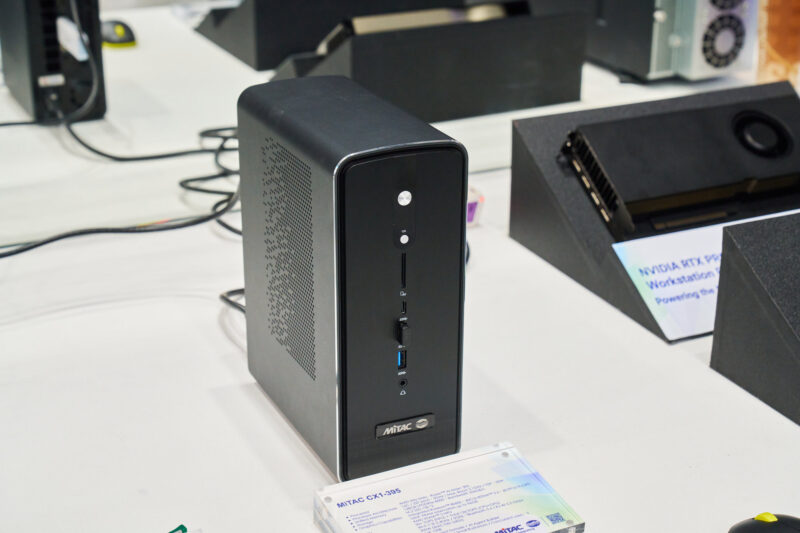
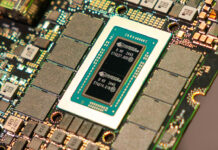
Powered by AMD’s Ryzen AI Max+ 395 processor, this is MiTAC’s entry into the burgeoning ecosystem of Ryzen AI Max (Strix Halo) powered SFF boxes for developer use. The company has seemingly opted to focus on performance, giving the mini-PC a rather breezy cooling system to help keep AMD’s big APU well-cooled. You can also see this is a nice design with an internal power supply.
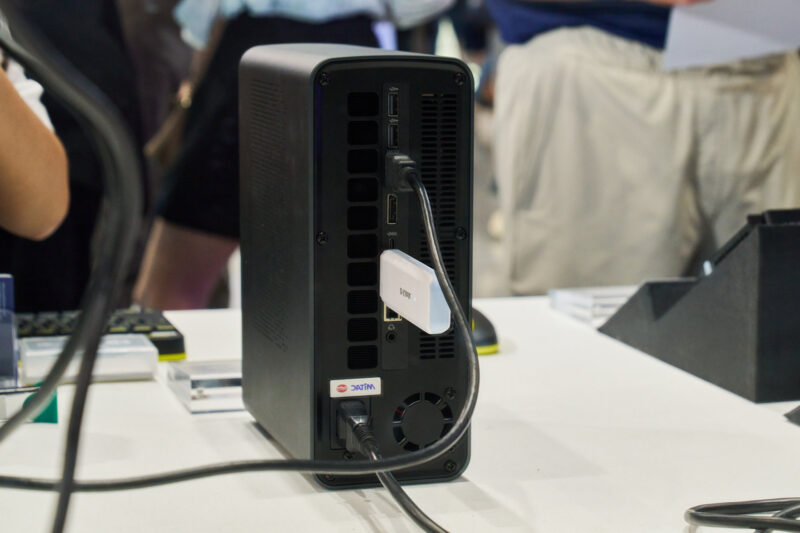
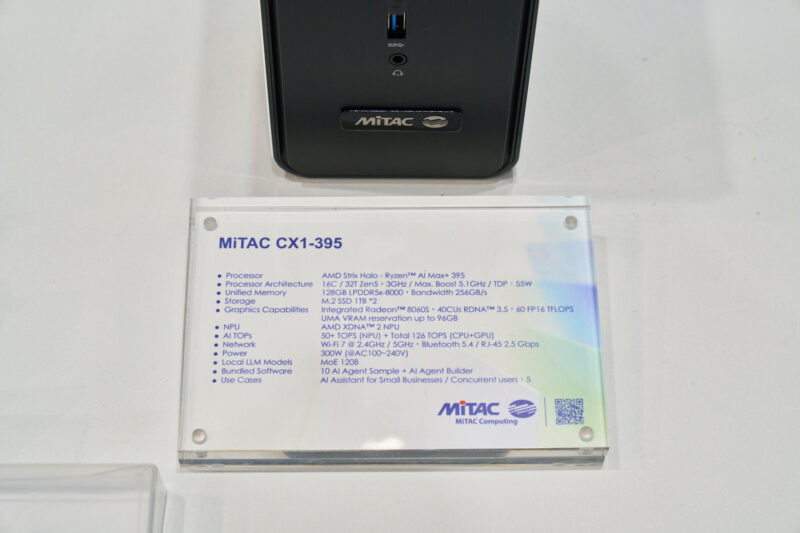
Besides AMD’s chip, the specifications for the box are pretty typical for a Ryzen AI Max system, pairing the APU with 128GB of LPDDR5X memory, a couple of M.2 slots for SSD, and Wi-Fi 7 connectivity. Surprisingly, the company did not spring for a high-end wired networking solution here, so while the system does come with an RJ45 Ethernet port, it only runs at 2.5Gb.
Count this as one that we were not expecting to see, but it caught our eye.
Final Words
From diamond-cooled AMD Instinct GPU servers to high-capacity Solidigm storage, and even a fun little AMD Ryzen AI Max+ 395 system, there was a lot in the booth to look at in the booth. If you want to see a review we did last summer of the MiTAC G8825Z5 AMD Instinct MI325X 8-GPU server, you can check that out to see more about how the company builds servers.
Aside from all of the neat hardware, it was fun to see things ranging from thermal interface materials to management software getting a feature in the booth. That was one of the largest server management software displays we have seen in a booth in a long time. That is also a feature we know is important to those building large clusters.

At this rate of taller and taller racks, future data centres will look like old book libraries where each bookcase is two stories tall and you have a ladder on a rail to move around.
Ok I can see a trademark application for “MiOBMC” but where is the source code? I cannot find it anywhere… If this is actually open source I am interested, but what is supported, where is the code?
“At this rate of taller and taller racks, future data centres will look like old book libraries where each bookcase is two stories tall and you have a ladder on a rail to move around.”
9-12ft racks were fairly standard in telco cable rooms for a llloonng time. Even in large campus DEMARCs. Maybe we’re just going back?
It’s cool people are starting to experiment with diamond cooling, although these approaches are all so primitive–the thermal interface resistances are too high and the homogeneous thickness of a diamond layer isn’t effective. You need to work with the silicon manufacturers and use a CVD process with controlled nucleation and growth to get a non-uniform diamond layer to grow directly on the die, then cool with water flow directly over the diamond coated die. That’s the end-game for silicon.