

Diamond Cooling in the MiTAC G8825Z5 Server
Besides their rack-scale offerings, MiTAC also offers a large array of individual servers. And a few of these were getting showcased at the show. First up was the MiTAC G8825Z5, a very beefy 8U dual-processor AMD system that houses 8 MI350X accelerators. Unlike MiTAC’s rackscale-optimized servers, which incorporate liquid cooling to maximize hardware density, the G8825Z5 is a tamer air-cooled system that is not making the same push for density. But even with the relaxed density, this server still has a cooling trick up its sleeve in the form of Akash Systems’ “Diamond Cooling” technology.
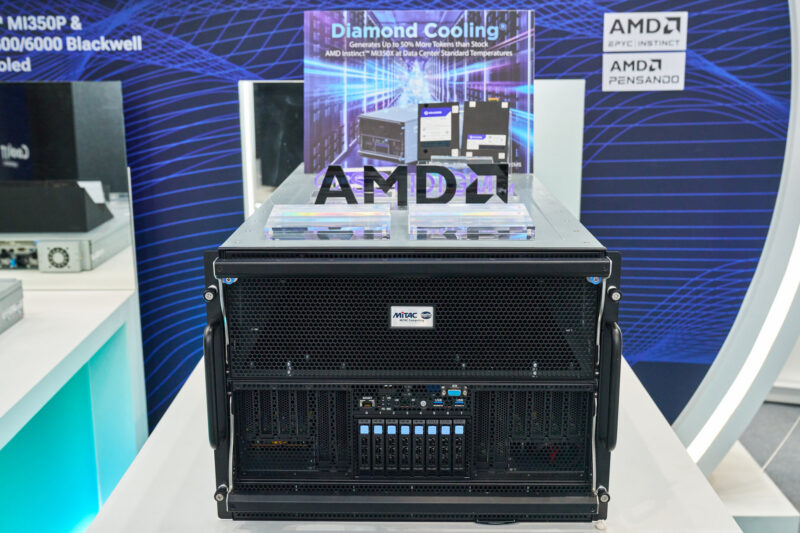
The flashy name is not unearned. Akash is using synthetic diamond as a thermal transfer medium, counting on the higher thermal conductivity of diamond (or rather, structured carbon) to outperform copper. The central idea being that with a more conductive material, a smaller temperature difference is required to extract the same amount of heat energy from a processor, allowing data center operators to run warmer environments. This, in turn, would allow data centers to operate with less cooling, making them more energy-efficient overall.
Besides the AMD hardware at the heart of the system and the exotic cooling system keeping those chips cool, the G8825Z5 also comes with quite a bit of expandability, thanks to its size. For storage, the system offers 8 U.2 drive bays.
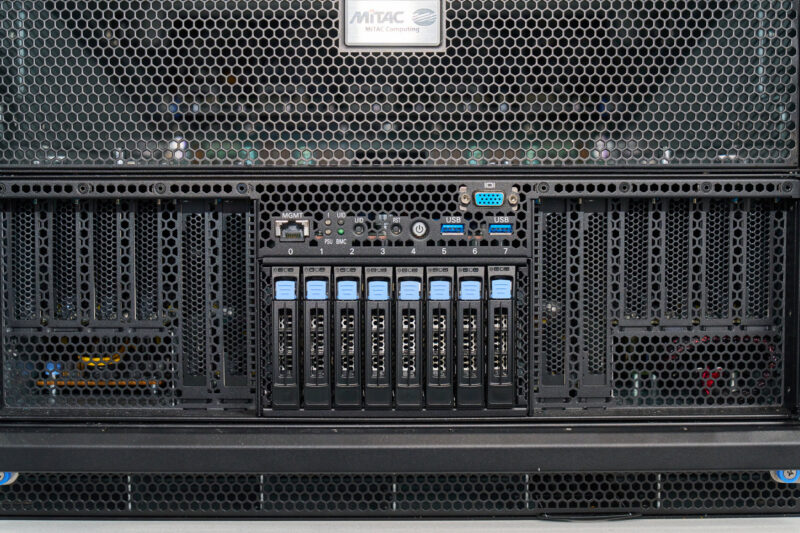
For further PCIe expansion, there are 8 HHHL PCIe Gen5 slots and 4 FHHL PCIe Gen5 slots, giving server vendors plenty of options for plugging in NICs, DPUs, and other customizations.
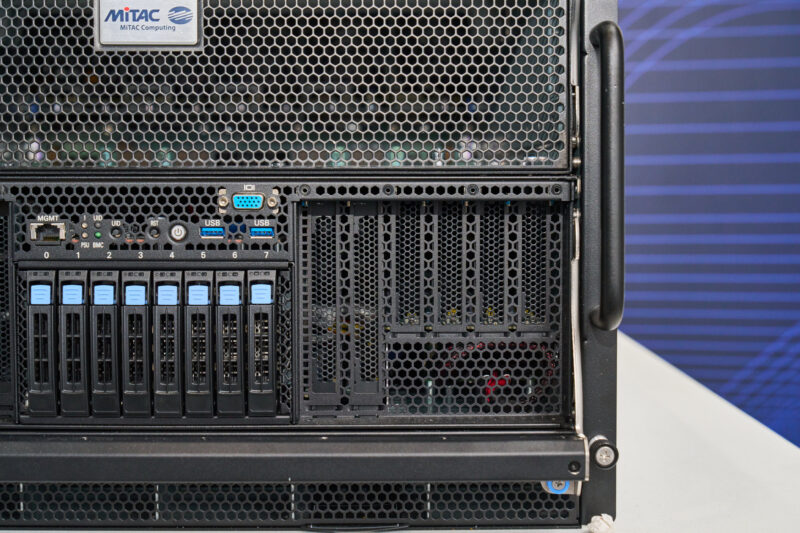
This is one neat box.
MiTAC TN85-B8261 For Traditional PCIe Compute
For those who need a more conventional server without exotic cooling technologies or trays of OAM-form-factor GPUs, MiTAC also continues to make numerous highly customizable PCIe servers. One such example at the show was the TN85-B8261, another dual-socket AMD server intended for use with AMD or NVIDIA PCIe accelerator cards.
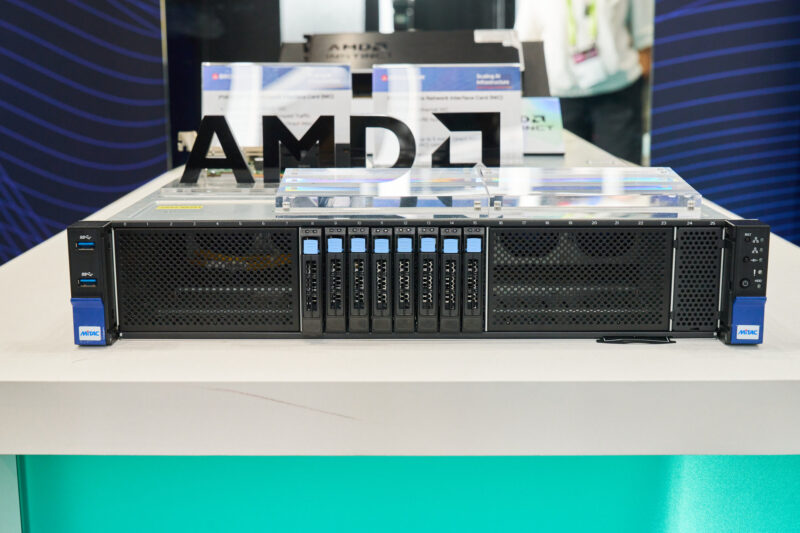
The 2U server can be filled with either EPYC 9004 (Zen 4) or 9005 (Zen 5) processors, and with enough slots for one DIMM per channel, supports up to 6TB of RAM across both CPUs. Meanwhile, the PCIe card matrix gets a bit more complex, but fundamentally, the system has 4 FHFL double-wide PCIe Gen5 slots. This allows it to fit up to four of AMD and NVIDIA’s latest mid-power PCIe cards. If you want to use high-performance (i.e., high-power-demand) cards, such as the AMD Instinct MI350P or NVIDIA RTX PRO 6000 Blackwell Server Edition, you will have to drop it to 2 cards per server.
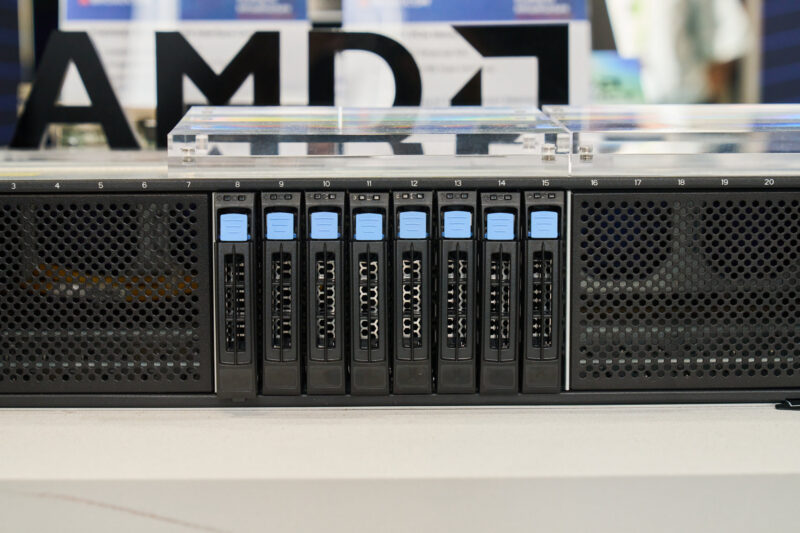
The version on display at Computex was the 8 SSD bay version, which features 8 U.2 drive bays. For customers with greater storage needs, there is also a variant of this system with a whopping 24 drive bays, essentially filling the entire front of the system with storage.
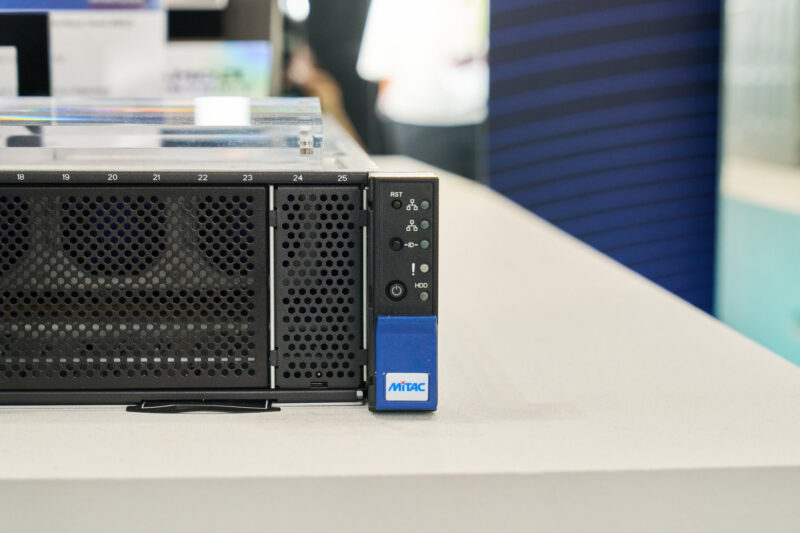
The system comes with dual 2.7kW power supplies, underscoring its more modest aims. MiTAC considers it a broad-use case workhorse, not least as a server for AI inference workloads.
MiOBMC and MiOPF Open-Source Firmware Stack
Alongside all of MiTAC’s hardware, the company also had a bit of software to show off at Computex. MiTAC has been developing/implementing an open-source firmware stack based on OpenBMC and EDK2 as an alternative to the traditional proprietary options, which they are positioning as a competitive advantage as well as a functional advantage for customers.
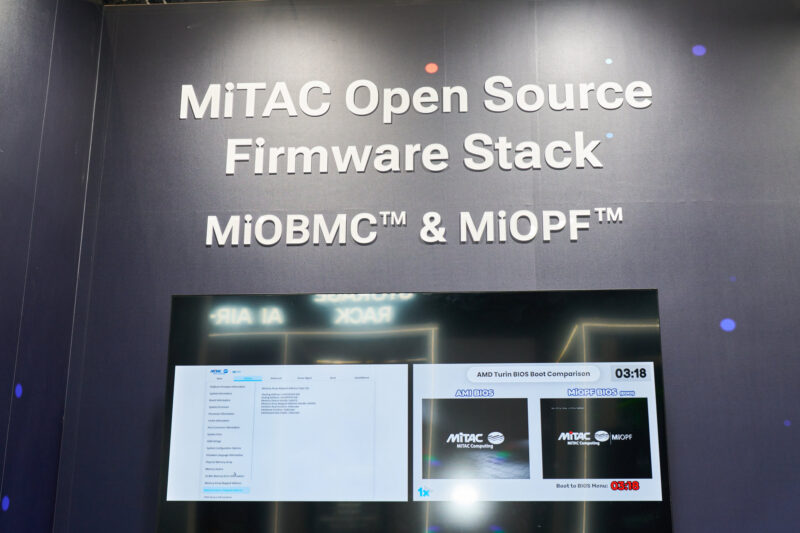
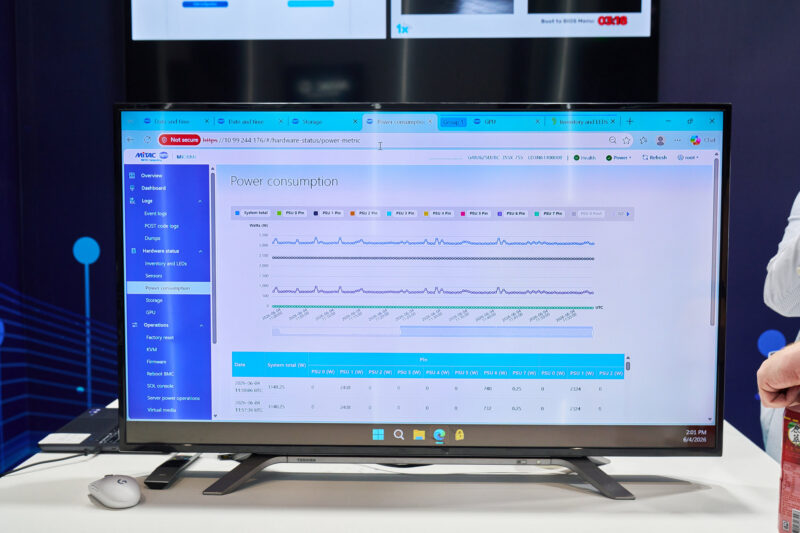
MiOBMC is the company’s open-source BMC software, which is used in conjunction with their MiOPF EDK2-based system firmware. The company had demos of the complete ecosystem in action at Computex, showing off the advantages in tasks such as boot times, as well as showcasing the monitoring and management capabilities that come with MiOBMC.
The firmware side is a new frontier for open source. A lot has already been happening, but with OCP looking into the space, it has become an industry trend. MiTAC is focusing on industry-standard management and layering its flavor on top rather than starting with a proprietary base.
Next up, let us take a look at storage and some of the other odds and ends MiTAC had on display.

At this rate of taller and taller racks, future data centres will look like old book libraries where each bookcase is two stories tall and you have a ladder on a rail to move around.
Ok I can see a trademark application for “MiOBMC” but where is the source code? I cannot find it anywhere… If this is actually open source I am interested, but what is supported, where is the code?
“At this rate of taller and taller racks, future data centres will look like old book libraries where each bookcase is two stories tall and you have a ladder on a rail to move around.”
9-12ft racks were fairly standard in telco cable rooms for a llloonng time. Even in large campus DEMARCs. Maybe we’re just going back?
It’s cool people are starting to experiment with diamond cooling, although these approaches are all so primitive–the thermal interface resistances are too high and the homogeneous thickness of a diamond layer isn’t effective. You need to work with the silicon manufacturers and use a CVD process with controlled nucleation and growth to get a non-uniform diamond layer to grow directly on the die, then cool with water flow directly over the diamond coated die. That’s the end-game for silicon.