

Minisforum MS-02 Ultra Power Consumption and Noise
Ahead of testing the MS-02 Ultra, the power and noise prospects for the system were an interesting dilemma. On the one hand, Minisforum has built a system necessitating a 350 Watt power supply. On the other hand, they built a rather large system, with 4.8L affording quite a bit of room for larger, quieter fans. So this is not a system that is geared to land at either end of the spectrum. This is either a tiny howler or a silent giant. Instead, it is intended to land somewhere in the middle.
At idle, we measured power consumption in the range of 19 Watts, with some fluctuations as high as 21 Watts while Windows was spinning up and down various worker threads. And while the 285HX SoC and associated platform is reasonably power efficient (it is still based on desktop hardware, after all), the 25GbE NIC is another matter. That E810 controller can easily draw several more Watts on its own, and more, of course, once transceivers are plugged in and need power as well. That is also largely why we were not able to hit idle power levels near or below the 10W mark – something the rest of the system should be capable of reaching.
Meanwhile, under a full load with CPU-Z’s stress test, we saw power consumption peak at around 190 Watts before dropping to a steady-state around 145 Watts. Being that the MS-02 is based on mobile hardware, it has a pretty distinct turbo period where it can maintain its peak for 30 seconds or so before being reined back in and capped at its long-term limits. Otherwise, as this is a system without a video card installed, we are not actually taxing the system’s power supply all that hard, which is to say that overall system power consumption would be much higher if a video card were installed.
As for acoustics, the MS-02 fares pretty well here. At idle we measured it at 35dBA, just a single decibel above our studio noise floor. Conversely, load noise peaked at just 41dBA, before settling down at nearly 39dBA once the system’s turbo window ended and its performance and power consumption hit their steady-state value. 39dBA is not going to be silent by any means, but it is pretty quiet – especially for a system packing room for three PCIe cards. In fact, that overall volume seems to be doing Minisforum a pretty big favor here, as it allows for larger, higher CFM fans than what could normally be put in a mini-PC.
Key Lessons Learned
Distilling the MS-02 Ultra down to its essential components, we found a lot to like about the system.
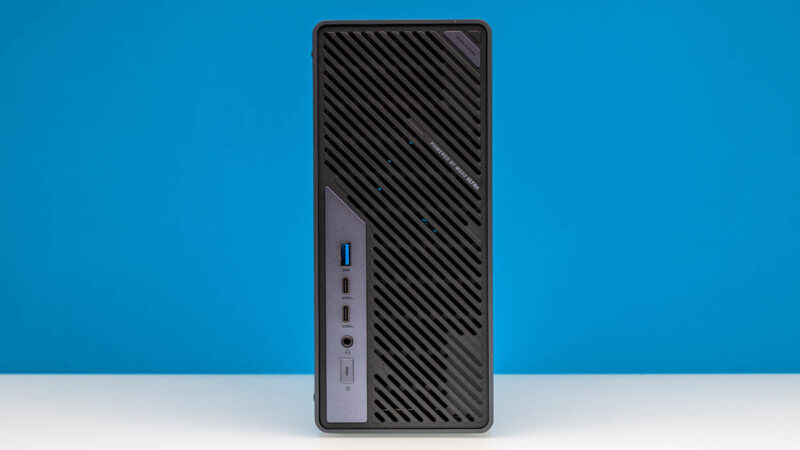
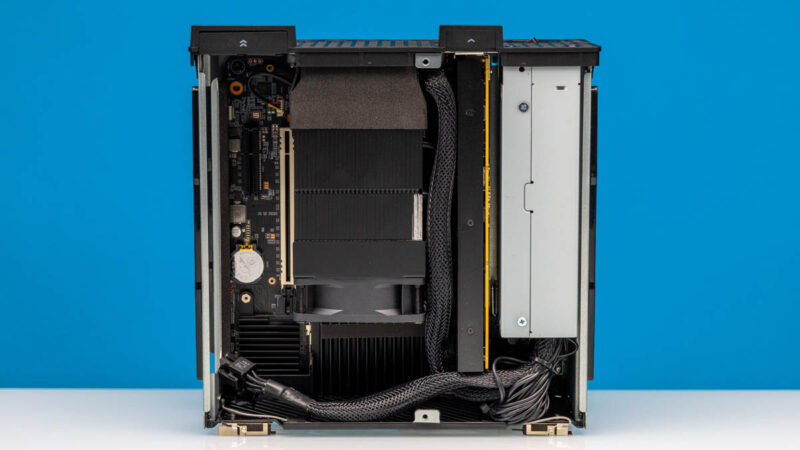
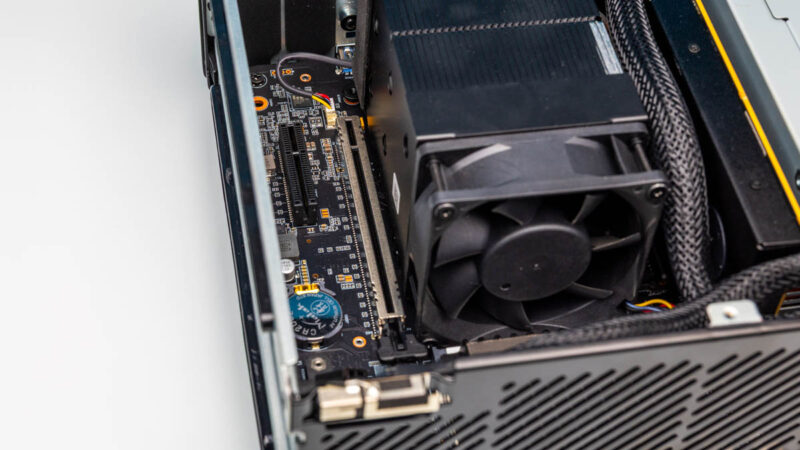
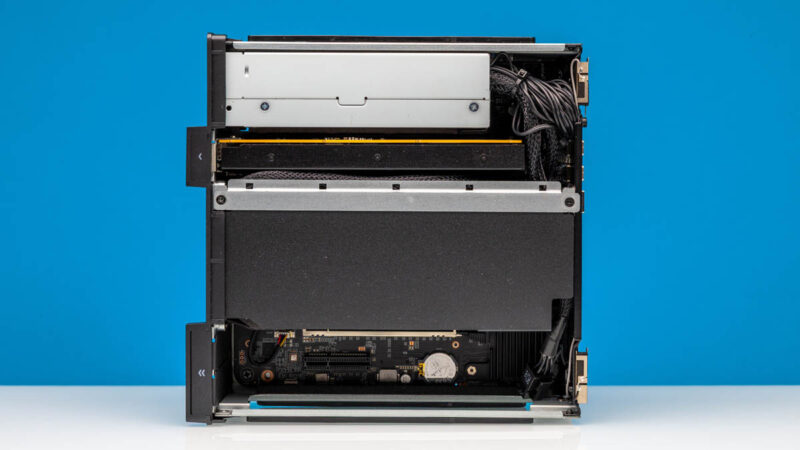
The big thing (pun intended) is its size. While still a small form factor system, the larger-than-usual 4.8L size affords some unique opportunities with the system. Three half-length, half-height PCIe card slots are practically unheard of in this space and offer a lot of expandability options. This leaves room for more M.2 slots than most other systems, and even room for a second set of SO-DIMM slots to run a larger amount of memory (or extra sticks of cheap memory) in a 2DPC configuration.
That kind of expandability also feeds into Minisforum’s ability to offer dual 25GbE via a PCIe card. Though it is not a ridiculous amount of bandwidth by modern standards, it is still quite fast. It is fast enough to offer the equivalent of a PCIe Gen4 x4 SSD’s worth of bandwidth. Which ultimately opens the door to using external storage over a network and achieving transfer rates rivaling those of a local SSD.
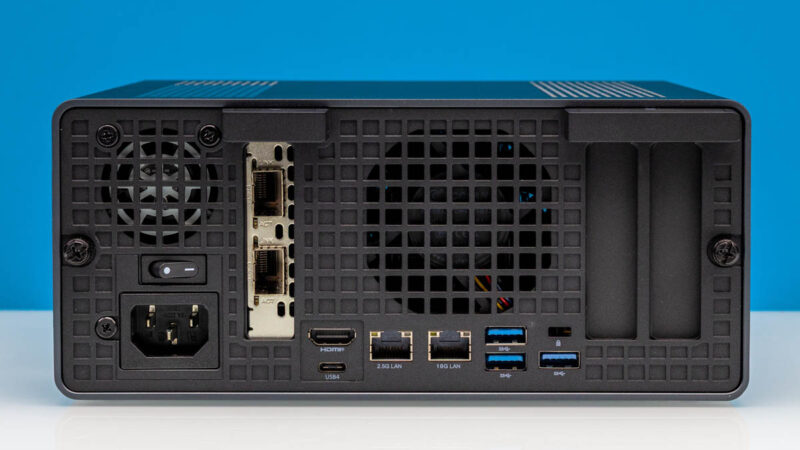
The one catch to all of this, though, is that by going with a relatively large chassis, Minisforum is giving up most of the size advantage of being a SFF PC. For the end user, this is fine, but from a competitive standpoint, this means that the MS-02 Ultra is starting to run into the same space as traditional mini-towers, which is a far more saturated market and can make it harder for the MS-02 and other sizeable SFF PCs to stand out.
Final Words
The rise in interest in small form factor systems for AI development has opened up a new market for mini-PC vendors like Minisforum. At the same time, it has required them to rework some of their designs to better fit the needs of the market, because although the small size of these systems is a nice perk, it is not the primary factor drawing in AI developers. Rather, that is system performance. And the tiniest of tiny systems just do not have the space to cool a high-end APU or install a current-generation video card, meaning that these otherwise small systems need to be made a bit bigger to accommodate that hardware.
The end result is systems like Minisforum’s MS-02 Ultra. At 4.8L it is still a rather small system – particularly in comparison to any kind of traditional tower – but it is far from their smallest. With an Intel Core 9 Ultra 285HX CPU and room for a double-wide video card like an RTX 4000 Blackwell SFF, it is stronger than ever – but the chassis has undergone a growth spurt as well.
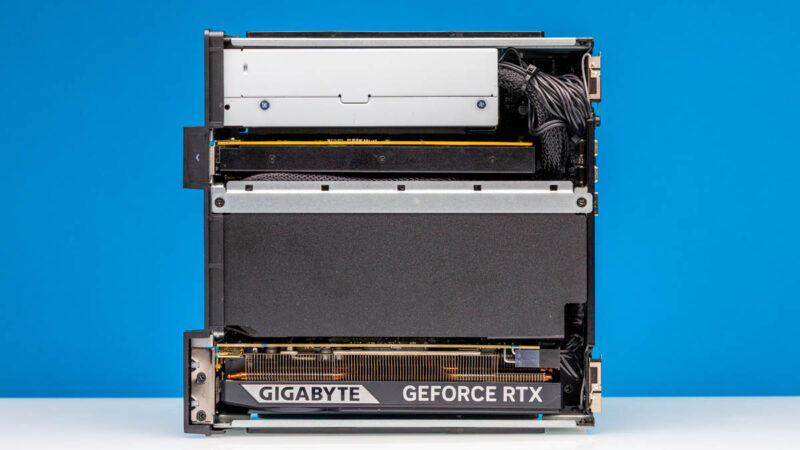
If you are in that niche that needs an SFF PC with a reasonably high-end video card in it, or a system that includes 25GbE networking out of the box, or better still, both at once, then the MS-02 Ultra is a system that was built for you. With a copious amount of I/O bandwidth for peripherals and a spacious double-wide PCIe bay for expansion cards, it is a system that is well-designed to deliver both high compute performance and high bandwidth to send those compute results wherever they need to go.
Where To Buy
If you wanted to find the Minisforum MS-02 Ultra online, here is an Amazon Affiliate link. Here is an Amazon Affiliate Link to the Gigabyte NVIDIA GeForce RTX 5060 LP card we installed as well.

I wish they’d have managed to make this fit into 2U so you could fit 2 of them side-by-side in a rack (via a presumably-optional bracket). As it is, it’s about 8mm too tall.
The MS-01 has a similar problem, where it’s ~3.5mm too tall for 1U.
These are slick. Wish I had a use case for one.
I would love to see a comparison between native Intel ECC memory support and the software based ECC capabilities offered on some of the mini platforms. I have soft ecc enabled via bios on 4x alderlake mini boxes and they have been stable for 1 yr+.
I wonder when MCIO pinout and cable finally landed in SFF or normal desktop mainboard? So many benefits come from it.