

Intel Arc Pro B50 Performance
For this, we are going to focus our attention on The Arc Pro B50 and the NVIDIA RTX A1000. A fair point may be that a card like the AMD Radeon Pro W7500 is a great competitor here. Our sense, however, is that the low-profile market is a bit different. Take a look at the Dell Precision 3280 Compact that we reviewed as an example. Our test system had a NVIDIA RTX 4000 Ada 20GB GPU. That is a $1250 GPU with 20GB of memory, but you will notice a dual slot low profile location on this system.
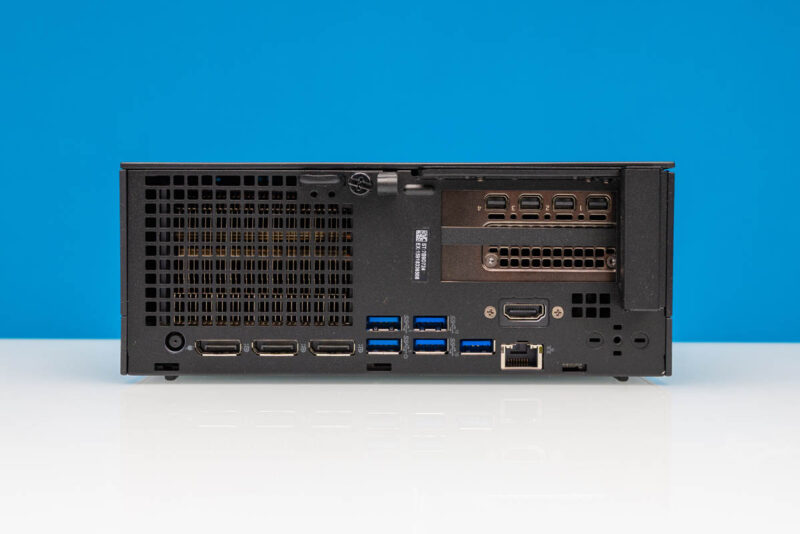
Likewise, going to the Lenovo ThinkStation P360 Ultra Review we see another dual slot low profile solution. This has a NVIDIA RTX A5000 16GB mobile GPU, but it shows the same physical constraints.
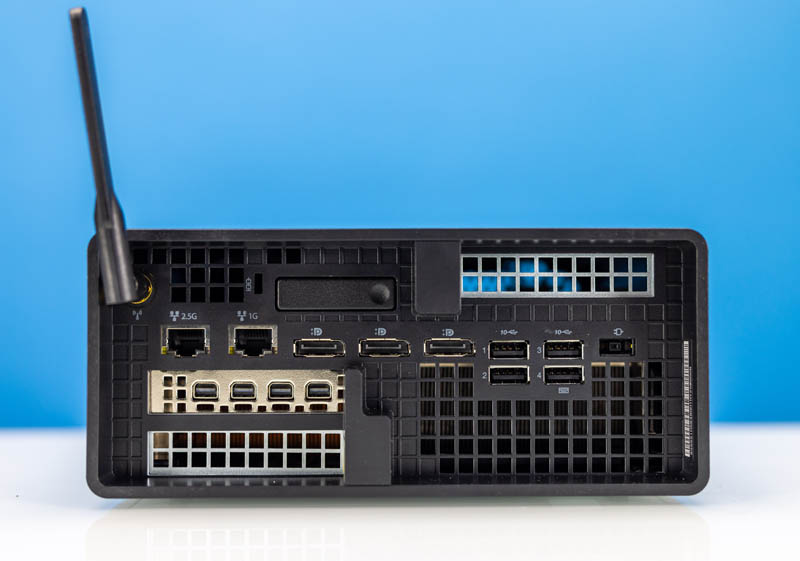
Also, there is a price consideration. At $349, the B50 is really competing in a lower-end segment of the market. To be clear: If you can swing another $900 for a GPU, the NVIDIA RTX 4000 Ada is great.
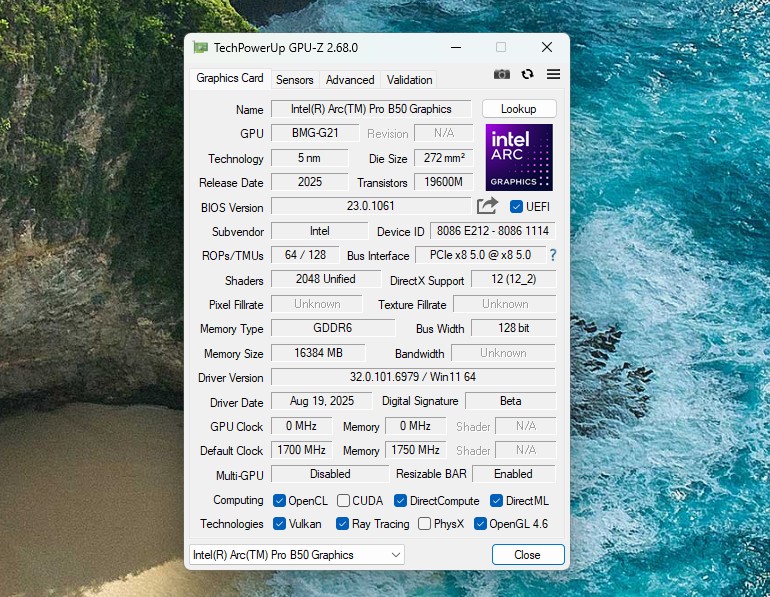
With that, we are using the NVIDIA RTX A1000. This is an 8GB card from PNY that Intel is really targeting with the B50. A1000 means Ampere generation, but NVIDIA is very happy to sell its data center GPUs at $40K each and the RTX Pro 6000 Blackwell at closer to $9K each. Selling a $400 GPU is perhaps less of a priority for NVIDIA. We should also point out that an Intel Arc Pro B50 is not related to a NVIDIA B200 or B300. Intel uses B for Battlemage and NVIDIA uses B for Blackwell. An Intel Arc Pro B50 is not 1/4 of a NVIDIA B200. So, instead, we are using the $400 NVIDIA RTX A1000 that is the company’s current offering in this segment and the one that Intel is targeting with its B50.
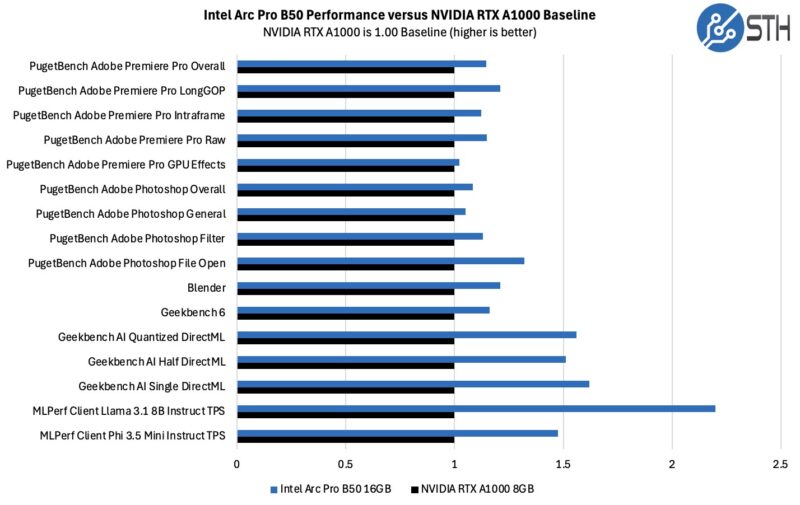
A few items to note here, and perhaps the big one, is that we are looking at new Intel versus Ampere generation NVIDIA. Still, that is the competition in the low-profile GPU space. On the MLPerf Client results, we are using the ORT GenAI versions to cross architectures, but this is another case where OpenVINO does wonders, especially on the Phi 3.5 Mini Instruct side.
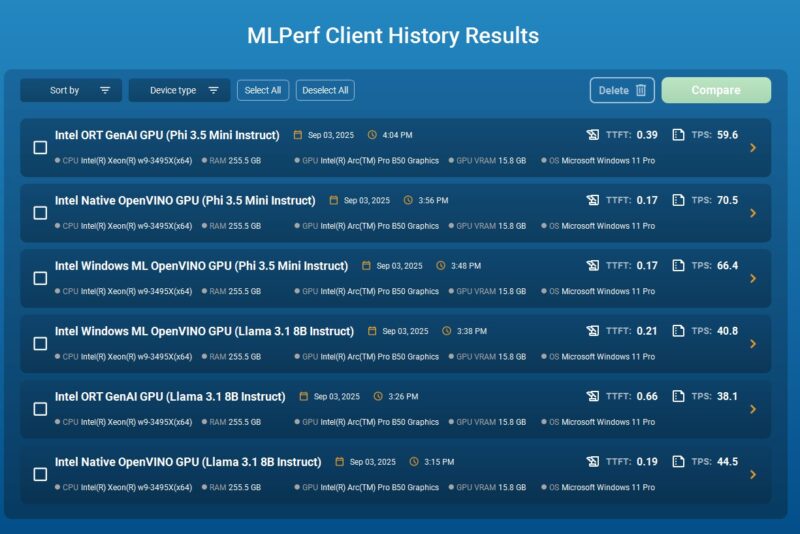
If you wanted to do value in addition to this, we would probably use $429 for the NVIDIA GPU and $349 for the Intel which means you can use roughly 23% to adjust for the value. I generally do not like doing that, but since GPUs are an area where seemingly every few dollars gets you something bigger and better, perhaps you may want to do that.
Also, we are using the DirectML results above for Geekbench AI. Switching to OpenVINO and the numbers get crazy very quickly.
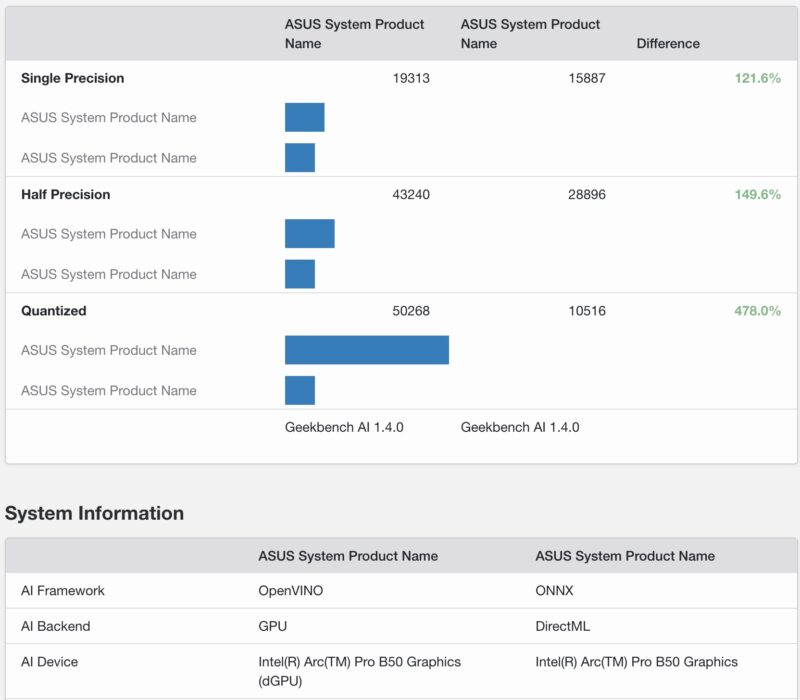
That just gives almost silly fast numbers so we are keeping everything on DirectML.
Next, let us get to power consumption and noise.



@John Lee
On the Geekbench AI chart, Can’t you relabel the two scenarios for the graph? I get that the only change is the framework, but when looking at the chart and having both runs labeled as “Asus system Product Name” makes things beyond confusing.
This review mentions the A1000 and A4000 but this GPU seems to be trying to match the A2000 16GB Ada edition more then either of those, given it has the same VRAM. The Cooler looks completely identical too.
Having recently purchased an A2000 Ada (and slapped on the single slot N3rdware cooler), I’d be curious to know how it compares to this, when it comes to home-server tasks like trans-coding under Plex, running local LLMs, doing detections in frigate etc. I guess in this case it comes down as well to CUDA vs VAAPI/ quicksync as well.
Also I didn’t see it mentioned in the review, but these intel cards are probably the cheapest way to get hardware AV1 encoding into mini PCs like the MS-01, and I think this B50 has that as well.
sff? mini?
what is here sff or mini?
this is just full length and 2-slots thick gpu.
I want to see a comparison between Arc B60*8 system and RTX 6000*2 system.
A RTX 2000 Ada is a $799 GPU, this is less than half that cost, no? I’d also say these won’t fit in the MS-01 since its dual slot not single, no?
It is SFF because it’s half as tall as a normal GPU.
And the A2000 is also originally a dual slot card, but it is possible to purchase an aftermarket single slot cooler for it, which makes it fir inside the MS-01.
Having a good video encoding engine and SR-IOV support makes this rather interesting, although I would have loved to see the more images of the fin stack of the cooler and the PCB. I know it’s not a gaming card, but these are nice to have, in my opinion.
I’d love to see this somehow trialed in a good homelab setup with Frigate and inference times, gpu usage, and power consumption. You can get a good starter unit with an Intel 12th – 14th gen but this could be a growth choice for folks who use the MS line and want to use the GPU for mixed workloads.
I need a B50 or dual B60 which is single slot full height! So I can put many of them in a single server chassis for QSV transcoding.
Doesn’t do much good without knowing a good SFF PC to use with it?
One thing I’d like to see is how this GPU performs in normal workstation tasks like AutoCAD, AutoCAD Fusion, and SolidWorks.
I noticed the other day that AutoDesk lists some older Arc GPUs in their compatibility matrix. If the Arc Pro B50 goes on the compatibility list and performs well, this is a killer deal for a workstation GPU.
I will NEVER but a product based on the “they will release software features later” mentality.
You always lose, features never arrive of are half baked.
If they do come out with the features – GREAT! But that should NEVER be expected -NEVER.
If the product doesn’t support a feature you see looking for at launch, or if it still needs work to get it to perform as expected (hello Intel CPU division) then do not buy it – no matter how cost effective it might APPEAR to be.
Suggesting anyone more or less (depending on how you look at it) is irresponsible journalism.
@John: exactly my thoughts!
People take it granted that sriov, the arc pro b ultimate killer feature, is indeed coming as promised in 3-4 months. But! If the captain decides in 2-3 months, that “naah, lets fire everyone from the gpu department”, before the sriov driver is released, then all gullible super-optimistic-believer will realize they made a bad decision based on future promises.
This is perfect for my 2U server case. Already have it on order, looking forward to putting it through its paces with thermals and power as a priority for me.
Im excited about sriov. My VMs will all be video accelerated.
Review could have used a section on llama.cpp performance
Still no VR for any intel GPU