

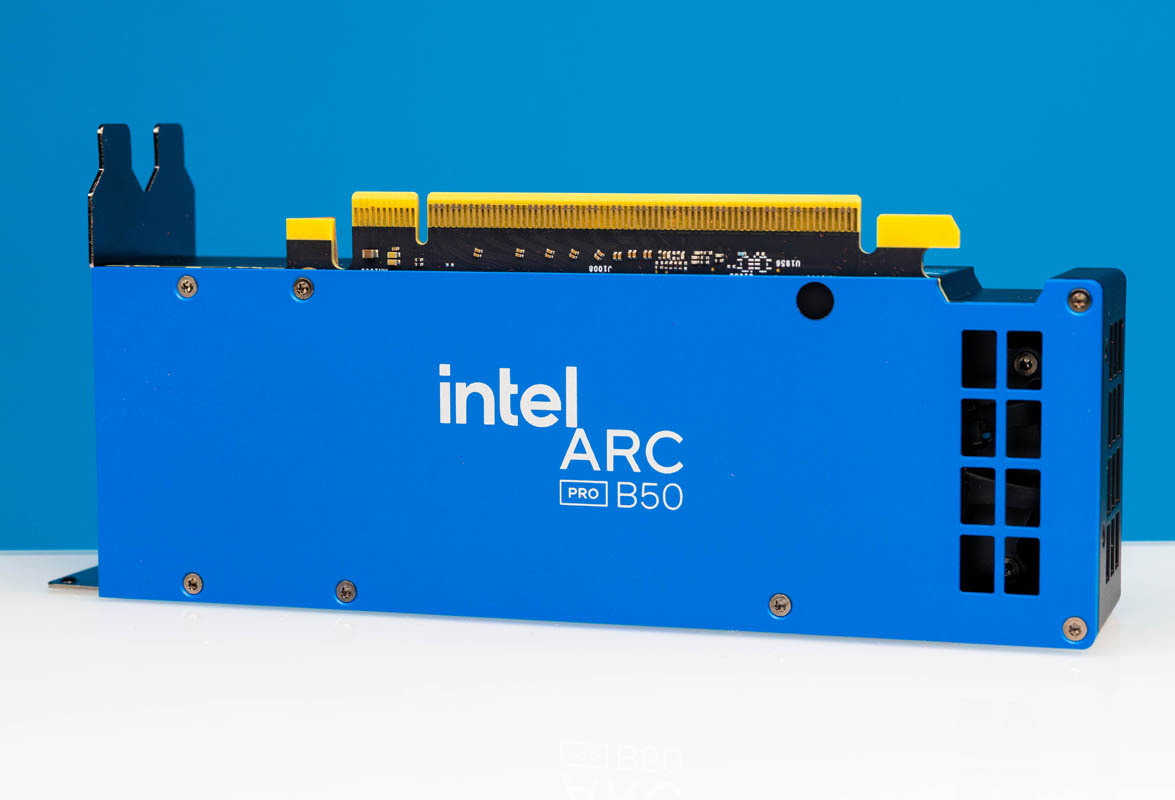
At STH, we have reviewed a number of professional SFF systems in the past. One of the big benefits of these platforms is the ability to remain compact while also offering a GPU for accelerated computing. Now, Intel has its newest generation of “Battlemage” professional GPUs for professional workstations. The Intel Arc Pro B50 has a twist, however. It is a low-profile, dual-slot GPU that is both quiet and features 16GB of onboard memory. That gives the new GPU an interesting value proposition.
Intel Arc Pro B50 Hardware Overview
First, let us take a look at the card. This is a low-profile SFF card. Intel provides both the low-profile and full-height brackets, but being short in stature is a specific feature as we will show in our performance section (that will make sense later.)
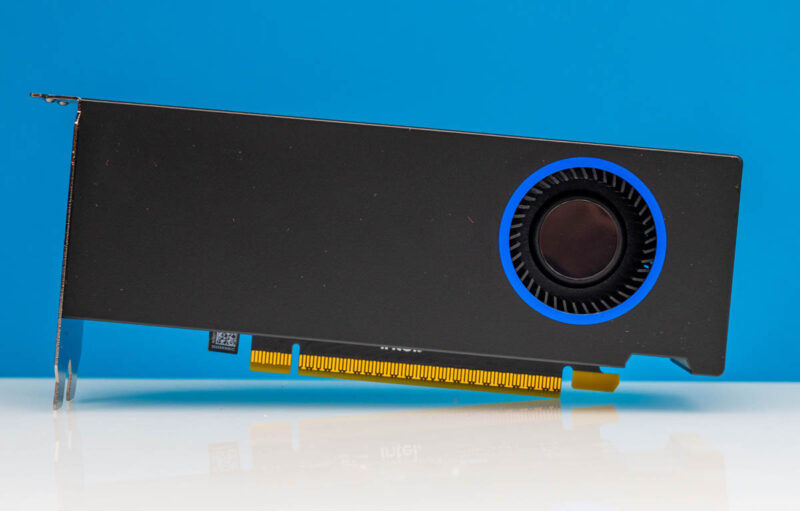
The PCIe connectivity is PCIe Gen5 x8.
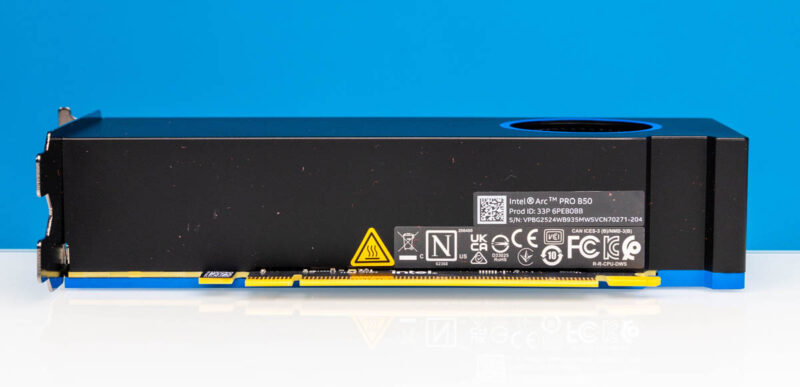
Something that is a bit different in this class is that it is a dual-slot device. Given the choice, we would prefer a single-slot solution. Still, this kept the GPU quiet in our testing so it was not bad at all.
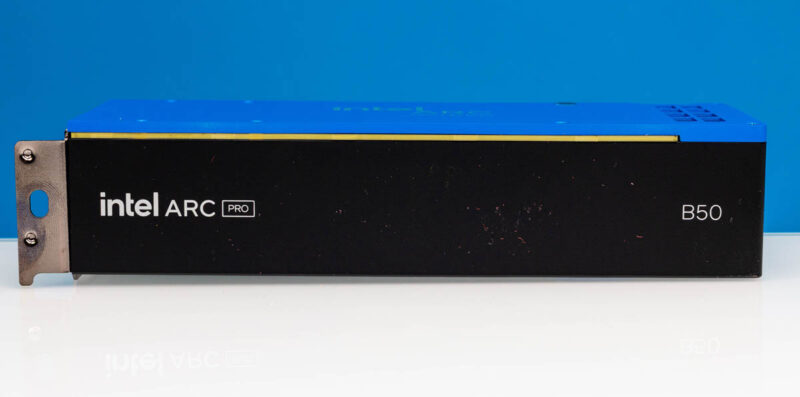
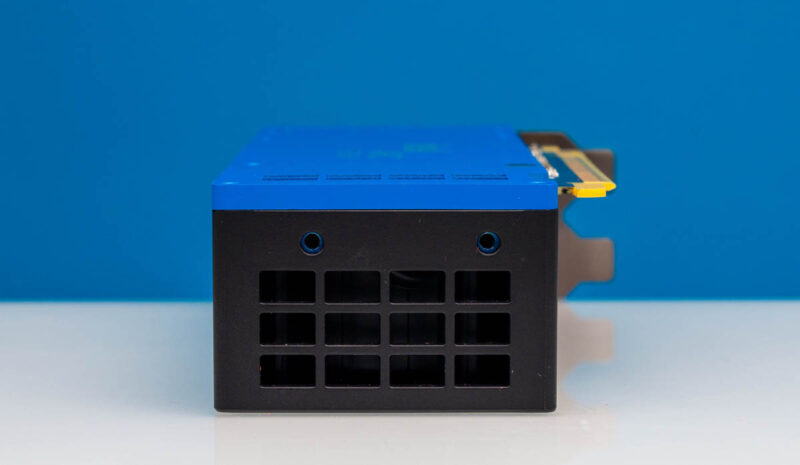
On the end, we have a vent as well as holes for GPU support. Most professional workstations have support for GPUs built-in to help keep the GPU arrive to its desk in the same position as it was shipped from the factory. This is not really for preventing sagging on a small GPU like this. Instead, it is to keep the GPU secure.
The rear I/O panel is four miniDP connectors that also have holes for locking connectors.
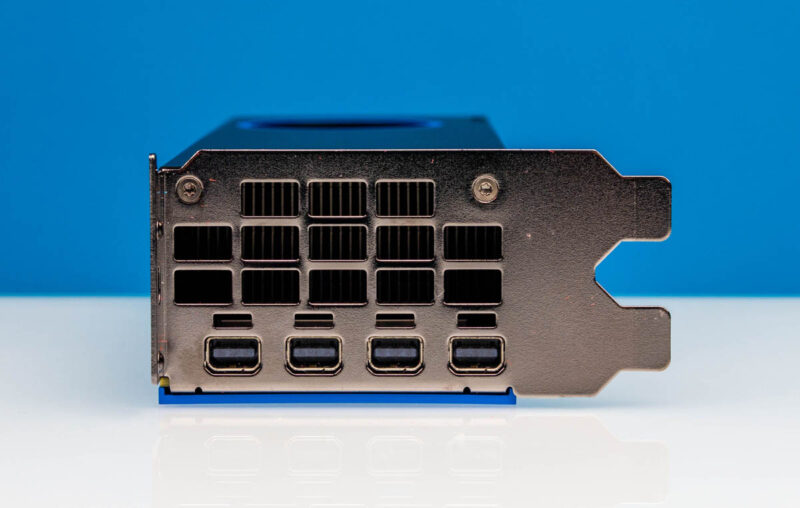
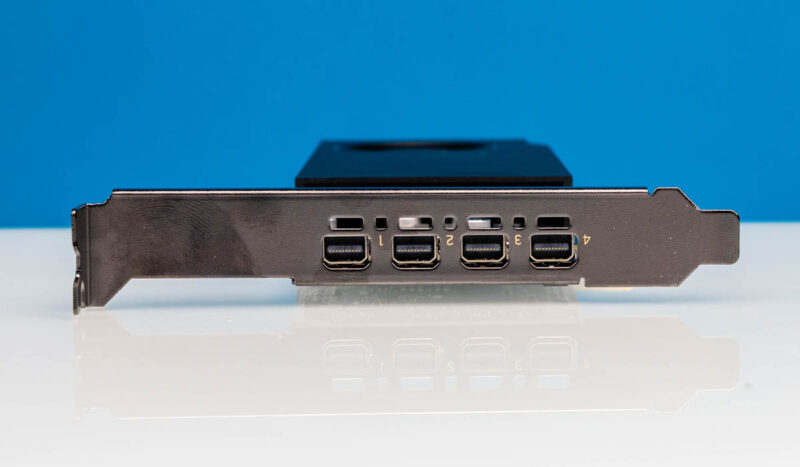
Here is a very small nit that most will not care about, but let me illustrate using the NVIDIA RTX A1000 that Intel targets the B50 against. On the NVIDIA card sold by PNY, we get numbering on the brackets as to which port is the primary #1 port. Intel did not do this on the bracket it sent. Also, on the B50 the ports are numbered in reverse order as they are on the NVIDIA card. The industry should just standardize on this so that way OEMs can make documentation for systems easier.
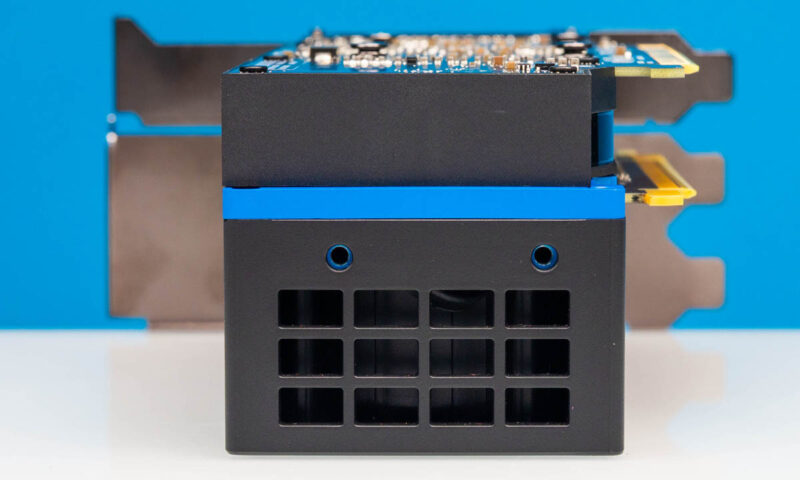
Here is a shot at the two cards from their ends since it shows the full-height bracket installed on the B50.
Of course, let us get into the specs and pricing.
Intel Arc Pro B50 Specs and Pricing
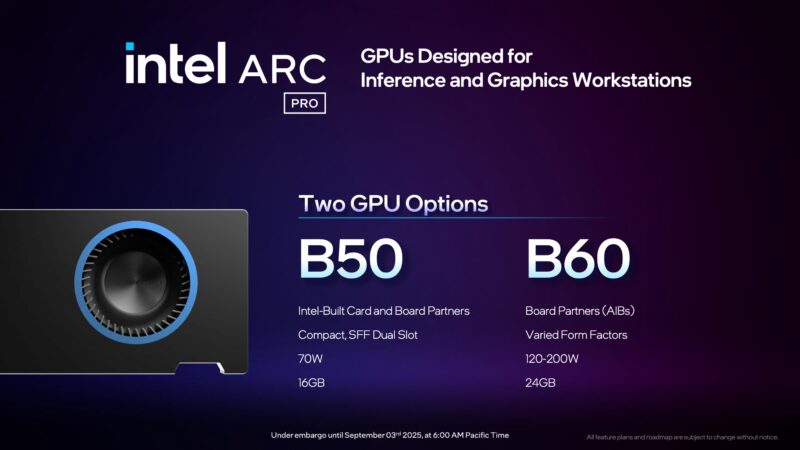
At Computex 2025 we showed the Intel Arc Pro B50 and B60. The B60 Intel is enabling with specific customers that want to buy the GPUs for specific workloads. Big customers that want the GPUs for AI inference are easier to support since it limits the number of configurations and applications that they run. For the rest of us, we get the Intel Arc Pro B50.
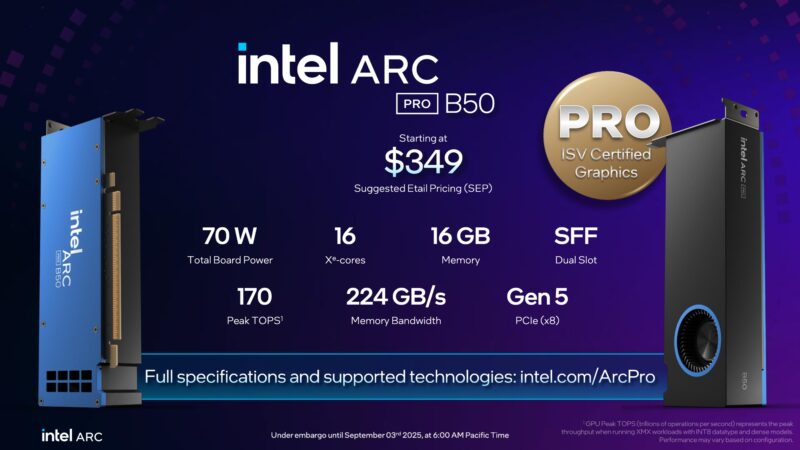
At Computex 2025 we were told that the Arc Pro B50 was going to be $299, but it is now starting at $349. Most of this Intel said was due to memory pricing and tariff risk. Intel gave its card slightly more performance as an offset, but the dream of a new sub $300 16GB GPU is shattered.
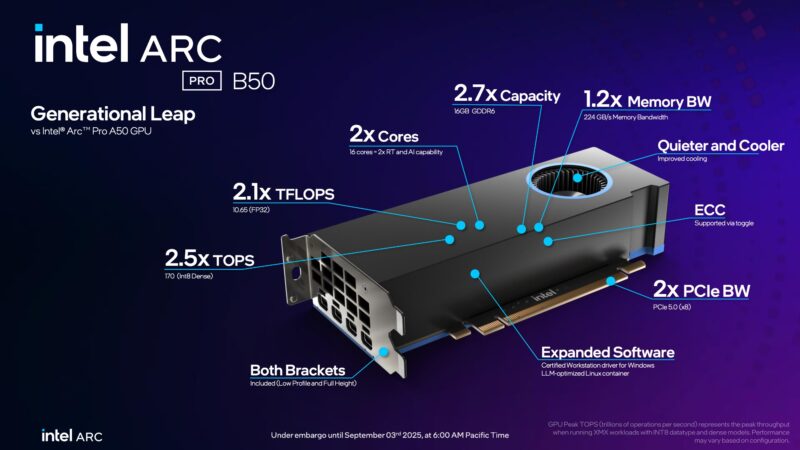
There are new features like a toggle for ECC support, PCIe Gen5, and a new architecture making this a big leap over the Intel A50 generation. Given the generational comparison below, it is somewhat strange that Google shopping this morning (September 3, 2025) has the lowest priced A50’s at prices higher than the B50 is launching at. At the same or close pricing, the clear choice is to get Battlemage.
With that, let us get to performance.



@John Lee
On the Geekbench AI chart, Can’t you relabel the two scenarios for the graph? I get that the only change is the framework, but when looking at the chart and having both runs labeled as “Asus system Product Name” makes things beyond confusing.
This review mentions the A1000 and A4000 but this GPU seems to be trying to match the A2000 16GB Ada edition more then either of those, given it has the same VRAM. The Cooler looks completely identical too.
Having recently purchased an A2000 Ada (and slapped on the single slot N3rdware cooler), I’d be curious to know how it compares to this, when it comes to home-server tasks like trans-coding under Plex, running local LLMs, doing detections in frigate etc. I guess in this case it comes down as well to CUDA vs VAAPI/ quicksync as well.
Also I didn’t see it mentioned in the review, but these intel cards are probably the cheapest way to get hardware AV1 encoding into mini PCs like the MS-01, and I think this B50 has that as well.
sff? mini?
what is here sff or mini?
this is just full length and 2-slots thick gpu.
I want to see a comparison between Arc B60*8 system and RTX 6000*2 system.
A RTX 2000 Ada is a $799 GPU, this is less than half that cost, no? I’d also say these won’t fit in the MS-01 since its dual slot not single, no?
It is SFF because it’s half as tall as a normal GPU.
And the A2000 is also originally a dual slot card, but it is possible to purchase an aftermarket single slot cooler for it, which makes it fir inside the MS-01.
Having a good video encoding engine and SR-IOV support makes this rather interesting, although I would have loved to see the more images of the fin stack of the cooler and the PCB. I know it’s not a gaming card, but these are nice to have, in my opinion.
I’d love to see this somehow trialed in a good homelab setup with Frigate and inference times, gpu usage, and power consumption. You can get a good starter unit with an Intel 12th – 14th gen but this could be a growth choice for folks who use the MS line and want to use the GPU for mixed workloads.
I need a B50 or dual B60 which is single slot full height! So I can put many of them in a single server chassis for QSV transcoding.
Doesn’t do much good without knowing a good SFF PC to use with it?
One thing I’d like to see is how this GPU performs in normal workstation tasks like AutoCAD, AutoCAD Fusion, and SolidWorks.
I noticed the other day that AutoDesk lists some older Arc GPUs in their compatibility matrix. If the Arc Pro B50 goes on the compatibility list and performs well, this is a killer deal for a workstation GPU.
I will NEVER but a product based on the “they will release software features later” mentality.
You always lose, features never arrive of are half baked.
If they do come out with the features – GREAT! But that should NEVER be expected -NEVER.
If the product doesn’t support a feature you see looking for at launch, or if it still needs work to get it to perform as expected (hello Intel CPU division) then do not buy it – no matter how cost effective it might APPEAR to be.
Suggesting anyone more or less (depending on how you look at it) is irresponsible journalism.
@John: exactly my thoughts!
People take it granted that sriov, the arc pro b ultimate killer feature, is indeed coming as promised in 3-4 months. But! If the captain decides in 2-3 months, that “naah, lets fire everyone from the gpu department”, before the sriov driver is released, then all gullible super-optimistic-believer will realize they made a bad decision based on future promises.
This is perfect for my 2U server case. Already have it on order, looking forward to putting it through its paces with thermals and power as a priority for me.
Im excited about sriov. My VMs will all be video accelerated.
Review could have used a section on llama.cpp performance
Still no VR for any intel GPU