

GMKtec EVO-X3 Power Consumption and Noise
A common theme in all of the Ryzen AI Max systems we have reviewed so far, and GMKtec’s systems have been no exception, is that all of these systems have shipped with sizable power supplies. The SoC itself can draw quite a bit of power under full load, and then there is the need to power the rest of the system, including power delivery for numerous USB ports and the fans within these systems.
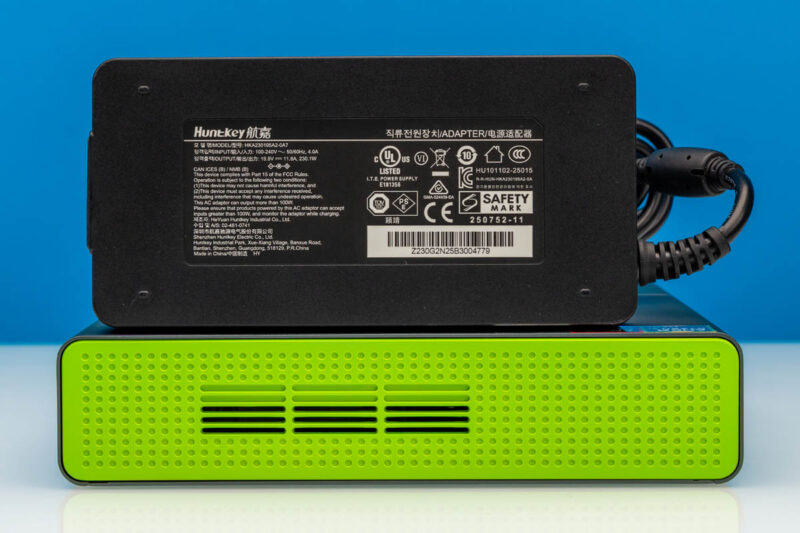
GMKtec includes a 230 Watt brick with the EVO-X3. As it happens, this is the same capacity adapter that shipped with the EVO-X2. Which, if nothing else, outlines how the peak power consumption of the two systems is effectively unchanged.
In practice, that means we are looking at a peak power consumption for the system of around 160-180 Watts under a heavy, sustained workload. This accounts for the 140 Watt TDP of the Strix Halo chip itself (in GMKtec’s “Performance” mode) along with the various supporting chips that make up the platform. Though it is worth keeping in mind that the max power consumption is something of a pathological figure; for LLM inference, which is a prime use case for this system, we measured the system at around 100 Watts or less. Even though inference is a GPU-heavy task, the decode stage is so memory-bound that the GPU is not running at full tilt at all times, which keeps the overall system power consumption well below the system’s max.
Key Lessons Learned
On the whole, GMKtec’s EVO-X3 has been one of the more interesting Ryzen AI Max mini-PCs that we have had cross our lab desks in the last year. While there is no shortage of designs, few of them break the usual mini-PC mold in this fashion. And how it does so makes for some very interesting trade-offs compared to other systems.
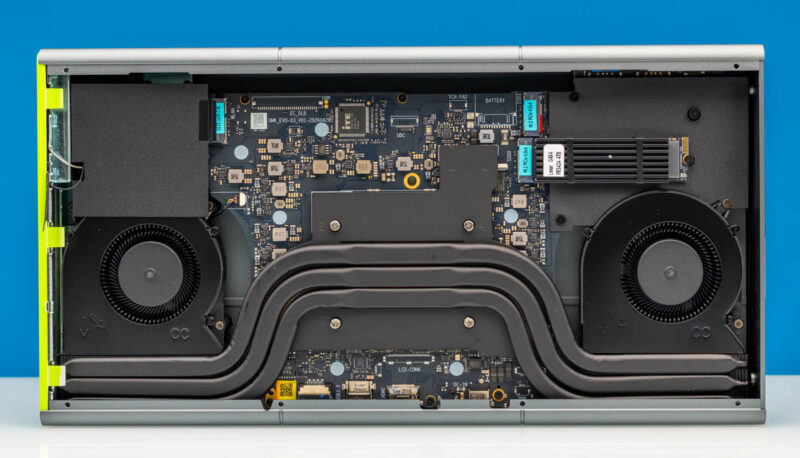
As we noted earlier in our review, the inclusion of an OCuLink port is unlike any other Ryzen AI Max+ mini-PC on the market. Some have offered Thunderbolt 4 for external PCIe connectivity, but until now none have offered the even faster OCuLink port. So if you have a use case for the port, something like an external GPU where even Thunderbolt 4 wouldn’t be enough, it is a really cool option.
The trade-off, however, is a noticeable lack of I/O elsewhere in the system. It has only a single 40Gbps USB-C port (even though Strix Halo supports 2 of them), plus two USB 3.x Type-A ports. Because GMKtec did not include a dedicated DisplayPort output, that sole USB-C port doubles as the only DisplayPort output. So if you need more than the PC’s single HDMI output, you have to sacrifice a precious USB-C port.
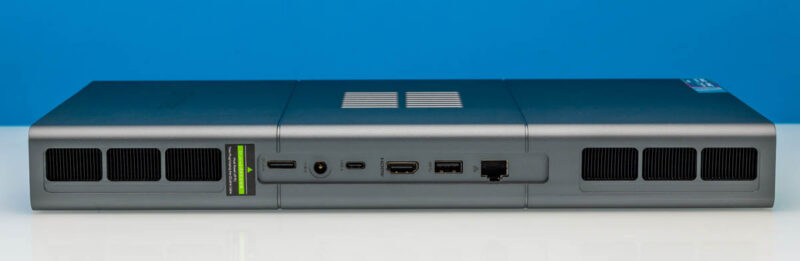
Meanwhile, the inclusion of just a 2.5GbE wired network is a straightforward miss on GMKtec’s part, as this is a PC that is begging for a 10GbE port. When Ryzen AI Max systems first launched, 2.5GbE was still acceptable because there were few controller options. Now that Realtek’s cheap 10GbE controllers have been on the market for almost a year, a lack of 10GbE is a harder sell. Given the OCuLink port, GMKtec likely would have needed to sacrifice something else to free up PCIe lanes, say the second M.2 slot, but that would have been an acceptable trade-off in this case. Otherwise, you can always add 10Gb Ethernet via a USB adapter, but to reach full 10Gb speeds, you will need a Type-C adapter, which again eats up that sole USB-C port. It makes the EVO-X3 an odd juxtaposition. The lack of USB ports and display outputs makes us see it as a small server, but a 2.5GbE port is too little bandwidth for that role in 2026. A way to lower storage costs is to use a NAS and share storage across devices. Moving 90GB models is much faster over 10GbE than 2.5GbE, to the point where you can easily notice the time saved.
I/O aside, it is clear GMKtec has learned from its past designs. The EVO-X3 is a faster system and by most metrics a better system in regards to features. As a result, the EVO-X3 earns its name: it is not just another EVO, but it is a better one as well.
Final Words
Wrapping things up, throughout the process of reviewing so many Ryzen AI Max+ 395 systems over the past year, it has become increasingly clear that while the chip did not pan out quite the way AMD expected as a high-performance x86 SoC for a broad ecosystem of devices, it has found an extremely useful (and profitable) niche as a chip to power AI workstations. Since the chip was first announced, we have seen AMD’s partners and even AMD itself embrace it. Now so has GMKtec.
The EVO-X3 is a solid entry in the AI workstation market. GMKtec has done their homework, and while we have some concerns about the lack of USB ports, they have excelled in other ways such as performance, cooling, and the unique inclusion of an OCuLink port for external PCIe connectivity. On that basis alone, the EVO-X3 manages to stand out from a crowded market of other Ryzen AI Max mini-PCs in a way that few other mini-PCs can.
Though this means that to get the most out of it, you really do need to be all-in on local AI inference. Thankfully for GMKtec and AMD, the software and models to do this are getting better all the time, and where local AI inference is now versus when these boxes launched around a year ago has already evolved by leaps and bounds. And especially if you have an interest in privacy and not taking the risk of exposing data by using cloud-based inference services, then the EVO-X3 is a strong proposition.
The other side of the coin to that consideration is cost. We have seen the price of Ryzen AI Max mini-PCs tick up over the months, and GMKtec’s is no exception, with the high-end 128GB RAM + 2TB SSD configuration now going for $3800. Yet in spite of that, when we look at the broader market, the EVO-X3 is something of a value proposition right now. AMD’s Ryzen AI Halo box runs for $4000, and after NVIDIA’s recent price hikes, GB10 boxes are a staggering $6950, over $3000 more than GMKtec’s Ryzen AI Max box. Given the current price trends for RAM and NAND flash, we would not be too surprised if the EVO-X3 eventually goes the same way as well, but for right now GMKtec has one of the most affordable 128GB AI mini-PCs on the market, making it a very attractive option indeed.
Where to Buy
If you want to find the GMKtec EVO-X3 online, here is an Amazon Affiliate link.




Unfortunate that they did not give y’all the 495 SKU. The 395 is pretty well understood.