
Following last week’s announcement of their WSE-3 Turbo accelerators and CS-4 racks, Cerebras has come to this year’s Hot Chips conference to present the hardware to the event’s technical crowd. Designed to be a turning point for Cerebras, the CS-4 marks their first foray into a dedicated rack-scale system that can operate inside of a single scale-up domain – giving Cerebras’s hardware the scale it needs to compete with other recent innovations in this space. At the heart of these racks is the turbo version of the WSE-3 wafer scale engine, which has doubled the clockspeeds (and thus performance) of its predecessor essentially across the board.
This article is being written live from the presentation, so please excuse any typos.
Cerebras Talks Going Rack-Scale with Their WSEs at Hot Chips 2026
The development of a rack-scale system is important for Cerebras for several reasons. Besides the sheer performance that a single rack-scale system can offer by putting 3 WSEs within a single rack, the Nexus platform the CS-4 rack is based on is essentially the hardware backbone of Cerebras’s systems for the next few years. As well, this is the next step towards meshing WSEs with GPU racks to play off the strengths of the two accelerator types – in this case, building off of WSEs’ high decode performance. Cerebras is already in the process of this, which will see WSEs paired with AMD’s forthcoming Instinct MI455X accelerators.
Cerebras is diving right in to the subject of the CS-4 rack and the WSE-3T processors/engines inside of the rack-scale system.
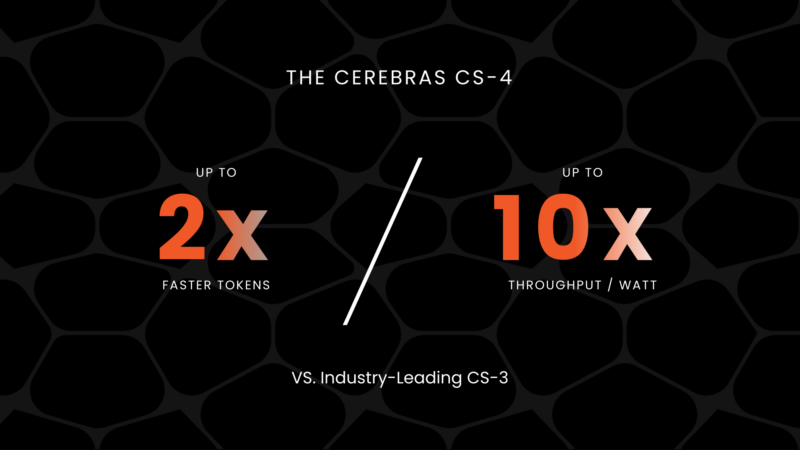
CS-4 is designed to push the frontier on both a throughput and energy efficiency basis. Versus CS-3, CS-4 offers 2x more tokens, at 10x more tokens per watt.
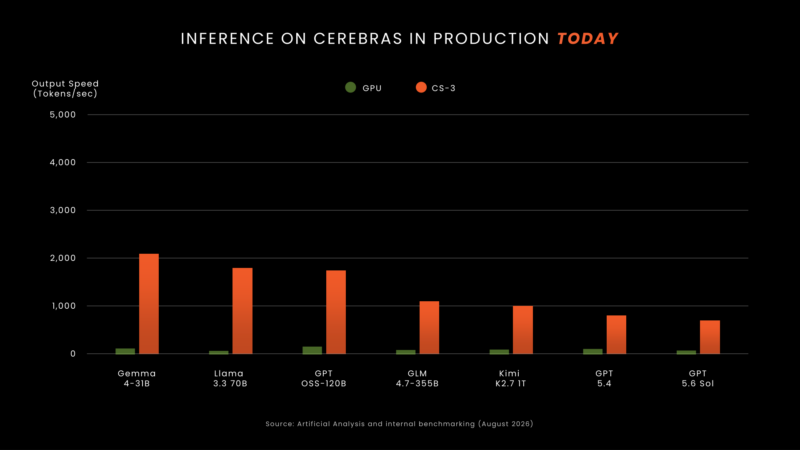
A big part of Cerebras’s messaging is on how their wafer scale engines compare to GPUs.
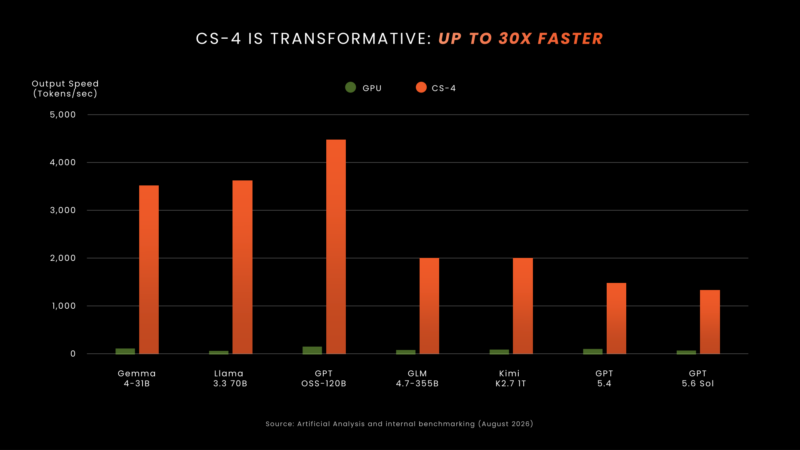
CS-4, in turn, is designed to extend that even further, moving that to upwards of 30x faster than a GPU.
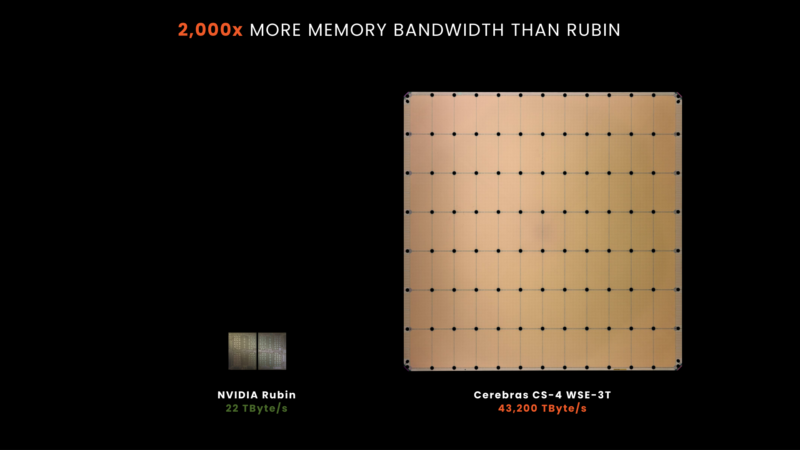
The number that matters the most for inference performance is memory bandwidth. By relying entirely on on-chip SRAM, WSE3-T offers 43,000 TB/second of memory bandwidth
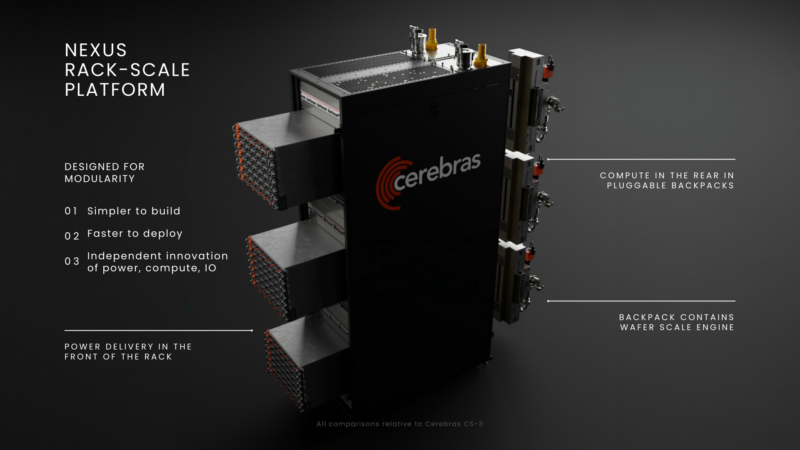
For Cerebras’s rack-scale platform, the company has developed their Nexus platform. The power goes in the front of the Nexus, while the compute goes into the rear in the form of pluggable backpacks.
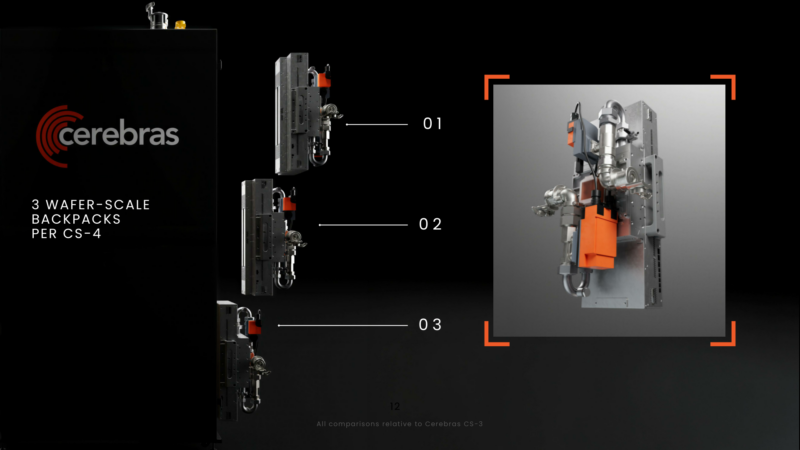
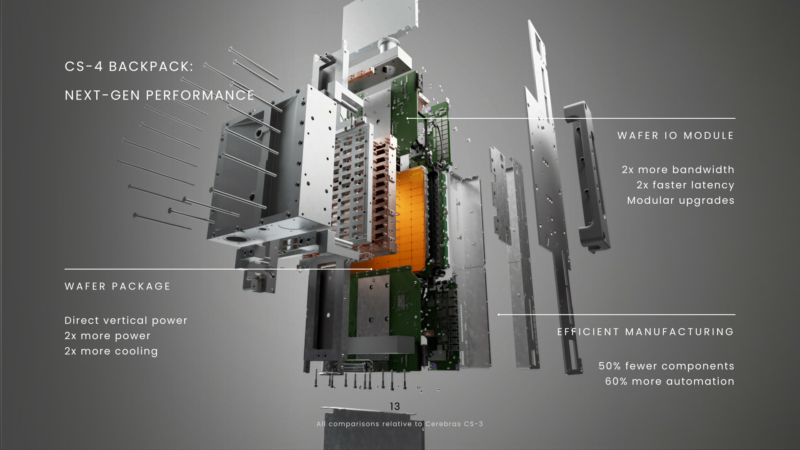
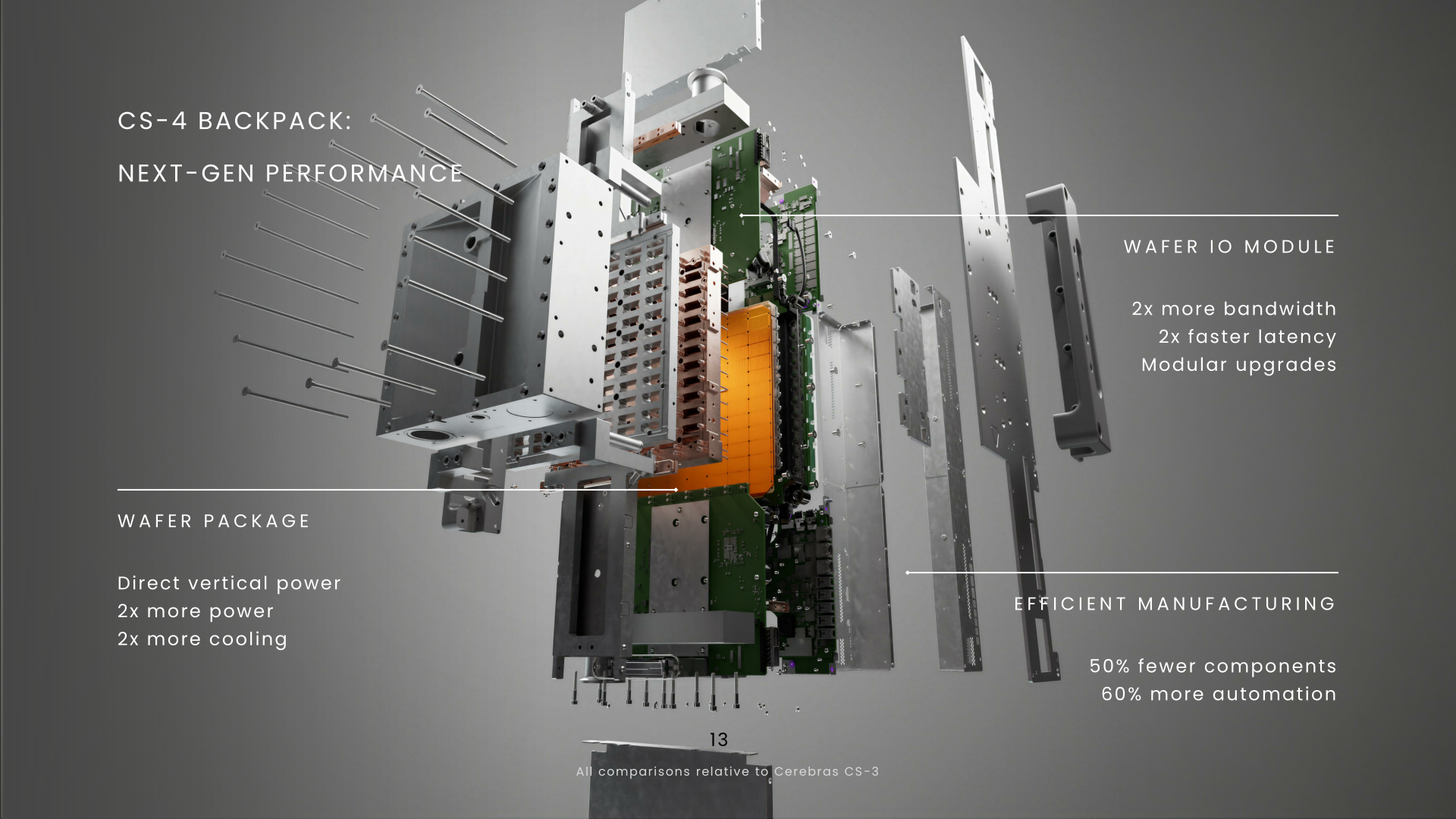
Diving a bit deeper into the backpacks, the purpose of the backpacks is multi-faceted. Besides providing I/O connectivity to the rack, it also is how power and cooling is attached as well. The CS-4 backpack offers twice the power and cooling as the CS-3 design. At the same time, Cerebras is able to build this with 50% fewer components than CS-3.
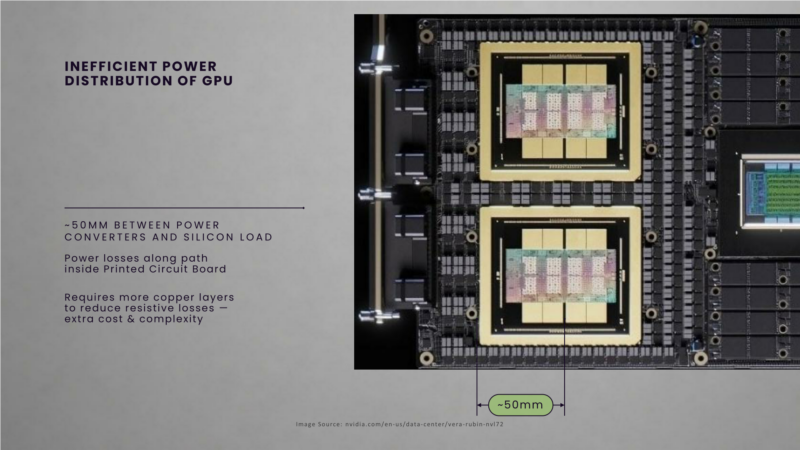
Once again making a GPU comparison here, Cerebras is talking about how power delivery works on GPUs. And specifically, what they see as the downsides to the power delivery requirements for these chips.
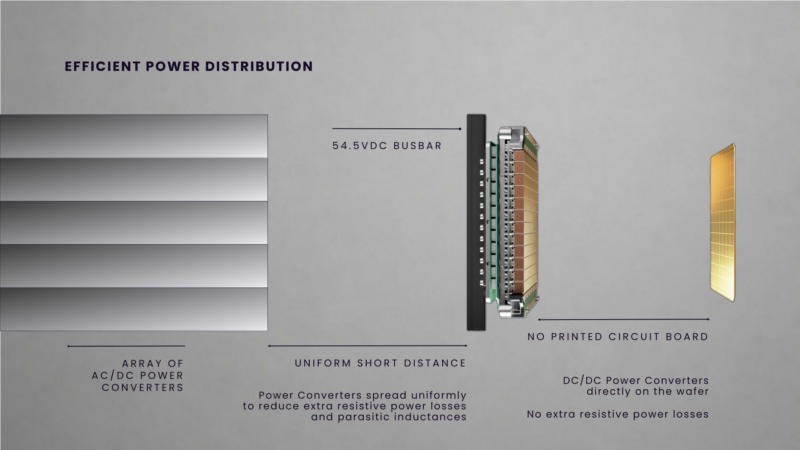
For CS-4, on the other hand, makes several changes to more efficiently deliver power. The vertical design is a big part of this, as it allows for the DC-DC converters to be very, very close to the busbar.
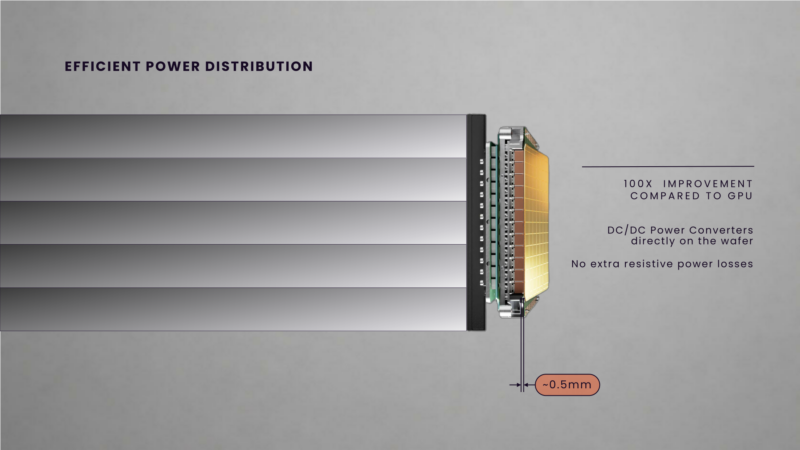
And the WSEs, effectively stacked on top of these, are also positioned very close, minimizing resistive losses.
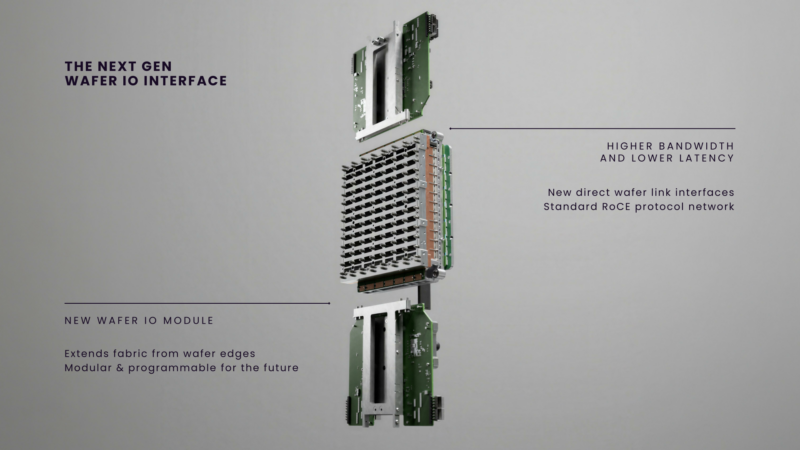
Meanwhile the next-gen wafer I/O interface uses a new module structure.
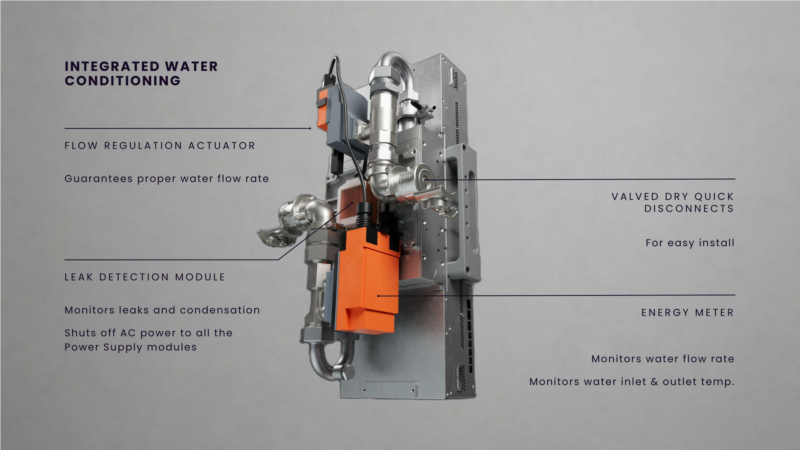
As noted earlier, the backpacks are also how the WSEs are cooled, and connected to the larger liquid cooling network. Each backpack does leak detection and has its own energy meter. As well as being valved for quick disconnects.
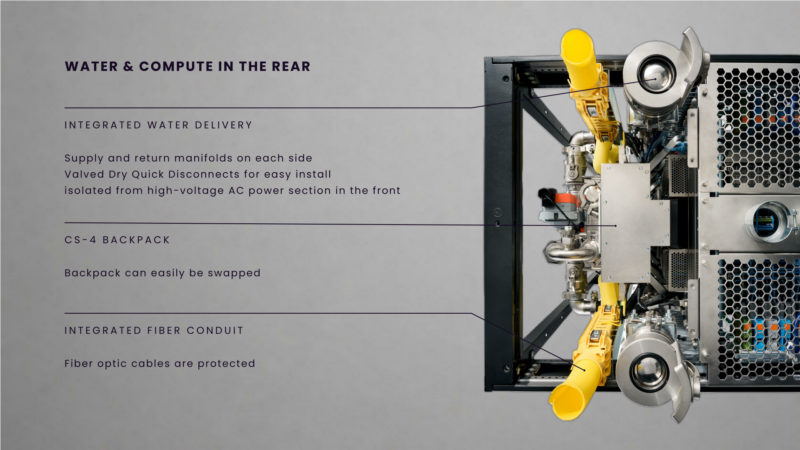
Speaking of water, here is a look at how it works on the rack scale.
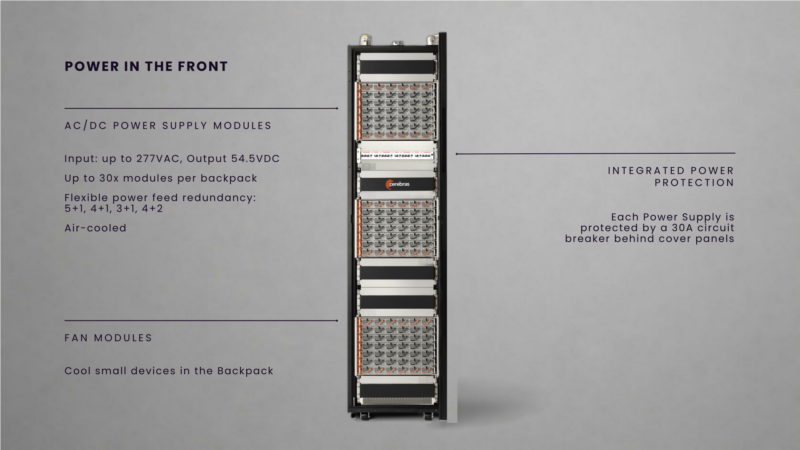
CS-4 provides power intake from the front of the system. Each PSU is protected by a 30A circuit breaker, with inputs up to 277V AC. There are up to 30 PSU modules installed per backback.
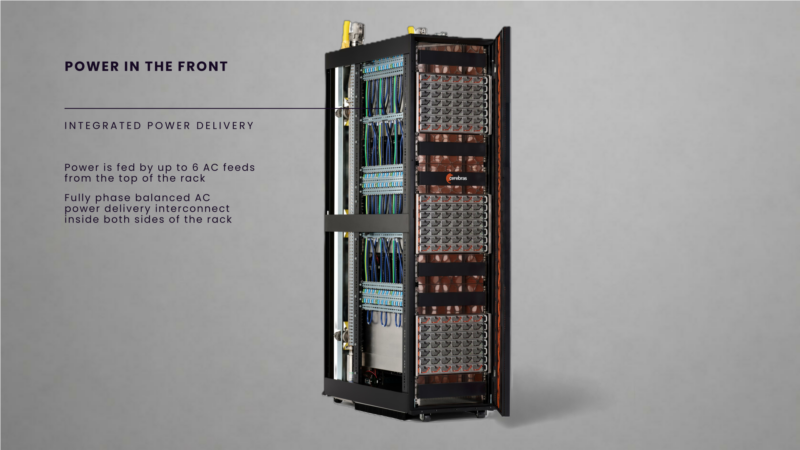
Power is fed from the top of the rack. The AC power delivery system is fully phased balanced.
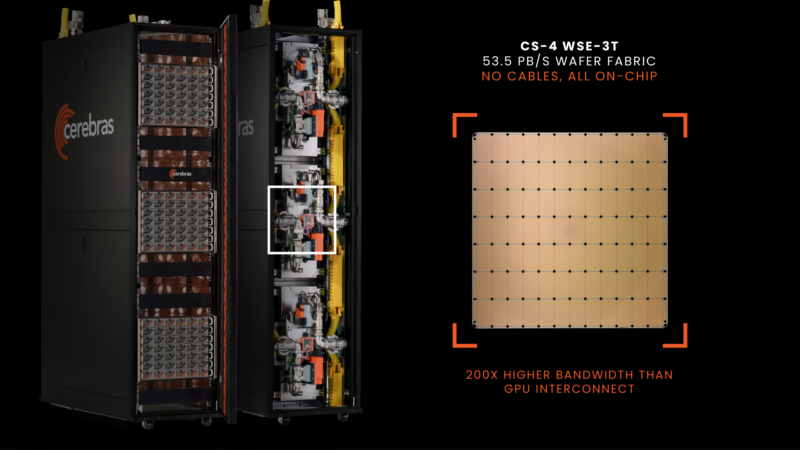
Meanwhile on the networking/interconnect front, a major point of pride for Cerebras is how their design doesn’t require a large amount of cables. Each wafer routes between its processing elements entirely on the wafer, via the 53PB/sec internal fabric. And even between the wafers of a CS-4, the backpacks connect to each other.
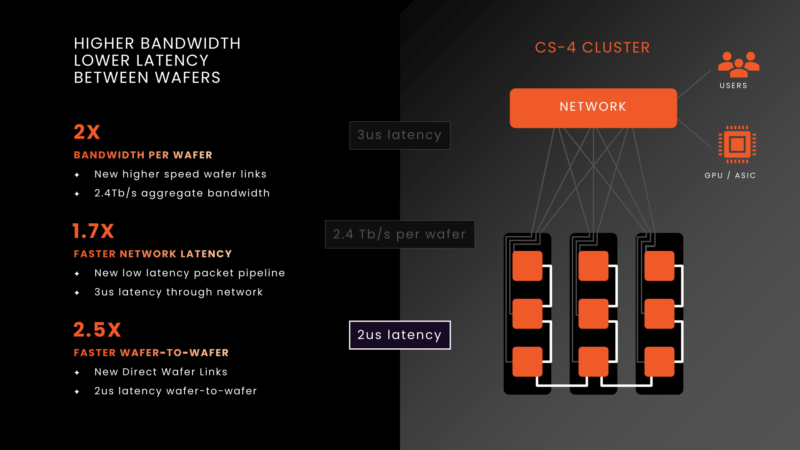
The direct wafer links between the backpacks mean that the wafer-to-wafer latency can be as low as 2 microseconds. There is 2.4Tb/second of aggregate bandwidth from each wafer.
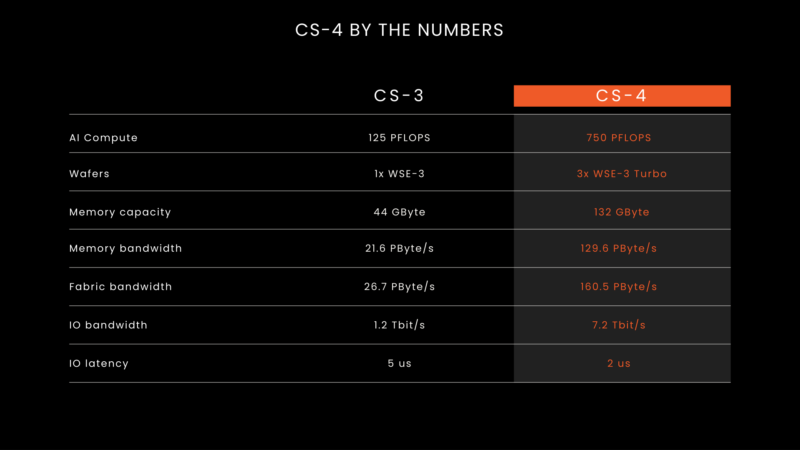
Going over the specs for CS-4, the rack-scale system employs three WSE-3T engines, which offers a total (on paper) improvement of 6x for most throughput and bandwidth metrics.
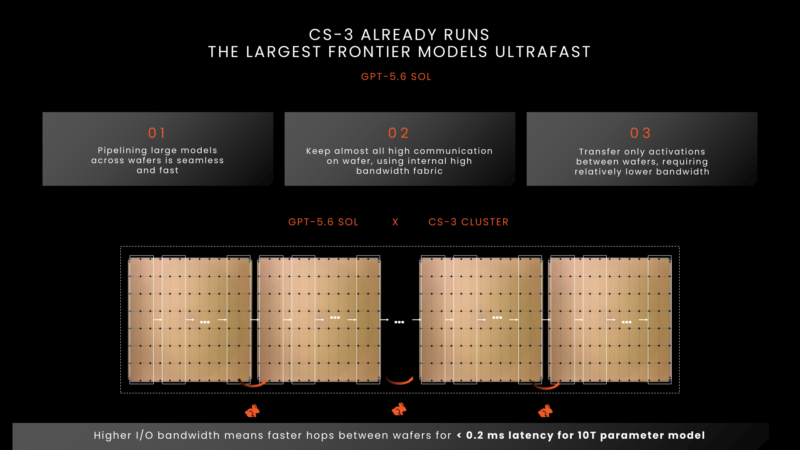
Taking a quick look at how a model flows through the system with GPT-5.6 SOL. CS-3 is already able to run the world’s largest frontier models. CS-4 will allow for even larger frontier models in the future.
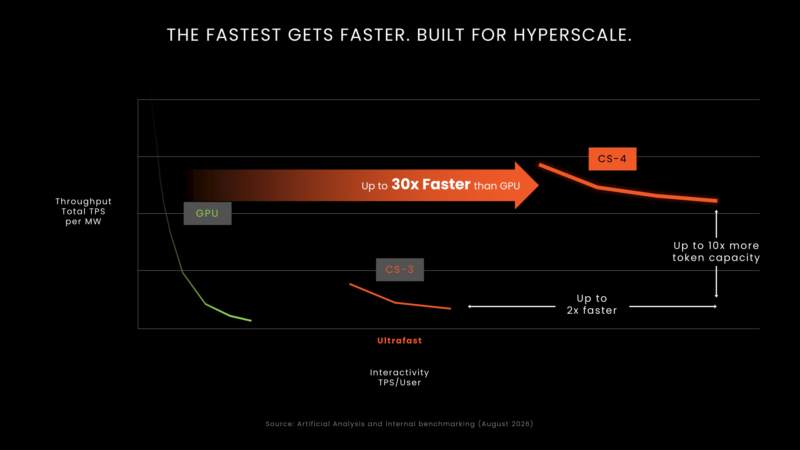
Summing up CS-4, the next-gen rack-scale system is designed to leave even the CS-3 in the dust. The CS-4 will offer both 2x faster tokens and 10x the token capacity on a tokens/second/watt basis.
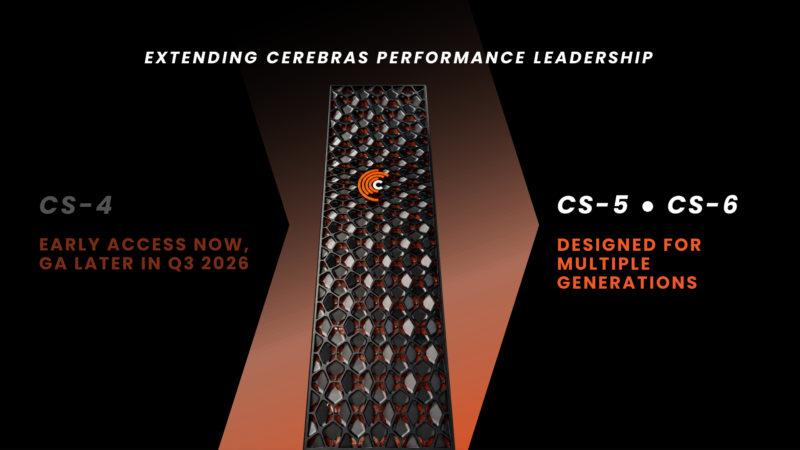
CS-4 is not Cerebras’s stopping point, either. The Nexus platform is going to be the basis of the CS-5 and CS-6 systems as well, which will employ newer WSEs.
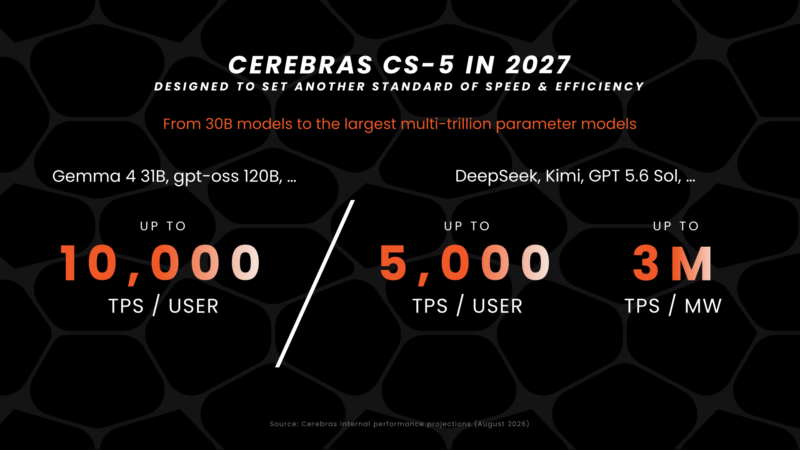
The CS-5 system is due in 2027. Cerebas is promising up to 3 million tokens per megawatt of performance. Or up to 10,000 tokens per second per user.

To support wafer scale processing, everything had to change. 3D packaging, power, and cooling.
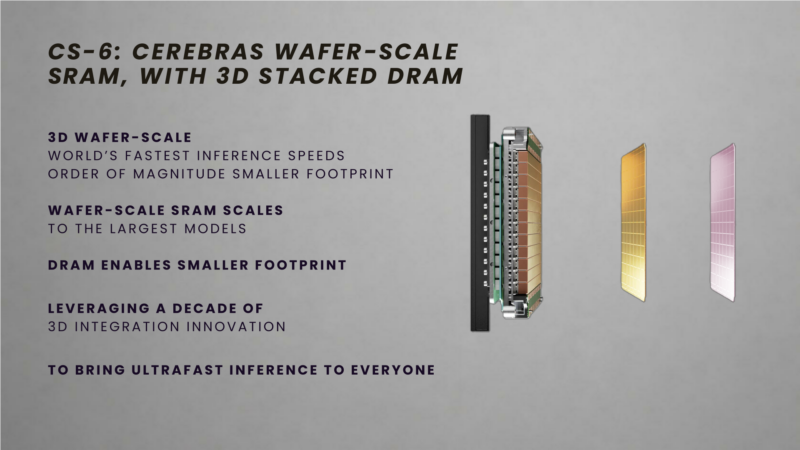
And CS-6 will be even more ambitious. Cerebras will be employing DRAM for the first time, stacking DRAM on top of their wafer scale engines to give them ability to design smaller processors with similar memory capacity as the largest WSEs with SRAM. Unfortunately Cerebas is not going into a ton of detail here on just what they are up to, but at a high level the concept appears to be to cut down on the amount of SRAM they have on each WSE in order to pack in a larger amount of compute hardware. That leave the stacked DRAM to pick up the slack in terms of memory.
We have a full recap on the Substack, including where all of these pieces ranked in terms of popularity: