

ASUS Pro WS W890E-SAGE SE Block Diagram
Here is the block diagram for the ASUS Pro WS W890E-SAGE SE.

The extensive I/O supported by the Xeon 600 platform means the board’s block diagram is rather complex, and, by necessity, rather detailed.

With all of the PCIe slots, M.2 slots, and MCIO connector hanging off the CPU, the remaining devices hang off of the W890 chipset in some fashion. Meaning they all share a DMI Gen4 x8 backhaul connection to the CPU. Among the connections here are the AST2600 BCM, the E610 network controller, all USB3.x and 2.x hosts, and even a header for an optional WiFi + Bluetooth radio card.
ASUS Pro WS W890E-SAGE SE Performance
Taking a look at the performance of the SAGE SE, the motherboard has little trouble driving our Xeon 658X CPU. With a nominal TDP of just 250 Watts – 100 Watts below the top Xeon 600 SKUs, the overclocking-friendly board hardly breaks a sweat running our CPU. Our steady-state TDP is even lower than Intel’s official figures, at closer to 230 Watts.
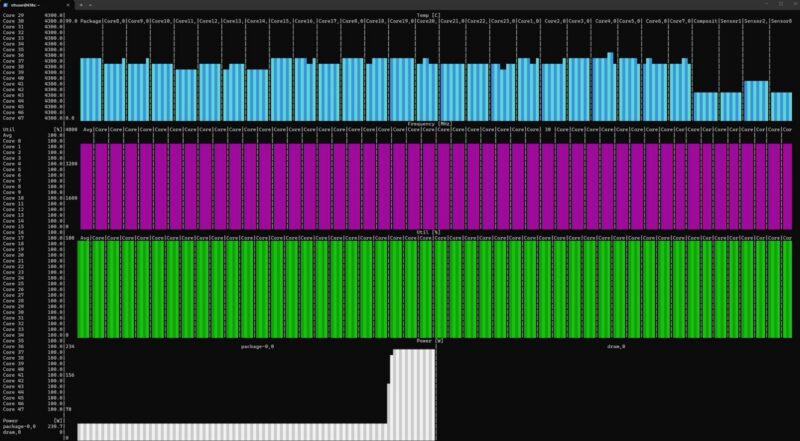
Combined with a Noctua NH-U14S DX4677 cooler, none of the Xeon’s CPU cores get above the mid-60C mark in temperature. This helps the ASUS motherboard keep all CPU cores running at over 4 GHz even under this stress-test workload.
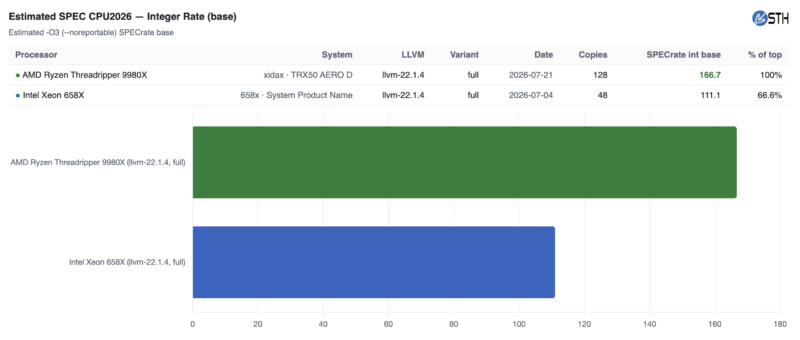
Otherwise, with regard to numerical performance, the SAGE SE plus Xeon 658X put up a solid performance.
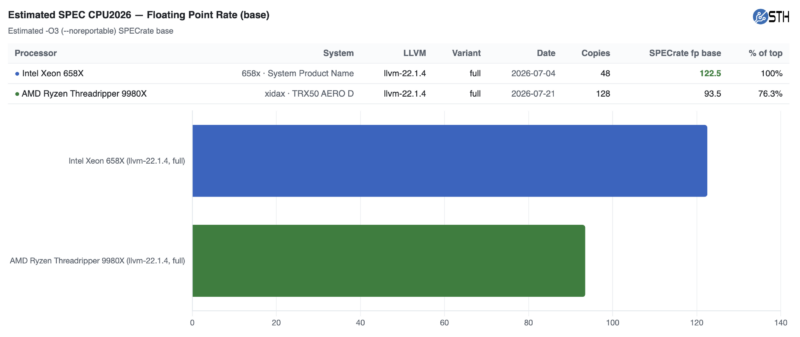
The 24-core Xeon cannot top our Threadripper 9980X system in integer performance on SPEC CPU2026. It, however, turns the tables on floating-point performance, thanks in large part to the greater memory bandwidth of the Xeon 600 platform.
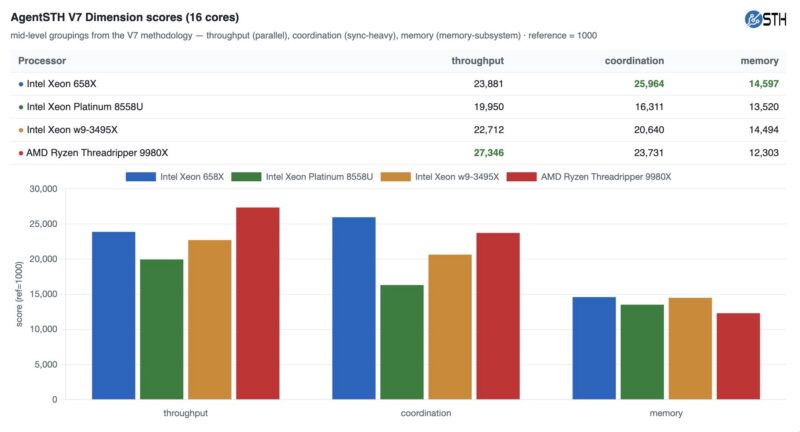
The system also fares well in our AgentSTH V7 agentic AI benchmark. With 16 cores in play across all our CPUs, the SAGE SE + Xeon 658X falls a bit short on compute throughput but fares well with multi-core coordination and in-memory performance.
Next, let us discuss cooling a bit.

“Non angeli, sed angli”, as Pope Gregory the Great didn’t say.
(In other words, a couple of times you call them Angelboost fans, not Angleboost.)
Unfortunately, there are virtually no Xeon 600s available for month. The motherboards are sitting on the shelves at german distributors like a lump of lead.
@James
Whoops! Thank you for pointing that out. It has been fixed.
Xeon processors across the board are just so expensive, at least until you get all the way down to Cascade Lake. The only thing expensive on the AMD side is DDR5 gen threadrippers. I’m not sure why this is the way it is but it’s been like that forever, even though AMD been dominating ever since EPYC Rome and the 3990X. Are there any server or workstation Xeons that are really worth it if your interest is a CPU-based workload performance?
Great review for anyone considering a serious workstation build. The detailed look at the motherboard’s expansion and platform capabilities makes it much easier to understand who this board is really designed for.
Workstation Xeon 658x would be of really worth to check