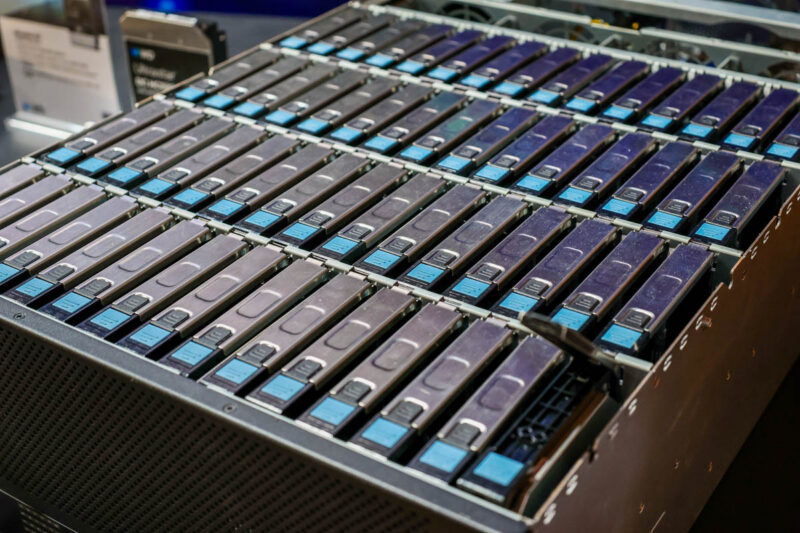
We also saw storage servers for both disk and NVMe. Storage is becoming another important area for AI clusters, which is something many of the speakers also highlighted.
Disk had been largely thought to be moved out of AI infrastructure since high-performance NVMe matched better with AI servers. Now, storing large amounts of data on NVMe has become much more costly compared to disk, so disk has strongly reasserted itself in a slower tier focused on cost per PB.
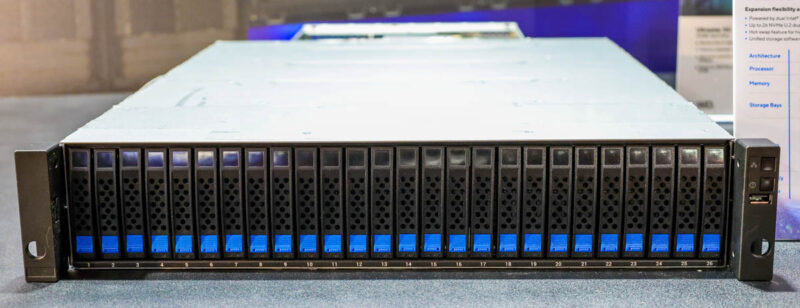
Aside from disk-based servers, ASUS also had NVMe storage-focused servers like the ASUS VS320D-RS26N for higher-performance storage to feed servers and GPUs.
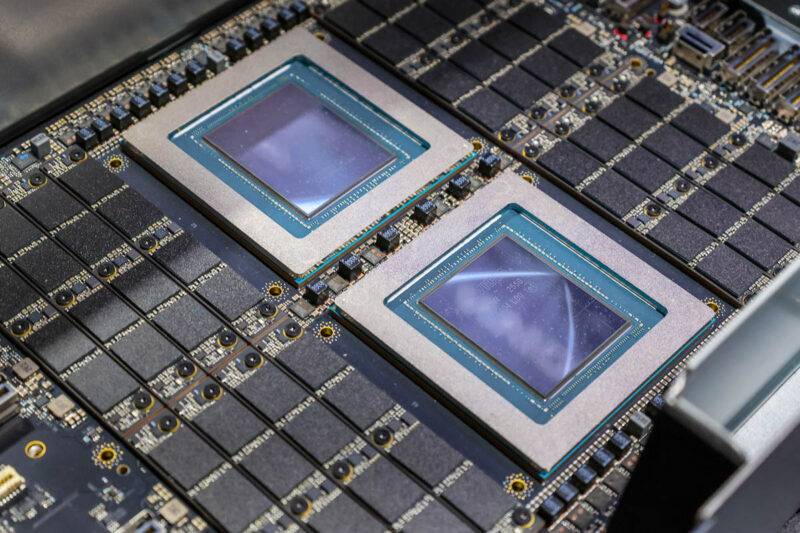
One other neat server was the ASUS XA P2N-E2, which is an MGX platform that supports two NVIDIA Vera CPUs. When NVIDIA discusses Vera in the context of agentic AI, this is a great example of what that type of platform may look like. It is also designed to be a more general-purpose compute platform.
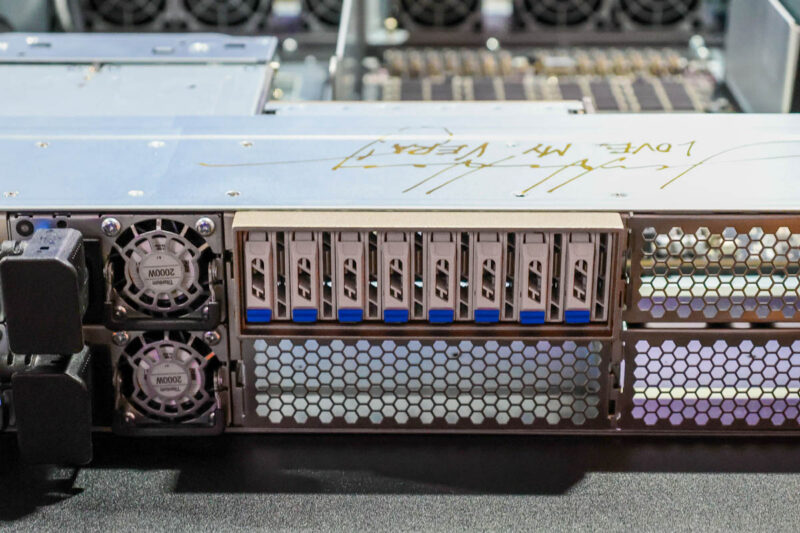
These can be combined with PCIe GPUs like the NVIDIA RTX Pro 4500 Blackwell or RTX Pro 6000 Blackwell Server Edition GPUs. These are designed for high single-thread performance and lots of memory bandwidth. They are next-generation platforms that even feature PCIe Gen6 for high-speed networking and storage.
While many of the speakers focused on data center trends and implementing AI in their organizations, my panel discussion (Winning in the New Era of AI: Harnessing Innovation, Enabling Sovereign AI, and Scaling Business Value) had Crusoe, Aleria, ASUS, and IBM all on stage.
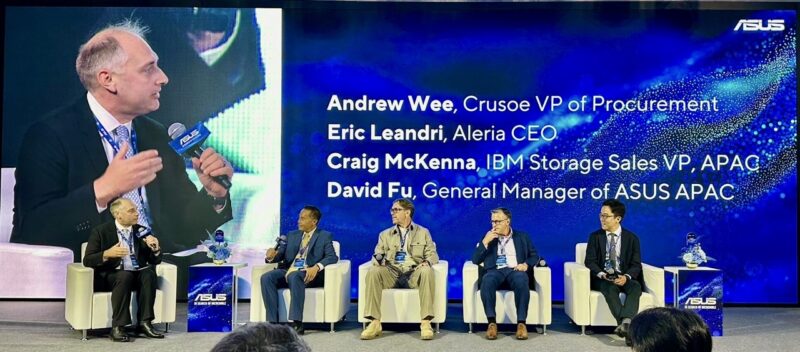
We had a lively discussion around sovereign and enterprise AI, which are quickly becoming major trends in the industry. Eric Leandri, the CEO of Aleria, showed how they were implementing agentic AI for portfolio companies and how the adoption was ramping. Craig McKenna of IBM focused on how IBM was helping its customers meet the challenges of going into practical implementations. David Fu of ASUS discussed how customers were looking to efficiently deploy new, more efficient generations of AI Factories. Andrew Wee of Crusoe discussed how Crusoe’s in-house manufacturing and harnessing new energy sources accelerate AI deployment across its range of engagement models, from providing low-level resources to hosting models as a service.
Companies are trying to figure out how to take the machines that we saw in the lobby and deliver excellent AI experiences to their internal and external customers.
Final Words
It was an awesome opportunity to get to chat with folks about what they are working on. That ranged from memory makers to ASUS. I always appreciate doing the panel discussion allowed me to ask questions about how folks are thinking about sovereign AI and enterprise AI that may be different from how we talk about it, either on the local AI scale at one extreme or at the Gigawatt AI Factory scale at the other. If you ever have the opportunity to attend one of these events, I would highly recommend it, as the conversations both on stage and in the hallways are excellent.