

ASRock Rack 8U8X-GNR2 SYN B200 Block Diagram
We are testing the server early in its cycle, so we do not have the server block diagram, but we managed to find the ASRock Rack SP2C741D32G-2L+ motherboard’s block diagram.
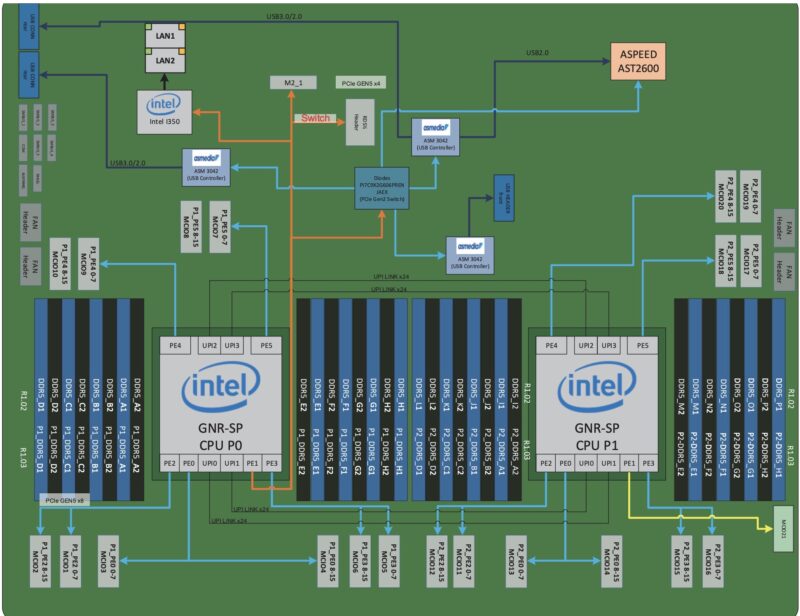
Something you will quickly notice is that there is no longer a PCH on this motherboard. Intel moved to a PCH-less design with Xeon 6 which is a more modern design.
This is a very modern motherboard design and one that really is highly customized for this system. It would be strange to see a motherboard with the entire trailing edge made up of MCIO connectors in a standard 1U or 2U server. These MCIO cables offer a flexible way to move PCIe lanes inside a system and help with better signal integrity over longer runs. This is a big server, so the runs got even longer in this generation.
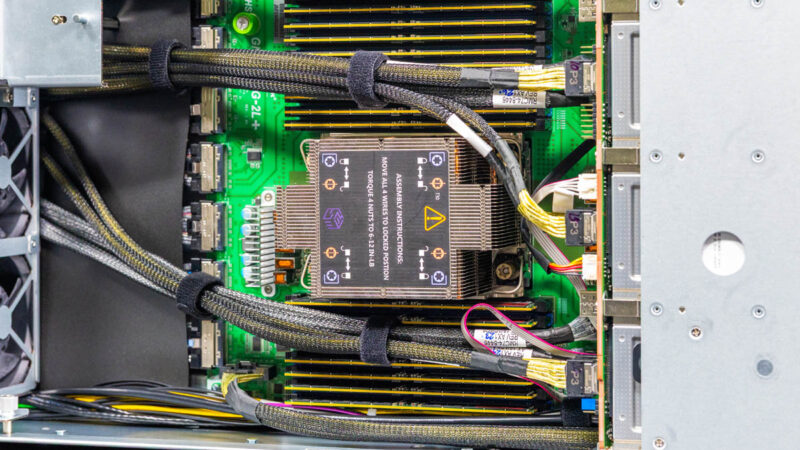
These AI servers use so much specialized PCIe connectivity that this deisgn makes a lot of sense. Many large server vendors, even Dell, effectively use their 1U/2U standard motherboard for their GPU systems. ASRock Rack is customizing the motherboard for the application. That makes a lot of sense since when a company is investing in systems that cost hundereds of thousands of dollars, optimizing the motherboard that ties the system together is worthwhile.
ASRock Rack 8U8X-GNR2 SYN B200 Performance
Over the years, we have tested many AI servers. There are two major categories where the servers can gain or lose performance: cooling and power. The cooling side concerns whether the CPUs, GPUs, NICs, memory, and drives can all run at their full performance levels. The power side concerns whether we often get different power levels on the NVIDIA GPUs, sometimes due to air or liquid cooling choices. We are running at the official 1000W GPU spec here.
ASRock Rack 8U8X-GNR2 SYN B200 GPU Performance
On the GPU side, NVIDIA has made it very easy to get consistent results across vendors. We were able to jump on a cloud bare metal B200 server and re-run a few tests.
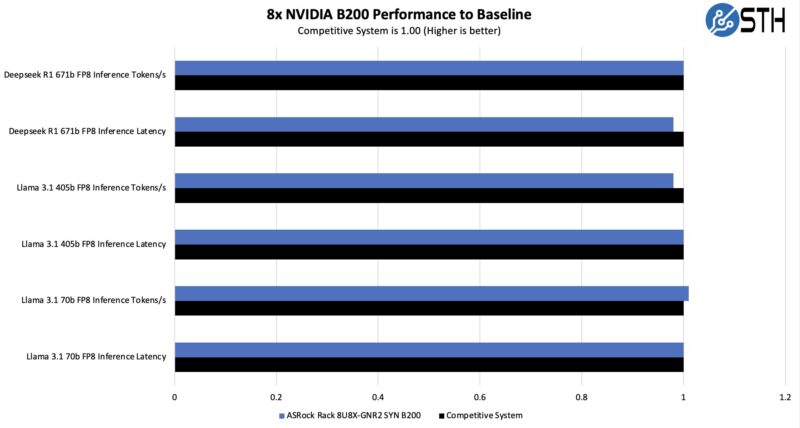
The NVIDIA Blackwell GPUs offer more memory and more performance. Something worth noting is that we also get Blackwell generation architecture improvements. With the larger chassis, and the new larger heatsinks, this system is doing a great job of cooling its 8000W of GPUs.
ASRock Rack 8U8X-GNR2 SYN B200 CPU Performance
We ran through our quick test script and compared the Xeon side to our reference 2U platform.
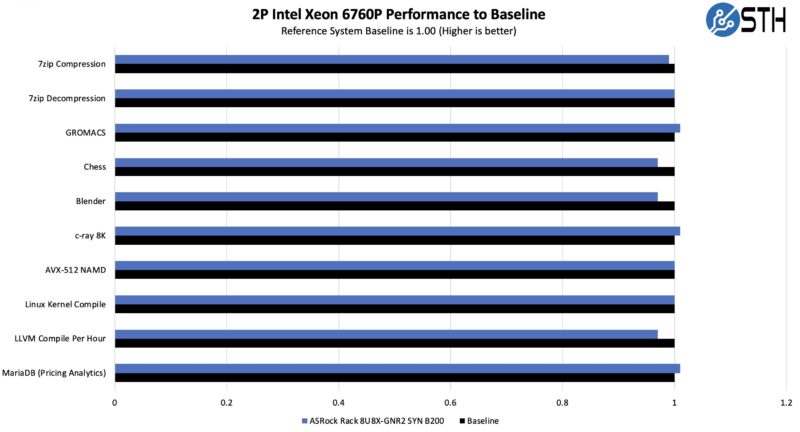
Small differences here are typical to see in server-to-server comparisons. “Back in the old days” in 2016-2019 it was more common to see swings in GPU servers of 10% or more. Now, we expect GPU servers to track standard CPU servers in terms of CPU performance. That is exactly what this system offered. The Intel Xeon 6760P was an interesting choice since these are the 64-core Xeon CPUs.
Next, let us talk power consumption.


The sytem from Pegatron looks exactly the same.
The delta over 5 years (Fall? 2020) in the cost, power usage, capability of the 8-way Nvidia servers is quite impressive (along with a $5T market cap.)
Toward the end of my IT career I installed two dual X86 (Xeon or Epyc?) eight A100 based Nvidia servers (vendor: Lambda). My circa 2019 racks supported < 10 KW iirc. The servers (one per rack) were perhaps 4U and cost just one Starbucks coffee < $100K each.
Change is happening quite fast. These things are practically outmoded 2 years are being installed (H100 hourly rental costs 2024 vs 2025)…