

AMD Robotics Software Suite
The final piece of the puzzle, then, is not hardware. Rather, it will be software. Something that has long been AMD’s Achilles heel, over the last few years, we have seen AMD work hard to close the gap with NVIDIA in the server space through ROCm and its many iterations and improvements. As part of its expanded push into the physical AI space, AMD is making a fresh effort to improve its robotics software stack as well.
Recognizing that their hardware needs a solid software stack to make for a complete (and competitive) product, AMD is kicking off development of a new dedicated robotics software stack they are calling the AMD Robotics Software Suite. Based on the ROCm ecosystem, AMD is developing dedicated SDKs for the platform, starting with a core robotics SDK and a broader physical AI SDK.
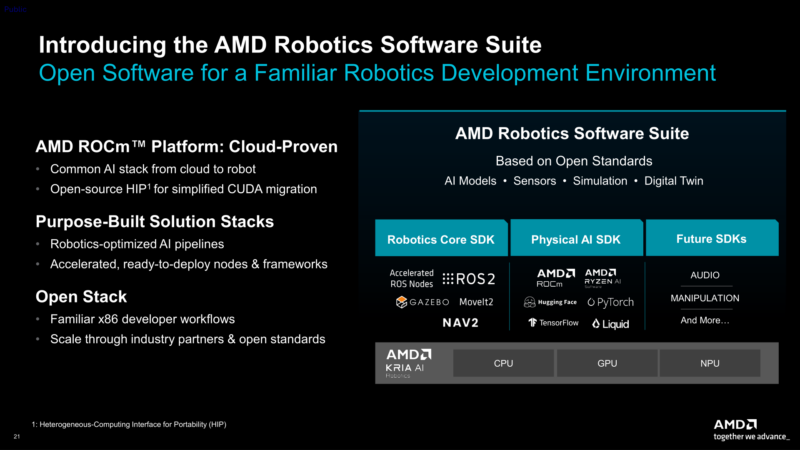
As with the rest of the ROCm ecosystem, AMD is taking an open-source approach here. Besides leveraging other open source projects and model databases, including ROS 2 (Robotics Operating System 2) and Hugging Face, AMD is also going to be developing and releasing its own code.
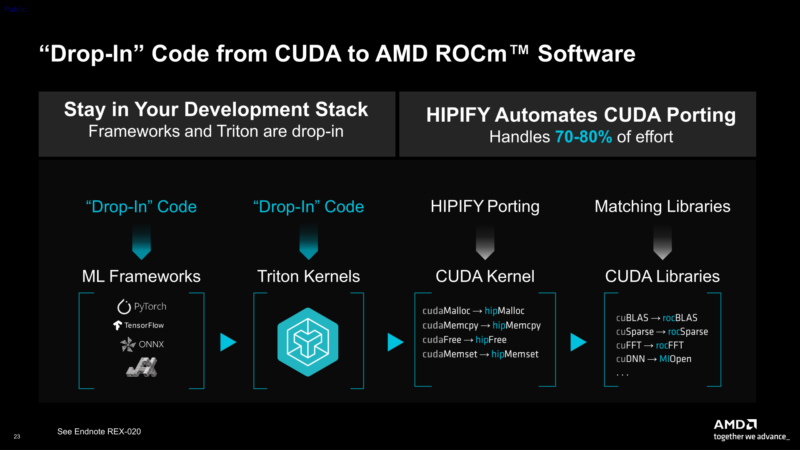
Keeping in mind AMD’s intention to peel away market share from NVIDIA, ROCm’s HIPify tools will also be a major part of their robotics software suite to help developers migrate their CUDA code to AMD’s ecosystem. AMD tells us that HIPify can cover 70-80% of CUDA porting efforts, significantly reducing the amount of work needed to port to AMD’s ecosystem, but not eliminating it entirely. As has been the case for most of the last decade, any reliance on HIP is a bit of a gamble on AMD’s part, precisely because it cannot do 100% of the porting work. But, as this is a bootstrapping process for AMD, they need to start somewhere.
“Bootstrap” is the keyword there, as the Robotics Software Suite is not going to be a one-and-done project for AMD, but instead, this is the start of a multi-year effort. AMD has already been working on the suite for around 9 months, and is continuing to ramp up the amount of development resources they are allocating to the project. To that end, in the mid-term, the company is looking not only to expand its robotics and physical AI SDKs but also to develop additional SDKs for audio, manipulation, and other tasks.
AMD Physical AI: Past, Present, and Future
As outlined towards the start of this article, AMD’s push into physical AI is designed to be a broad and sustained effort. While the focus of their announcements at Advancing AI is on current-generation products, including those launching later this year, the company’s vision for physical AI hardware is long-term. This is not the first Kria kit that we covered at STH. We had the Xilinx Kria KV260 FPGA-based Video AI Development Kit running a few years ago, when it was an FPGA with low-power Arm cores. Still, the models and use cases have shifted an enormous amount over the past five years, so the hardware needs to as well.
One of the biggest impacts of AMD’s greater investment in the field is that it gives the embedded hardware division more resources to develop future generations of hardware. While the current Ryzen AI Embedded product stack is using industrial-grade versions of AMD’s existing Zen 5 mobile chips, that may not always be the case. While AMD is not ready to talk about future products in detail, the embedded team is mindful of the options opened up by the use of chiplets and the ability they bring to mix and match chiplets to meet their needs. The undercurrent of that conversation was that, while we should not expect AMD to design any chiplets specifically for the embedded market in the near future, the embedded team now has the resources and remit to commission its own chip configurations.
Accordingly, the launch of the Ryzen AI Embedded P100/X100 series marks the start of a yearly cadence for AMD’s embedded x86 SoC offerings. Going forward, the company wants to release updated chips every year, effectively aligning its embedded hardware with its consumer hardware’s release cadence. All of which will be a major change from AMD’s previous release cadence, which was closer to 2 years (and following AMD’s actual silicon development cadence).
Meanwhile, the software side of AMD’s physical AI operations is just getting started. AMD’s need for additional SDKs to flesh out their ecosystem means that the Robotics Software Suite development team is facing a long road ahead of them, but by working at it piece by piece, AMD believes they will be able to follow a similar roadmap as the ROCm ecosystem itself and build out a comprehensive software stack for the physical AI market.
Final Words
Wrapping things up, AMD is no stranger to the physical AI market as its FPGAs have been shipping for robotics for many years. It is fair to say that the company’s aspirations for the market are on a whole other level. Thanks to advances in the AI field, AMD is gearing up to make physical AI a modest part of its product offerings, ideally evolving into a major pillar of the company.
Getting there is going to take significant work from the company on both the hardware and software development sides. While AMD is eager to peel away market share from NVIDIA and capture a larger slice of what is expected to be a growing market, it will not be able to do so overnight.
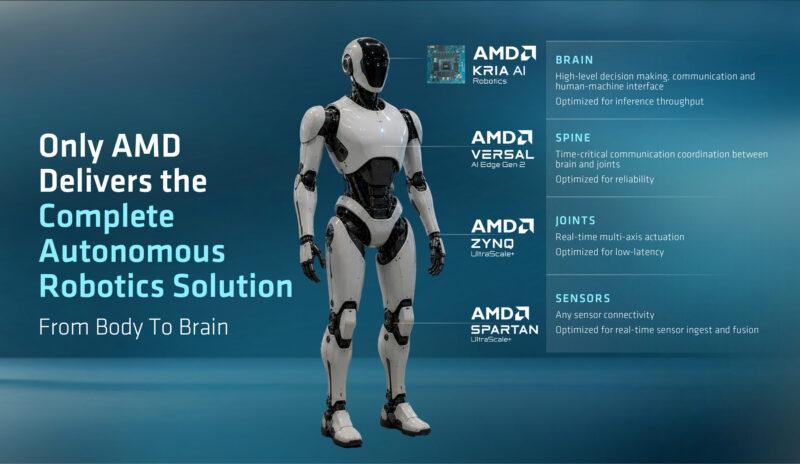
At the same time, however, AMD believes it has a leg up in the market through the sheer comprehensiveness of its current hardware portfolio, not to mention how much wider it will be in the future. With AMD already having significant exposure in the robotics market through its FPGAs, it can pitch itself as offering a “complete body-to-brain solution,” leveraging its full portfolio of FPGAs and SoCs to supply all the major compute chips needed for the robotics market. It is certainly a unique offering at this time, though how much AMD will be able to parlay its current FPGA-based market share and experience into the even more lucrative physical AI market remains to be seen.
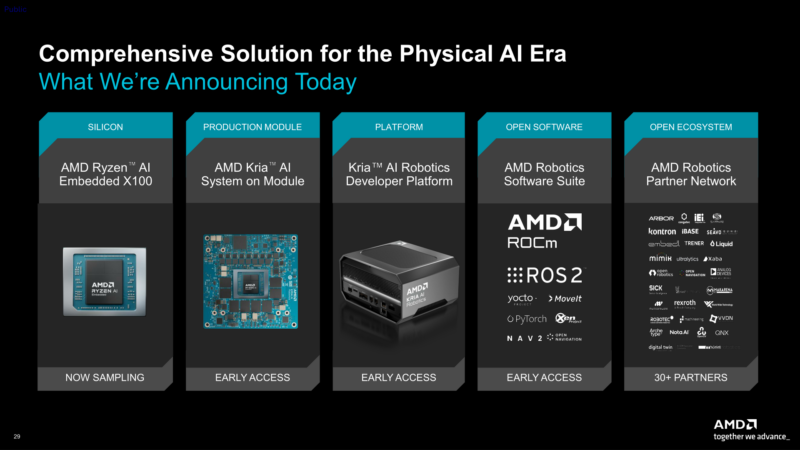
In the meantime, the company is gearing up to launch the rest of its 2026 physical AI products. The Ryzen AI Embedded X100 chips are sampling to customers now, with availability scheduled for Q4 of this year. Meanwhile, the Kria AI SOM and Kria AI Robotics Developer Platform box are on a similar schedule, with early access for customers available now, ahead of general availability in Q4.

Hardware-wise AMD seems very well placed for physical AI/robotics thanks to the FPGAs. I would give them that.
Software-wise though, I guess ok the inference side they are fine, but on the training/simulation side, do they have all the pieces as well? What’s the equivalent of Nvidia Isaac Sim for example?
It seems like Gazebo is maybe not as good in terms of graphics? Are they going to contribute to Gazebo and fix the gap?
Also for
“Reality is likely to be a bit less kind to AMD here (the lack of tensor cores in RDNA 3.5 puts a hard cap on compute throughput)”
RDNA 3.5 has WMMA instructions for fp32, fp16 and bf16 which are the “tensor core instructions”. MI455x has literally the same instructions (but also supporting fp8, mxfp4). So I would say RDNA 3.5 has “tensor cores”.