

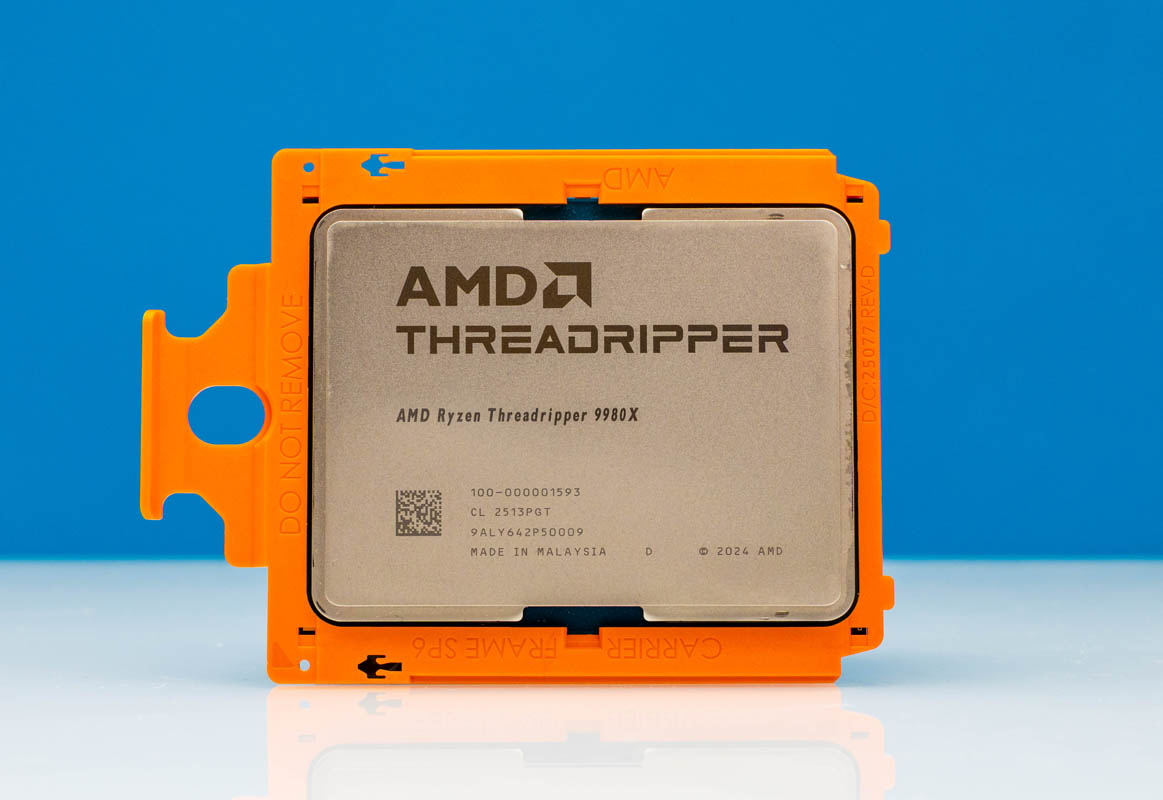
The AMD Ryzen Threadripper is the awesome new 64-core and 128-thread workstation processor from AMD. It is also something that does not have a direct competitor right now on the Intel Xeon side. Or better said, the previous generation really did not have a direct competitor on the Xeon side, but now there is an update for AMD.
AMD Ryzen Threadripper 9000 Series
The key to the AMD Ryzen Threadripper 9000 series encompasses two lines. First is the HEDT-focused AMD Ryzen Threadripper 9000 series that we are looking at today. The second is the AMD Ryzen Threadripper Pro 9000 WX series for higher-end workstations. The Pro version gets the higher-end WRX90 8-channel DDR5 platform while the HEDT TRX50 platform is only 4-channel memory. The reason we have the TRX50 is that adding memory channels and PCIe lanes adds cost to motherboards, so the TRX50 is the lower-cost platform to configure.
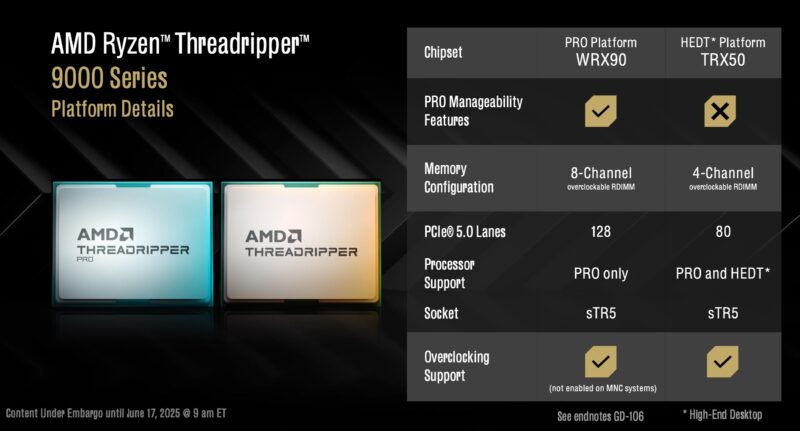
We will let you read the Threadripper 9000 series platform summary. Since we are focused on the HEDT part, we only get that 4-channel memory, but in this generation it is DDR5-6400 base, but we have systems with DDR5-7200 and DDR5-8000 working.
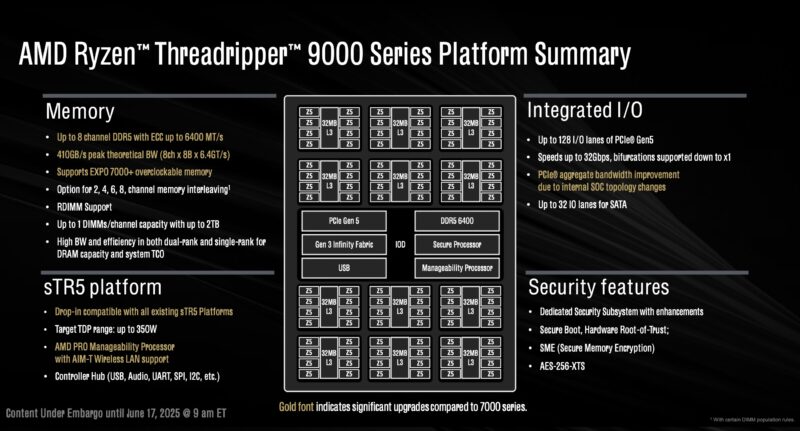
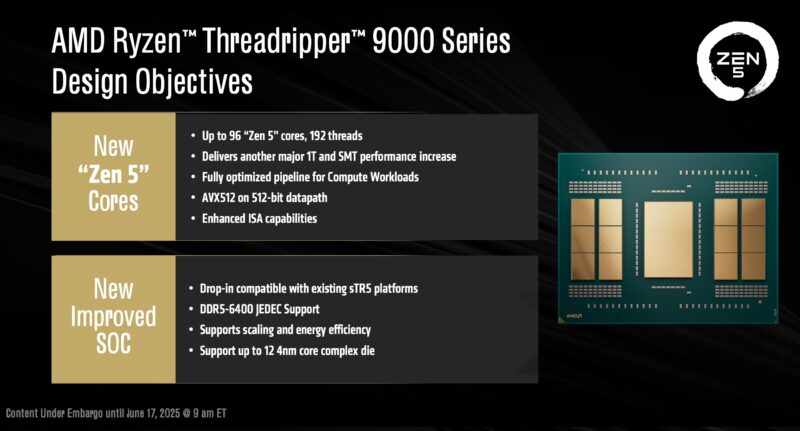
If you are familiar with the Threadripper 7000 series HEDT part, this is the Zen 5 version with faster memory and a few tweaks. That is not bad since we get the faster AVX-512 implementation in Zen 5 and other improvements.
Next, let us get to the SKUs and pricing.
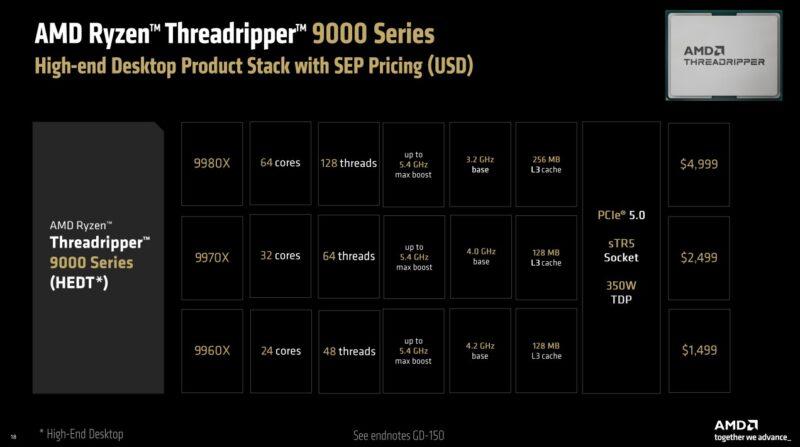
AMD Ryzen Threadripper 9000 Series SKUs, Pricing, and Chips
There are three new HEDT parts. I asked in June about which SKUs drive the most volume, and AMD said the lower-cost and core/ count parts, so do not discount that 24-core Threadripper 9960X. We have both the Threadripper 9980X and Threadripper 9970X but are focusing this piece on the Threadripper 9980X.
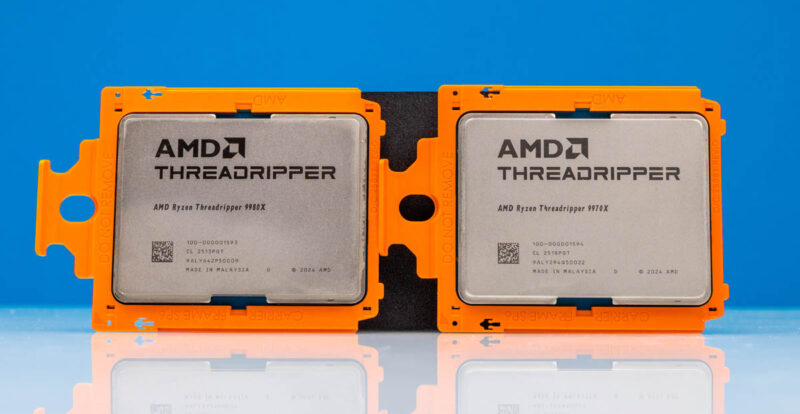
I will simply say that I think there are folks who might want to buy the 32-core part and instead purchase two Radeon AI Pro R9700 GPUs for use in the system with the price differential. That is the reality these days, especially when part of the platform’s benefit is its connectivity.
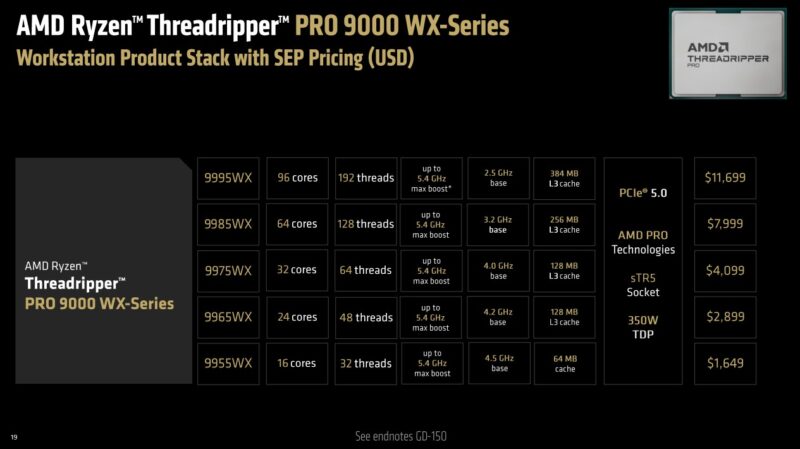
The pricing is certainly on the higher side with the Threadripper Pro 9000 WX series. At some point, you wonder if these chips have list prices that are designed for heavy discounting.
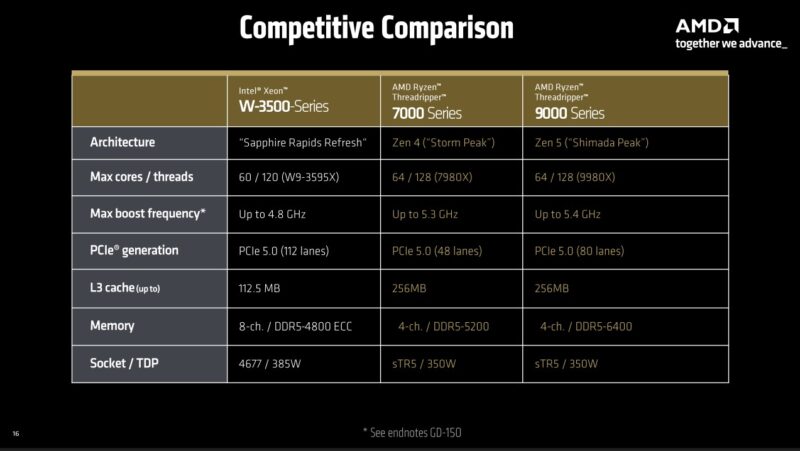
The competitive landscape is somewhat strange. The Intel Xeon W-3595X is probably the closest competitive part. That is still using the Sapphire Rapids generation of Xeon to hit up to 60 cores, albeit with 8-channel memory and more PCIe lanes. The MSRP is a bit higher than the Threadripper 9980X at $5889. At the same time, these Sapphire Rapids Xeons use the older core IP, and have a single DSA enabled, so the other accelerators are not available. Intel could not move to the Emerald Rapids generation due to challenges with the PCIe configuration to get 112 lanes, so Intel is stuck with the higher idling three-generation-old parts in the market.
Next, let us get to the performance.

Still better… Yeah, if you’ve got the money for it. I suspect almost nobody will have this kind of money, so these probably won’t sell very many units. Just my hunch, though.
AMD’s Zen 5 desktop parts were initially released with MSRPs that led to swift price cuts and bundle deals to prop up weaker than expected sales. AMD’s RDNA 4 consumer GPUs were initially released with MSRPs that led to swift price ‘rebates’ and weaker than expected sales (AMD actually lost market share to nvidia in the consumer GPU space).
AMD’s Epyc and Instinct parts can be priced at levels where hobbyists don’t purchase them new, because they are obviously intended for enterprise use where budgets are much larger.
So which category is AMD trying to put the Threadripper line-up in? I think it would be reasonable for the high core count Threadrippers to be in the ‘can be priced such that they are targeted at enterprise budgets’ category and the low core count Threadrippers to be in the ‘should be priced such that they are targeted at hobbyist budgets’ category. But unfortunately, it seems that even the low core count Threadrippers are way too expensive.
For many tasks memory bandwidth is the bottleneck. Apple targeted three marketing niches with their M4, M4 Pro and M4 Max processors, each having roughly double the bandwidth of the previous. The Ryzen, Ryzen Threadripper and Ryzen Threadripper Pro WX follow the same memory-bandwidth-doubling pattern for x86 desktops.
While number of PCIe lanes and core counts also vary, it would be interesting to see a head-to-head comparison between the Apple and AMD lineups focusing on memory bandwidth and how that affects different types of computing applications.
I want this for my workstation so badly. With the sheer amount of computation I and need processing power this will help push me over the edge to get one at least before the year is out. I’ll drop down to the lower 9970x pro as i need to still buy RAM for this beast.
This will last me for the next 3 years to make my accountant happy :D
This Threadripper 9980X and 9970X article seems very price/performance focused, which is excellent, but a couple of paragraphs mentioning the (for example) EPYC 4585PX, would be better.
That processor is only $700 (with half the performance and a third the cost, with half the power consumption). A savings great enough to pay for the whole system, along with the three R9700s.