

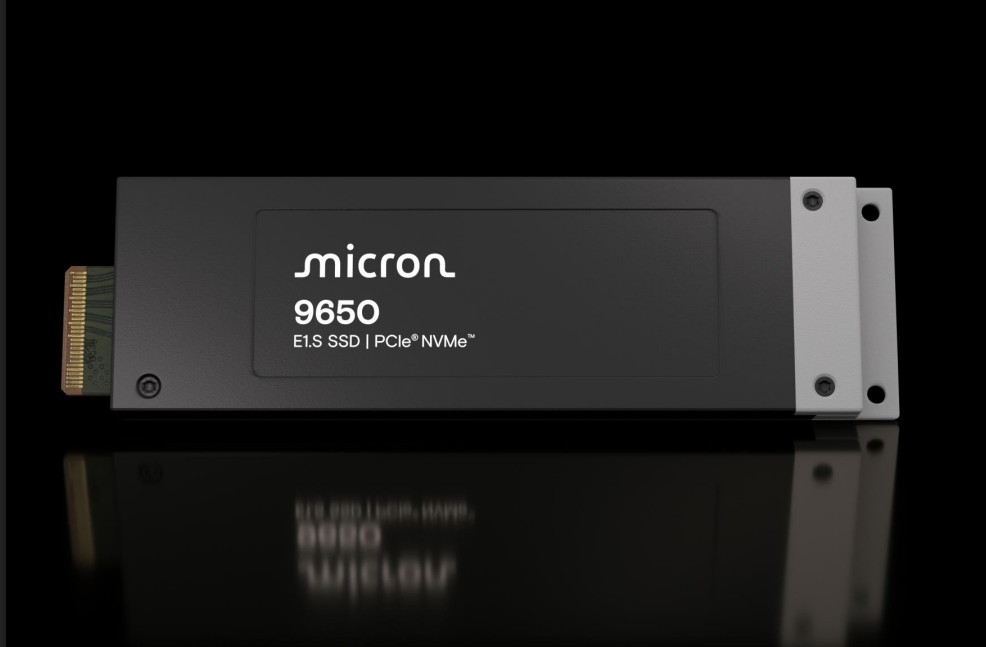
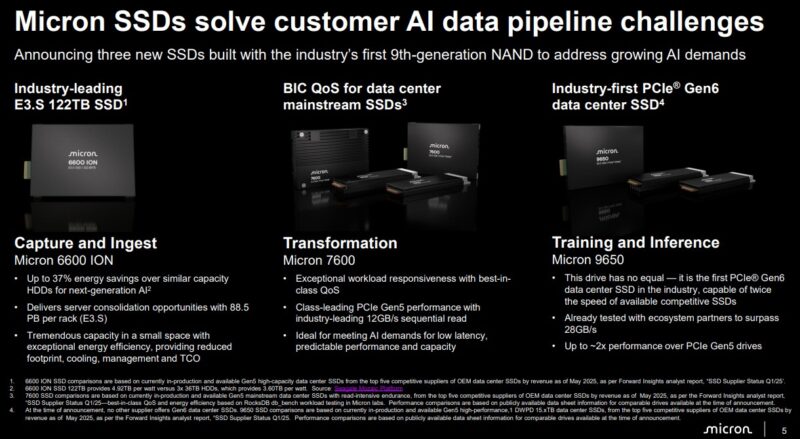
Micron announced a trio of SSDs as we get into the announcement season ahead of FMS 2025. One is a new PCIe Gen6 SSD, the Micron 9650 designed for AI servers. There is then the Micron 6600 ION scaling up to 122TB. Finally, there is the more mainstream Micron 7600 PCIe Gen5 SSD.
Micron 9650 PCIe Gen6 SSD
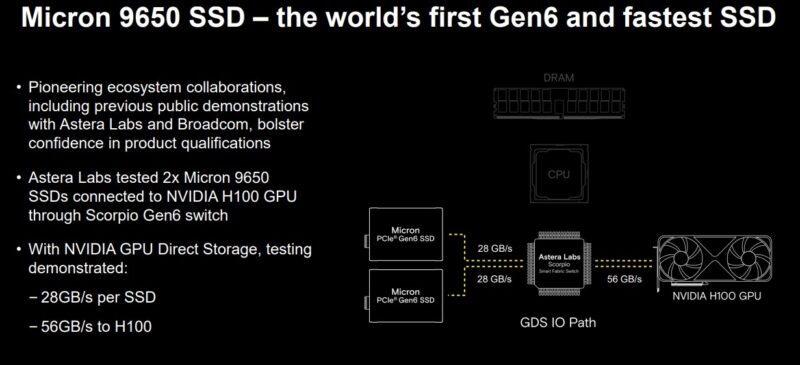
Starting with the big one, the Micron 9650 is a PCIe Gen6 NVMe SSD. There are both Pro and Max variants. Capacities scale to 30.72TB.
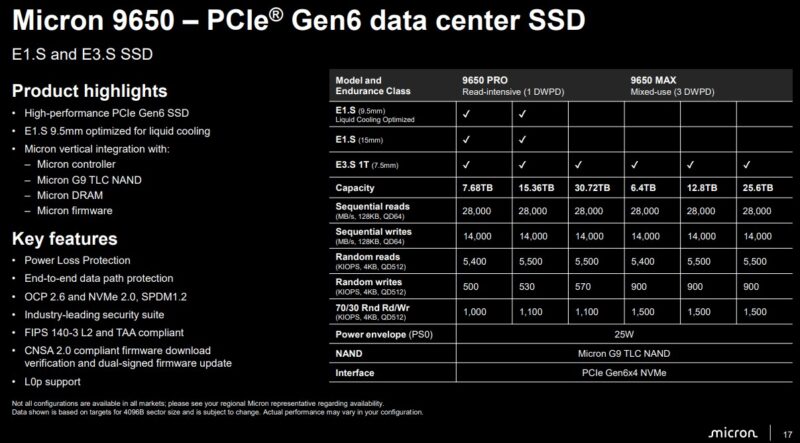
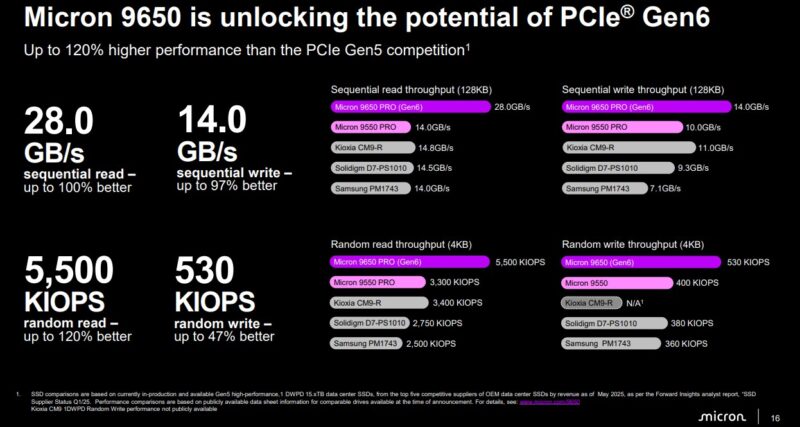
Just to give some sense of scale, the new SSDs are capable of 28GB/s of sequential read and 5.5M random read IOPS, putting them well beyond PCIe Gen5 SSDs in terms of speed.
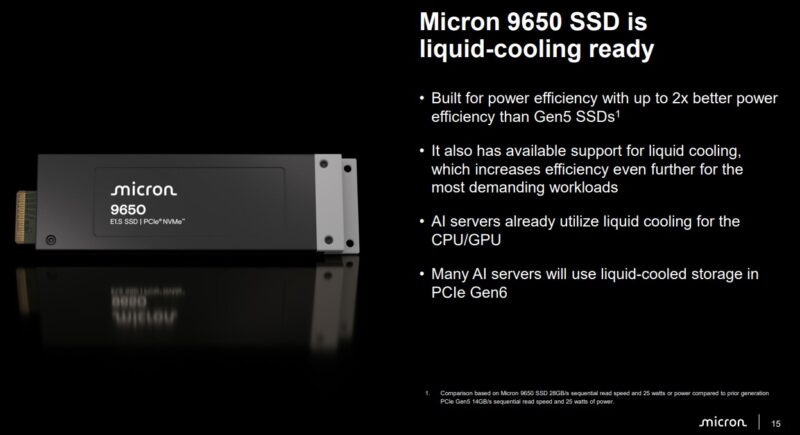
The drives are also being noted as being liquid-cooling ready. For next-gen AI systems, the SSDs are liquid-cooled to help remove fans from the AI servers. We showed this Liquid-Coolable NVMe SSD Design demo previously, but that spring-loaded coldplate requires SSDs to deliver heat towards the coldplate side. Micron has done this work. With the upcoming Blackwell B300 generation being PCIe Gen6, this is a big deal in the industry.
Micron also tested this with an Astera Labs Scorpio PCIe Switch.
Something big here is that there is no longer U.2. U.3 was relatively short-lived for the tri-mode controllers, but from what we understand, U.2 signaling is too much of a challenge, so we expect PCIe Gen6 SSDs to take over in 2026 generation servers and beyond.
We have been saying EDSFF is coming for U.2 and M.2, and PCIe Gen6 will be the catalyst.
Micron 6600 ION 122TB SSD
The Micron 6600 ION is designed for PCIe Gen5 servers. With 30.72TB to 122.88TB of capacity, these drives are designed to offer a capacity tier for AI data centers.
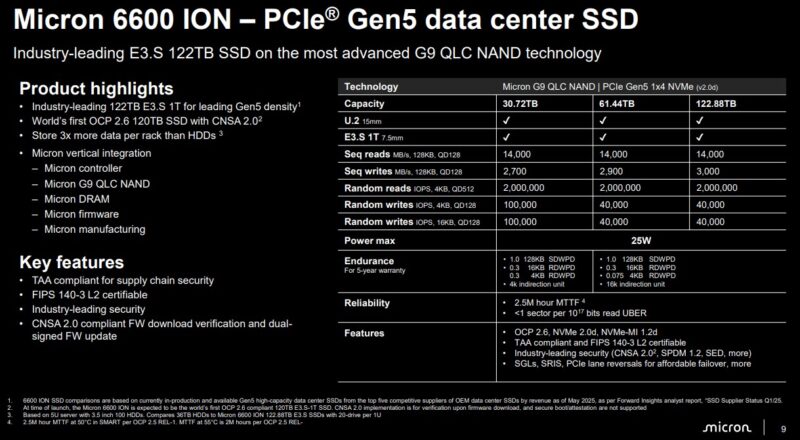
Micron says that the E1.S 122.88TB drive is denser than the U.2 at 122.88TB drives, and much denser than hard drives. This is designed as a PCIe Gen5 drive and to be significantly faster than the Solidigm D5-P5336 122.88TB NVMe SSD we reviewed.
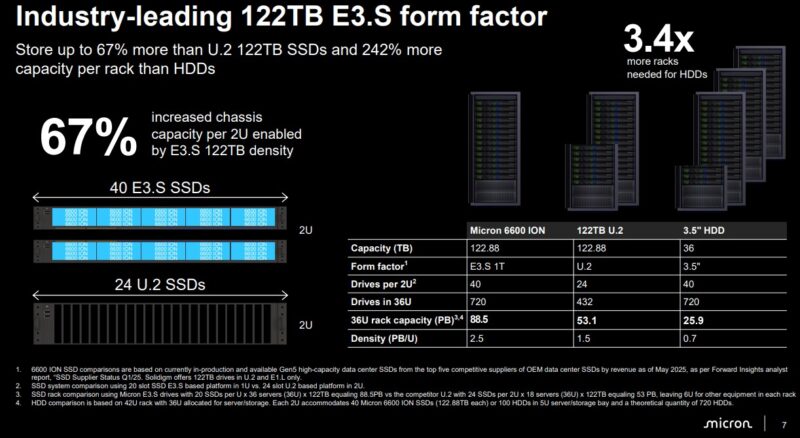
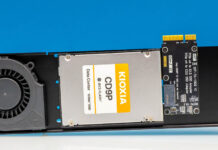
We have seen the recently announced Kioxia LC9 SSD hit 245.76TB of capacity in a single U.2 drive. So that would be denser than the 6600 ION, but Micron thinks it has a performance advantage.
Micron 7600 SSD
For the mainstream PCIe Gen5 NVMe SSD market, the Micron 7600 has both Pro and Max variants. Pro drives in Micron’s naming mean 1 DWPD while Max means 3 DWPD these days. Usually, the 3 DWPD gives higher write endurance and also performance at the expense of capacity.
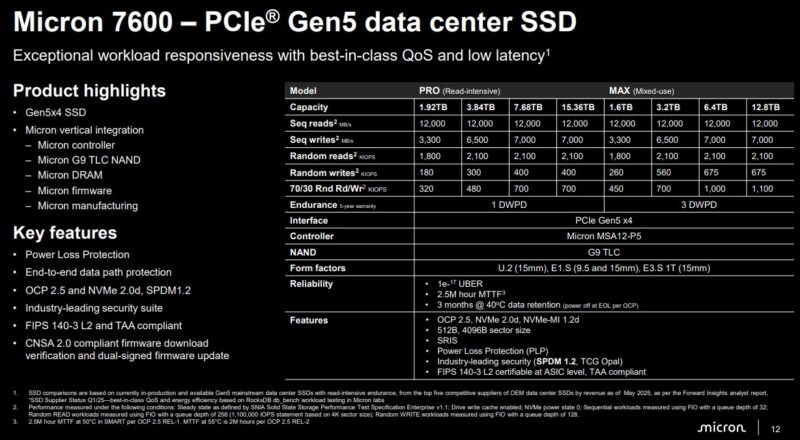
As a new generation of PCIe Gen5 NVMe SSD, Micron, as we would expect, says that its new drive is faster than its competitors’ older drives. What is not there is also the capacity side. We recently tested Kioxia CD8P-R 30.72TB PCIe Gen5 NVMe SSD, and that is twice as dense as the lower DWPD Micron 7600 Pro. Still, the largest capacities in this class of drive tend to be lower volume. In the Micron ION segment, it is the opposite, as the highest density drive tends to win.
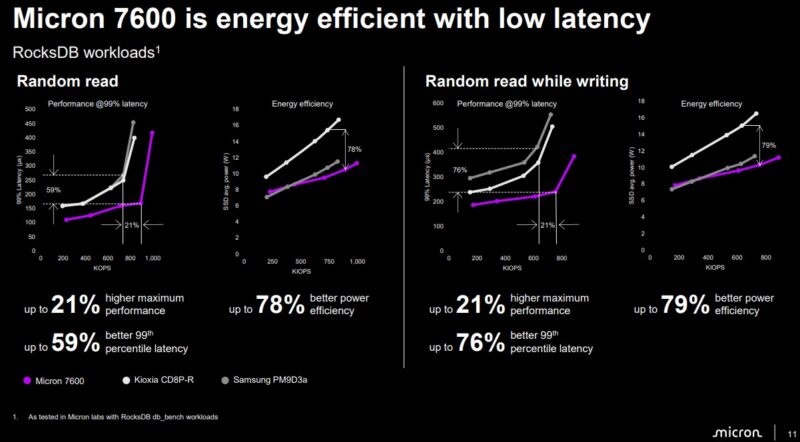
Something that is interesting is that Micron is targeting smaller capacities. These drives go down to 1.92TB and 1.6TB. Many vendors are starting to drop sub-3.2TB capacity drives as the underlying NAND density has increased.
Final Words
This was a lot. Micron has high-performance drives in the Micron 9650 PCIe Gen6 SSD. It has capacity covered with the Micron 6600 ION (although we hope a follow-up 245TB drive is coming as mentioned in the press release.) Then there in a mainstream SSD option in the Micron 7600.
Three announcements all at once, it must be FMS season!

I have a quick question, if I may. We just saw Kioxia’s 245.76 TB SSDs and now this one. Why are consumer M.2 NVMe SSDs (and SATA ones too) still stuck at 4 TB? Shouldn’t we be at 32 TB at the very least? Seems like server SSDs are evolving by leaps and bounds but regular “average Joe user” SSDs are firmly stopped at 4 TB. Did the SSD manufacturers just decide we the People aren’t worthy of drives any bigger?
@Stephen. There are consumer 8TB SSDs, both m.2 NVMe as well as 2.5” S-ATA. Isn’t the lack of larger capacity ones just because consumers are simply not willing to pay for large SSDs? The price scales fairly linearly with storage capacity.
Or maybe it also matters that the SSD vendors earn a lot more by selling the flash chips as enterprise solutions?
@Additional Pylons. I have seen 8 TB NVMe SSDs, but so far only from Sabrent (admittedly, I haven’t really done any looking for 8 TB drives intentionally). I can agree with consumers not wanting to pay for large SSDs (shit’s too expensive, one of my other more main complaints with tech in general), but I mean come on. How expensive is it really to make the flash chips? They are made on the same manufacturing machines as every other IC in existence. Surely, NAND flash cells don’t require anything like the level of complexity that CPU and ASIC logic requires. Okay, maybe they’re a bit more involved than the dirt simple 1T1C cells of DRAM chips, but I can’t imagine them being very much more than that. It just sucks to me that CPUs are so much less expensive and the average user can technically afford them but SSDs are “No can do”. We get actual generational improvements, however small, in CPUs (maybe not so much in graphics processing, no thank you Nvidia AND AMD!), but it seems like that never really translates to storage any more. It used to, though, and I remember sub-1 GB hard drives. I don’t know, maybe I’m complaining needlessly. It just seems like consumer drives aren’t keeping up with the rest of technology whereas the way overpriced enterprise stuff is advancing along just fine.
It was over 5 years now that I had worked on and brought to market the first 8TB M.2 SSD using QLC NAND at the time at Sabrent. This was a successful launch and we sold many of these drives, often used in 8x M.2 RAID cards for workstations. The Rocket 4 Plus 8TB version had an even higher success rate and still growing. The shift from the QLC version happened as the QLC NAND dried up. At the time these drives were in the $2K range per drive, yet they sold out as fast as we could get them in. Price was high mainly to recover development costs. Then the R4P 8TB dropped to $1K range and even more were sold. At first these were workstation class drives with some highend client based machine, even laptops and gamers. Then PS5 users started installing these drives. 16TB M.2 drives are in the works now. Its not so much the cost factor, its heat and power draw that limits uses. I suspect 32TB M.2 drives will follow depending on adoption rates.
Comments are closed.