
As we roll into the fourth quarter of 2026, NVIDIA and its partners are in the middle of the Vera Rubin ramp-up, including hyperscalers making some of the first NVL72 systems generally available to their customers. With Vera Rubin reaching the tipping point of its production roll-out, NVIDIA is also finally locking down the hardware shipping specifications. As it turns out, the company has quietly revised those specifications, with the Rubin GPU now offering less memory and scale-up networking (NVLink) bandwidth than NVIDIA previously promoted, but more scale-out bandwidth.
As initially spotted by IT Home, back in September NVIDIA posted the updated specifications for its Rubin GPU and various Rubin-based products on their webpages and in NVIDIA’s architecture datasheet. To be sure, it is not unusual for server hardware specifications to change before a product’s launch, especially for something like Vera Rubin, which was announced nearly a year in advance. NVIDIA’s case is no different, with the company previously noting that those specifications were preliminary and that “all values are up to and subject to change” at the time.
Rubin GPU: Less HBM4 Bandwidth, Less NVLink Bandwidth, More Scale-Out Bandwidth
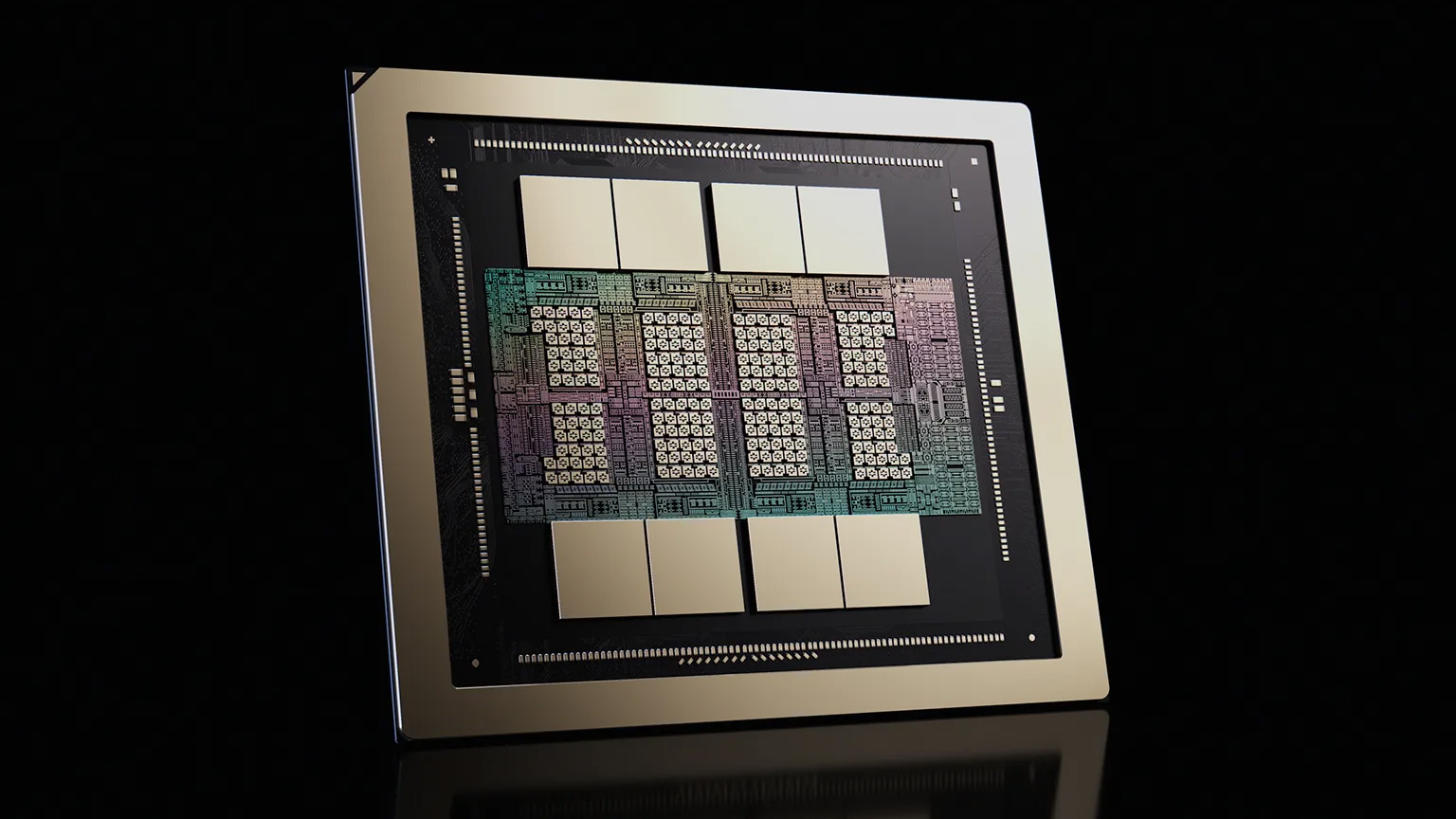
First, let us talk about NVIDIA’s Rubin GPU. The cornerstone of NVIDIA’s ambitions for this generation, NVIDIA’s Rubin server GPU will find its way into systems big and small and serve as the building block for much larger projects.
| NVIDIA Rubin GPU Specifications | ||||
| Preliminary | Shipping | |||
| NVFP4 Inference | 50 PFLOPS | 50 PFLOPS | ||
| NVFP4 Training | 35 PFLOPS | 35 PFLOPS | ||
| INT8 | 250 TOPS | 250 TOPS | ||
| TF32 | 2 PFLOPS | 2 PFLOPS | ||
| GPU Memory | 288GB HBM4 (8x36GB) |
288GB HBM4 (8x36GB) |
||
| GPU Memory Bandwidth | 22TB/sec (8×2048@10.75Gbps) |
19.2TB/sec (8×2048@9.375Gbps) |
||
| NVLink Bandwidth (Scale Up) |
3.6TB/sec | 3.0TB/sec | ||
| Networking Bandwidth (Scale Out) |
0.4TB/sec | 0.45TB/sec | ||
| Architecture | Rubin | Rubin | ||
Compared to NVIDIA’s preliminary specifications, the HBM4 memory bandwidth for a single Rubin GPU has been revised down notably. NVIDIA was initially targeting 22TB/second of memory bandwidth per Rubin GPU. At 8 stacks of HBM4 memory, that meant running each stack at about 10.75Gbps/pin. But with these revised shipping specifications, a single Rubin GPU will now provide 19.2TB/second of bandwidth, for a data rate of about 9.375Gbps/pin, a net loss of 1.375Gbps, or roughly 11%.
This spec change comes as NVIDIA has been projecting some very aggressive data rates for HBM4. The super-sized version of the high-bandwidth memory specification already doubled the memory bus width per stack from 1024 bits to 2048 bits. At the same time, the official specification called for HBM4 stacks to run at a slightly lower clock rate than HBM3E, targeting 8Gbps/pin. NVIDIA’s 10.75Gbps rate was significantly higher than the original HBM4 specification, and even their newly reduced 9.375Gbps data rate is still quite a bit above.
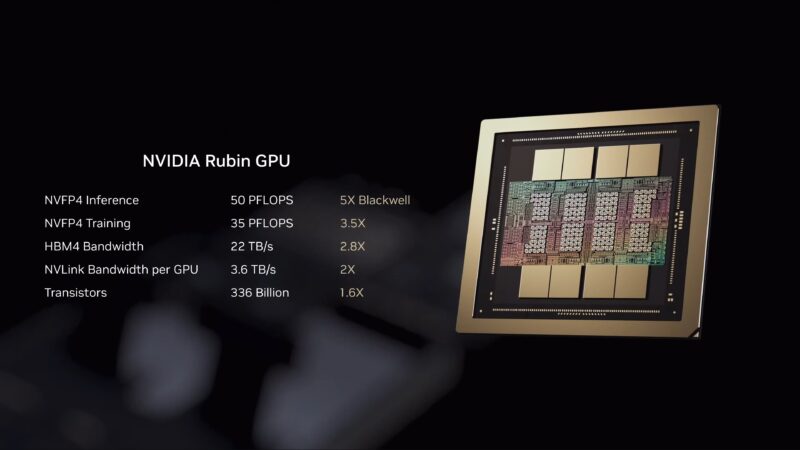
For context, NVIDIA’s rival AMD will run its HBM4 stacks on the MI455X at only 7.6Gbps/pin. So NVIDIA’s revised targets are significantly higher than those of some other HBM4 consumers. Even after the news broke, NVIDIA has not said why it revised the memory bandwidth specs down. In lieu of that, the immediate assumption is that NVIDIA and its memory partners cannot deliver on those specs, be it memory controller speeds, memory stack speeds, memory stack yields (how many can run at the desired speed), or perhaps a combination of all of those factors. Regardless of the reason, the net result is that customers will have less GPU memory bandwidth at their disposal, with performance ramifications.
NVLink interconnect bandwidth is also taking a hit compared to NVIDIA’s original expectations. The preliminary specification for NVIDIA’s multi-GPU connection and scale-up fabric was for 3.6TB/second of NVLink bandwidth for each Rubin GPU. That is now a flat 3.0TB/second, a 600GB/second (or 17%) reduction. NVLink is an area where NVIDIA pushes hard to make many physical GPUs act as one, so it usually pushes the limits of what is possible.
While NVLink (scale-up) bandwidth has been reduced, scale-out networking bandwidth is now overperforming. For a single Rubin GPU, NVIDIA is offering 450GB/second of networking bandwidth, up from their preliminary specification of 400GB/second.
Beyond these changes, NVIDIA has not changed any other specifications for Rubin GPUs. The theoretical (on paper) compute throughput remains unchanged at 50 PFLOPS of FP4 inference and 35 PFLOPS of FP4 training. So NVIDIA has hit its clock speed and memory-capacity targets for the GPU.
NVIDIA Vera Rubin NVL72: Rackscale Revised Accordingly
Rubin’s spec changes will also affect all the products it will go into, most notably NVIDIA’s flagship Vera Rubin NVL72 rack. NVL72 showcases all of NVIDIA’s technologies, integrating its Vera CPUs, BlueField-4 DPUs, and, of course, Rubin GPUs.
| NVIDIA Vera Rubin NVL72 Specifications | ||||
| Preliminary | Shipping | |||
| NVFP4 Inference | 3600 PFLOPS | 50 PFLOPS | ||
| NVFP4 Training | 2520 PFLOPS | 35 PFLOPS | ||
| INT8 | 18 POPS | 250 TOPS | ||
| TF32 | 144 PFLOPS | 2 PFLOPS | ||
| GPU Memory | 20.7TB HBM4 | 20.7TB HBM4 | ||
| GPU Memory Bandwidth | 1580TB/sec | 1400TB/sec | ||
| NVLink Bandwidth (Scale Up) |
260TB/sec | 216TB/sec | ||
| Networking Bandwidth (Scale Out) |
28.8TB/sec | 32.4TB/sec | ||
For NVL72, its specifications have been revised in lockstep with the changes to a single Rubin GPU. That means that cumulative GPU memory bandwidth has gone from 1,580TB/second to 1400TB/second for the rack-scale system, a net loss of 180 TB (11%). Though, as with a single Rubin, the GPU memory capacity for NVL72 remains unchanged at 20.7TB of HBM4.
NVLink bandwidth across the system for its scale-up domain has also been adjusted. NVIDIA’s plans to offer 260TB/second of bandwidth across the rack have been revised down to 216TB/second, a 17% reduction matching the new 3TB/second rate of each Rubin GPU.

The silver lining for NVL72 is that it gets the same scale-out networking bandwidth boost as the individual Rubin chips. So whereas NVL72 was originally slated to offer 28.8TB/second of networking bandwidth, that has been dialed up to 32.4TB/second (bidirectional). This means that for larger deployments that make heavy use of scale-out networking, more bandwidth (and ideally, more performance) is now available than NVIDIA first projected.
Past this, the rest of the figures for Vera Rubin NVL72 remain unchanged from the earlier specifications. Whether an NVL72 rack can hit quite the same level of AI performance with less memory and NVLink bandwidth as originally intended seems doubtful, but the GPU compute hardware (and its CPU counterpart) is shipping at spec.
NVIDIA Rubin HGX NVL8: Losing Some HBM4 Capacity as Well
Finally, separate from the specification changes to the base Rubin GPU and the NVL72 rack, NVIDIA has also revised its other products built from Rubin. This includes the Vera Rubin Superchip, the Vera Rubin NVL4, and the HGX Rubin NVL8 products. The last one is getting a special mention here because, on top of the Rubin spec changes, it is getting a further change of its own.
| NVIDIA HGX Rubin NVL8 Specifications | ||||
| Preliminary | Shipping | |||
| NVFP4 Inference | 400 PFLOPS | 400 PFLOPS | ||
| NVFP4 Training | 280 PFLOPS | 270 PFLOPS | ||
| FP8 Training | 140 PFLOPS | 130 PFLOPS | ||
| TF32 | 16 PFLOPS | 16 PFLOPS | ||
| GPU Memory | 2.3TB HBM4 | 2.0TB HBM4 | ||
| GPU Memory Bandwidth | 176TB/sec | 130TB/sec | ||
| NVLink Bandwidth (Scale Up) |
28.8TB/sec | 24TB/sec | ||
| Networking Bandwidth (Scale Out) |
1.6TB/sec | 1.8TB/sec | ||
On top of GPU memory bandwidth and NVLink bandwidth reductions, NVIDIA is also cutting back the amount of HBM4 memory available in NVL8 systems. These systems were originally set to come with 2.3TB of HBM4, but that is now down to a flat 2.0TB, losing 300GB (or 13%) of GPU memory.
NVIDIA’s preliminary figure would require each Rubin GPU in an NVL8 to be a full Rubin with its complete complement of 288GB of HBM4 available. However, a 2.0TB setup means each GPU needs only around 250GB of HBM4 available. That, in turn, requires only 7 of the GPU’s 8 HBM4 memory stacks.
Consequently, NVL8 is taking the biggest memory bandwidth hit of the entire Rubin family. Rather than losing just 11% of its memory bandwidth, it is losing 26%, or about 46TB/second. Each Rubin GPU would only have 250GB to 252GB of memory available, for 16.8TB/second of bandwidth per GPU.
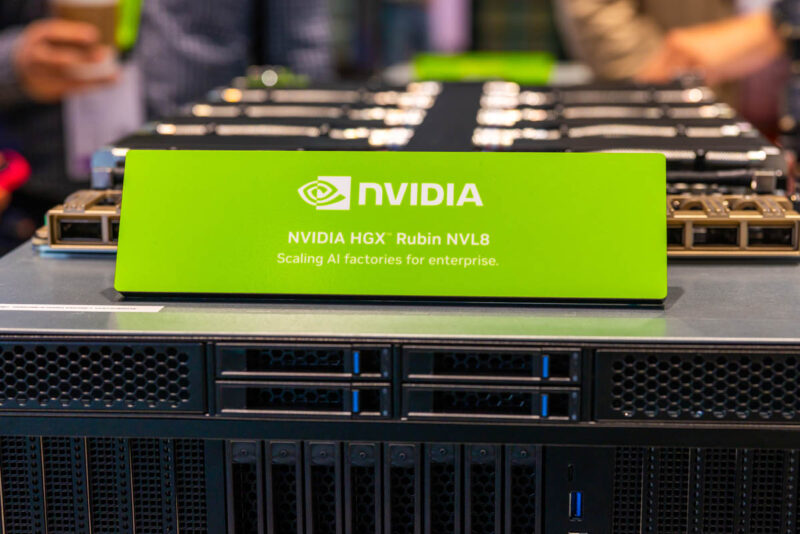
Inference performance remains unchanged, at 400 PFLOPS for FP4, but FP4 training performance has been reduced from 280 PFLOPS to 270, and FP8 training has similarly been dialed down from 140 PFLOPS to 130. The 8-way Rubin systems do get the same network bandwidth improvement as the rest of the Rubin lineup. That figure has gone from 1.6TB/second to 1.8TB/second.
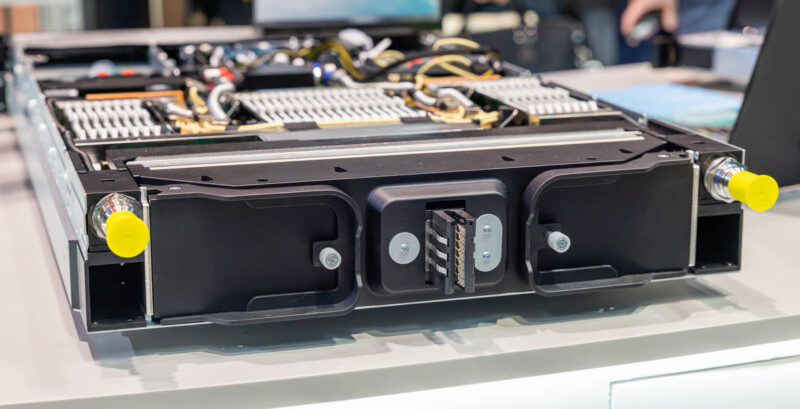
Finally, these changes affect both versions of the HGX NVL8, as well as DGX systems based on the NVL8 platform. Both the HGX Rubin NVL8 (Rubin + x86 CPU) and the HGX Vera Rubin NVL8 (Rubin + Vera) are subject to the same GPU changes.
Final Words
It seems NVIDIA has had to rein in its ambitions for the Rubin GPU to bring the product to market at the scale they are aiming for, dialing back both GPU HBM4 memory bandwidth and NVLink networking bandwidth. The full ramifications of these changes are unclear at this time since not all workloads are bottlenecked by memory or networking bandwidth in the same way. In some respects, it is academic, since these changes apply to all shipping Rubin hardware from day one. Still, there will be a lot of NVIDIA Rubin deployed over the next few quarters.