

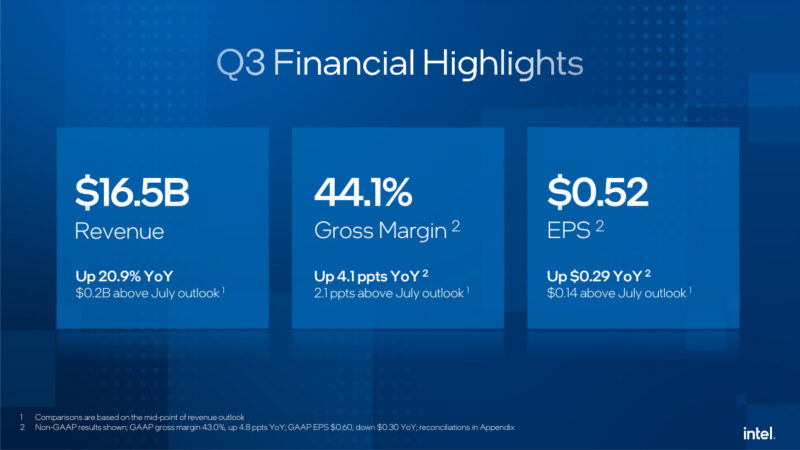
Intel reported third-quarter 2026 earnings with revenue of $16.5 billion, up 21% year-over-year. Non-GAAP gross margin reached 44.1%, and non-GAAP EPS came in at $0.52. Data center demand is surging while the client PC business is struggling (mightily) under memory market conditions. We do not always cover these, but Patrick asked me to do this one because it shows a trend we have seen recently at STH.
Intel Q3 2026 Results Show Contrasting Segments
First off, at an overall level, Intel’s headline numbers are relatively positive. Up almost 21% Y/Y is good, but last year was not great for Intel.
The Data Center and AI (DCAI) group delivered $7.3 billion in revenue, up 78% year-over-year. David Zinsner, Intel’s CFO, called it Intel’s strongest data center revenue growth in 15 years. Segment operating income reached $3.0 billion with a 41.5% margin. One of the interesting bits on why we were covering this announcement is that the demand in the market has shifted towards AMD’s 192-core Turin parts, which Intel does not have a direct competitor for (maybe Clearwater?), but partners tell us that Xeon 6 is selling because basically everything is selling.
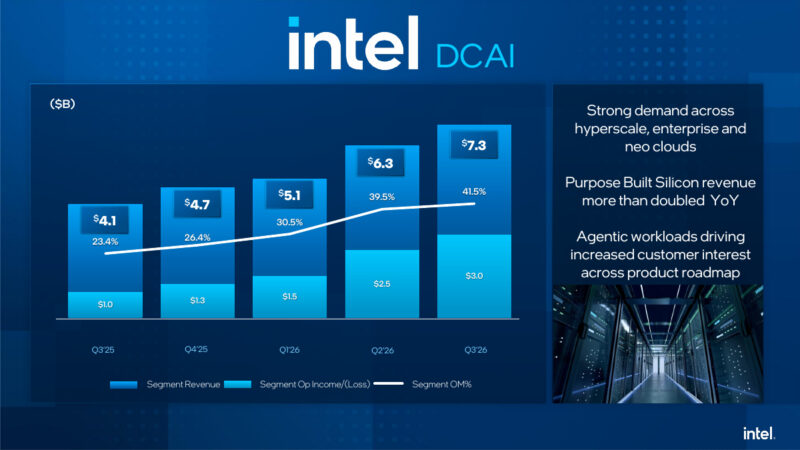
Demand is strong across hyperscale, enterprise, and neo cloud customers, with “Purpose Built Silicon” revenue more than doubling year-over-year. Lip-Bu Tan, Intel’s CEO, said Intel’s immediate priority is unlocking additional supply to meet extraordinary demand for the Xeon family. On the call, he said that substrate availability is limiting output and it would take some time to ease.
The client side looks very different. Client Computing and Physical AI Group (CCPG) revenue fell 5% year over year to $8.1 billion. Overall inflation is well north of zero depending on the index you use, so revenue falling is not good. On the call Intel cited industry-wide memory shortages impacting the total addressable market. Higher DRAM and NAND prices are pushing system costs up and hurting demand. On the call, it sounded like Intel was looking for 18A supply to be used on the data center side pending substrate availability.
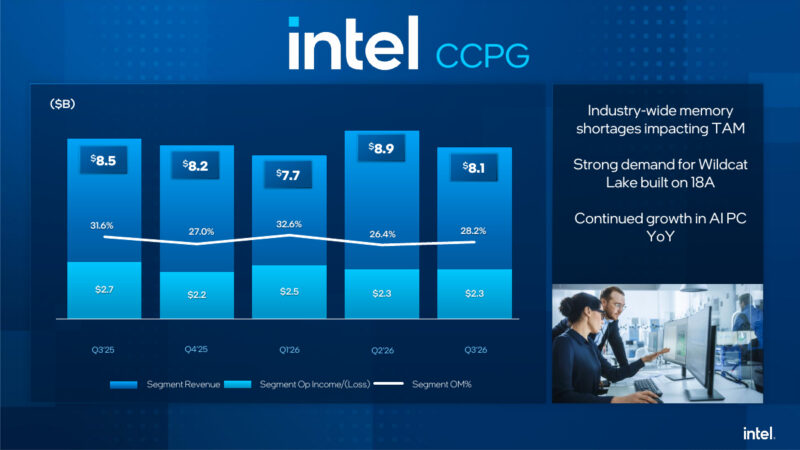
Intel expects the PC slowdown to continue at least through the first half of next year. Memory and NAND pricing pressure is expected to persist into 2027, which means client system costs are likely to stay elevated for a while longer. For those who see today’s memory prices and think they are shocking, the earnings call commentary did nothing to make me think Q1 would see a decline in memory pricing.
Intel Foundry posted $6.7 billion in revenue, up 58% Y/Y, though that figure includes intersegment transactions rather than external customer sales alone. The segment still recorded an operating loss of $1.9 billion with a negative 27.7% margin, but that is narrower than the $2.3 billion loss a year ago.
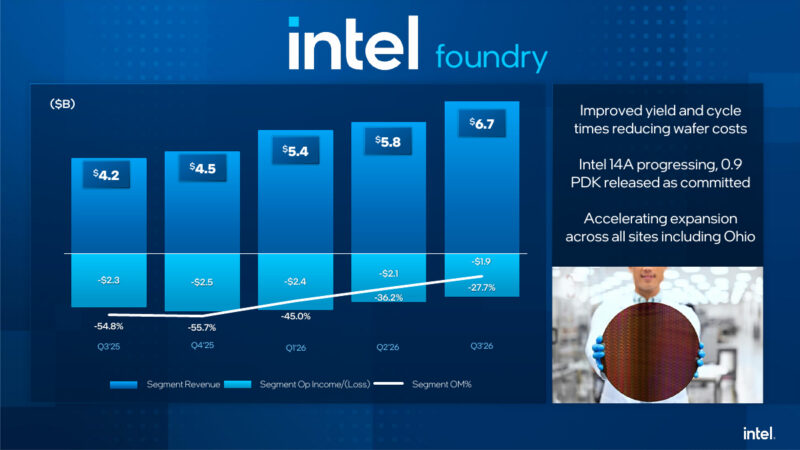
Improved yields and cycle times are reducing wafer costs. Intel released the Intel 14A 0.9 process design kit in October as committed, and expansion continues across sites including Ohio.
Final Words
We do not cover all earnings calls, but Patrick’s thought was that this was an important one since it also tells a story of STH. Folks wonder why we have been doing a lot of AI desktop and server/ networking coverage, and fewer mini PCs. Intel’s Panther Lake is a cool product, but it is not running larger local models. Right now, DRAM and NAND are being priced for the value they bring attached to AI nodes. Likewise, the NVIDIA-Intel investment and the many NVIDIA GPU-based systems with Intel Xeon CPUs are helping drive Xeon 6 sales and push pricing up. As a result, we are seeing the market demand for non-local AI PCs drop due to higher prices, while the AI-related markets are cooking. We know folks want more mini PC reviews, but this is a fundamental industry challenge. A smaller client-side market also means fewer small companies trying to innovate on form factors, while the data center market is the exact opposite. This came out very clearly in Intel’s earnings.