

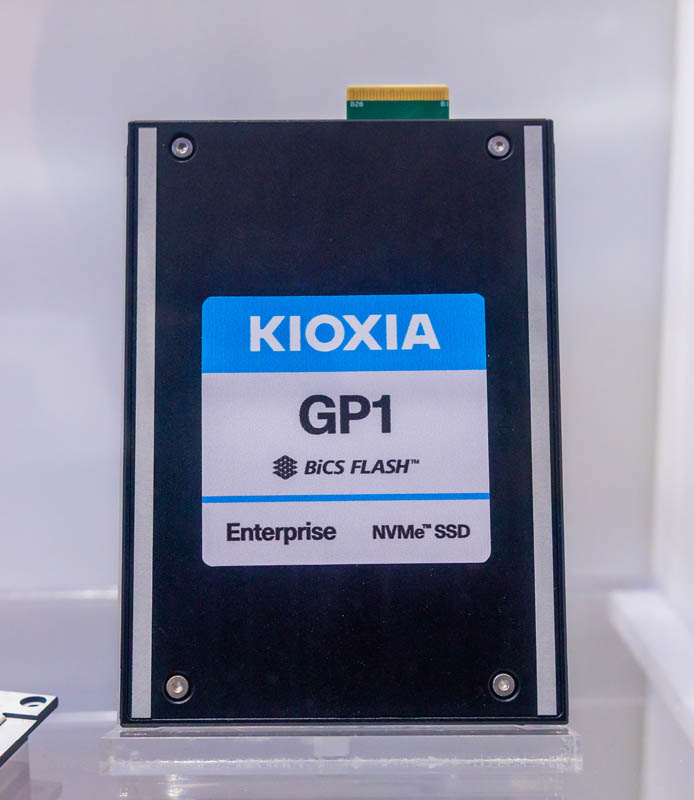
There is a new push in the industry, not just for capacity, but also for higher-performance NVMe SSDs. With PCIe Gen6, companies like Kioxia are looking at ways to deliver very high-performance NVMe SSDs over the new links. Kioxia’s answer is to use SLC NAND to get to 10 million IOPS per drive. Eventually, the goal by next year or so is to get drives into the 100M IOPS range.
Kioxia Shows off its 10M IOPS GP1 SSD
The GP1 Series rides PCIe Gen6 and Kioxia’s XL-FLASH generation 2 memory, a low-latency SLC-class NAND that the company pits against conventional TLC-based SSDs. Kioxia claims up to 10 million random read IOPS per drive at a 512-byte block size, plus an endurance rating up to 50 DWPD. Finer-grained 512-byte access granularity and that high write endurance together suit workloads where latency and sustained rewrite matter more than capacity, which is the fast-tier role the drive targets for Gen6 servers.
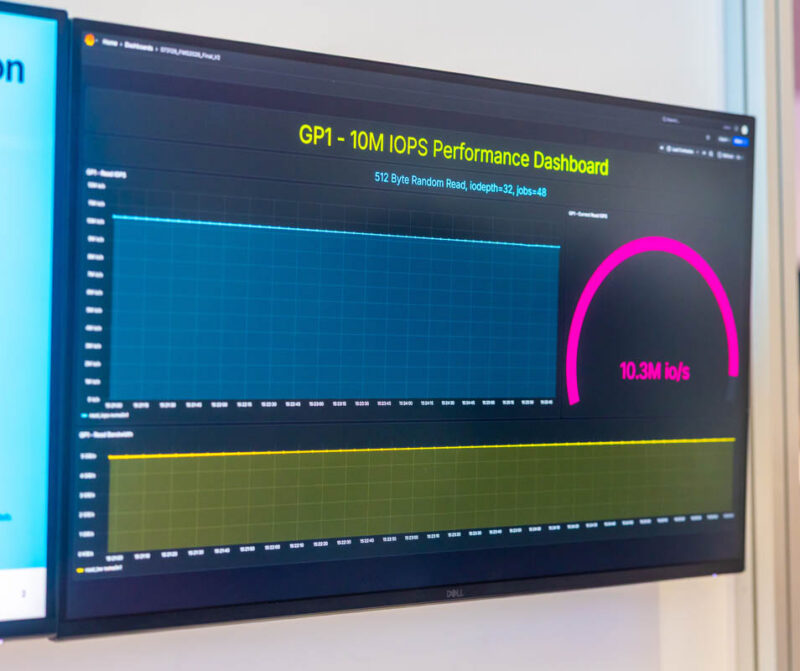
Kioxia even showed the drive running at just over 10M IOPS on the show floor, with performance so consistent that we originally thought it was just a static slide rather than a live system running inside the booth.
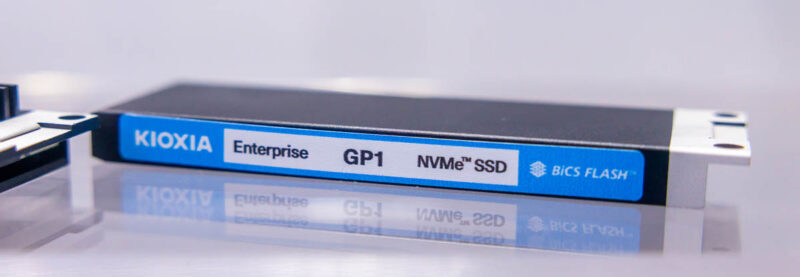
GP1 covers E3.S and E1.S in 9.5 mm and 15 mm heights, all air-cooled, with cold-plate liquid cooling support on the E3.S and E1.S 9.5 mm variants. Supporting both air and cold-plate cooling within a single family lets a server maker choose the approach that fits its chassis, rather than locking in a single cooling scheme. Those EDSFF form factors align with the flash-heavy Gen6 platforms vendors are building, where a drive can achieve high per-device IOPS through SLC rather than relying on broad TLC parallelism.
Final Words
Previously, we looked at the Kioxia FL6, which seems like a predecessor to this drive, with an earlier XL-FLASH generation and only PCIe Gen4 support. Now we have the newer, faster drive, the Kioxia GP1. While the market is capacity-constrained in general, a new ultra-fast storage tier for AI servers prioritizes performance, offloading some traditional DRAM tasks to lower-cost NAND. To do that, higher-performance SSDs are required, and that is the market segment that Kioxia is targeting here.

I wonder how these would compare to Optane if they still existed. I know they’re not the same (Xpoint vs SLC) but still
SLC for the win. I have some of the original Intel X25-E ssd’s from 2010 or so. They also use SLC, and have been running here continuously for 16 years now under web and database workloads. None have failed, and all still show 100℅ health!
The only reason the industry moved away from SLC was cost. It is otherwise superior in all other aspects.
I miss Optane so much. I understand why it was cancelled but I think it was a bad move