

Seagate Expansion 28TB External Hard Drive Performance
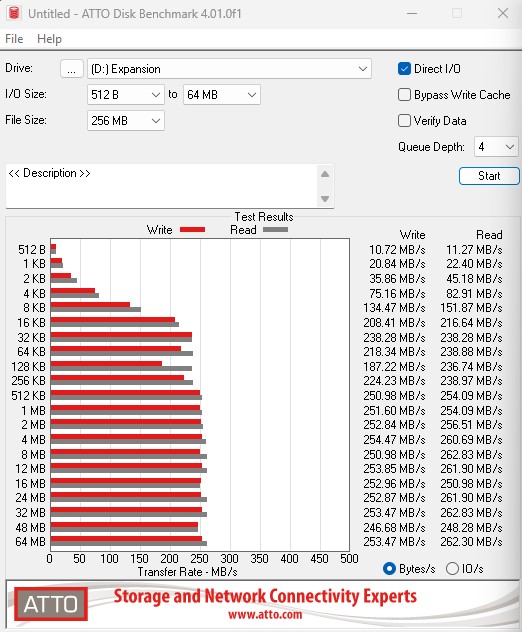
First, turning to ATTO, usually a good benchmark for hard drives, here is the 256MB file size result:
Here is the 8GB result:
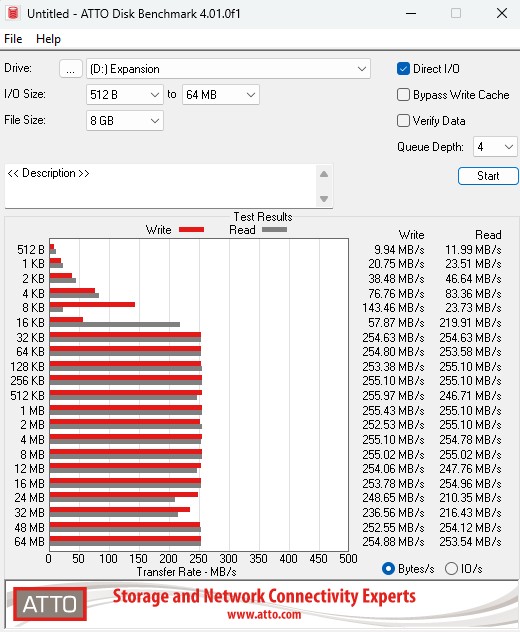
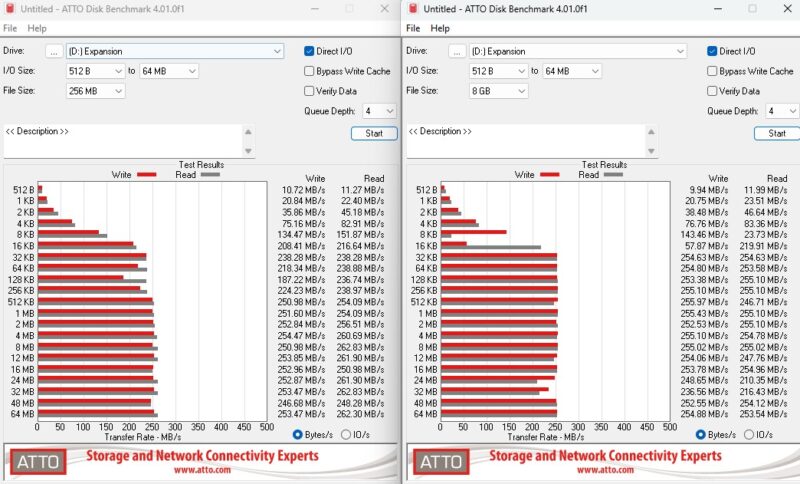
Overall, decent numbers right at the 250-260MB/s mark. Here are the side-by-side results:
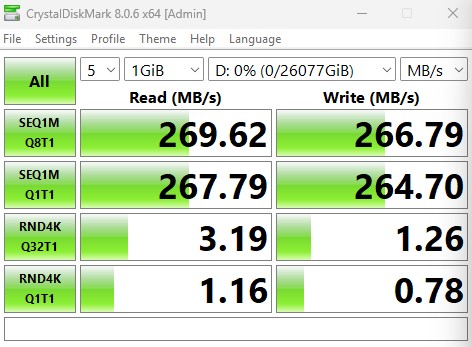
Turning to CrystalDiskMark, here is what we saw on the 1GiB test:
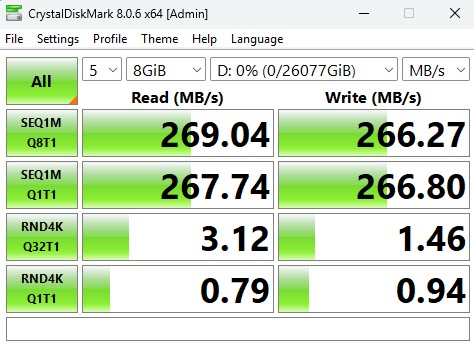
Here is the 8GiB version:
Here is the side-by-side:
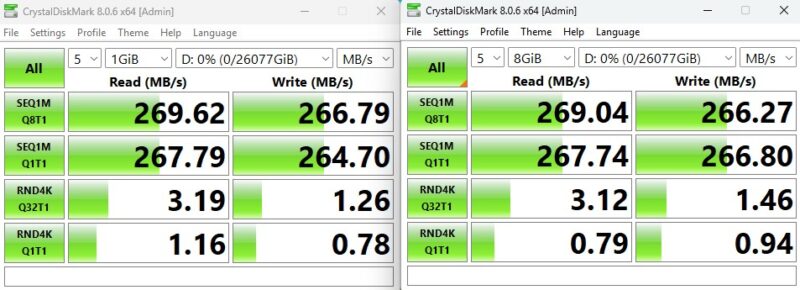
We actually got slightly better sequential results on the CDM side than the ATTO side. Of course, this is still much slower than a modern SSD, but it is also $330 for 28TB.
At this point, we are mostly using hard drives for backup storage, so we care most about the sequential speeds rather than random. Random workloads these days should be on SSDs.
Seagate Expansion 28TB External Hard Drive Power Consumption
Some folks will want to know how much power these external drives use, so we hooked it up to the power meter.
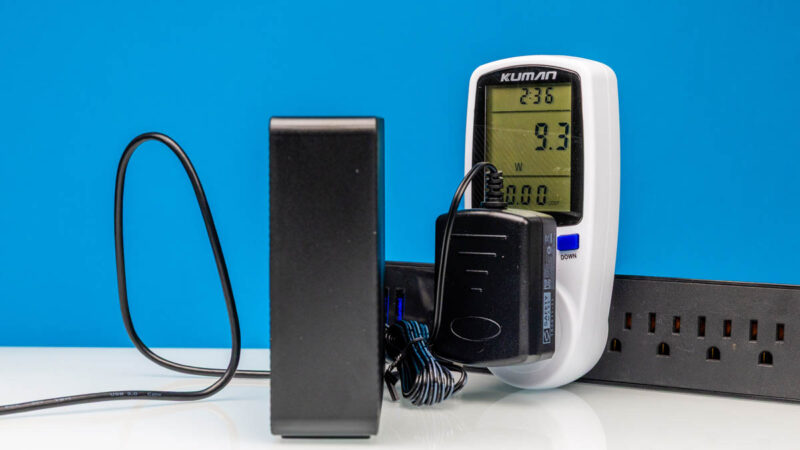
At idle, we got around 9.3W, and we saw over 15W at the wall during operation.
Final Words
For $330, this is a fairly normal external drive, except it provides 28TB of capacity.
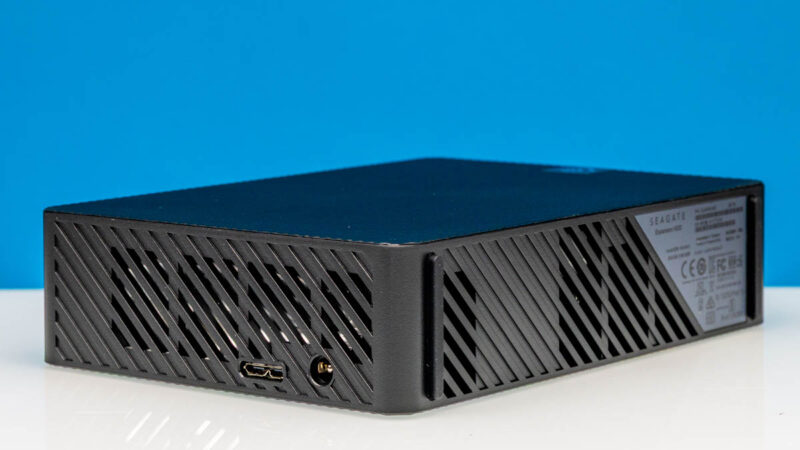
To us, the big win was finding the 28TB Barracuda inside. It is a bit amazing that the same company can sell 28TB drives for $330 at retail (figure ~20% for marketplace and shipping?) but if you want to buy the internal drive, you will spend $569. Of course, that is unless you are a major hyperscaler or OEM. Still, $330 for a HAMR drive is great. If we had some kind of SMR drive in the USB expansion, we would be less than thrilled. Seeing the Class 1 Laser helped give the confidence that we would like what we saw inside.
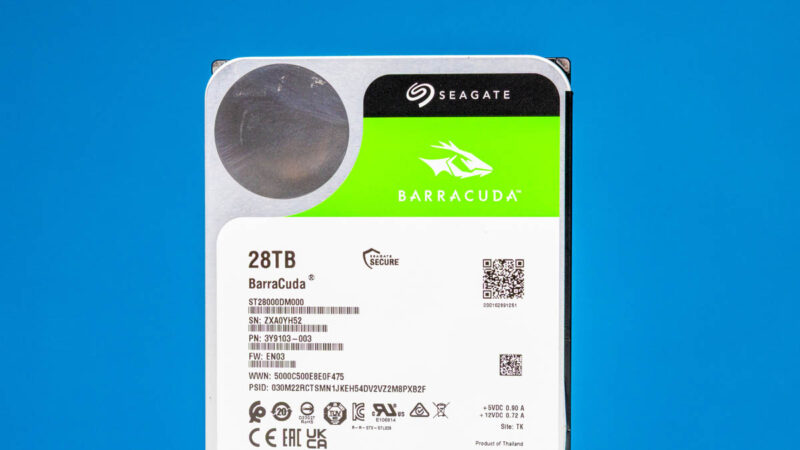
Of course, if you just need a 28TB external hard drive, then this is currently the option on the market.
Where to Buy
If you want one of these drives, we have an Amazon Affiliate link here. Please note, we purchased ours from Amazon, but you may get something different inside than what we found.

I know we don’t really care much about the enclosure, but why the hell is it not usb C? It’s not 2015 anymore, who is even still making those weird micro usb 3 connectors
@Thomas, I think it is because they want to require the wall-wart power supply for these enclosures. I have a couple of them in small capacities, and it has always bothered me that they don’t print the input specs somewhere on the enclosures, so I don’t have to go digging for the no-name one they provide.
I am also very disappointed to see those micro-B connectors. Even the cheapest boards and enclosures from Aliexpress use USB-C these days.
@DiHydro, I don’t think it has anything to do with the wall-wart. Those are there, because USB is only used for data and ports on computers don’t generally support USB-PD, even if it’s a USB-C port (would be nice if they did, some GPUs do have USB-C ports that do and go up to at least 12V). So that’s why they need an extra power supply, but whether the data goes through a micro-B or USB-C port shouldn’t make any difference whatsoever. There are plenty of external hard drives that have a PSU with a USB-C port.
Why can’t we have a 28 TB U.2 NVMe SSD in the enclosure instead? Why are old-fashioned hard disks still a thing? I don’t get it at all. I swear, consumer SSDs are seemingly forever stuck at 4 TB while server SSDs are pushing 256 TB and up. Yet, spinning rust is the only game in town if the average Joe or Jane wants storage in a single unit that’s more than 4 TB. Kinda sad if you ask me, which nobody is.
Do you have any measurements about heat?
Does it get much hotter during writing in comparison to a 24gb nonHamr drive?
I guess laser is not used at reading?
Also any hint if it is 5400 or 7200rpm drive
> Why can’t we have a 28 TB U.2 NVMe SSD in the enclosure instead?
You could, but instead of costing $330 it would cost thousands of dollars. Both SSDs and spinning rust keep getting bigger, but the price differential per bit doesn’t really change all that much. The physics of how these devices operate probably means that for larger capacity, spinning drives will continue to be more affordable quite far into the future.
(Also, add me to the club of people disappointed in the old fashioned connector. Now that really is sad.)
“For those wondering, we tried, and unlike a typical external USB SSD, with the hard drive we needed the power adapter.”
Is the author quite new to computing? I think most people know the difference between a traditional hard drive and an SSD. And it’s not exactly a state secret that your 3.5 inch external hard drives need a power supply. Which kind of why (a) the unit has a power socket, and (b) the drive is supplied with a PSU.
Miv – I can tell you the author is not, but you have to remember that many folks are new to external hard drives, or buy them once every 5 years. Just because you know why does not mean some of the 150K+ people who have already seen this article do not.
I have always envisioned STH as a venue where we offer a range of content, while also providing on-ramps for folks to learn. That kind of comment is not kind to those who are learning.
Ok, fair do’s.
Can anyone definitively point out if it’s cmr or smr. The higher capacity HAMR drives are smr. Eg 34tb+
There is a thread here but nothing is definitive:
https://www.synoforum.com/threads/seagate-expansion-28tb-stkp28000400-cmr-barracuda-has-anyone-tried-it.14757/post-73375
If you’re in the UK, take a look at serverpartdeals.com or robertelectronics.co.uk. They sell manufacturer recertified drives – with Robert Electronics offering a full 5 year warranty on theirs.
I’ve got two from RE in my NAS; a friend of mine has 3 and this week, one of his failed so RE are sending him a replacement, no charge.
Pricing is competitive with the shucked approach but you actually get a warranty.