

SanDisk Extreme PRO USB4 Portable SSD 4TB Performance
One of the nice things about the move to 40Gbps USB4 is that, besides the speed of course, it gets us over the awkward hump of the first era of 20Gbps USB, which came in the form of 3.2 Gen 2×2. The first two-lane USB standard, afforded by the USB-C connector, Gen 2×2 never saw universal adoption on USB hosts. Intel in particular was very slow to add Gen 2×2 support to its hardware – most of which could already support higher speeds via Thunderbolt and USB4 modes – and as a result it is always been a bit of a crapshoot whether a user would be able to get the full 20Gbps out of a Gen 2×2 drive on a recent machine.
40Gbps USB4 (technically Gen 3×2) is far more universal. A user will still need a 40Gbps USB port to get the most out of a USB4 drive, but there are no glaring holes in host support this time. 40Gbps is a USB data transfer rate that all the major hardware vendors are supporting.
The updated hardware also makes some changes under the hood in how the drive communicates with a host. Whereas the USB 3.x generation drives used USB Attached SCSI Protocol (UASP), the newest USB4 drives are using direct NVMe over their USB connection. In practice this should not make a wild difference, but it means that these portable SSDs are now using the exact same protocol as their internal counterparts. In other words, they have truly become external SSDs.
Moving on to the actual benchmarking, we are going to use a number of popular tools to benchmark the drives. You can use the same free tools to evaluate the performance of your drives for comparison.
CrystalDiskMark Benchmark
CrystalDiskMark is used as a basic starting point for benchmarks as it is something commonly run by end-users as a sanity check. We use both 1GB and 8GB test sizes.
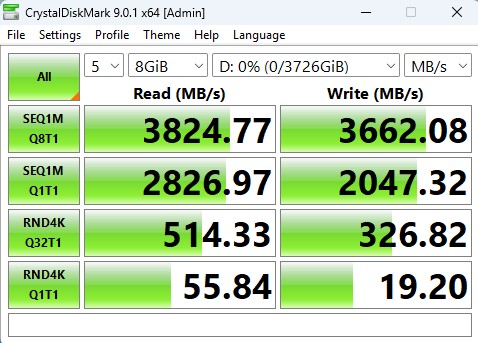
A simple and straight sequential test, CrystalDiskMark does a good job of showing off what these portable SSDs can do under ideal circumstances. And in the case of the SanDisk Extreme PRO USB4 Portable SSD, the drive delivers on SanDisk’s performance claims, passing 3.8GB/second for reads and writing just a bit slower at just under 3.7GB/second. Compared to the previous-generation USB 3.2 Gen 2×2 Extreme PRO, this is an 89% improvement in sequential read performance, and a similar jump in sequential write performance.
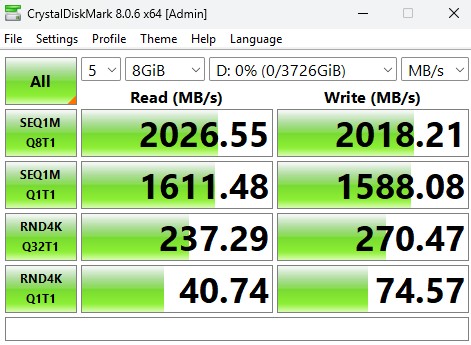
Otherwise, sequential performance is a bit more of a mixed back. With a large queue of operations, 4K random reads and writes are also significantly improved over the previous drive – especially readers – but 4K random performance with a queue depth of 1 has split. 4K reads have improved by around 37%, but 4K writes have significantly regressed: whereas the USB 3.2 Gen 2×2 drive could sustain 74MB/second in 4K random writes, the USB4 version of the Extreme PRO can only sustain 19MB/second. At this point it is not clear why we are seeing this performance regression, as it is not clear how much of a role the internal NAND plays versus the controller, or even the USB4 host controller on our testbed.
Meanwhile, though keep around 1GB tests for historical comparisons, at this point it is clear that these latest-generation portable SSDs are hardly being stressed by 8GB operations, let alone a 1GB operation that represents less than one-third of a second of transfer time.
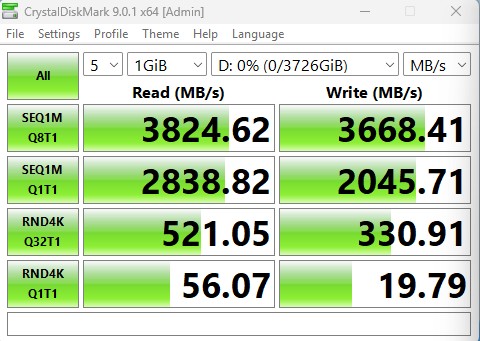
Overall, in sequential workloads the Extreme PRO USB4 delivers on its promises, offering very high burst read and write performance for large transfers.
ATTO Disk Benchmark
The ATTO Disk Benchmark has been a staple of drive sequential performance testing for years.
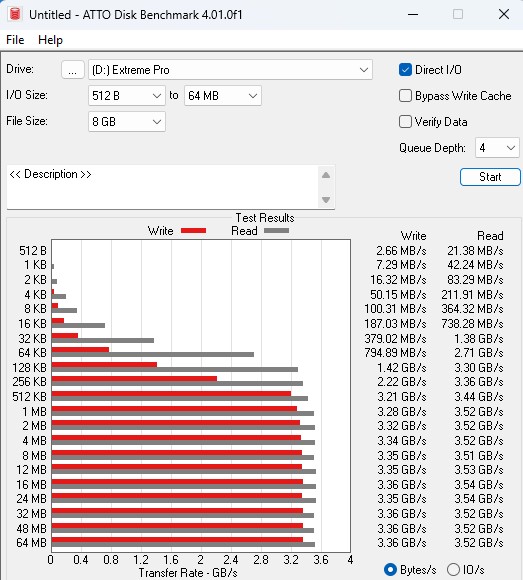
Another test with a focus on sequential operations at different sizes, ATTO helps to illustrate how big of a read or write operation is required to really get the most out of the Extreme PRO. At queue depth 4, 128KB reads will get you most of the way there, while for writes it takes about 512KB. This is a similar curve as we saw on the USB 3.2 version of the drive, though with higher transfer rates overall.
Anvil’s Storage Utilities
Anvil’s Storage Utilities is a comprehensive benchmark that gives us a very in-depth look at the performance of the drives tested. This benchmark was run with both a 1GB and 8GB test size. Here is the 8GB result:
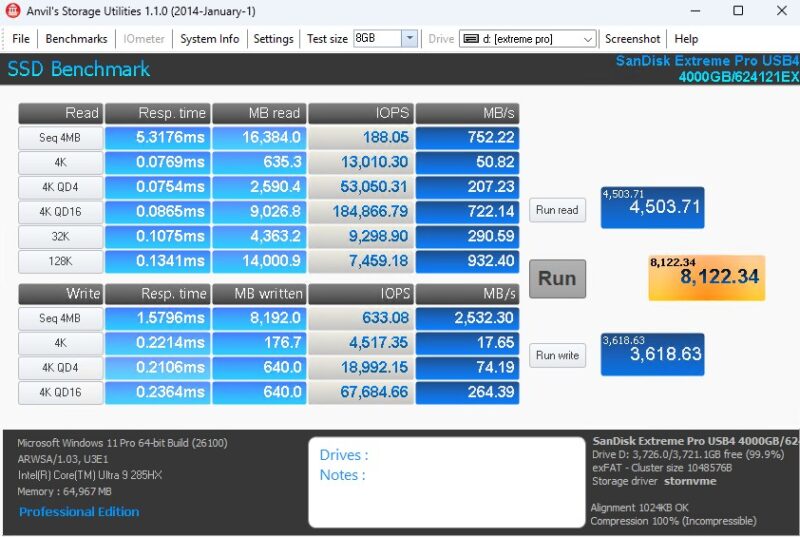
Anvil largely seems to be confirming what we saw earlier in terms of scalability. Though the peak sequential performance numbers are lower – something that is not unusual for Anvil.
AS SSD Benchmark
AS SSD Benchmark is another good benchmark for testing SSDs. We run all three tests for our series.
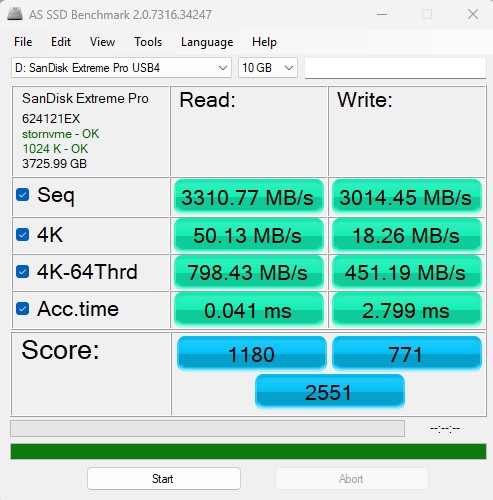
With a 10GB test size, AS SSD largely echoes the numbers we saw from CrystalDiskMark. Though the overall sustained performance for both reads and writes is a bit lower than the earlier benchmark. Notably, it does confirm the regression in 4K random writes.
BlackMagic Disk Speed Test
BlackMagic Disk Speed Test is focused on testing storage for use in video workflows.
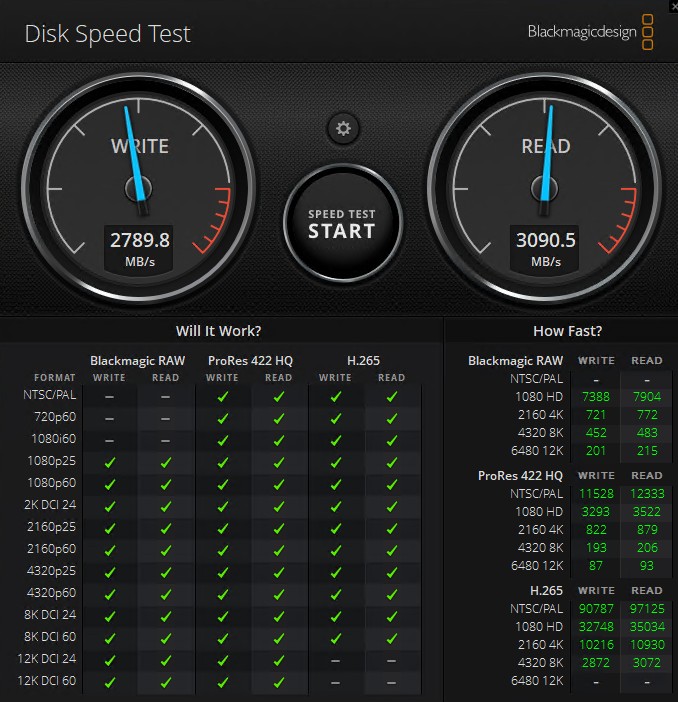
With a focus more on video than raw metrics, BlackMagic gives us a different interpretation of what is largely the same performance data. Reads and writes here are again not quite as high as what we saw with CrystalDiskMark, though it is not unusual for BlackMagic to turn in lower numbers overall. And in either case, these read and write figures means that the Extreme PRO passes all of BlackMagic’s testing with flying colors, having enough bandwidth even for ProRes 422 HQ encoded 12K video at 60fps, an extremely high bandwidth configuration that even the previous USB 3.2 version of the drive was not quite fast enough to reliably tackle.
Final Words
As an upgrade to SanDisk’s long-standing lineup of high-performance portable SSDs, the 4TB Extreme PRO Portable SSD with USB4 is another strong entry to that family. Capable of leveraging the significant bandwidth improvements offered by USB4, it comes close to doubling the sequential read and write performance of its predecessor – closely mirroring the bandwidth benefits of the newer USB standard. As a result, this drive is capable of exceeding the burst performance of even the best PCIe 3.0 internal SSDs – some of the fastest drives in the world a few short years ago – and is only eclipsed by the latest generations of internal PCIe 4.0 and PCIe 5.0 drives.
Those improvements do come with a cost, however. And I do not just mean the $479 price tag for a 4TB drive – though that is certainly a factor. In order to fit the internals of a higher performing drive into a portable SSD chassis, and to keep the whole thing cool, SanDisk has significantly enlarged the casing used with the Extreme PRO. It is still as durable as ever, and now that it is approaching the size of a modern smartphone, that is ruggedization is probably more necessary than ever. Seriously, this is quite the sizable SSD.
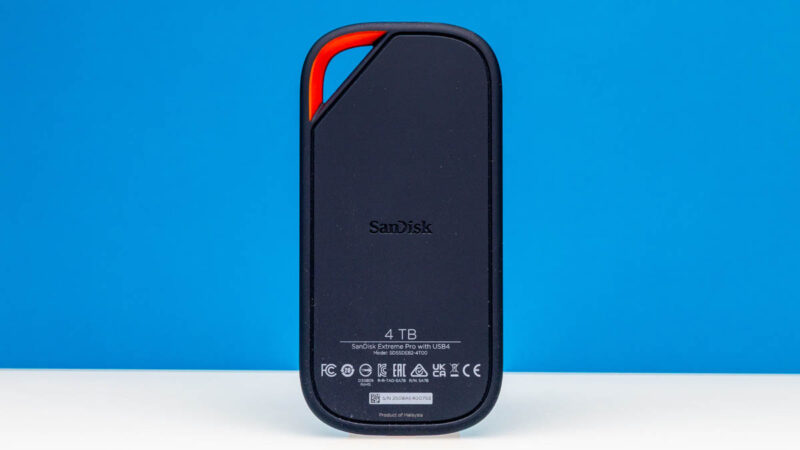
Overall, then, the Extreme PRO handily delivers on its design goals. The size and price premium do mean that it is not quite a must-buy in a market with competing USB4 SSD options at other price points and sizes. But the Extreme PRO portable SSD continues to be a unique entry in the market for users who want to have it all, with both high performance and a ruggedized case.
Where to Buy
We purchased our unit on Amazon. If you want to get the drive, here is the Amazon Affiliate Link.



Considering the alarming number of sudden failures from previous generations (they were very popular with photographers and video editors without proper backups), I would wait a few years to see if Sandisk managed to fix the issues…
Really enjoyed this review! The performance numbers and real world testing made it easy to see how fast this USB4 SSD is compared to others.
Take it apart and show whats inside
In addition to the speed, this drive attaches with “Protocol: PCI-Express” vs “Protocol: USB” like most USB 3.x external drives.
As a result, the macOS reports SMART and TRIM support without any vendor software.
>system_profiler SPNVMeDataType | grep -i -E “(trim|model|S.M.A.R.T.)”
TRIM Support: Yes
Model: APPLE SSD AP000000
S.M.A.R.T. status: Verified
TRIM Support: Yes
Model: SanDisk Extreme Pro USB4
S.M.A.R.T. status: Verified
Hadn’t tried it on a Mac. That’s good to know!
It would be nice if you could check what controller it uses inside. I don’t necessarily mean taking the drive apart, lspci should give us a rough idea of what it might be.
And it would also be nice if you could test the drive on older 10 and 20Gbps hosts to see how the controller behaves in those scenarios.
Furtnermore, power consumption could also be of some interest, as there can be rather large discrepancies between controllers, as well as the same controller operating in USB4 mode with PCIe tunneling and USB3 mode.
I’m currently using a Crucial X9 Pro 4TB external SSD for backing up my laptop via Veeam Standalone Windows Agent. It worked great. But now that Crucial is gone I may look at this Sandisk if I need a new or additional backup external SSD