

Why PCIe Gen5 Storage Will Remain Relevant
Enterprise data centers will not transition to PCIe Gen6 storage overnight. Strong demand for server CPUs means organizations will operate mixed generations of hardware for years to come. Many workloads continue to run efficiently on PCIe Gen5 platforms, and the installed base of these servers remains substantial across cloud providers and enterprise racks.
AI agent deployments illustrate why conventional infrastructure matters alongside GPU compute. Companies building agentic AI systems need traditional database layers, storage backends, and orchestration services to handle the requests that flow through their AI pipelines. As dense CPU rack designs show, the infrastructure supporting AI agents extends well beyond accelerators into familiar compute and storage territory, where PCIe Gen5 continues to deliver adequate performance.
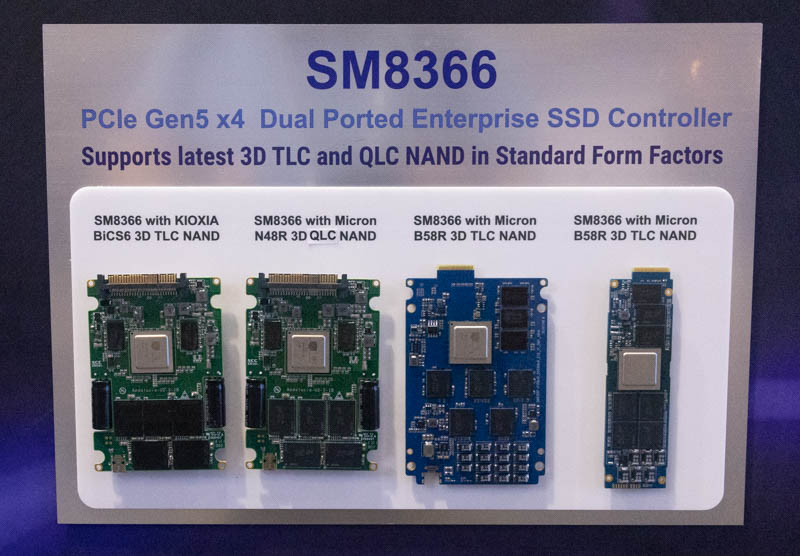
Capacity-focused storage tiers using QLC NAND represent another area where PCIe Gen5 retains relevance. These deployments prioritize cost per gigabyte over peak interface bandwidth, and mature Gen5 controller designs offer proven reliability at lower system costs. Silicon Motion states that its SM8366 controller achieves over 14.2GB/s sequential throughput and 3.5 million random IOPS while supporting QLC nearline SSDs up to 128TB capacity.
Our current market observation shows that NAND pricing has influenced the QLC landscape. Where the industry previously pushed toward maximum-capacity drives approaching 256TB, attention has shifted back to the 61.44TB and 122.88TB QLC tiers. These capacities align well with PCIe Gen5 performance envelopes, reducing the immediate pressure to adopt Gen6 for capacity-oriented deployments.
Mature controller ecosystems around PCIe Gen5 provide another practical advantage. Organizations deploying storage at scale benefit from validated firmware, established supply chains, and accumulated operational experience that newer Gen6 designs have not yet accumulated. This maturity matters for production environments where stability outweighs the appeal of cutting-edge performance.
Agentic AI is Creating Demand for Storage
Recently on STH, we have covered how CPU and GPU vendors have been vying for the title of the fastest CPU or GPU for the agentic AI era. Those tests are often conducted using proxied LLM calls and artifacts stored in system memory to make the results more consistent.

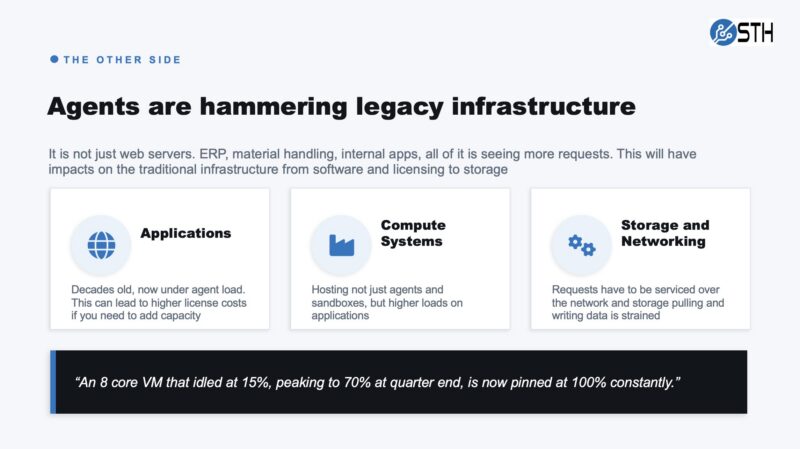
In real-world agentic AI workloads, storage can become another potential performance bottleneck. A request to an ERP system traverses the network to the application, then to a database, and so forth to reach the persistently stored source of truth. Even when local files are accessed for guardrails, context, or data analytics, those requests are often very dependent on storage. Also, when an agent simply saves a script, document, or other artifact, that action becomes dependent on storage write speed and latency. Perhaps a difference between how we currently benchmark agentic AI workflows and how they operate in the real world is that storage performance has a notable impact in the real world.
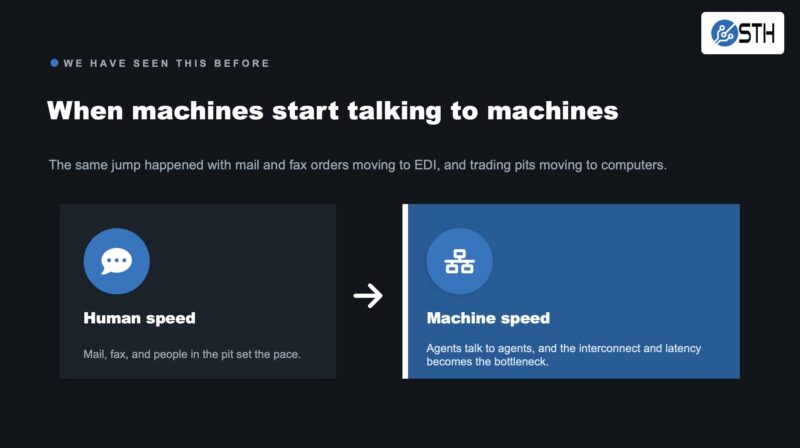
The industry started training models that brought us to the agentic AI era. Those agents caused a wave of AI inference build-out. Next, once that build-out gets utilized for agents, the load will shift to existing applications and the data that companies have build over many years. The current AI build-out is not just going to be about the next-generation of GPU servers. Instead, it is about increasing the amount of compute the world uses and the amount of data created and stored.
If you want to learn more about how agentic AI is not just impacting head-nodes for GPUs and the AI inference/ context, but also the rest of the infrastructure, the above video is likely worthwhile.
Final Words
Platform adoption will arrive in stages rather than as a clean swap from Gen5 to Gen6. Early AI systems will slot Gen6 into bandwidth-critical paths where model weights and checkpoint traffic demand maximum throughput, while Gen5 remains the sensible choice for capacity layers that prioritize cost per TB over raw per-device speeds. Earlier this year we asked Silicon Motion about this and they were seeing demand not just for PCIe Gen6 this year, but also PCIe Gen5.
AI infrastructure is really neat, and it is a bit of an odd point in the industry to be bounded by compute, DRAM, and NAND supply simultaneously. That means companies are working hard to build solutions to help relieve this pressure, but even existing applications will end up being impacted by the rise of AI agents as models get better, more utilized, and ultimately more active.


It’s long way from 1st to 3rd Gen PCIe try to catch up with GPU demand. When PCIe 4 show up, the GPU tech then stuck to enough for everyone.
SSD then put PCIe 4 and 5 as new idol of PCIe world along with fiber optics in network with rise of cloud services.
Now with AI craziness that relying much spread interconnection. Suddenly hardware for storage (ssd, ram) and network put themselves in race for moar bandwidth of PCIe.