

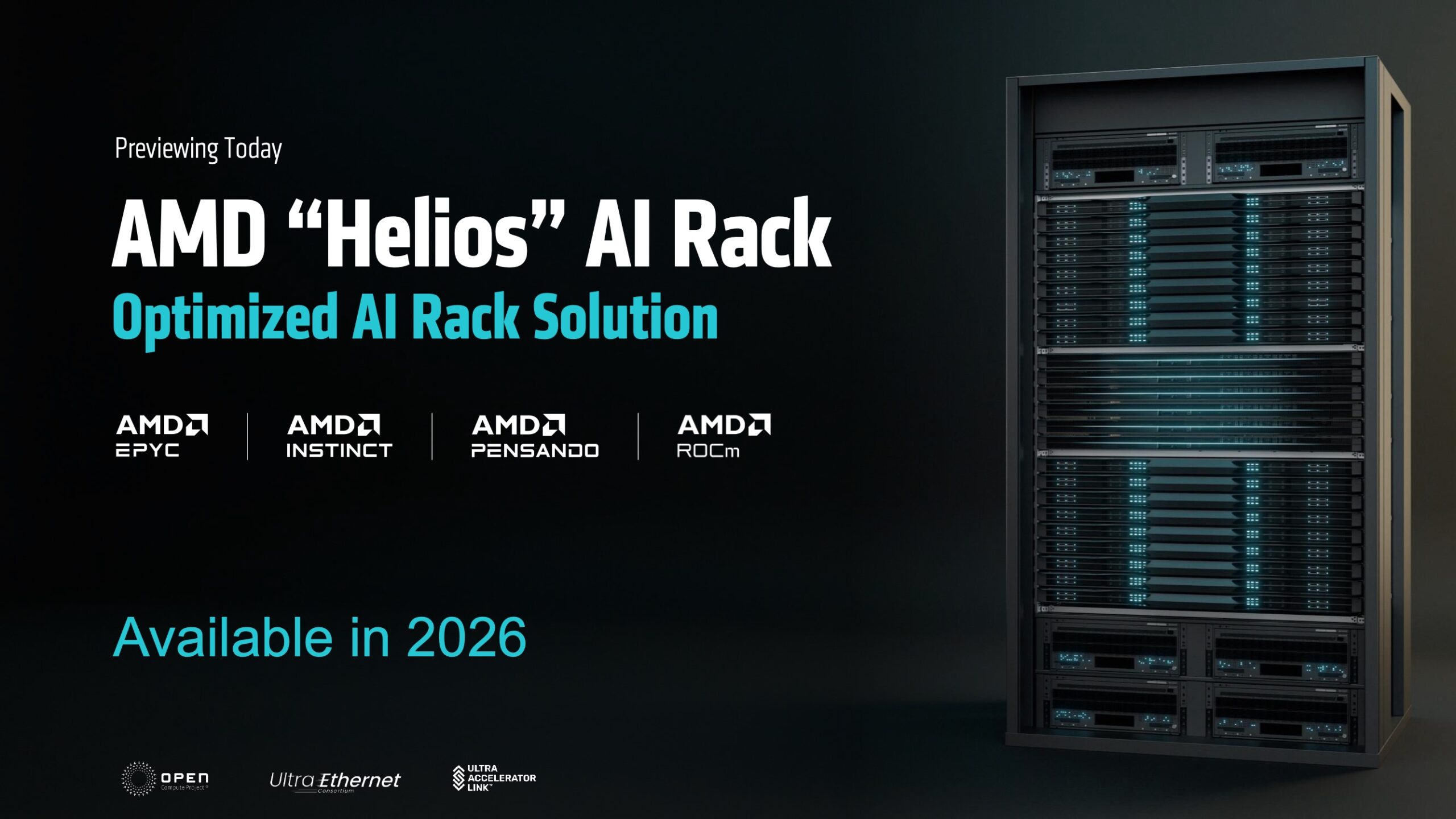
Today, AMD launched its Instinct MI350 series, but the more important announcements are probably what is coming in 2026. AMD is moving to a what appears to be a double-wide rack for its next-gen MI400 AI racks, adopting open ecosystem standards like UALink and UltraEthernet. AMD is going big for its next generation.
Next-Gen AMD Instinct MI400 AI Racks Go Double-Wide
Perhaps most important in this is that the MI400 is not far off. This is next year’s AI infrastructure from AMD.
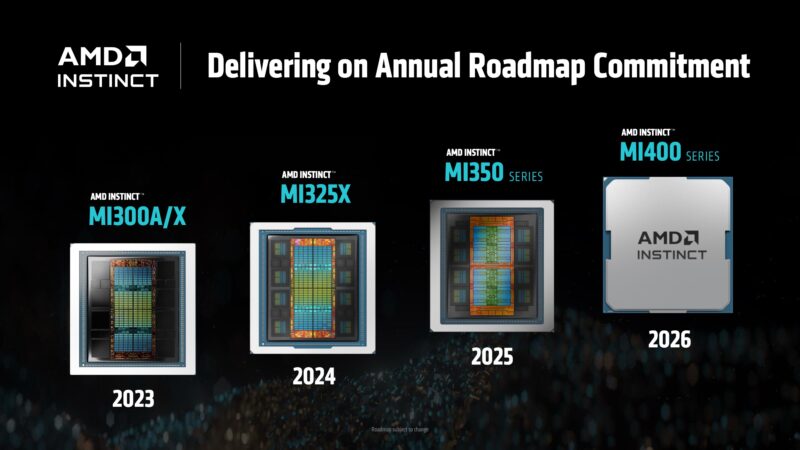
Beyond the AI accelerator MI400 series, the next-gen AMD EPYC “Venice” CPU and AMD Vulcano 800G NIC will be part of that. Reading between the lines, although not on the slide, AMD is also saying that 2026 will start the PCIe Gen6 era for EPYC.

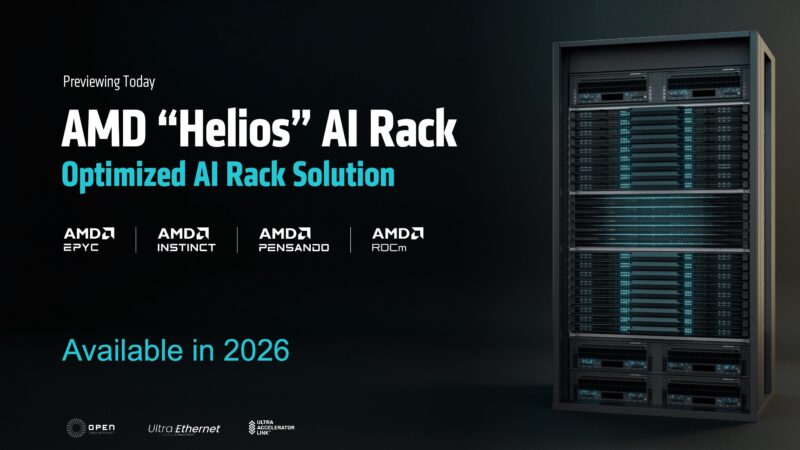
AMD is showing the preview today, but this is the AMD Helios AI rack. If it looks wide, this is a double-wide rack.
We covered this week that Micron Began Shipping HBM4 Memory for Next-Gen AI for 2026 accelerators. Micron also said this first generation is 36GB per stack so with 31TB of memory, and that gives us some idea of what a MI400 might look like 31TB/ 72 GPUs is around 440GB per GPU. Using 36GB HBM4 stacks, that seems to point to 12 stacks per accelerator whereas today’s MI350 is 8 stacks. That would also make sense if you see Rubin as an 8 stack HBM4 design when looking at the 1.5x memory capacity and memory bandwidth claims.
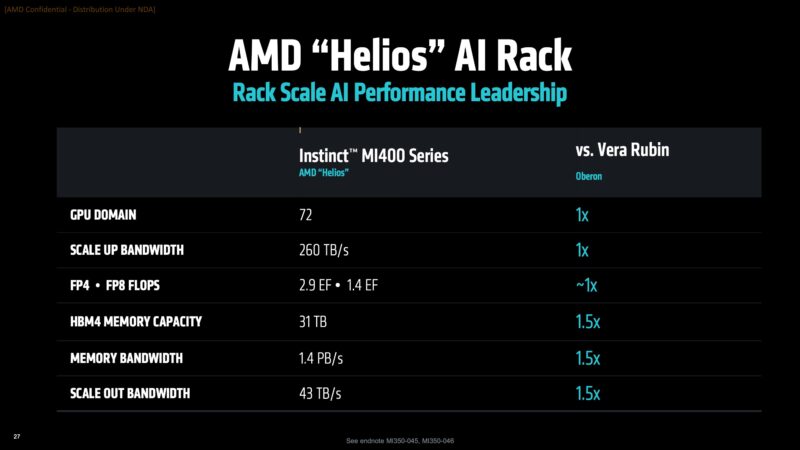
AMD also says that it will have more scale-out bandwidth.
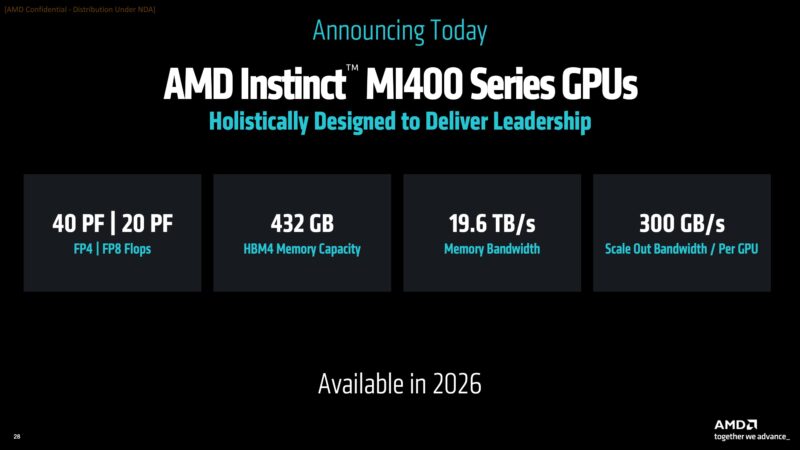
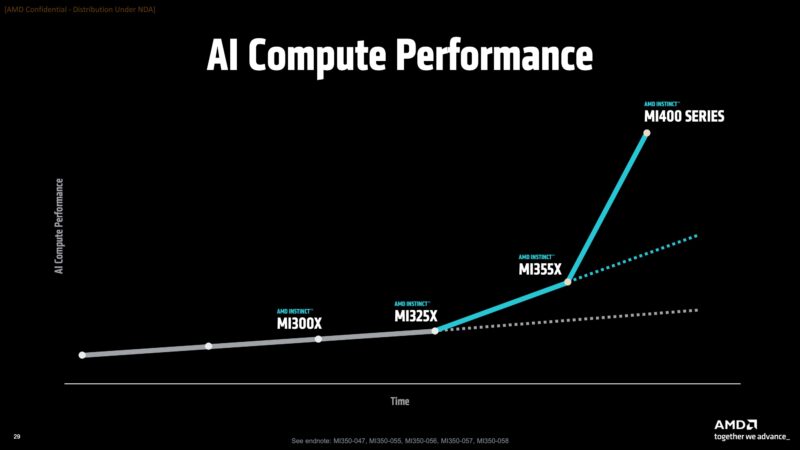
AMD says that with the MI450 and Helios, it can deliver up to 10x more performance compared to the MI355X. Sam Altman is on stage talking about OpenAI’s early collaboration and how important this is.
AMD said that it has Venice back in the labs. This will be up to 256 cores, on 2nm process and with up to 1.6TB/s of memory bandwidth. It will also be a PCIe Gen6 platform.
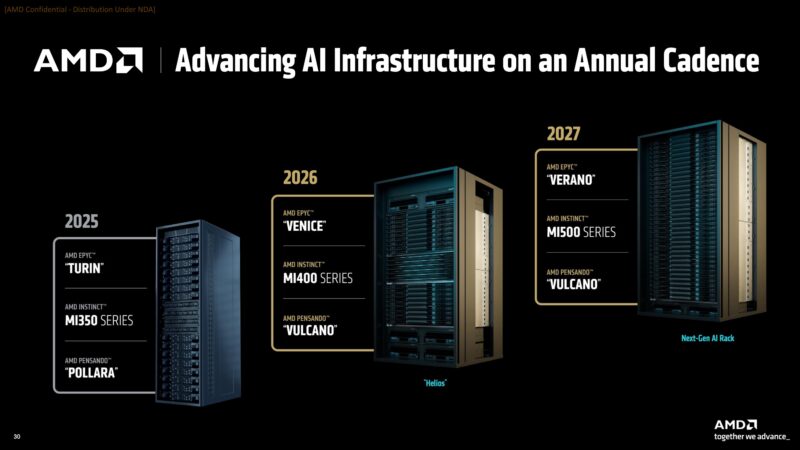
In 2027, we will get the next-generation AMD MI500 series AI accelerator as well as the AMD EPYC “Verano” processor.
Final Words
The Helios rack does not have a name. Instead of calling it something lame like a double-wide rack like one would name a trailer dimension, hopefully the industry follows up the MRDIMM (Mr. DIMM) and calls this something cool like the Big F_ing Rack (BFR.)
What is clear is the AMD MI350 series is designed to be the next-generation in the MI300 line pushing that more towards an AI optimization for current architectures. The big announcement today is the Helios AI rack with AMD’s 2026 generation. I cannot wait.
Update: I was able to ask Forrest Norrod about this, and he said Helios is an example of ZT Systems work with AMD. This type of deployment that was envisioned by the acquisition.



C’mon Patrick, you missed the ultimate pun:
it’s a Phat Rack!
By “double wide”, I’m going to assume these are 38-inch RUs. Old telecom relay racks were up to 24 inches, so definitely a wide rack.
I guess typo at the heading? should be trailers
Got it. Did 4 articles during that keynote. Typing too fast.
Anything but Ultra Rack.
It seems to be based on an OCPv3W rack. That is like two 21″ rack widths in one OU.
Patrick, do you think the industry will rally around OCP to fight the way nvidia is trying to make everything proprietary?
I mean, it’s pretty clear that we’re pushing the edge of what’s physically possible with 19″ racks today. You can’t fit 2 top-tier CPUs and a full complement of RAM, and it’s getting to the point where even 1 CPU takes up the full width possible in a 19″ rack. So we’ll need to either see systems getting *really* creative vertically (CPUs on the bottom, RAM on the top?) or we’ll see CXL RAM start take over rack-mount servers just because packaging constraints limit everything else too much.
I’m actually kind of curious at this point — how many high-end rack-mount servers are actually sold these days that *aren’t* bought a rack at a time with everything pre-integrated? Is the generic one-off high-powered 19″ server getting obsolete? If someone was making a competitive alternative format that fit into a 48″ wide footprint (so the space of 2x 19″ racks), would that actually be a deal-killer for more than a tiny number of customers? It’d do really fun things to the resale market, but we’ll presumably find a way to make due.
General reply + @scott, Since we can’t upload an image here but we can in the forum’s thread for this article I posted a reply there:
https://forums.servethehome.com/index.php?threads/not-just-for-oreos-and-trailers-amd-helios-next-gen-ai-racks-go-double-wide.48116/#post-471015