

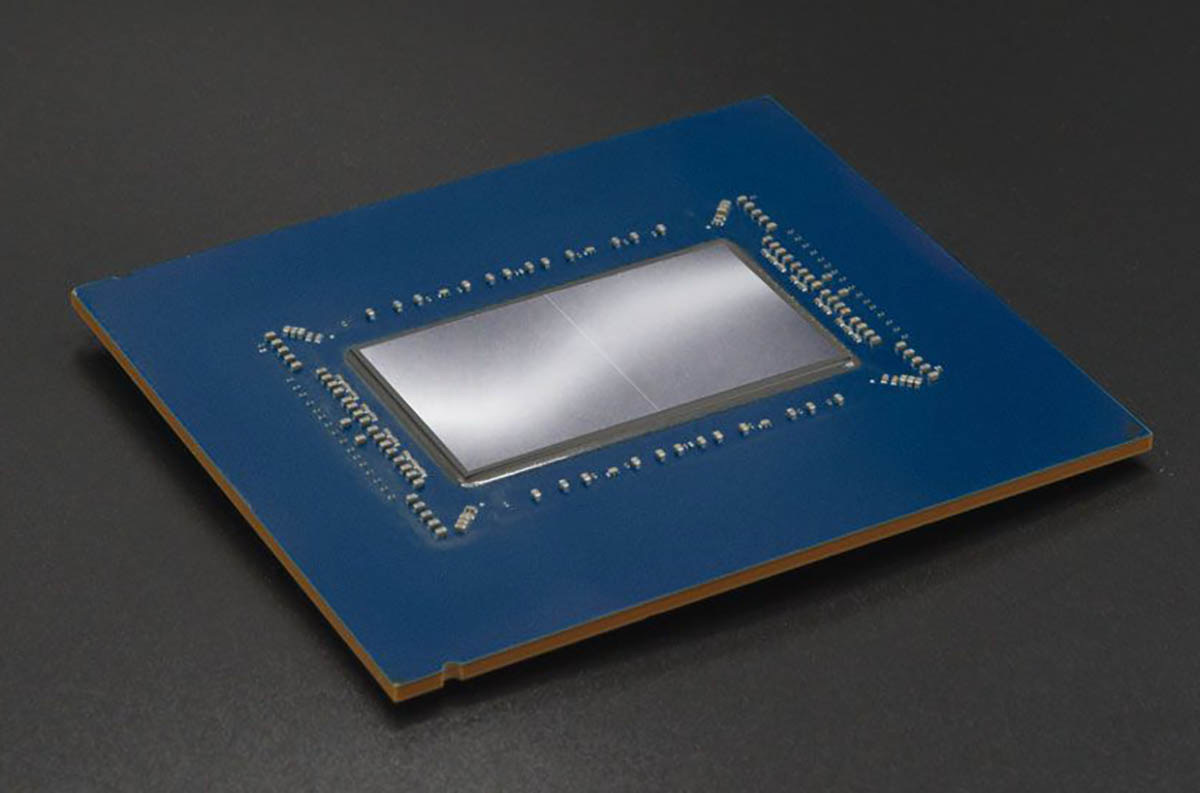
Microsoft showed off its newest Arm CPU. The Microsoft Azure Cobalt 200 is the company’s latest CPU, now being deployed for 2026 customer workloads. The company also shared one of the more interesting block diagrams to come from a cloud provider and that the new chips will be built on TSMC 3nm.
Microsoft Azure Cobalt 200 Shown
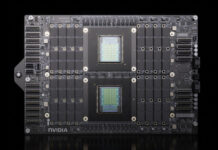
Here is the block diagram that Microsoft shared. The packages have two chips with a high-bandwidth interconnect between them. Based on the Arm Neoverse Compute Subsystems V3 (CSS V3) with 192 , Microsoft is able to integrate newer cores than the NVIDIA Grace CPU, for example. Each tile has 66 active cores (presumably for yield), six memory channels, and a Data Movement Accelerator, Crypto and Compression accelerator, and more. That makes the entire chip a 132 core, 12-channel design. Something else to note is that that accelerator design is reminiscient of what Intel has been trying to do with its 4th Gen and newer Xeons.
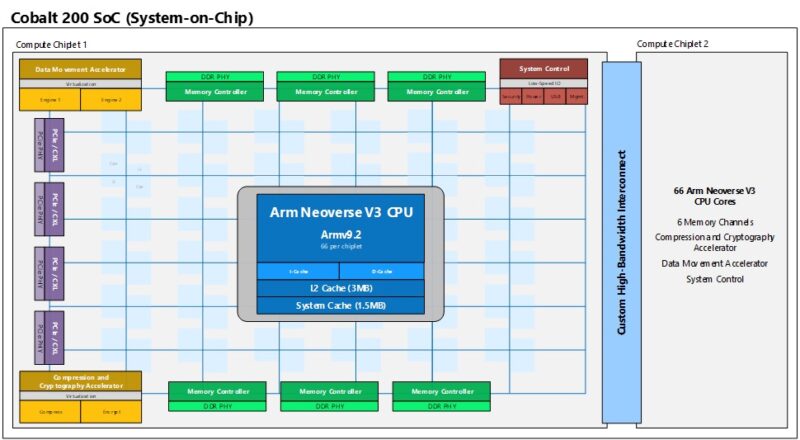
The chips then get 3MB of L2 cache per core and 192MB of L3 cache. The cores also have a feature that lets Microsoft optimize the clock speed on a per core basis.
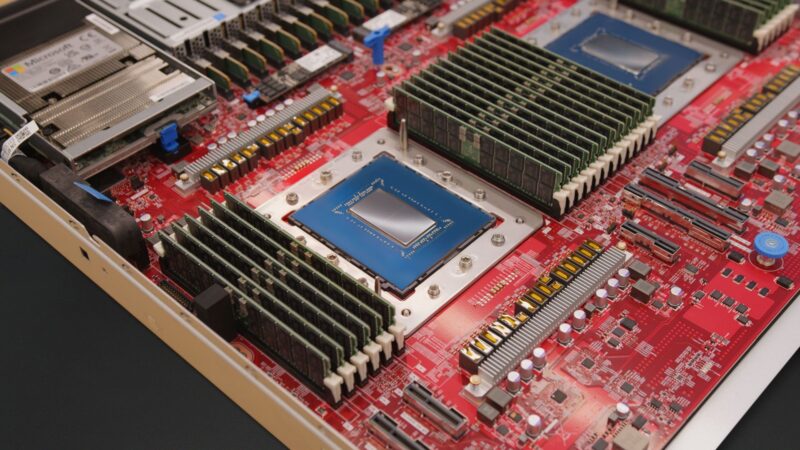
Microsoft also showed off the test system with two chips, E1.S SSDs, and the Microsoft NICs.
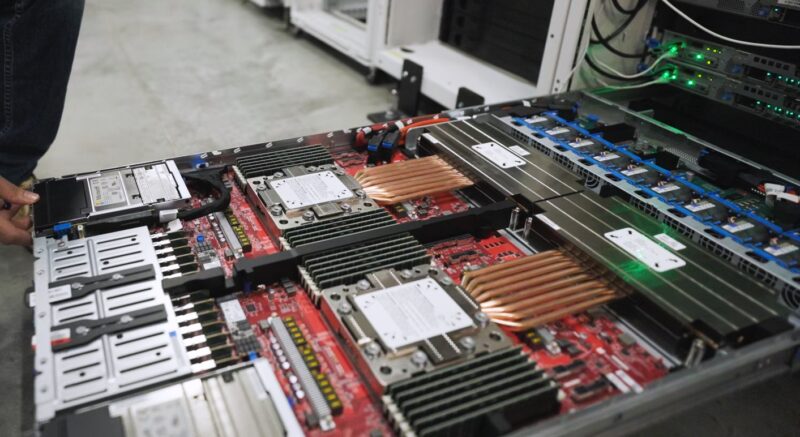
The thermal solution looks fairly typical for a Microsoft server, as Microsoft tends to use larger heatsinks tuned to its airflow and ambient temperature needs. One area where it appears to really differ is around the CPU socket, where we see eight screws and a much thicker perimeter around the fins around the socket.
Final Words
This is a big jump with Microsoft moving from Arm Neoverse N2 cores in Cobalt 100 to Neoverse V3 cores in Cobalt 200. It also really shows the power of Arm Neoverse CSS, which helps companies like Microsoft quickly design chips and get them into production. Hopefully, we will get to see the Cobalt 200 in action in early 2026.

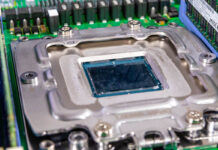

“One area where it appears to really differ is around the CPU socket, where we see eight crews and a much thicker perimeter around the fins around the socket.”
I assume crews means screws? The amount of typos and other tiny mistakes recently is a bit of a concern – please don’t let this site’s standards slip, sadly there are plenty of other low quality and AI generated alternatives waiting to take the place these days :(
To be fair, the typos are a good indicator that it’s not AI slop.
The left side of the last picture appears to show a total of 14 E1.S solid-state drive bays and 2 M.2 solid-state drives.
There are short fins directly on top of each processor socket. The 8 heat pipes from each processor socket (visible in the last picture) jump over DC-to-DC converters (visible in the second from the last picture) to reach the main fins. This creates space for each processor socket to have three PCIe x8 connectors, probably intended for CXL DRAM, and one PCIe x16 connector (most easily visible in the second from the last picture). These PCIe connectors could also be used to support an additional 10 E1.S solid-state drives, for a total of 24 E1.S drives. There doesn’t appear to be space in this chassis for normal PCIe or CXL cards. That probably means this same motherboard is intended to be used in a different chassis with more vertical space for PCIe and CXL cards.