

Lenovo ThinkStation PX Power Consumption and Noise
With dual CPU sockets and dual power supplies, the ThinkStation PX is no lightweight system. And as we saw in our tour of the hardware, that goes both figuratively and literally. As a result, in a maximum configuration, the system is designed to pull quite a bit of power and move plenty of air to remove all of that newly-generated heat.
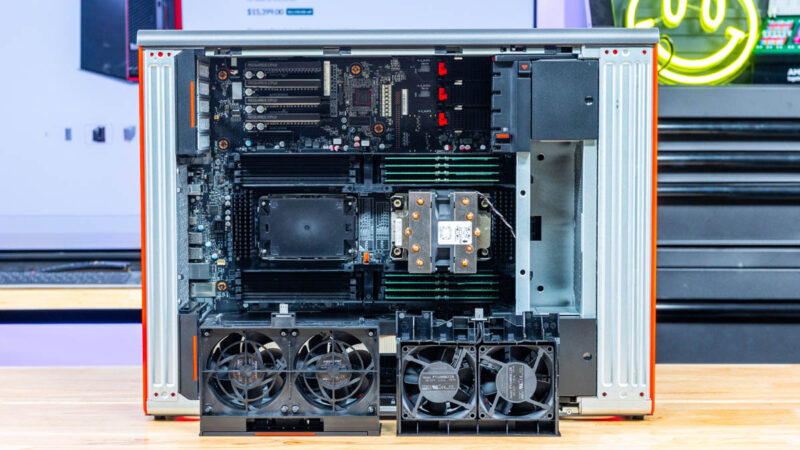
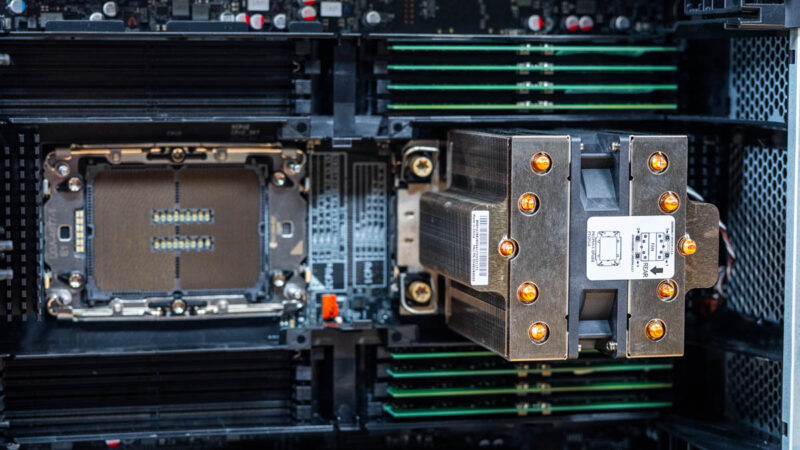
All told, there are 6 primary fans in the ThinkStation PX. This includes four intake fans – 2 for the CPU chamber, 2 for the PCIe chambers – as well as a second pair of fans as a rear exhaust for the CPU chamber. The CPU chamber itself is effective enough that the CPU heatsink does not require its own fan, and can be cooled entirely via the airflow moving through the chamber. As a result, there is no 7th high-performance fan tucked away inside the system itself.
In any case, even in a stripped-down configuration such as ours, the ThinkStation PX is (unsurprisingly) not optimized for idle power consumption. With the Xeon platform affording 8 memory channels, there is a lot to keep powered up even at idle. Overall, we measured it at 130-170 Watts at idle, and ramping up a 150W CPU plus a 300W video card put the peak load power consumption closer to 650-700 Watts.
As for noise levels, our findings are mixed. The idle noise of 38dBA is not amazing, but it is not too bad either. We got the load values well over 44dBA, which is a similar case: keeping in mind that this system is designed to handle two high-performance Xeon CPUs, 44dBA is not bad – and in practice, our specific configuration is greatly helped by the fact that there is just one mid-range Xeon CPU to cool instead. Overall this is not a silent system; it is a powerful system. Though Lenovo has clearly taken care to minimize noise generation as much as reasonably possible.
Key Lessons Learned
As Lenovo’s flagship Intel workstation, the ThinkStation PX is every bit the beast that Lenovo pitches it as being. But whether the beast will pull its weight depends on how the system is configured, as Lenovo offers a wide array of configuration options – not to mention end-user upgrades.
While I will never deride a company for offering flexibility in its designs, everything about the ThinkStation PX screams that it was built to handle the worst-case scenario of a fully equipped system. That means two high-end Xeon CPUs, three-to-four high-end video cards, several SSDs, and maybe something like a 200GbE NIC for good measure. This is a system that goes as far as accepting two power supplies just to deliver the 2350 Watts that such a system would require – blowing past anything a single-PSU system could support on a US 120 Volt outlet.
But this means that if you are not using two CPUs and a small army of video cards, the ThinkStation PX is not living up to its potential. And that potential still comes at a price, as accommodating all of that high-end hardware imposes significant design requirements on the overall PX chassis, which in turn gets baked into the system price regardless of the specific configuration.
In short, the ThinkStation PX is a hot rod of a workstation. It looks nice regardless of what is in it, but for it to tear up the streets (or tear through AI models) it needs to be given an engine to match.
Final Words
Going through a high-end Lenovo workstation is always a treat, as the care and design considerations that Lenovo puts into these systems is evident. With its focus on easily swappable parts, expertly routed cables, and copious documentation on how to maintain the system, the ThinkStation PX is as beautiful on the inside as it is on the outside, even if most people will never see it.
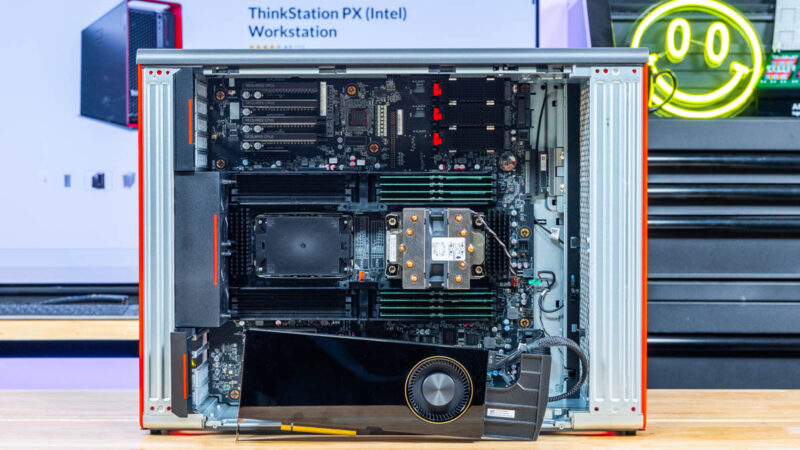
But aesthetics aside, the ThinkStation PX’s job at the end of the day is to do the kind of heavy computational work that only a dual-socket workstation can do. In that regard, Lenovo has positioned it to succeed. With support for two CPUs, 16 channels of memory, four video cards, and over half-a-dozen storage devices, the ThinkStation PX does not leave anything on the table. It is capable of accommodating as much computational hardware as you can stuff inside of a tower system – budget willing. In short, it is a beast: a server in the form of a desktop (or rather, floortop) computer.
Ultimately, for those rare power users who truly need every last bit of performance at their fingertips, the ThinkStation PX is exactly the kind of system it takes to get the job done.
 workstation performs and how it can be expanded)
No IPMI of any kind?
Ddr5 4400 is … terrible, to say the least.
@Codrut
Not by default. A BMC-on-a-card is an optional upgrade for the PX.
This system seems to have similar limitations as Dell’s Precision range; they don’t have much headroom above the PCIe cards for some of these current (non-workstation) videocards. I have a Precision 5820, 7920, and two 5860’s from Dell, and with some of these modern videocard sticking out an inch (or more) above the metal bracket, and then having the power connector ‘on the top’ (so you plug in the connector on the power cable and have to angle the cable itself, adding at least another half inch), you can’t close the lid on the system.
I am building my kid a system and had to specifically shop for an AMD GPU (going to run SteamOS on it, so Nvidia cards aren’t an option, and a 9060XT is about the same price as a 7600XT) that didn’t stick out over the metal bracket (which did significantly limited my choices).
There is an image showing the rear of the system, and it shows decent headroom, but on my 5820, to fit in a 1080GTX, I had to remove some kind of metal bracket from the lid, just to be able to close the lid.
@Ryan/Patrick. Any chance that on workstation reviews, you try some tall videocards to see what would fit in a system like this, as 2nd hand they make great mid-range (by the time they are 2nd hand they wouldn’t really be cutting-edge anymore) gaming systems.