

Intel Xeon 658X Performance
From a performance standpoint, the wide variety of CPU configurations available on the Xeon workstation platform means that the Xeon 600 series covers an equally immense range of performance profiles. Just the CPU performance scaling alone, from 12 cores up to 86 cores, represents a potential 7x range in CPU performance. Never mind the fact that some Xeon 600 chips get 4 channels of memory while others get 8.
This gives workstation builders and customers a wide range of system configurations and price points to choose from. It also means that there is no single “definitive” Xeon SKU that is the pinnacle of the platform’s performance. Even the top 698X SKU, with 86 cores and support for every feature under the sun, including MRDIMMs, is potentially held back by its TDP limits, which is why the chip has a notably lower all-core turbo frequency of just 3.0GHz, compared to other chips guaranteeing as high as 4.5GHz. All of which is to say that this is less of a hierarchy, and more of a spectrum.
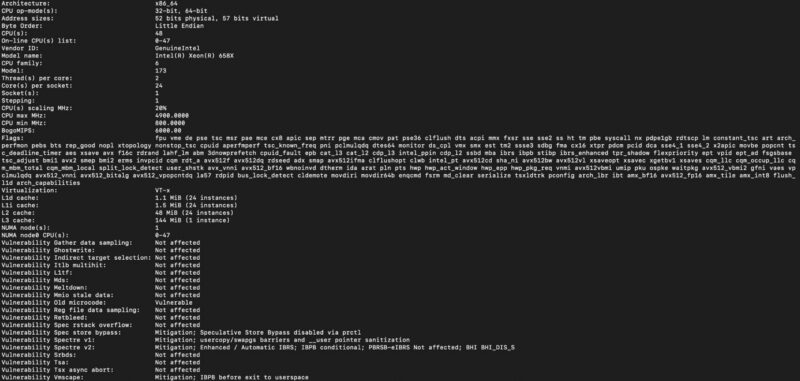
For our review of the Xeon 600 series, Intel sent over the Xeon 658X, their first-tier X-series part. With 24 cores, the chip is ahead of about half of the Xeon 600 stack (5 chips have 20 or fewer cores), but it is a fraction of the core counts offered by the highest-end (and most expensive) chips. On the other hand, it is an 8-memory-channel part and unlocked, so, core counts aside, it fully leverages everything the Xeon 600 platform has to offer.
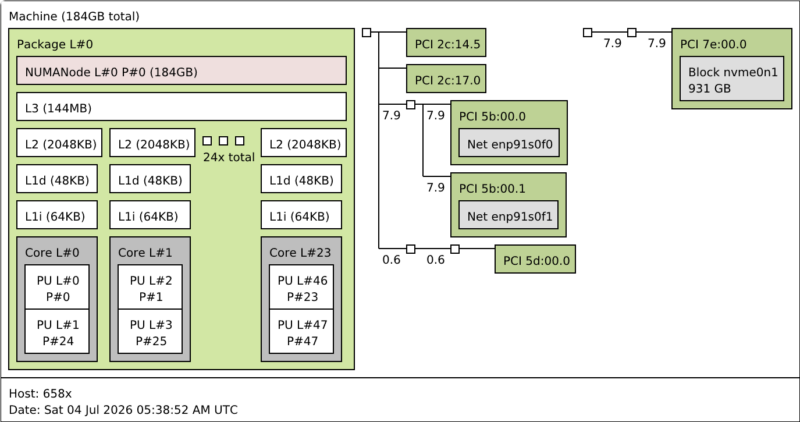
The wide spectrum of core counts across workstation parts does present a broader problem for apples-to-apples benchmarking, however. We have plenty of workstation and server processors lying around the STH labs, none of which have 24 cores. Most of our review sample chips have been higher-core-count parts, so the best we can do is look at the Xeon 658X in the context of either the platform or with a restricted number of active threads to level the playing field a bit better. It is not perfect, but it will have to do.
Core-to-Core Latency
To start off our look at chip performance, here is a quick look at core-to-core latency.
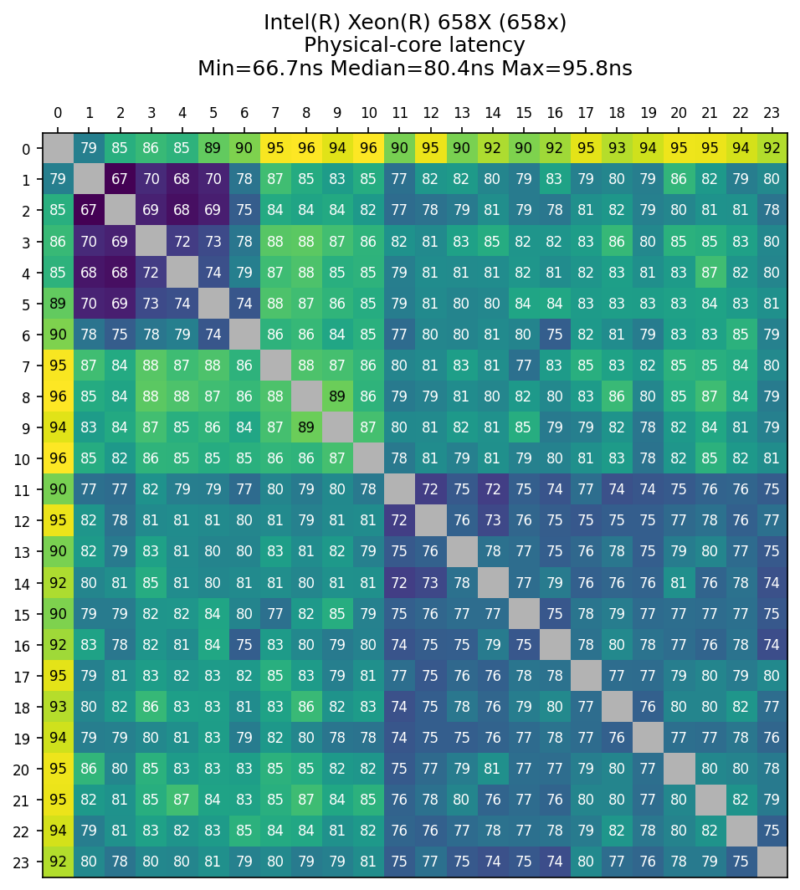
As a reminder, Granite Rapids employs a mesh fabric between the cores, which Intel terms a “logically monolithic mesh.” In the case of a 24-core part, Intel’s HCC compute tile is more than sufficient, so this is both logically and functionally a single monolithic compute die CPU from the perspective of the CPU cores.
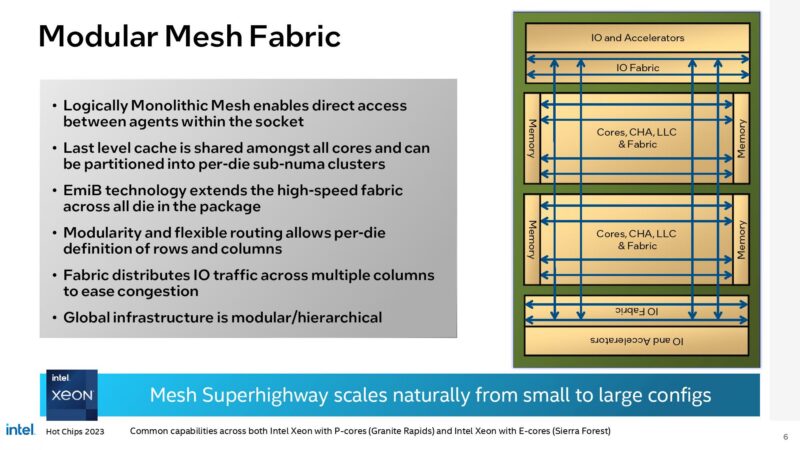
To that end, we see that core-to-core latencies are pretty smooth across the entire chip. The cores nearest a given CPU core typically have the lowest latency, with our tools recording a minimum latency of 67ns, but even the median is only 80ns. So there are no hard cut-offs where latency spikes when having to cross a chip barrier of some kind.
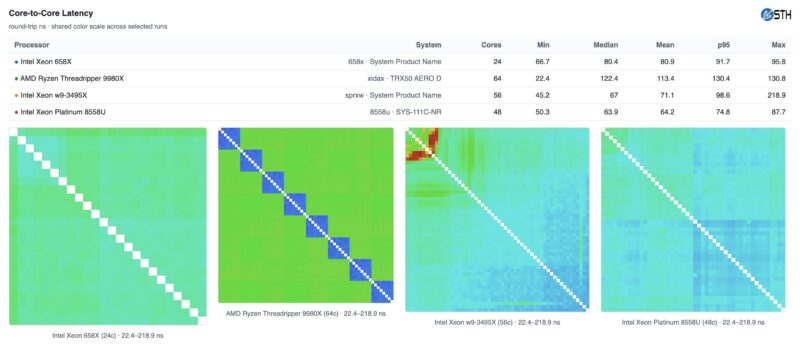
Throwing up a comparison with other workstation CPUs, the Xeon 658X largely behaves like Intel’s previous-generation Xeon parts in this respect. Though the average latencies (both mean and median) are higher for the 658X than they are for either the W9-3495X (Sapphire Rapids) or the Platinum 8558U (Emerald Rapids). Otherwise, as compared to AMD’s Threadripper 9980X (Zen 5), this shows why consistent average latencies remain something of a strong suit for Intel – albeit at the cost of higher minimum latencies.
Memory Performance
Shifting gears to memory performance, we have LMBench’s suite of tests.
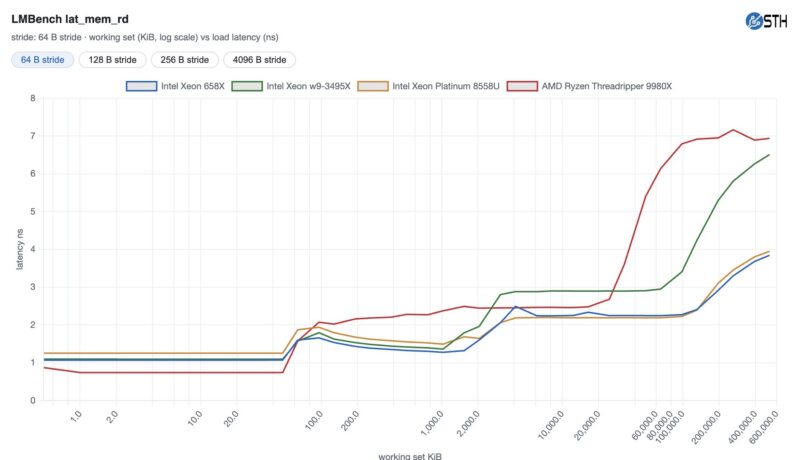
Starting off with the memory read latency benchmark (lat_mem_rd), we find that the Xeon 658X behaves quite a bit like Emerald Rapids when using a small 64 byte stride. Intel has a tighter memory latency range overall, with all of the Xeons clustered quite close together until we get past the L2 cache. After this point, the 658X is effectively tied with Emerald Rapids for most of the run, edging it out at the highest working sets. What keeps the 658X from sweeping this test, however, is that the Threadripper chip offers lower read latency at the L1 cache level.
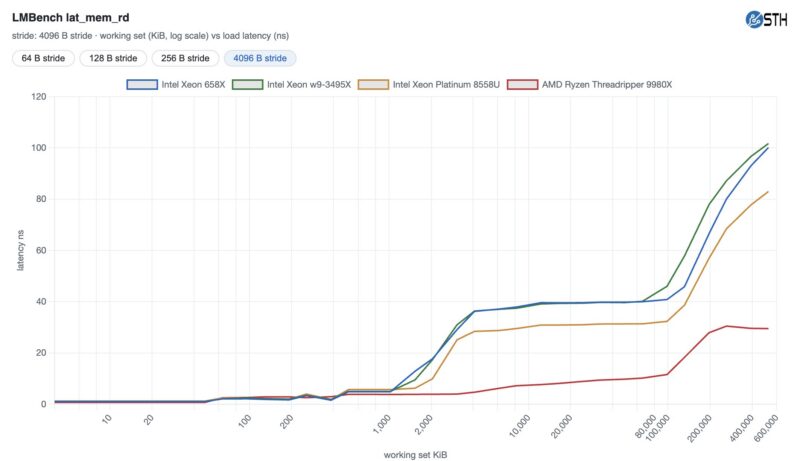
We also ran with a larger memory stride of 4KB (a full cache page size), and found that the picture changed significantly. The Xeon 658X ultimately performs worse than our Emerald Rapids CPU, despite the advantage of a newer architecture. More significantly, latencies are over three times as high as those of the Threadripper chip, even after the working sets are larger than the chip’s L3 caches.
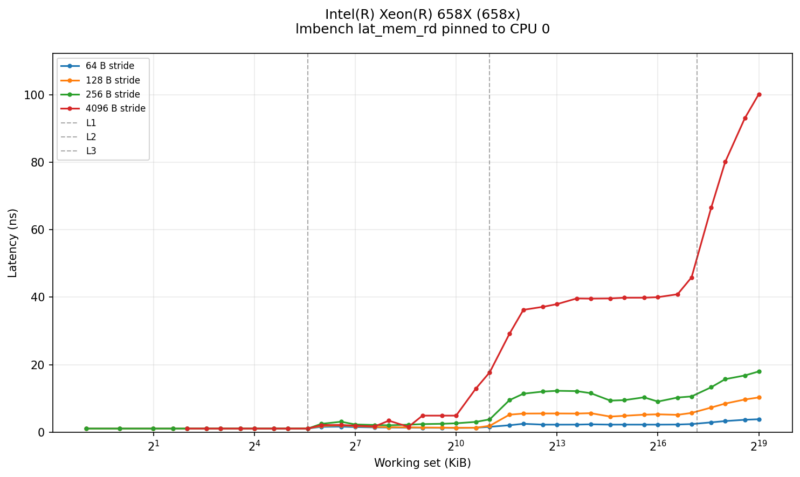
Plotting only the 658X across multiple stride sizes makes it easier to see what is going on. While latencies increase with larger stride sizes (as expected), 4KB strides get especially hammered here. Moving from the L2 cache to the L3 cache, and then again from the L3 cache to main memory, both incur large latency penalties.
SPEC CPU 2026
The recently released 2026 edition of the SPEC CPU benchmark suite also offers a fresh look at Granite Rapids’ performance. Just a note: we are using Ubuntu 26.04 LTS with LLVM 22 and are only using -O3 optimizations, so these scores are much lower than official benchmark runs. We are using that just to differentiate our estimated results from the official scores you may see from vendors that use highly optimized flags/configurations.
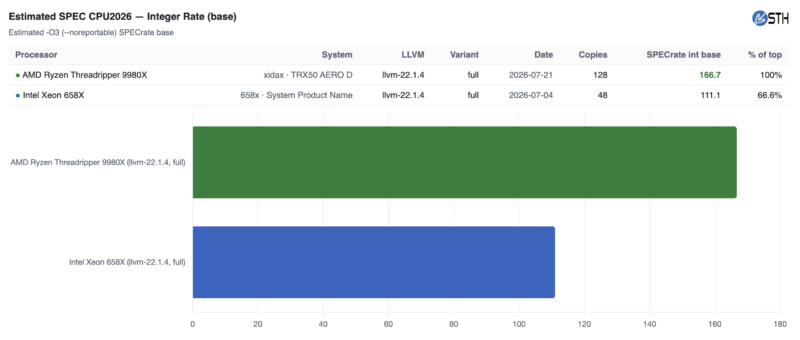
Despite working with rather mismatched workstation processors in terms of core counts, the Xeon 658X and Threadripper 9980X are a bit closer here than one would expect based on their specifications alone. True, the 64-core Threadripper is in the lead with a geomean score of 166.7 to the Xeon’s 111.1, however the Xeon comes within 66% of the performance with 40% as many CPU cores.
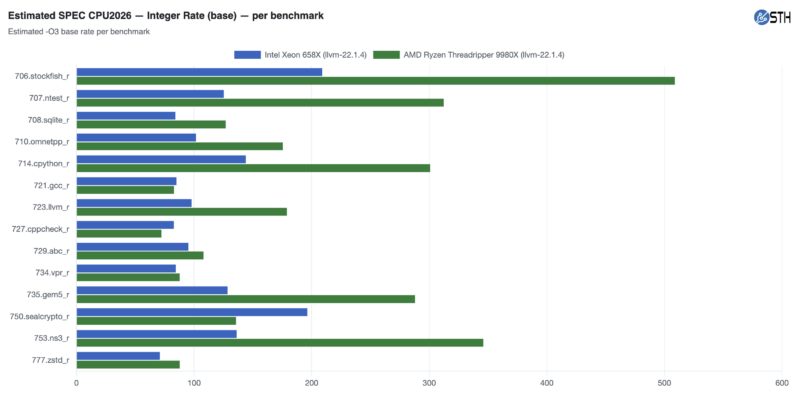
Looking at the individual benchmark scores, the Xeon even manages a couple of wins in tests with lower optimization levels. The story is even more remarkable on the floating point side.
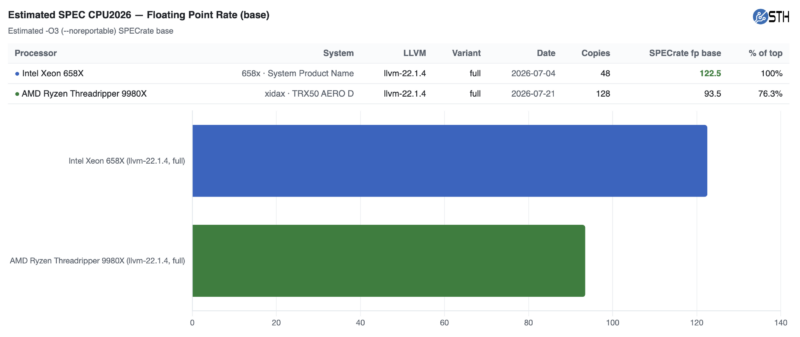
Here the Xeon 658X system is actually in the lead.
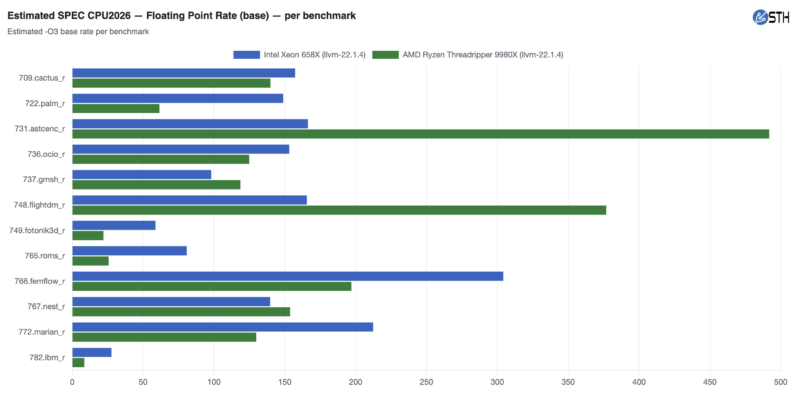
Once more looking at the individual scores, we find that the Xeon is winning more often than not, but also that the relative performance of the two chips is all over the place. Each chip takes a rather significant lead in some benchmarks, only to fall well behind in others. Again, this is all with the Threadripper system containing a much larger number of CPU cores.
Some of this comes down to architectural differences. The bigger difference, especially for the floating-point benchmarks, lies in the rest of the platform. The non-pro Threadripper is a quad memory channel platform, whereas the Xeon 658 is part of the high-end selection of Xeons that all get 8 channels of memory. The floating point benchmarks in SPEC have long been sensitive to memory bandwidth.
This means the comparison between the two chips is not apples-to-apples in either core counts or memory configurations. But it goes to show the role the complete platform plays in system performance, and really, why the extra memory bandwidth of an 8-channel platform can be very helpful, at least as far as SPEC CPU 2026 is concerned.




Anyone know why core 0 is such an outlier in the latency graph?
Not sure why anyone would pick this over AMD’s offering. We are not in 2006 anymore where games or apps would run slower on AMD due to software optimisation.
@justsomeguy
I have a suspicion it’s power management-related. But we admittedly haven’t had a chance to do any further diagnostics on the issue to properly isolate it.
It is good to see Intel somewhat back in the game.
Quite possible in the workstation market we are approaching a point where gains in CPU just really do not matter all that much. Can you really keep 30, 60, or 100 cores busy all the time? That is an immense amount of compute (of that sort), and for quite a lot of use we are likely to see diminishing return.
The next episode may be more about hosting one or more GPUs or LLM-custom PCIe cards, and the bandwidth to shuffle data to memory of across the PCIe bus. Need lots of PCIe lanes … but maybe not so much more CPU compute.
For many of us, current high prices limit our choices. But when the AI-bubble bursts, there will be a flood of disused GPUs on the market, and lots of folk wanting to lash together rigs that can make use.