

We ended up purchasing a bunch of these Intel SPTSLP2SLCDF 100G-DR1 optics a few weeks ago for a very specific application. The optics are QSFP28 modules with 500m of reach, utilizing single-mode fiber. Since we had an extra, we did the STH thing and took it apart. This is a neat optical module because it is doing something internally that is a bit different.
Intel SPTSLP2SLCDF 100G-DR1 500m 1311nm QSFP28 Module Quick Look
Intel used to have a business selling optical modules where Facebook/ Meta was its major customer. Ultimately, Jabil Bought the Intel Pluggable Silicon Photonics Business. Still, a huge number of these modules were produced.
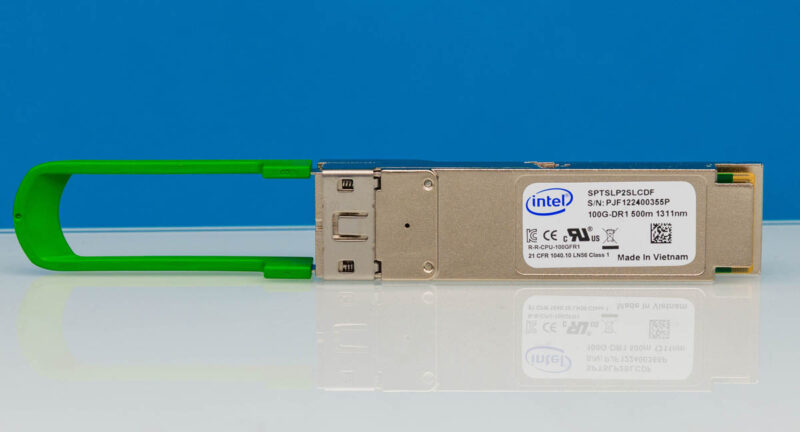
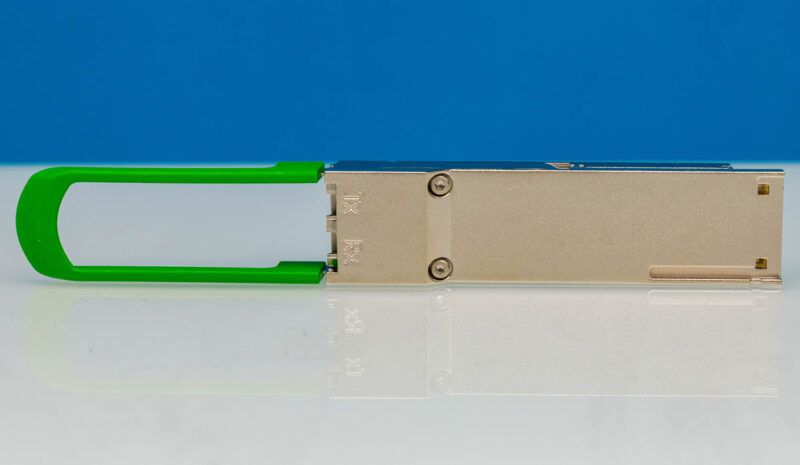
QSFP28 modules look fairly similar.
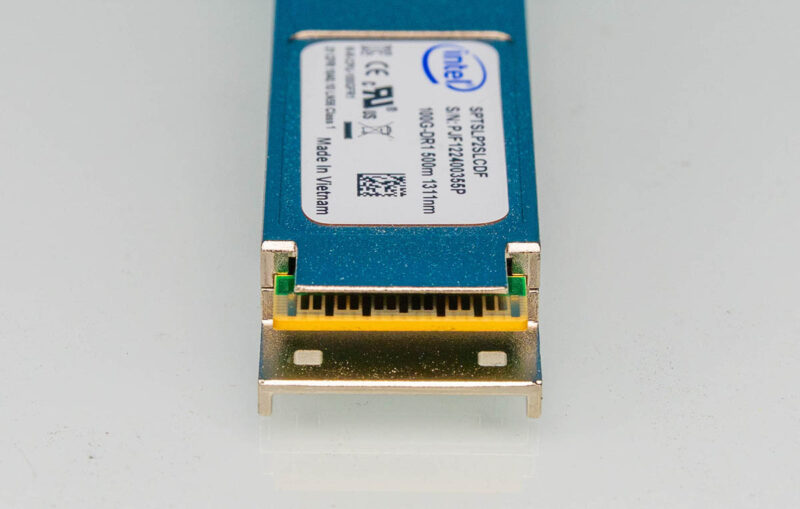
Starting with what makes this interesting is that this side is the QSFP28 connector, which uses NRZ.
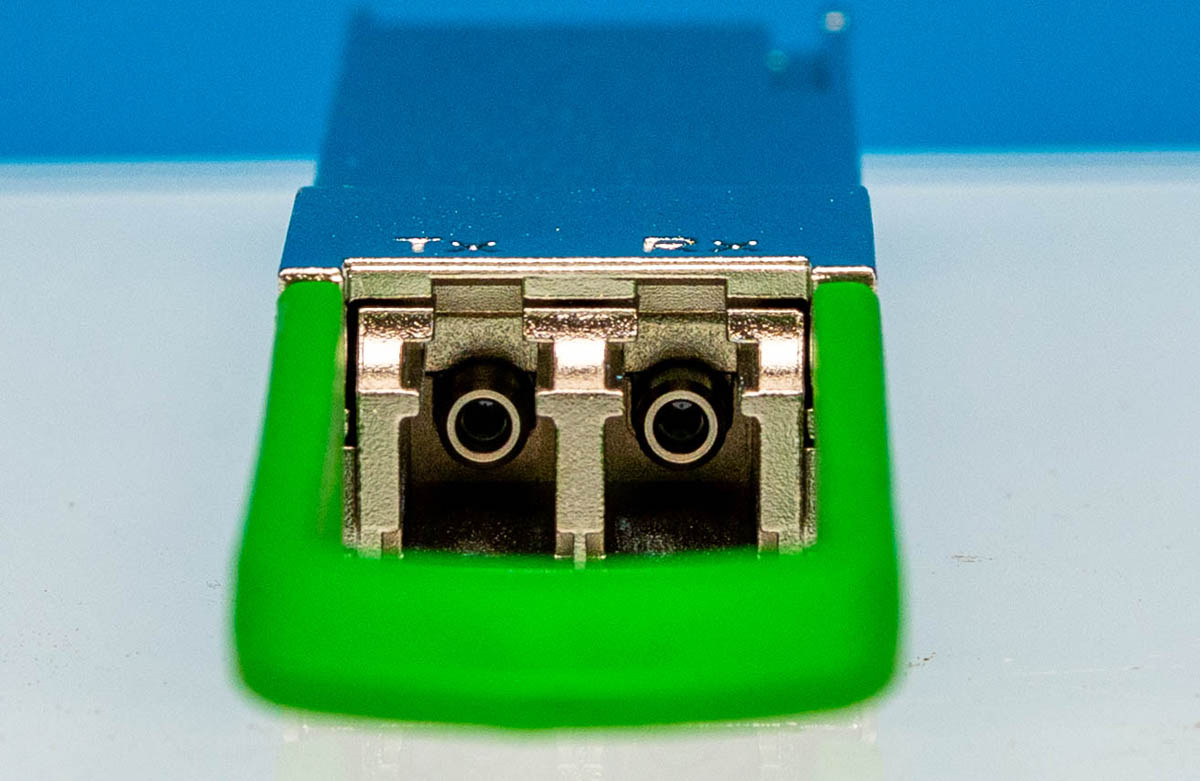
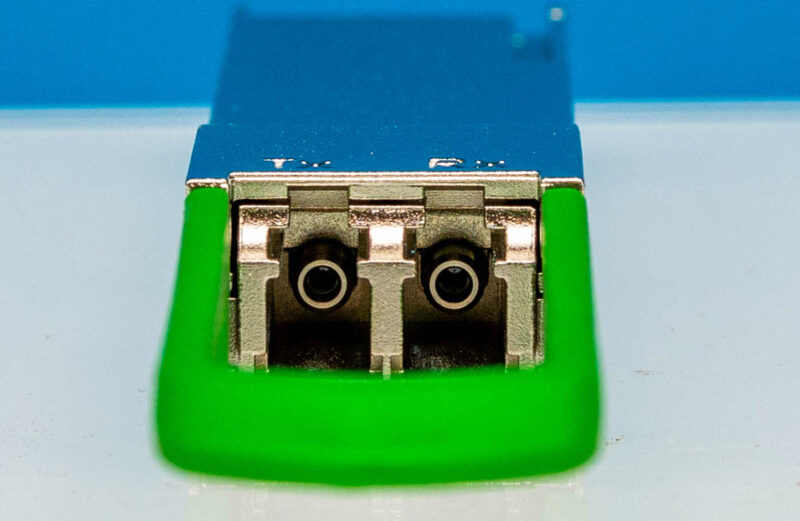
On the optical side, we have a single-mode LC connector. Since this is a DR1 optic, it uses PAM4.
Here is a quick look inside. At the bottom, you can see the Inphi IN010C25. Inphi was purchased by Marvell, so this is the Alcor 100G PAM4 DSP. More specifically, this is the 4x 25G NRZ to 1x PAM4 100G variant of the part.
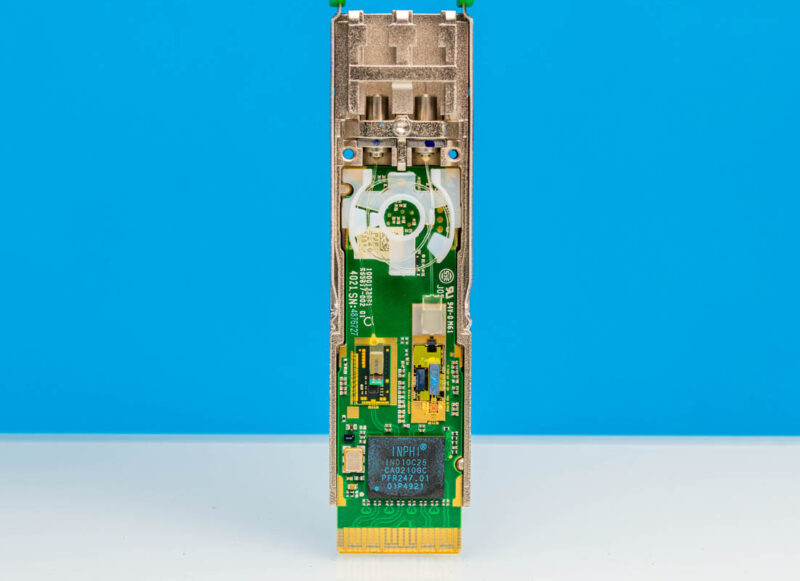
Opening this up, you can see the send and receive side.
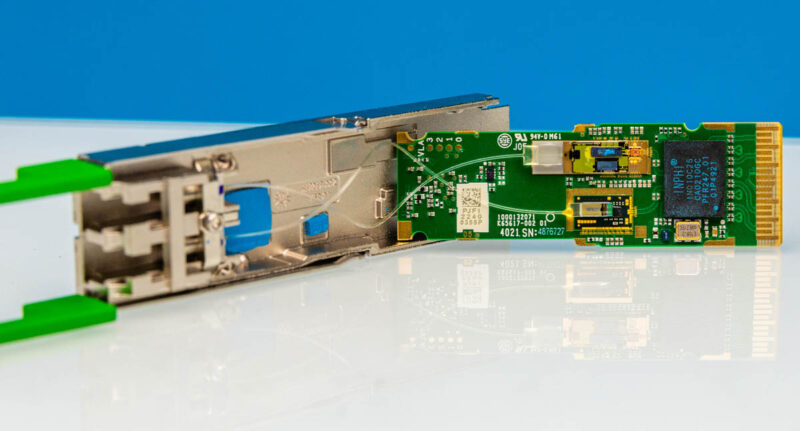
Here is a closer shot of the optical engines.
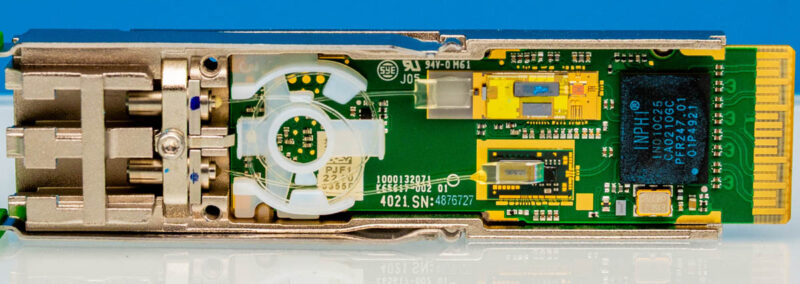
Here is the back side of the PCB.
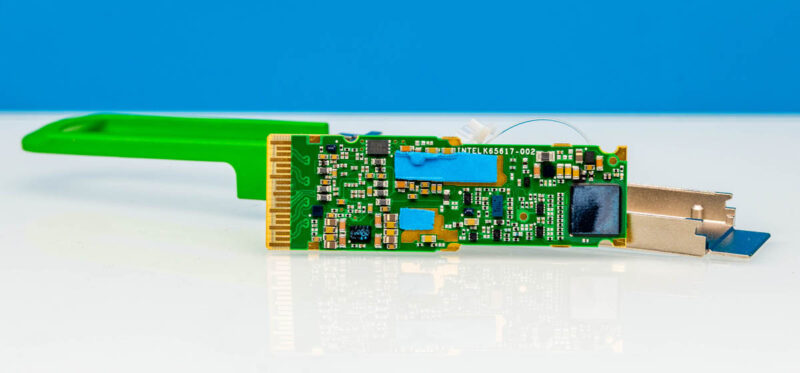
Inside these modules, we find something a lot more interesting than just looking at the metal case.
Final Words
We needed 32 of these, so we ended up buying 40, and one was sacrificed to bring this piece to you. We previously showed QSFP56-DD 400G DR4 Intel Silicon Photonics optics. That is an optical module that runs four PAM4 100G channels instead of just the one we are looking at here.
These are fairly specific tools and generally, we would not suggest getting DR1 optics unless you need them.

Why wouldn’t one want to use them ?
It seems those would simply the fiberoptics part significantly.
How much do used ones go for ?
Also, is this kind of thing to be expected in the near future across the board – using just one pair of fibers ?
Are prices about to come down ?
Also, aren’t there versions that do signal multiplexing purely through optical emans ( multiple wavelengths etc) ?
I’m assuming that you bought the 100G-DR1 optics so you could have 4 of them talk to a single 400G-DR4, but the article doesn’t actually say that. I doubt there’s any other real advantage for short-range single-lambda optics like this *today*. If they were higher-powered then they might make sense for WDM use, but short range + WDM is an unusual mix. It’s usually cheaper to just pull more fiber.
Also, technically, I think they’re actually just “100G-DR” according to the standard; I don’t know why other 100G-xR1 standards include a 1 but DR doesn’t.
I suspect that we’ll end up standardizing on either 100G-DR[1], -FR1, or -LR1 for the SFP112 generation, when 100G becomes the baseline for everything. DR is probably the cheapest, all else being equal, but that’s rarely the case, so I wouldn’t be shocked if -FR1 or -LR1 actually end up being the most common. They’re all using 1311nm and PAM4, so maybe they’re mutually compatible enough that they’ll interoperate, possibly with attenuation?
50GBaud PAM4 DSP has high power consumption and high cost. For distances up to 100 meters, SR4 is used; for distances up to 500 meters, PSM4 is used; and for distances up to 2 kilometers, LR LITE is used. Currently, DR1 is rarely used, except in cases where the main data network of DPI equipment is modulated with 50GBaud PAM4.