

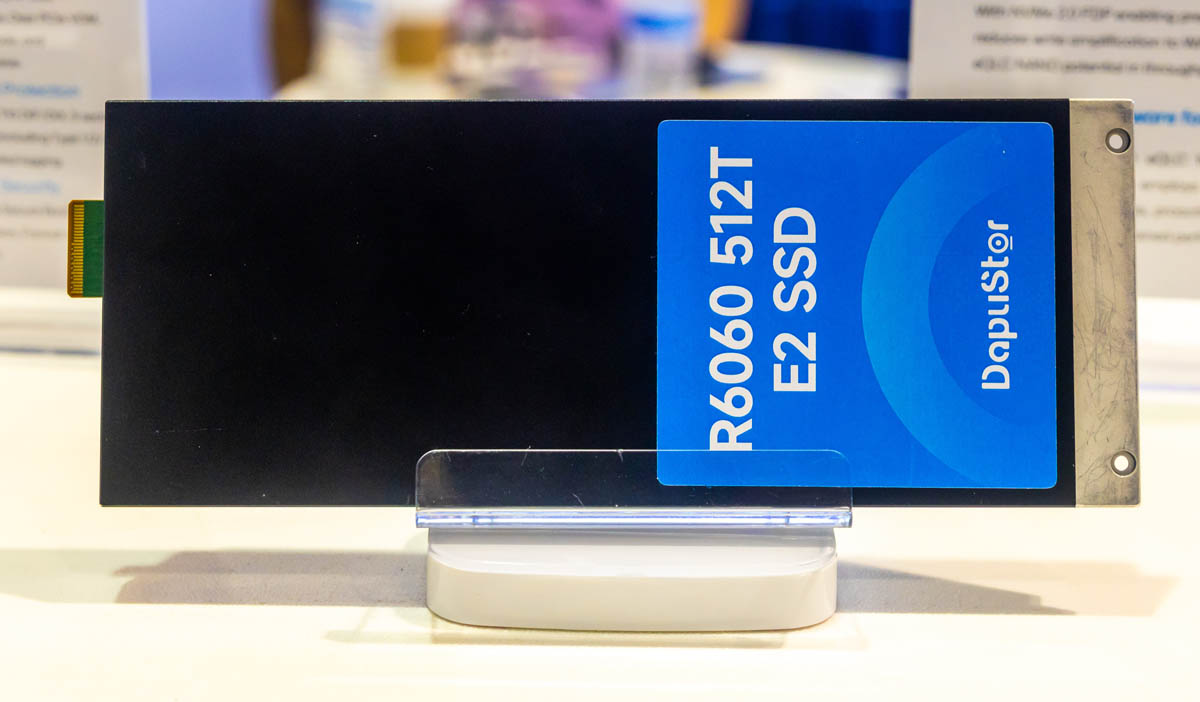
Last year, we covered A Meta Vision for GPU Scale Compute with 1PB E2 SSDs. At this year’s FMS2026, there are two major storylines. First, compared to last year, the show is significantly more upbeat, with many NAND and DRAM vendors experiencing unprecedented business booms. Second, there is a notable shift away from the trend of ever-increasing SSD capacities. That is what makes the DapuStor 512TB E2 NVMe SSD interesting to see.
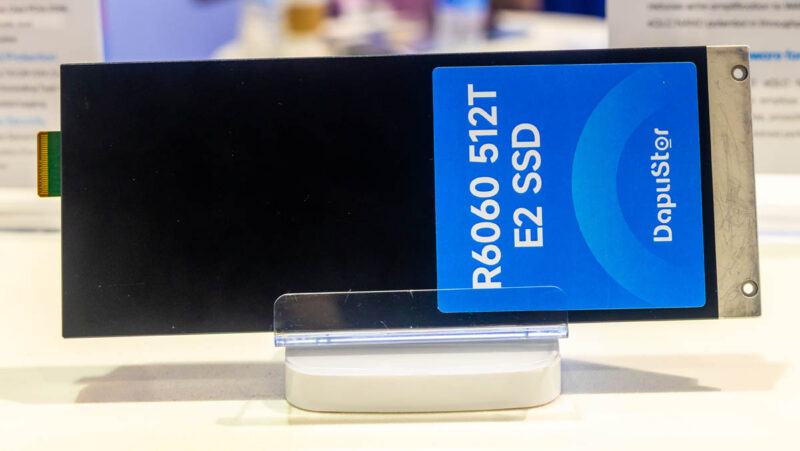
Gigantic DapuStor R6060 512TB E2 NVMe SSD Shown at FMS 2026
The drive is part of the company’s high-capacity family and uses the E2 form factor.
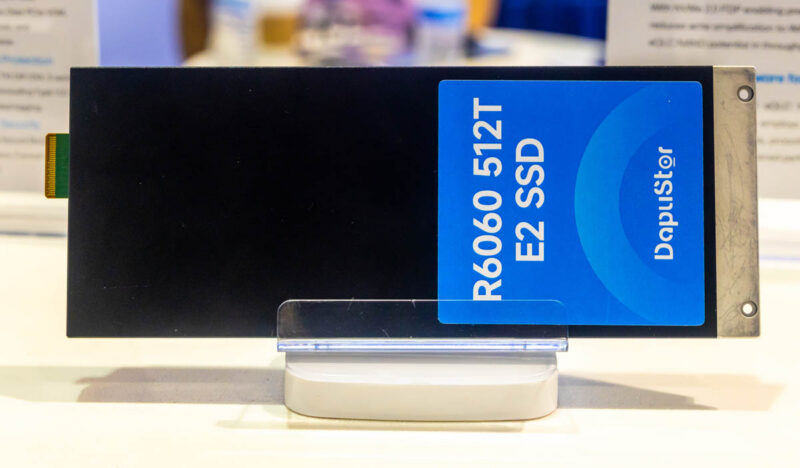
We previously reviewed the DapuStor Xlenstor2 X2900P 800GB SLC SSD and the DapuStor Haishen5 SSD H5100 30.72TB drives. High-capacity QLC NAND is in demand these days because simply holding enough training data for modern models, handling cache reads in inference, storing video and audio, and other applications are driving demand for storage capacity more than performance. As a result, DapuStor has a family of NVMe SSDs on display at FMS 2026.
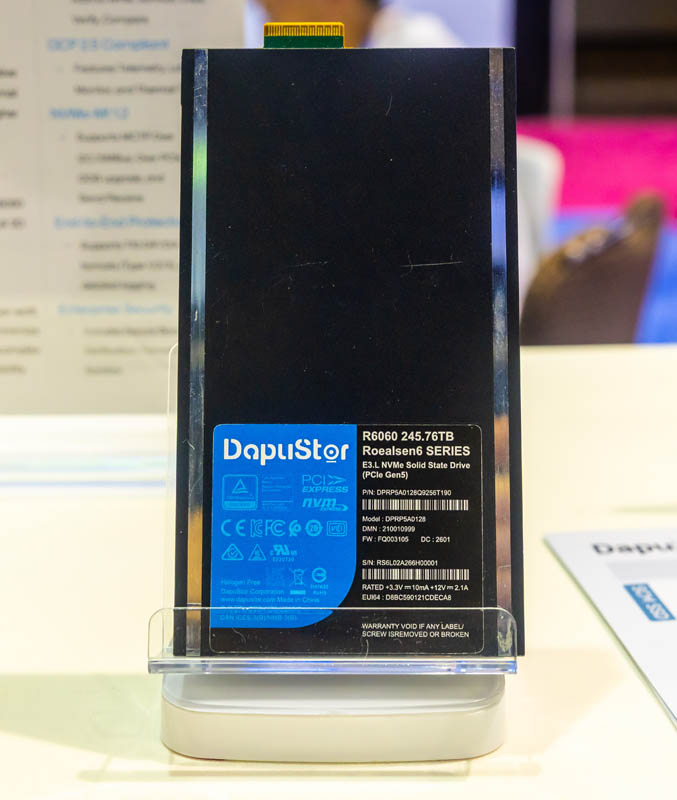
For form factors like E3.L and E1.L the capacity is limited to 256TB (245.76TB)
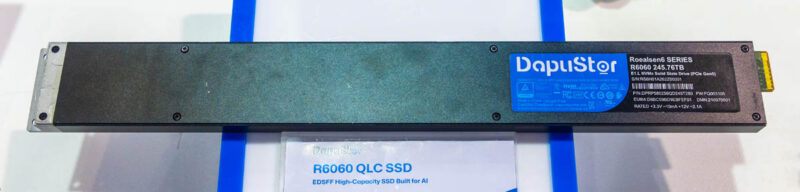
The big one, however, is the E2 SSD. This is a 512TB model, making it notably larger than the higher-end E3.S or U.2 drives that are pushing 256TB capacities.
The EDSFF E2 idea is really to build a platform that can handle more NAND placements than E3.L drives by adding a few mm more of depth and width to the devices.
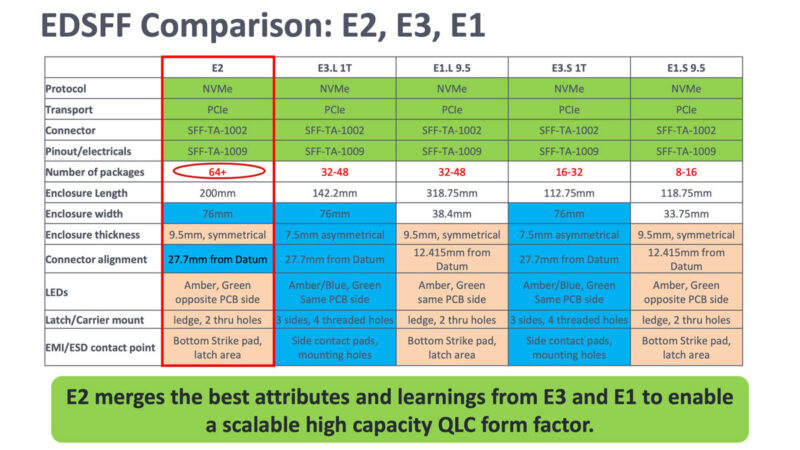
Even if you look at the server below, which has 36 E2 drive bays, a 512TB drive allows you to have a single system with 16PB of capacity.
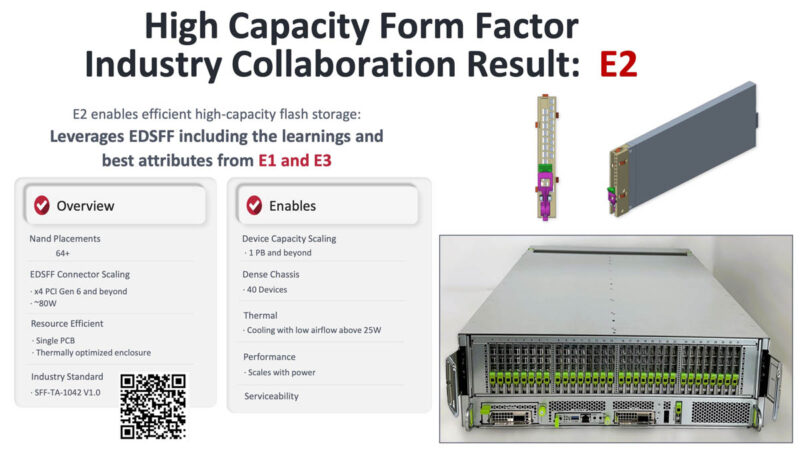
While one may argue that you could use 2U servers with E3.L SSDs and build denser storage than the server above, the real point is that the E2 form factor allows you to attach more capacity to a given CPU or dual CPU server. That, in turn, tends to lower the costs of getting storage online because you need fewer memory modules, chassis, motherboards, and so on. If you are optimizing for power, then having fewer CPUs, NICs, memory, and so forth also means a lower power envelope. What has happened in the meantime is that, as NAND pricing increased, the system’s cost is now so heavily dictated by NAND that it makes sense to use smaller-capacity drives. At some point, however, E2 also allows you to hit a lower capacity with lower-density NAND because you have more NAND sites, which may help deliver lower-cost SSDs.
Final Words
This was just a neat one to see. There is something about high-capacity SSDs that I always find interesting because I lived through the days when using an SSD meant trading off capacity for performance versus hard drives. I also remember the time when 512TB was a healthy-sized storage array. Now, SSDs are so much denser than hard drives that we have a half-PB in E2 devices being shown at trade shows.
I know folks are wondering how much this costs. We did not get an exact figure, but I would expect it to be a lot given current NAND pricing.

As cool as this is, Roealsen6 evokes explody drop shipped crap from AliExpress or Temu
Is it a 6 digit price tag attached?
wonder what the max power draw you can get over those 6x tiny 12V contacts on these drives
Increased capacity, lowered TCO, happy shareholders. What’s not to like, right?
What speeds can one expect from these E2 drives? If less than maxed out PCIe 6.0, I would prefer multiple smaller (faster?) drives in multiple servers for distributed fail surface and speed. Rebuilding a 16PB array, doing parity checks on 40 drives, cramming even more disks in already crammed servers… I remember rebuilding 5400 rpm HDD arrays era and beyond capacity and technology, it seems the time wasted for those unfortunate events keeps growing linearly with capacity (my intuition, I haven’t done the math)…but this is Meta and these will hold the exabytes of usage profiling crap for their AI training datasets where they write once, read alot, update/delete almost never.