

Beelink GTR9 Pro Internal Overview
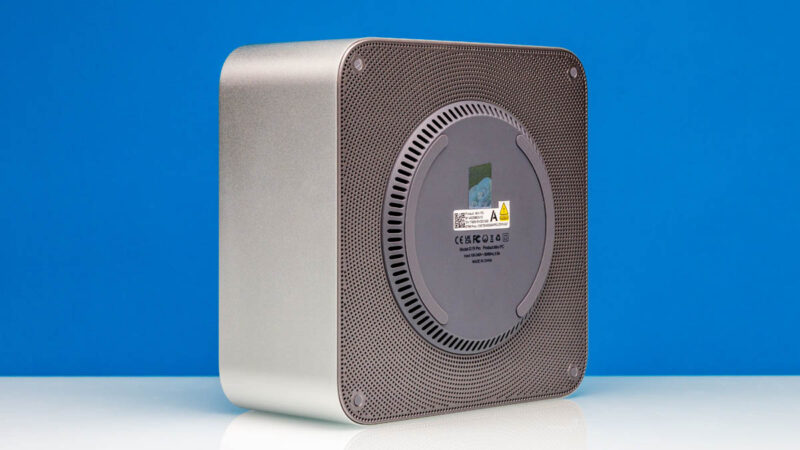
Since the top is all a single piece of metal, the only access is through the bottom of the unit.
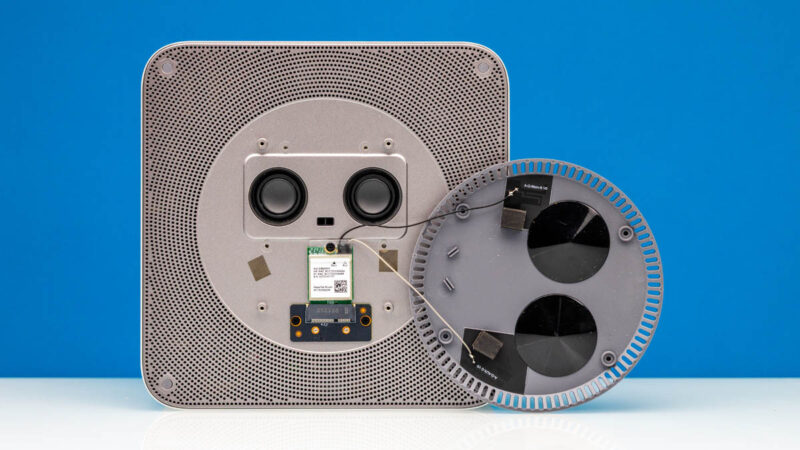
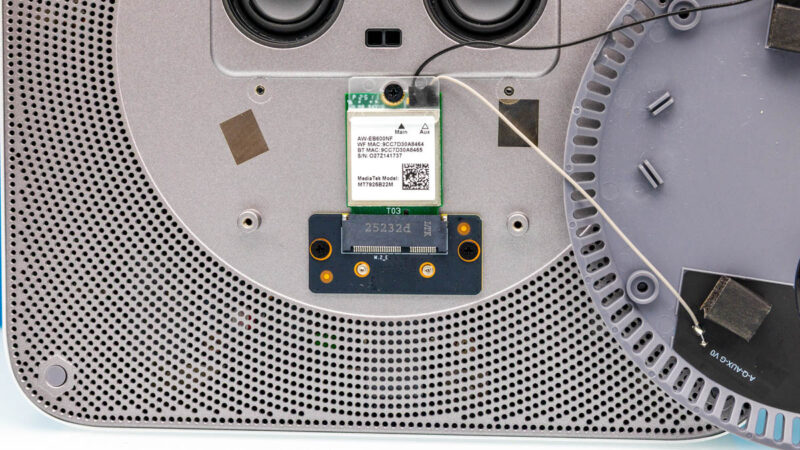
Pulling off the circular center section, we see the WiFi card and speakers. This is an example of how the design is becoming more complex versus something like the Beelink GTR7 Pro which was a favorite of that generation.
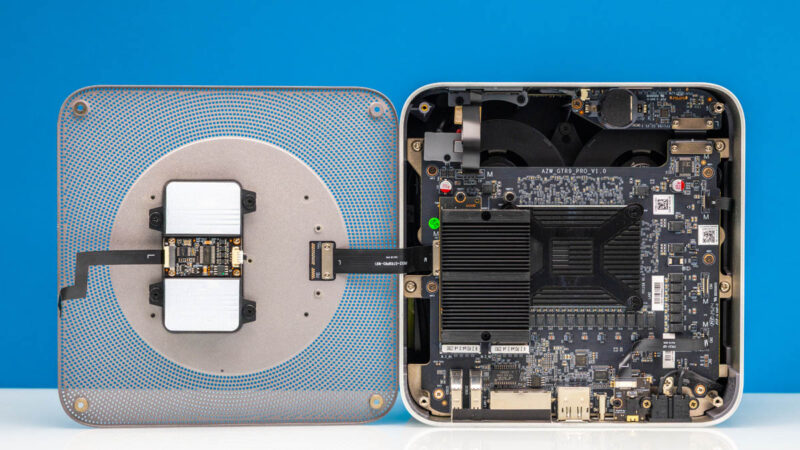
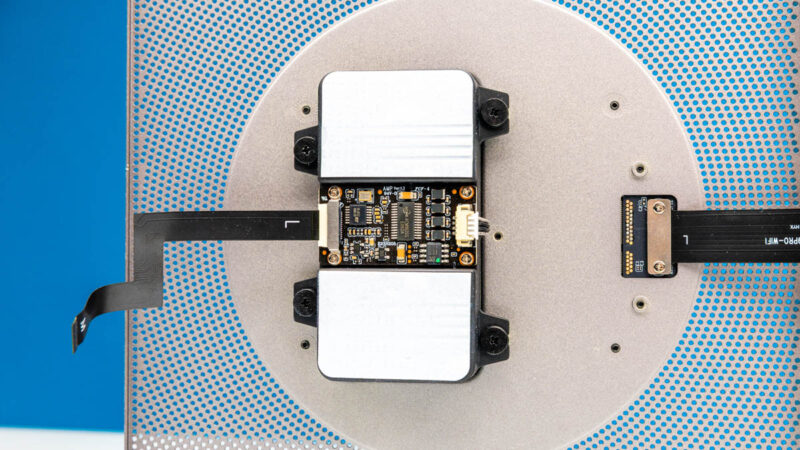
Showing how this is all connected also requires removing the bottom cover. You can see that there are two ribbon cables that help connect the bottom cover features.
One of them is for the WiFi card.
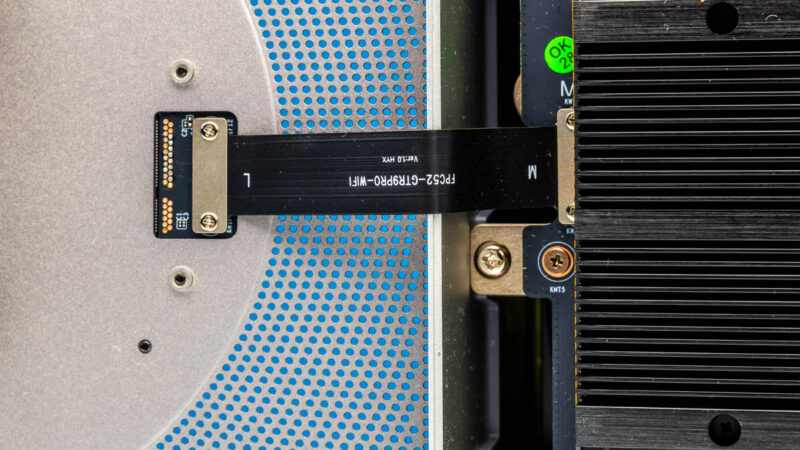
Instead of having theMT7225 WiFi 7 card inside the metal chassis, it is in this bottom plastic section. It costs a bit more to do this than to have it on the motherboard, but it is a really neat design.
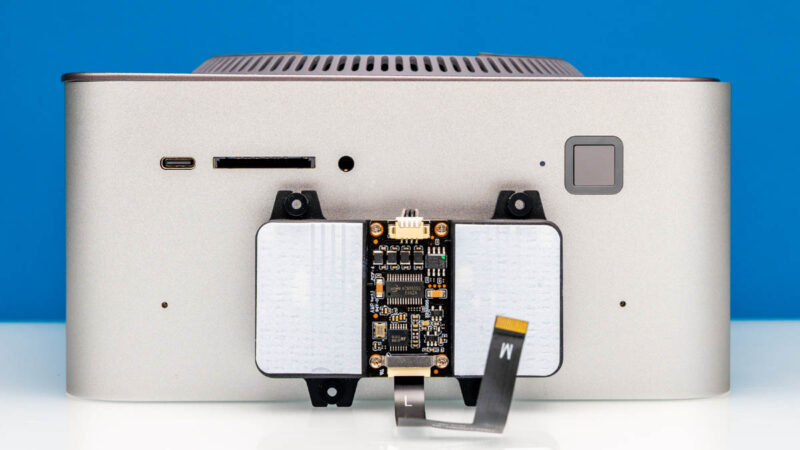
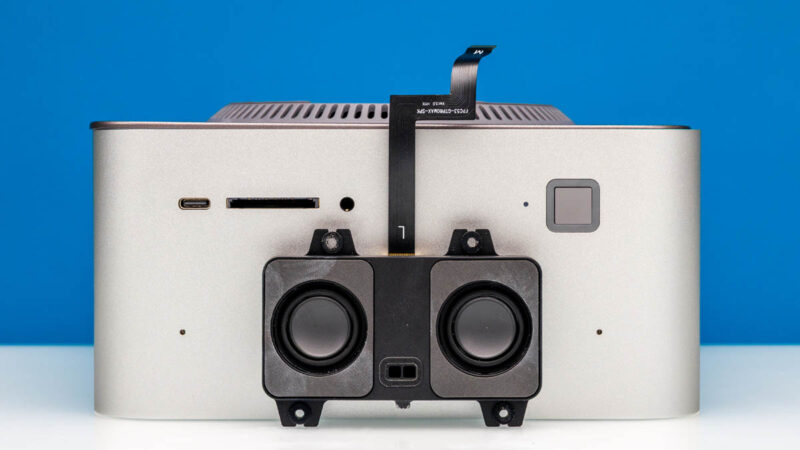
The other cable is for the speaker assembly.
We pulled this out so you can see it.
You will not want to use this system like a Boombox. On the other hand, it is at least something in terms of built-in audio.
Getting inside, there is actually not much to service because the memory is 128GB of LPDDR5X. That means both the memory and the CPU are soldered.
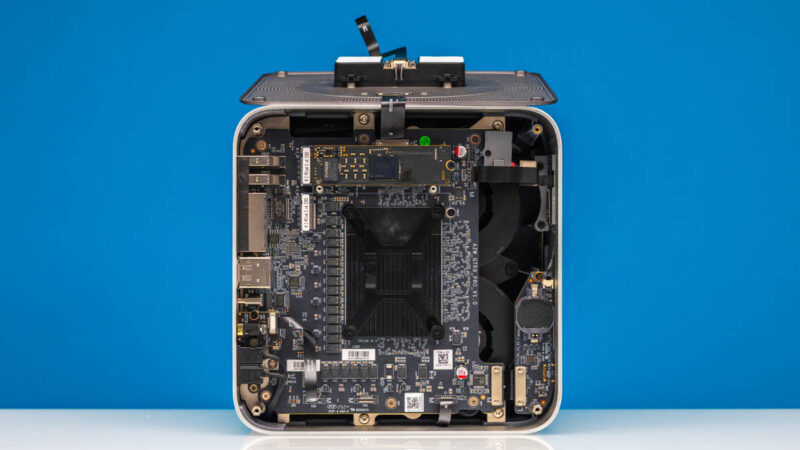
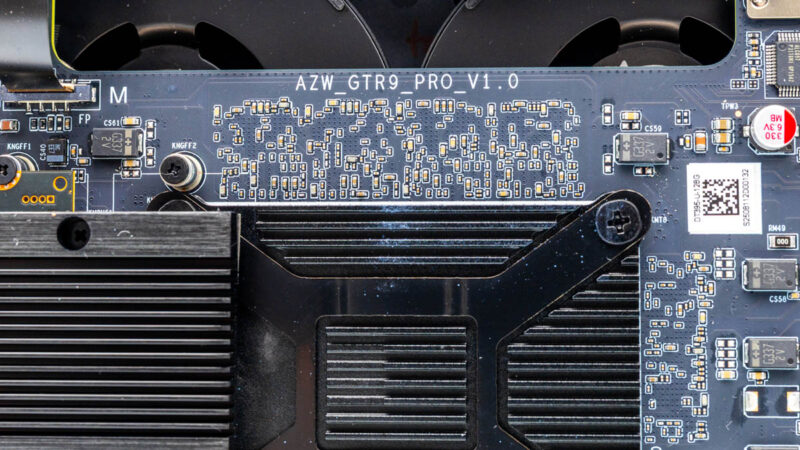
The bottom has a little heatsink under the AMD Ryzen AI Max+ 395 APU to keep it just a little cooler. The other heatsink is for the SSDs.
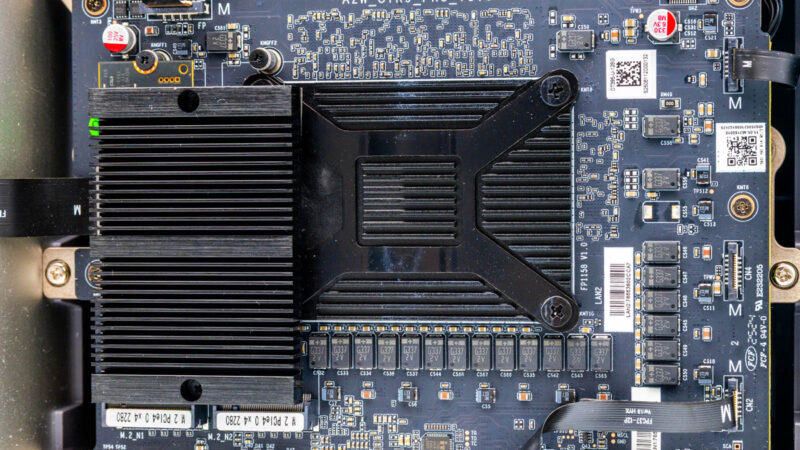
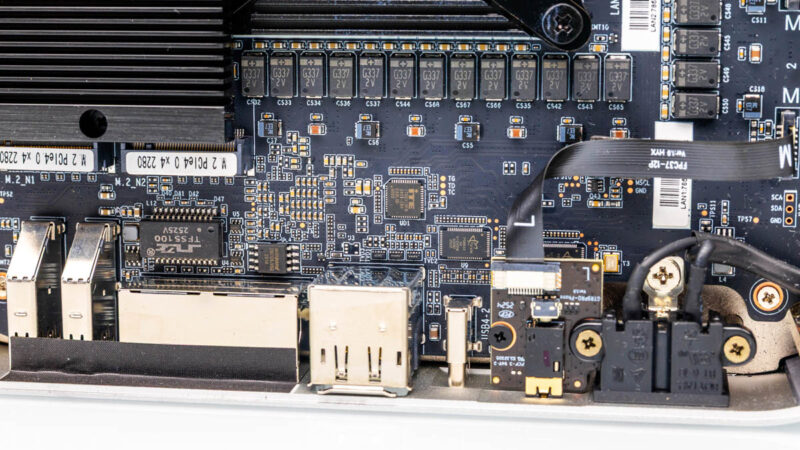
Built-in, we get a single 2TB NVMe. The two slots are M.2 2280 (80mm) and PCIe Gen4. A small feature is that these slots are labeled directly on the slot. That seems small, but when we talk about Beelink upping its quality, that is another good example.
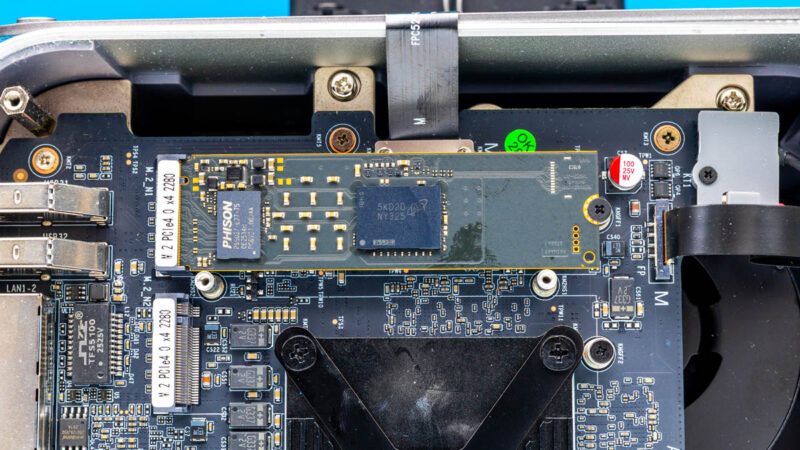
Another good example is that the system is no longer just a single PCB like we saw on older systems. Instead, the WiFi is on a different board, the speakers have another board, the front I/O has another board with the battery which is not just stuck with tape somewhere.
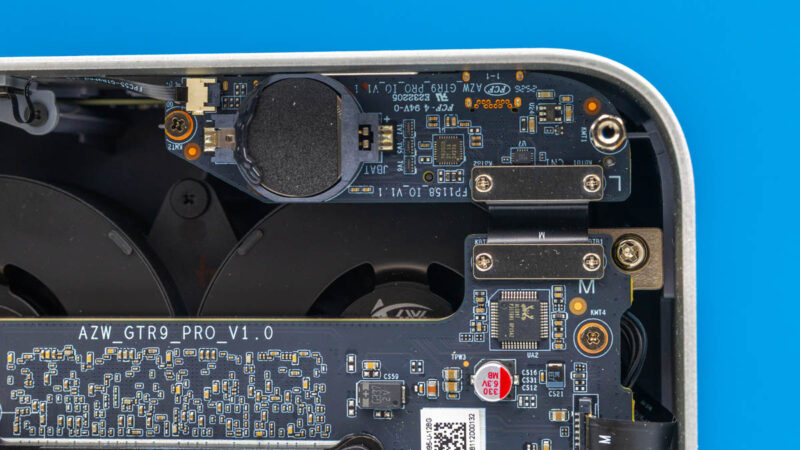
Even the rear ports are wired in a more complex level.
You can see the fans that cool the AMD APU, LPDDR5X, and more on the top of the PCB. We did not want to open this and mess up the cooling for our performance testing.
Next, let us get to the performance.


I’d love a bit more on how these run Linux, do all the drivers play nice etc
On paper specifications look good. In in practice we bought HP Z1 / Z2 months ago for much less
I returned mine because the fan noise was unbearable, at 52dBA, one full bel above the rate 32.
Comparing the gtr9 pro vs other Halo 395 systems on noise would be nice. I’d pick this over the framework desktop if it was quieter.
i like the GTR9 Pro but i would like it even better with working Intel E610. The NICs keep crashing under load, i have got Windows and Arch Linux. Right now i have got a USB-C NIC as a workaround.
Mark – Where did you get a HP Z2 Mini G1a Max+ 395 with 128GB for less than $1999? I cannot find it. I will buy one at that price to review.
Fazal – That is strange. We have 4 of these Strix Halo systems, and this is the quietest.
Bill – To me, the features are also better, and it is a lower cost. We filmed the Framework very soon after this one, but we put this ahead of the Framework in publishing order.
Todd – Yes. That is why we went into that issue here. I was told it is getting fixed with a new Intel driver, but it is not here yet, so we have that in the review. I feel a bit mixed on that since we can update this review when a fix arrives, but the video will mention that issue even after a fix arrives.
I have the EVO, the Framework Desktop, and the HP Z2 Mini G1a (~2600 usd on sale)
The HP is the loudest under load by a huge margin, and the EVO throttles. The Framework is very quiet but it’s larger and the fan is way bigger.
I’d like to see testing with different hypervisors and the ability to pass through the iGPU, as well as memory split between the different systems.
Obviously, 32GB isn’t a lot to run guest VMs, so other systems that allow more granularity would be great.
Thoughts?
@ThepHuck: do you know if there are any platform-specific considerations that would make Max 395 memory allocation and GPU behavior differ between systems; or is that a more general question about different hypervisors let you chop it up; but not specific to the Beelink take?
Since it’s a part whose main thing is memory allocation it certainly seems worth knowing; but if there are potentially subtle firmware quirks per-vendor that would make me a lot more nervous than if it’s the oddest of the APUs but AMD dictates all the low level behavior.
I cant wait for a noise comparison between this and the geekom a9 mega. This is 18x18x9.1 that is 17x17x7.1, quite a bit more compact
I had one of these. It’s not silent, especially if you enable the full 160W performance. I ended up returning it and getting a framework desktop mobo which performs much better on the noise front. I put the mobo in a custom case with a dual 10gbe card for cheaper than this unit. Neat concept but it fails in the sound and cooling dept.
Thank you for the review, seems like a neatly designed system. Beelink seems to take a lot of pride in the motherboard reinforcement components so that the PCB doesn’t warp under the weight of the cooler, that is completely not mentioned here I don’t take any issue, it is just hilarious to me.
That SSD seems…. janky? Sparsely mounted caps and exposed pads under what looks like the nand package. Do you have any idea what model it is? I think I will swap it out if I end up getting one.
Would be nice to have a comparison between E610 and RTL8127 in terms of driver availability, offload functionalities and OS/Distro/Hypervisor compatibility.
Also, since you have a couple Strix Halo systems, there are the upcoming GB10 systems, and apple probably is releasing M5 based minis and studios soon, any chance you’d make a more comprehensive AI capability piece for these APU boxes? A validation compatibility of these systems w/ popular AI engines and models would be nince for us to decide which one we should buy.
Serious question. Would this machine be absolutely great for Photoshop?
Does the ram work the same as 128gb ddr5?
Or am I missing something here?!
For those interested in this machine, be aware of a current issue with their dual Ethernet 10gbps driver.
https://bbs.bee-link.com/d/7762-gtr-9-pro-ethernet-malfunction-under-load/16
Other than that, it seems like a great machine.
A bit misleading to conclude with best for under 2k when it costs $2099
A number of years ago reviews of the Topton 8x 2.5GbE Router Firewall showed it could not finish a Geekbench 6 run without crashing nor could the Topton 4x 2.5GbE 2x 10GbE Router Firewall.
From the messages on the vendor support forum for the GTR9, the 10GB Ethernet crashes when placing the GPU under high load. Just like with the Toptop units, this does not sound like a driver problem to me but a hardware problem.
What I can’t understand is why anyone would consider hardware that is not stable anything but a not-fit-for-purpose frustration.
Don’t sound so skeptical: “The front has an array of microphones on top that are supposed to help isolate away background noise.’.
See Tait’s video, where they use multiple microphones and signal processing to remove noise and leave only the desired sound:
https://www.youtube.com/watch?v=CkuAeRfvbwU&list=PLWa6uO3ZUweCJdkCXWhENecSpwQyN7Jge&index=1
You have mentioned you’ve used a SanDisk SN850X 8TB SSD (double-sided) for the second slot. Is the big heatsink enough to cool it down from the top only? Was it recognized without changing anything in BIOS?