

Beelink GTi15 Ultra Performance
Inside the Beelink GTi15 Ultra, we get an Intel Core i9-285H, Intel’s fastest mid-power H-series chip from the Core Ultra 200 (Arrow Lake) family.
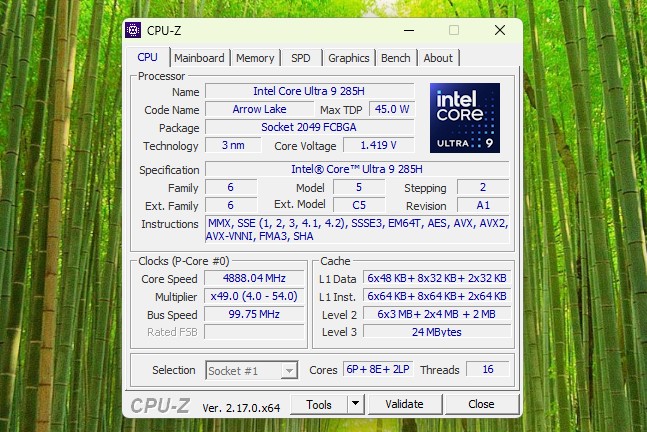
Introduced at the start of 2025, we have seen Arrow Lake in a few mini PCs thus far. The chip has arguably had a shallow impact in the mobile marketplace, but as a mini PC, it is right in its element, especially as the thermal and power headroom give it plenty of room to turbo. As the full-fat version of the Arrow Lake-H chip, the 285H gets access to all the hardware offered in Arrow Lake and the best clock speeds for the mobile chip, with the six performance (P) cores topping out at 5.4GHz. Meanwhile, backing P cores for highly threaded workloads is a further eight efficiency (E) cores. And finally, two low-power efficiency cores (LP-E), which are essentially always-on cores that are designed to handle light tasks so that the other cores can sleep when not in use.
Since we have reviewed the GTi15 Ultra’s direct predecessor last year – the Intel 12th Gen Core-based GTI12 Ultra – that is where we will focus on performance comparisons, to see how the latest iteration of the GTi series improves upon matters.
Geekbench 6 Results
Starting with Geekbench 6, we find that the newer GTi15 Ultra and its Core Ultra 285H CPU are delivering about 20% better performance in both single-core and multi-core CPU performance.
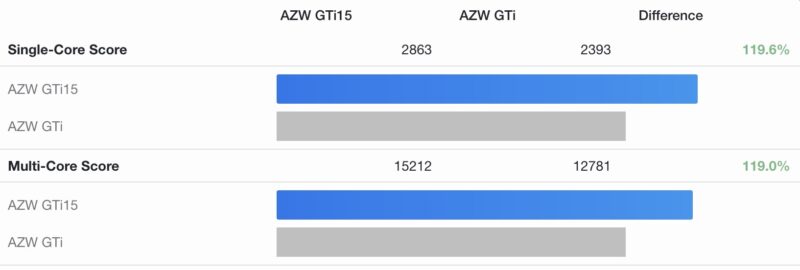
On paper, the GTi15 Ultra has more CPU cores, but since those two extra cores are LPE cores, this is effectively a 14 v 14 fight. In which case we are primarily seeing the architectural advantages of Arrow Lake (including clockspeeds) over Raptor Lake.
Even more significant improvements between these two generations of Intel CPUs can be found in GPU architecture changes and the resulting performance improvements.

In Geekbench 6’s GPU compute score, the GTi15 Ultra, with its Arc 140T iGPU, straight-up doubles the GPU compute performance of its predecessor, passing 33,000 points.
And since we had Beelink’s external GPU dock on hand, we gave the GTi15 Ultra a run in that as well, to see what the newer mini-PC could do for an external Radeon Pro W7700 video card.

Even with this test being primarily GPU-limited on paper, in practice, the GTi15 Ultra still delivers 20% better performance on the GB6 GPU test over its forerunner when both are equipped with the AMD Radeon Pro W7700 video card. The performance difference may be even greater with a more powerful video card to better stress the GTi15 Ultra’s faster CPU – the W7700 being a bit older at this point. It is, however, the same GPU we used with the GTi12 Ultra’s dock.

We actually saw slightly better performance with the new setup and the same GPU as well. That is a good sign that this type of system is progressing.
MLPerf Client v1.5
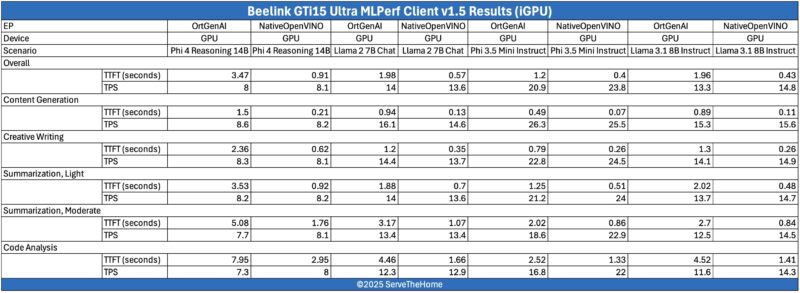
We ran MLPerf’s latest MLPerf Client v1.5 benchmark. This benchmark can stress both of the major AI processing blocks of the GTI15’s SoC, hitting the GPU cores and the more specialized NPU. Here are the iGPU results:
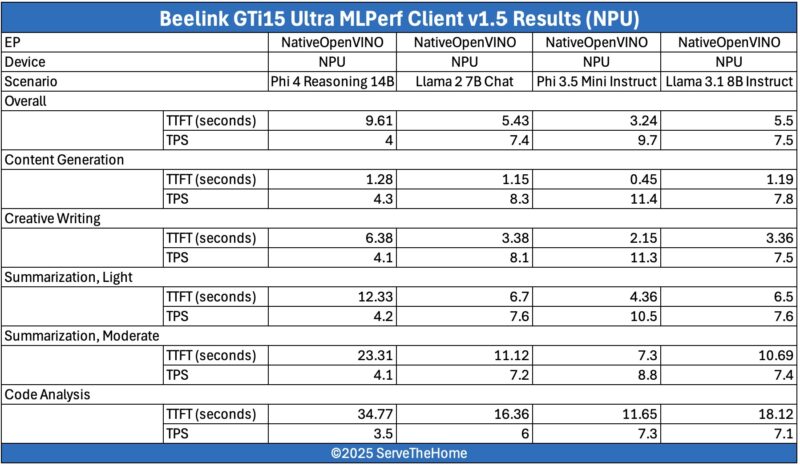
The NPU is an extra AI processing element, but it is not designed to be as fast as the iGPU. Instead, it is designed to offload, keeping the iGPU available for other tasks. Here are the results:
Since we had it installed, we ran the configuration on the external AMD Radeon Pro W7700 as well:
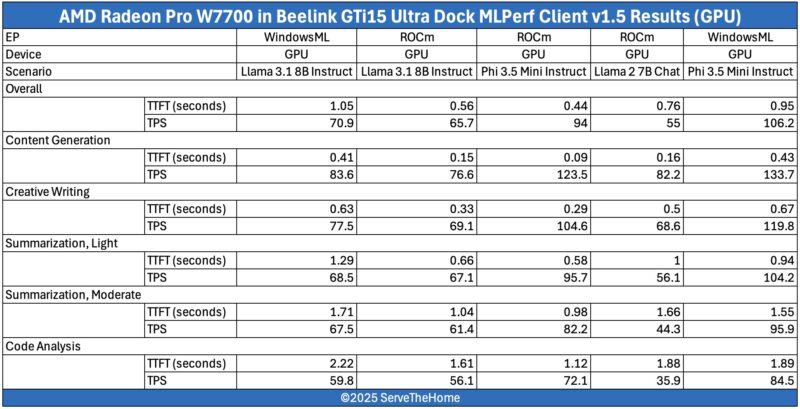
Ultimately, while the NPU pulls its weight in power-limited laptops, it is left to drift somewhat aimlessly in a desktop mini PC. The Arc 140T integrated GPU is simply better at the job – as you would expect from throwing more hardware at the problem – and there are no battery life implications to give the NPU a moment to shine. Of course, not every AI workload runs on the GPU – a big part of Microsoft’s Copilot+ brand is about pushing software that uses NPUs – but for any kind of performance-sensitive workload, we are left with little reason to use anything other than the iGPU. Of course, we have a midrange and relatively lower power AMD Radeon W7700 GPU that shows just how much of a speedup adding a larger GPU gives a system
Next, let us get to the power and noise.

“To the right of that is the PC’s sole 40Gbps USB4 port, offering the fastest I/O connectivity for the box. Note that this is not a Thunderbolt port – users wanting external PCIe connectivity will need to resort to Beelink’s GPU dock (more on that in a bit).”
What? PCIe tunneling is a mandatory feature of USB4, so of course it would work with Thunderbolt-based GPU boxes.
The full reason why is a bit above my pay grade. What I do know is that the GTi15 is not Thunderbolt certified, Beelink does not advertise it as such, and PCIe tunneling is not a supported feature.
It is officially a 40Gbps USB-C port that is capable of USB Power Delivery and DisplayPort 1.4 alt mode.
@Robert
No, PCIe tunneling is an optional feature for USB4 hosts. Thunderbolt 3 compatibility is also optional for USB4 hosts including extended data rates of 10.3125G and 20.625G and extended power delivery (TB3 provides different voltages and more power than base USB4).
Both features are mandatory for USB4 hubs and docks.
Can you provide a picture of the idle power draw you mentioned? I do see more than 27W on my unit which is consistent with all other reviews published so far. It will be interesting to see how you achieved those numbers (e.g. bios and firmwares).
I understand that. However, it is labelled as a 40Gbps USB4 port. That is only possible if it supports PCIe tunneling, otherwise it would need to be a 10 or 20Gbps port, which is USB3.2 gen1/2 or gen1/2×2.
I’m not trying to fault the article or anyone here, I am just genuinely surprised, because I’ve never seen a USB4 implementation on any device that advertised the full 40Gbps speeds without PCIe tunneling and I’m not entirely sure how that’s possible. Without PCIe, it should just be a USB 3.x port with DP alt mode support.
And in any case, the CPU itself technically has four built-in Thunderbolt 4 controllers and even if they didn’t use any of those and opted for an external USB4 controller, that must connect via PCIe, so the option should be there. Which makes it seem like a software limitation. But again, I don’t know what they did there, it just doesn’t make much sense to me.
Pcie x8 slot, not 16
@Robert
No, 40 Gbit/s does not mandate PCIe tunneling either. USB4 defines its own third generation of USB tunneling capable of 20 Gbit/s (USB4 Gen 3×1) and 40 Gbit/s (USB4 Gen 3×2). USB4 v2.0 goes further with Gen 4 up to 80 Gbit/s.
Having Thunderbolt 4 controllers isn’t enough since TB itself requires periphery elements on the motherboard, especially around power delivery, tighter integration with the rest of the system, and of course paid certification. Those all cost money which Beelink doesn’t think is worth the potential benefits.
Have you tried to install pfsense or TNSR on it? It looks like it could be a fine router for 10Gbit