

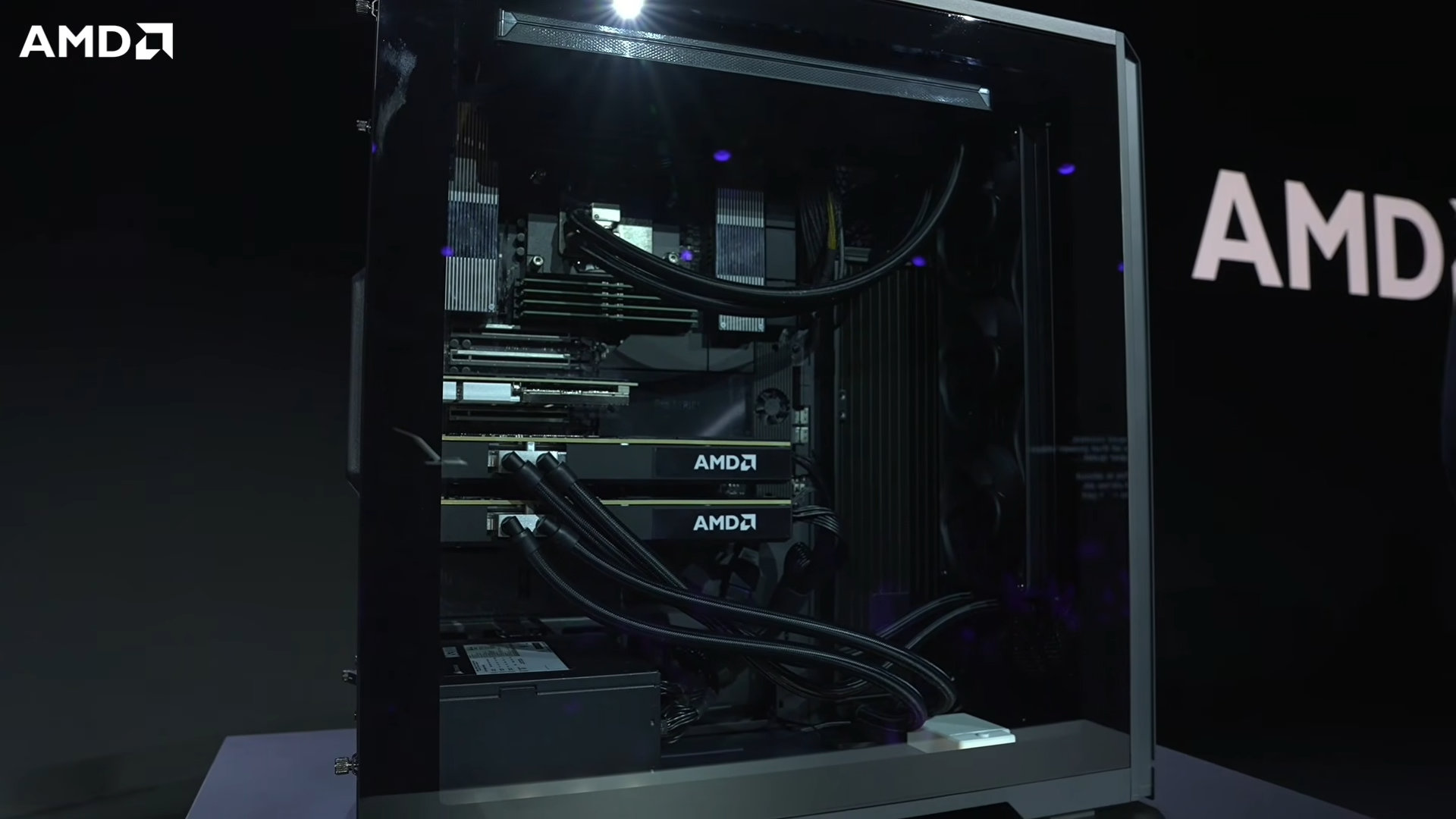
As part of an AI-centric opening keynote for this year’s IFA tech convention in Berlin, AMD has announced that the company is adding another Halo-branded developer device to their lineup of systems with the Threadripper Halo Station. The forthcoming dev system is a full tower system based on a pairing of a Threadripper Pro CPU and Instinct MI350P accelerators, with the purpose of offering a high-end, high-throughput system for local AI inference and development.
Announced by Jack Huynh, AMD’s Senior VP and GM of their Computing and Graphics Group, the Threadripper Halo Station is intended to augment AMD’s existing Ryzen AI Halo box, which was their initial Halo system based around the company’s Ryzen AI Max+ (Strix Halo) processors. In the case of the Threadripper Halo Station, the use of a Threadripper Pro processor and discrete AI accelerator cards is essentially AMD going for the other end of the market, with a high-performance system that can offer far better performance than what the petite Ryzen AI Halo boxes can offer.
AMD Announces Threadripper Halo Station
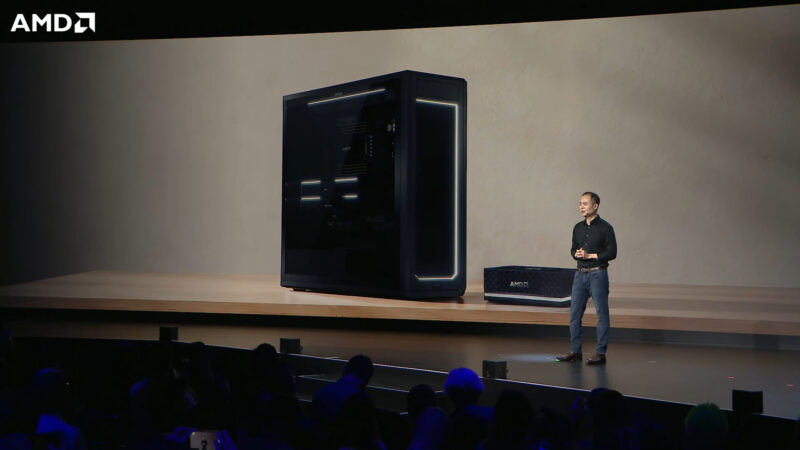
Diving right in to the hardware itself, the Threadripper Halo Station briefly demoed by AMD at IFA appears to be a tower system assembled from existing commercial-on-the-shelf AMD components.
| Threadripper Halo Station Key Specs | |
| CPU | AMD Threadripper Pro 9995WX (Zen 5, 96C/192T) |
| Accelerators | 2x/4x AMD Instinct MI350P |
| Operating System | TBC |
| Memory | CPU: Up To 2TB DDR5 GPU: 144GB HBM3E (each) |
| Storage | TBC |
| Video Card | Optional |
| PSU | TBC |
| Form Factor | Tower Workstation |
| Networking | TBC |
At the heart of the system is a Threadripper Pro processor. Huynh explicitly mentioned that the system on display featured a 96-core processor (and with no qualification of “up to”), which would be AMD’s flagship workstation Ryzen Threadripper PRO 9995WX processor. This is a 96 core Zen 5 chip with 8 channels of DDR5 memory and 128 lanes of PCIe Gen5 connectivity. According to AMD, the Halo Station systems will ship with up to 2TB of memory.
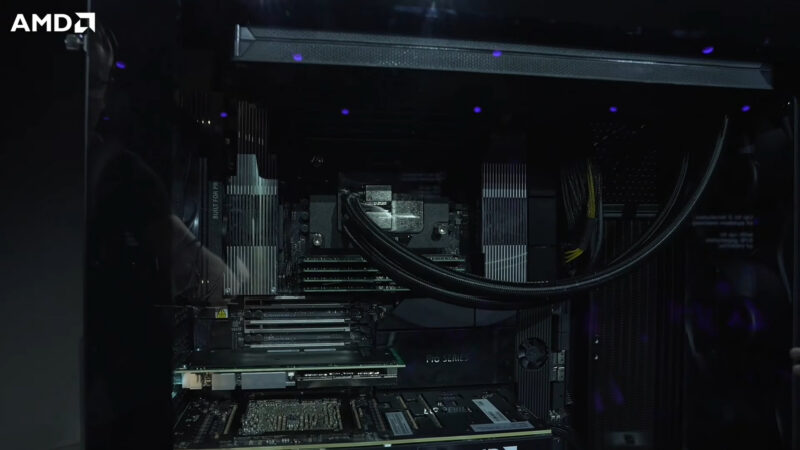
Meanwhile the bulk of the heavy lifting in terms of AI workloads is provided by AMD’s Instinct MI350P accelerator cards. Launched a bit earlier this year, the MI350P is a cut-down version of AMD’s CDNA 4 architecture MI350X accelerator that is designed to fit in a PCIe form factor. Each one of these cards comes with 144GB of HBM3E memory, and enough of AMD’s matrix cores to offer 2.3 PFLOPS of MXFP8 performance.
The base Threadripper Halo Station configuration will come with two of these accelerators, giving the system a total of 288GB of GPU memory. According to AMD there is “a path” to installing 4 of them for even more performance and local memory capacity (576GB), though it is unclear at the moment if the company is talking about selling systems with that configuration, or that as a PCIe-based system customers could install more accelerators.
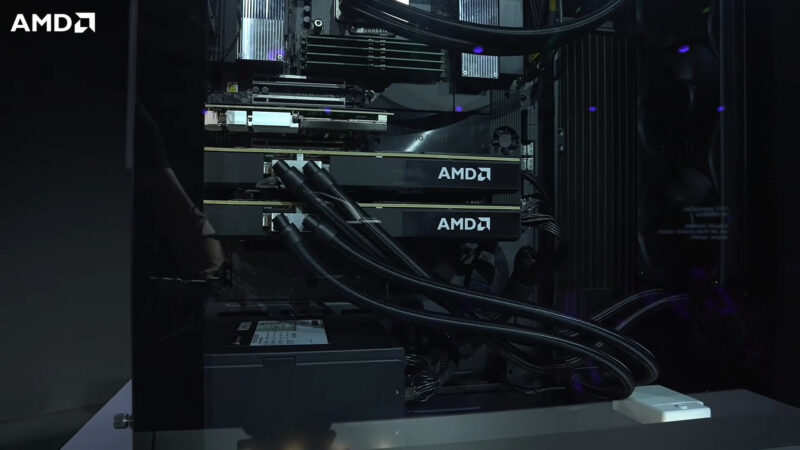
Notably here, these are not standard MI350P cards: the cards in the Halo Station are liquid cooled cards. In fact, all of the major processors on the system are liquid cooled, as AMD is looking to maximize cooling capacity and minimize noise generation. With that said, the showcase system was using closed loop radiators for each processor rather than a shared loop across the entire system, underscoring how this system is assembled from COTS hardware rather than being a more customized and optimized design.
Nonetheless, this does mark the first time we have seen liquid cooled MI350P cards, as this was not a cooling configuration AMD offered at the time of launch for the accelerators. Designed for use in standardized PCIe servers first and foremost, one of the driving features for those cards is that they are air cooled in order to work with those servers. However, as desktop workstation systems do not offer forced air cooling, AMD would need another high-performance cooling solution in order to be able to place the 450W+ cards into a desktop tower.
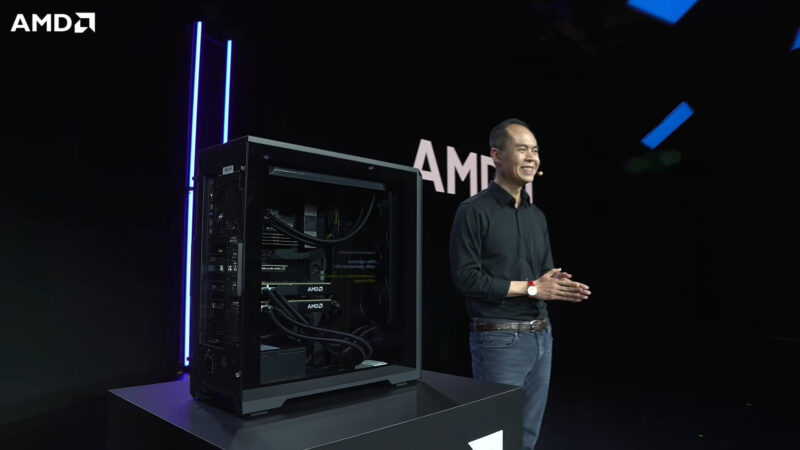
Outside of the core specifications, the specific demo unit used in AMD’s presentation appears to be using ASUS’s Pro WS WRX90E-SAGE SE motherboard, a high-end WRX90 platform that is designed to be paired with the Threadripper Pro 7000/9000 processors.
The showcase system also had an unidentified SFP networking card installed. One of the drawbacks of the mini-PC form factor Ryzen AI Halo system is that AMD did not install any kind of high-speed networking hardware in the system (the fastest port is a 10Gb Ethernet jack), so it looks like AMD is addressing this concern with their larger station system. Which, given the larger amount of data a Halo Station system would be expected to ingress, is all but needed at this scale.
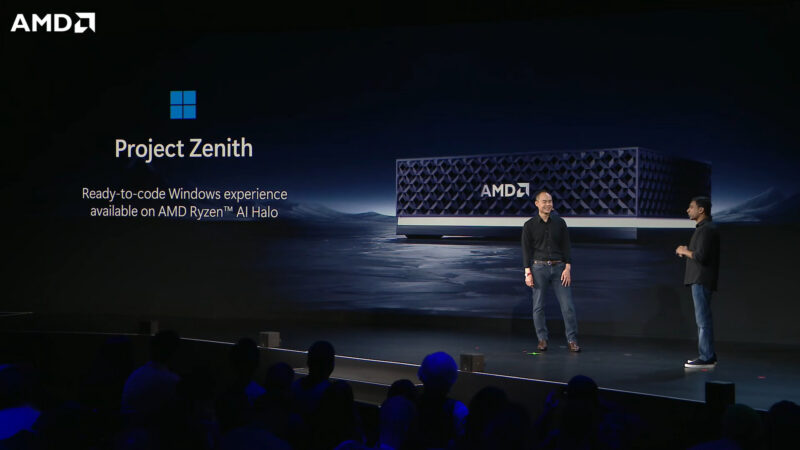
Hardware specs aside, AMD has not disclosed anything about the software stack that will be running on the dev box. It is a reasonable bet that the Halo Station will run the same Linux-based software stack that is already on the Ryzen AI Halo, though a Windows option cannot be ruled out, especially as AMD had Microsoft on stage for a partner spotlight during the keynote address. The Windows software house outlined their Project Zenith toolkit for developers, which is a curated collection of several of their existing development tools (such as VSCode) and will be available pre-installed on Ryzen AI Halo systems.
Finally, we would be remiss not to point out the obvious similarities between the Threadripper Halo Station and NVIDIA’s rival DGX Station systems – right on down to the similar naming. Both systems target the same high-end development segment and aim to put server-grade AI hardware into a desktop computer. Though among their differences, it is notable that NVIDIA used a single B300 accelerator (and its companion Grace CPU module), whereas AMD is relying on multiple GPUs spread over multiple PCIe cards.
Final Words
The demand for AI hardware has been the fire that has been powering AMD for much of the past few years, and as we have seen in a successive string of announcements from the company this year, they are rolling out an ever-wider array of products to address the market. Laying the groundwork for developers is a bit part of this effort, as evidenced by the launch of the Ryzen AI Halo earlier this year, and now the bigger and more powerful Threadripper Halo Station system. Combining all of AMD’s flagship desktop hardware into a single box, the Halo Station is nothing short of the best of AMD’s AI hardware, for developers who need as much processing power as possible right at their fingertips.
Wrapping things up, AMD has not announced pricing or availability for Threadripper Halo Station. Given the COTS nature of the hardware displayed, it should be something they can validate and ship relatively quickly. We will add more details as they become available.
Update 2026/09/08: Following Friday’s keynote, as of this morning AMD has published a product page for the upcoming workstation. While they are not announcing any further technical details, they are giving it a rough release date: the Threadripper Halo Station will be available in 2027.


up to “2Gb” of memory…
-> definitely that is supposed to be 2 terabyte of memory
As with prior AMD AI products, they often look interesting but then pricing and availability is non-existing. You’d think they would do everything they can to get hardware out to build market share and have hardware in the have of external developers to also help closing the software support gaps they have…
yeah change the 2gb to 2TB that caught my eye too.
Whoops! Thanks for the catch, Fourstone
This is an exciting look at how AMD is pushing high-end AI development into workstation-class systems. The combination of Threadripper Pro with multiple Instinct MI350P accelerators and up to 2TB of memory makes the Halo Station particularly interesting for developers working with large local AI workloads.
>hypothetical configuration webpage
>memory options
>512gb (8x64gb DDR5 ECC RDRAM by “literally anyone”)
>+$20,000*
T..t.thanks!
*price subject to arbitrary and chaotic changes (exclusively increases); Random Joe Workstations R-US makes no money off memory. Please see the permament cartoon dollar signs in the eyes of Micron, SK Hynix, and Samsung executives and shareholders.
i would expect at least 70k+ prices