

Acemagic F3A Internal Hardware Overview
In terms of perplexing perplexities, here is one. The lid is held in place by a screw that prevents a latch from being operated. Remove the screw, and the latch becomes functional and you can easily pop off the top.
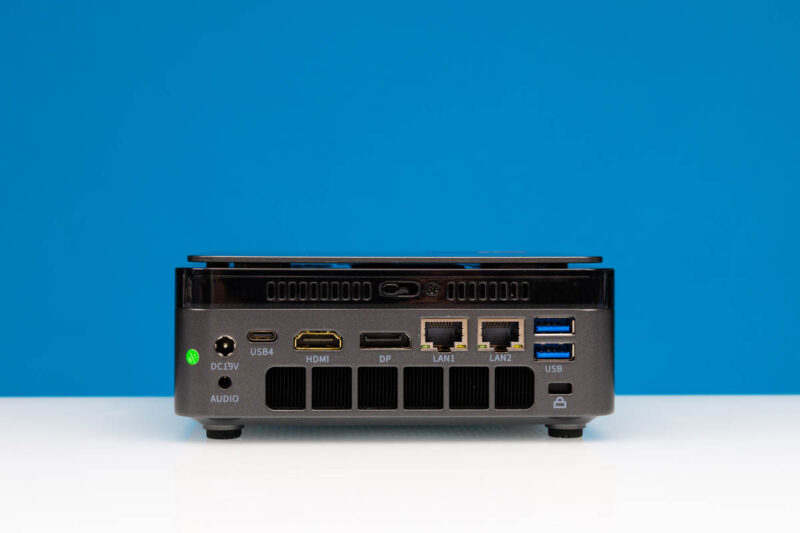
Once you do that, however, you cannot access components. Instead, there is a fan to cool the memory and SSDs, but that panel takes another four screws to remove. We could not figure out why you would make essentially a tool-less lid, but then require tools to do anything underneath.
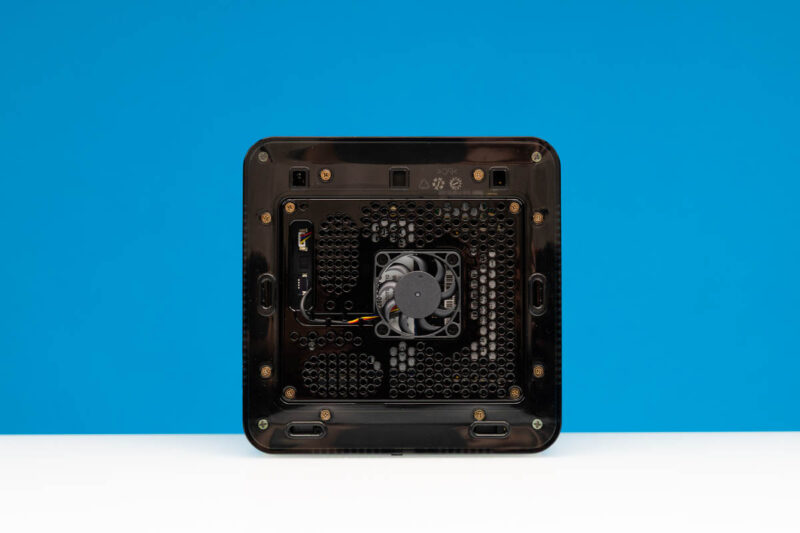
The lid mechanism actually worked well too.
Once we remove that fan, we get to our components.
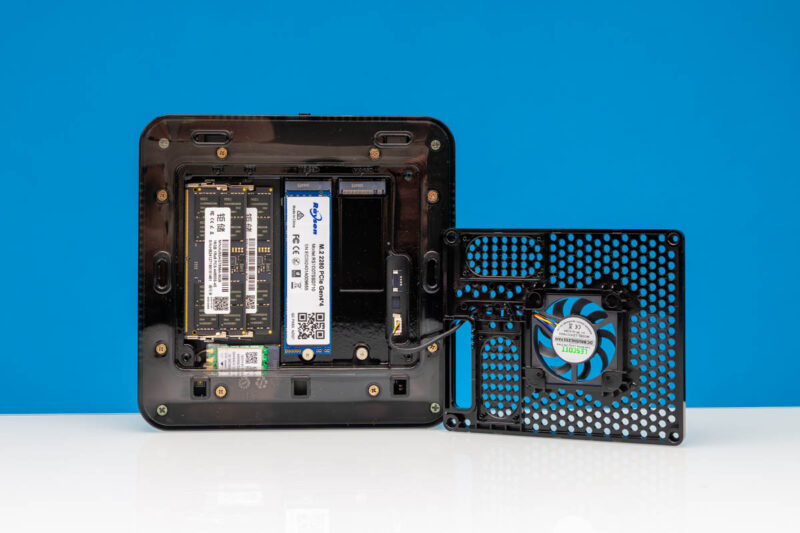
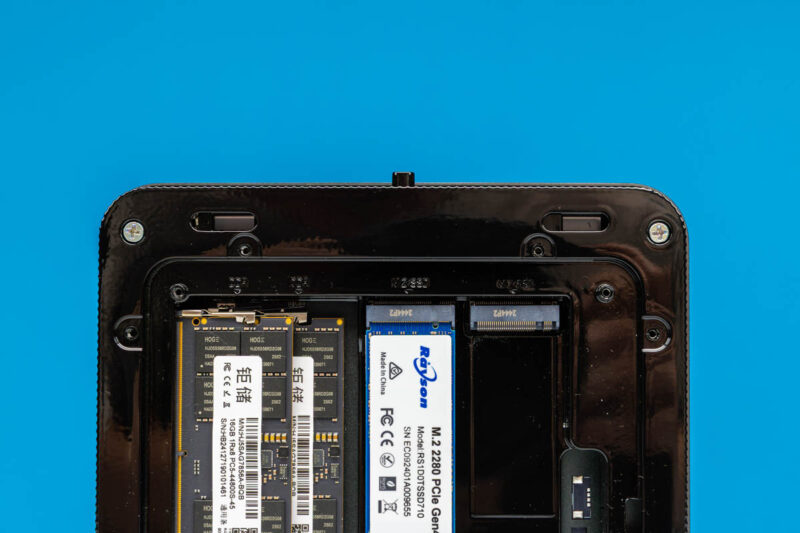
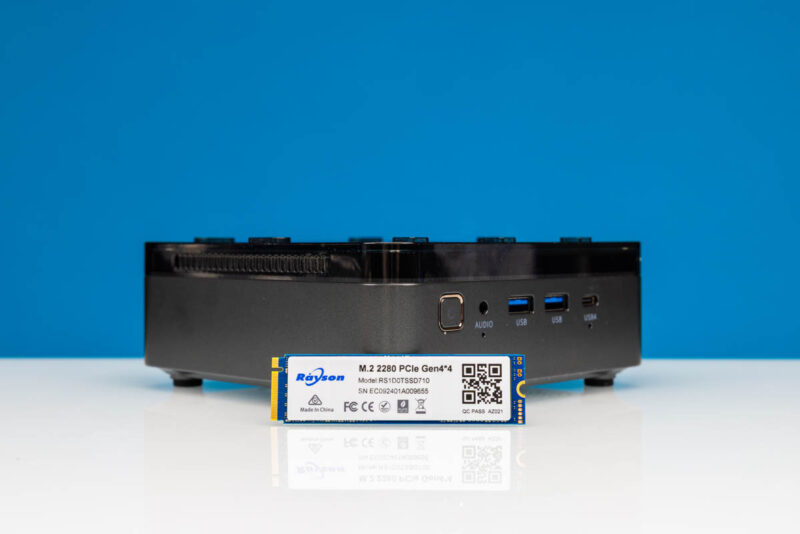
Our system came with a 1TB from Rayson. This is not a well-known brand, so I would replace this with something I know to be reliable. That is just one of the slots as there is a second slot so you can have two SSDs.
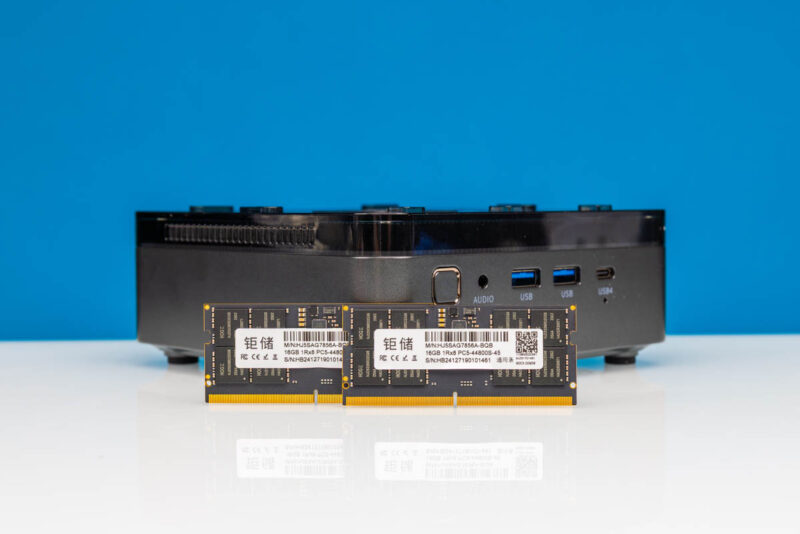
On the memory side, this is what we got. These are DDR5-5600 SODIMMs, but again, not from a well-known brand.
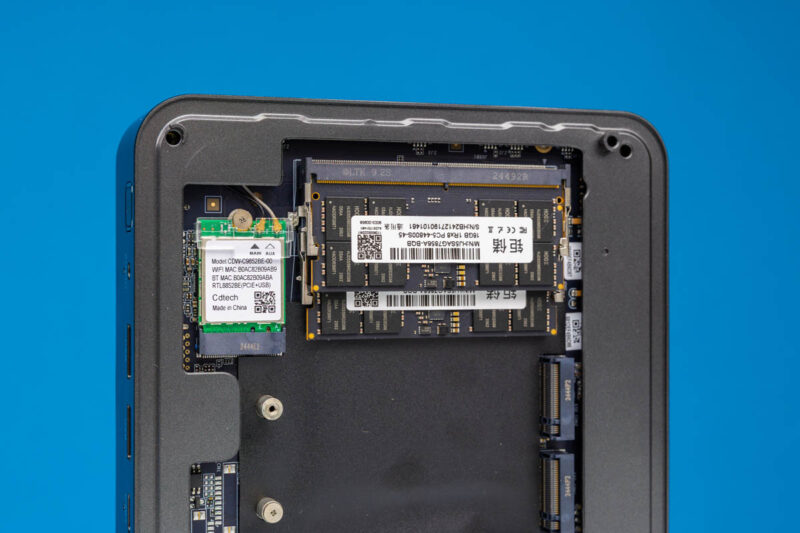
In terms of WiFi, we only get WiFi 6 and it is a bit of a bummer. This is a Cdltech Realtek RTL8852BE card. Normally we would expect something like an AMD/ Mediatek RZ616 or an Intel AX210. Also, for a higher-end mini PC like this, it would have been nice to see WiFi 6E/ WiFi 7.
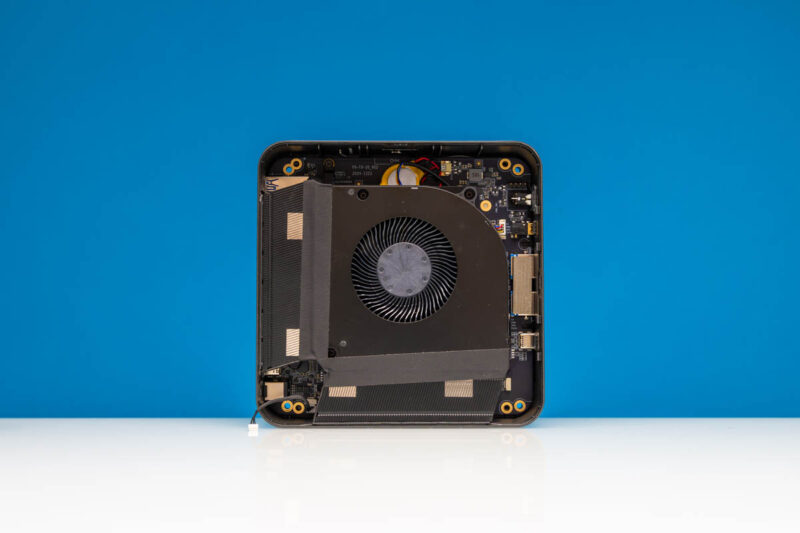
Opening the bottom of the system, we can see the cooler for the AMD Rzyen AI 9 HX 370.
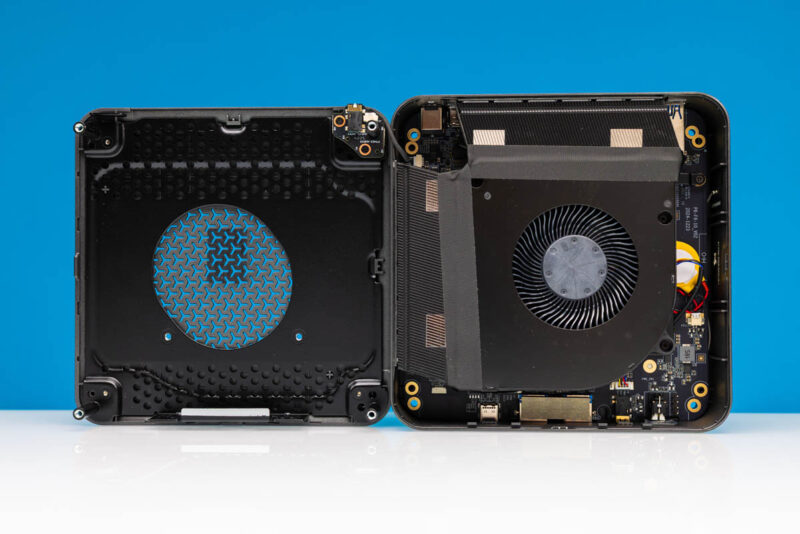
The coolertakes up most of the bottom of the chassis. Also, getting to that battery to swap would be a pain.
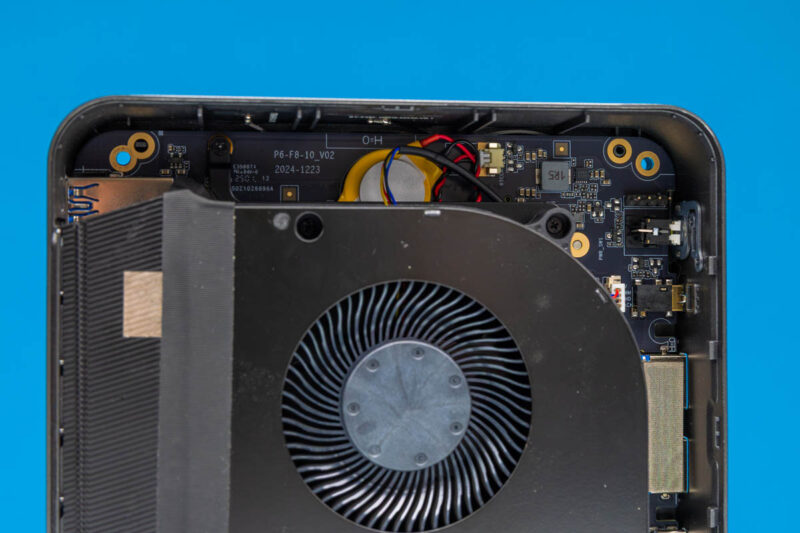
Overall though, this cooler worked well.
Next, let us get to the performance.



Consider changing the hero image description to “Acemagic F3A: ISO 64,000” LOL.
According to the review this mini PC can run DeepSeek R1 70B distilled although slowly. How slowly? I’ve tried the same model on an older dual socket Epyc server and quickly realised that too slow makes a big difference in terms of usability.
As large language models perform differently than what’s included in the current selection of Serve the Home benchmarks, I think comparing DeepSeek R1 70B performance across a wide variety of CPU and GPU hardware would be make a very interesting article.
Did this thing come with preinstalled Windows? Be careful, Acemagic shipped Mini PCs with preinstalled malware/spyware in the past; you can find this documented very well on YT.
TBH, since then i dont trust them. Uefi is clean? With that, it would be possible to undermine anya installation, also fresh own ones.
I’d guess, no ECC Ram capabilities? This i’d love: a silent Ryzen mini PC for proxmox with 2 fast Lan ports and ECC support.
I am also waiting for the AMD AI MAX+ 395 MiniPCs to come out. I agree with Eric Olson that it would be nice to see an LLM inference speed comparison across different CPUs and GPUs. For me the expandable RAM is key. I was looking at the SER9 when it launched late last year, but I ended up with a 8945HX MiniPC because I didn’t like that I couldn’t get at least 48 GB of RAM in the SER9. I do LLM inference on some of my MiniPCs but my primary use for them is part of a Proxmox cluster so having expandable RAM is more important than maximum performance.
Does it have GPIO pins for connecting a pikvm for power control?
There is a 64GB version of the SER9 available now.
RAM size and (computational) speed needs to be kept in balance. Upgrading to 256 GB of RAM is pointless, since models requiring that amount of RAM will be very slow at this system. Even a 70B model is sluggish.
Thats where nvidias DGX Spark is much more promising: It combines a fair amount of RAM with, well, acceptable speed. This combination is much more usefull. That explains the price difference.
DPC Latencies would be interesting.
As important as computational speed is, bandwidth to memory is also pretty vital. Otherwise you not only have less than optimal number crunching, but the processor spends more time sitting idle waiting. The (quad channel?) higher bandwidth memory in the Spark is an important part of the design as well.
Which leads to my question: does anyone know if there’s a HEDT or workstation or gaming price range product (system or motherboard and compatible CPU) that uses DDR5 and has quad channel RAM? Ideally paired with an integrated GPU, but that seems unlikely.
Right now seems like Threadripper is probably my best bet for pricing, but I am interested if anyone has other suggestions.
Threadripper, Epyc, Xeon are the only choices I know of that support quad channel with DDR5 memory slots. Mac’s M4 minis have quad channel as well but they suck for gaming. M4Pros are Octachannel? They double the bandwidth and you can get a Mini with up to 64GB of ram, soldered. That makes them possibly decent for moderate gaming. The upcoming Framework desktop will be quad channel up to 128GB, and has an internal PCIe x4 header. In comparison, all of the AI 370 mini PCs are dual channel from how I’m reading specs.
DDR5 only supports up to 6000 MT/s, LPDDR5X supports around 8000 MT/s. If you need an AI-specific design both the M4 Mac Mini and Framework systems are looking interesting. Otherwise, unless you really need quad channel RAM, you can probably buy a decent base system for cheap and use dedicated GPUs instead.
Any idea where the wifi antennas are? I’m getting pretty slow wifi performance. Will probably swap the wifi card first before thinking of swapping the antennas
i sm no overly concerned abou it having ddr5 instead of lddr5 qs it allows you to add memory. 5600 vs 7000 clock isn’ really gating o be noticeable in real world applications. benchmarks might see it, but i doubt snyone will to se any in rregular use/.
The mem modules do not look like DDR5-5600 SODIMMs.
Hi,
I ordered the Acemagic F3A barebones following your youtube video about the device.
I have some difficulties to make it work properly.
I installed 128 Go of Ram, a SSD and Windows pro.
I updated the OS and all the drivers recognized automatically by Windows.
I installed AMD Adrenalin in order to allocate more Vram to the radeon iGPU. On this program, the changes applied are not taken into account after a restart and the VRAM drop to an insignificant 0.5 Go of Vram. I did not see a useful menu on the bios to set the allocation.
Moreover, the wifi board seems not taken into account as well because it does not show up.
The official website offers some drivers to download but offers no explanation to use them.
Could you enlighten us how to start from here?
Cheers,
Aiille
The company has not offered to refund me yet but this has major driver/hardware issues, bios update didnt help, the stats are misleading and the company has no support. It took me 3 months to make the pc work close to specs accessible but a lot of issues here and unfortunately this review made me buy it. I guess I learned they did the review to get a kickback. A lot of good options out there but his is not one. Now I am 850 out plus the 600 I spent to upgrade it to get a running Local llm but I would of been better off getting the framework or GTK.
Official website claim it just supports 96Gb of RAM so even it shows 128 I doubt its true
@sdchew its inside and put antenas outside of box because there is some interference (its not card i also replaced card but if i use same antennas wifi signal was wrong so i just pout 30 cm intenas outside of box and everything is working.
@mehdi I have lapotop where official support is 32gb and i just intalled there 64gb without problems. So probably you need look on supported memory in cpu spec.