

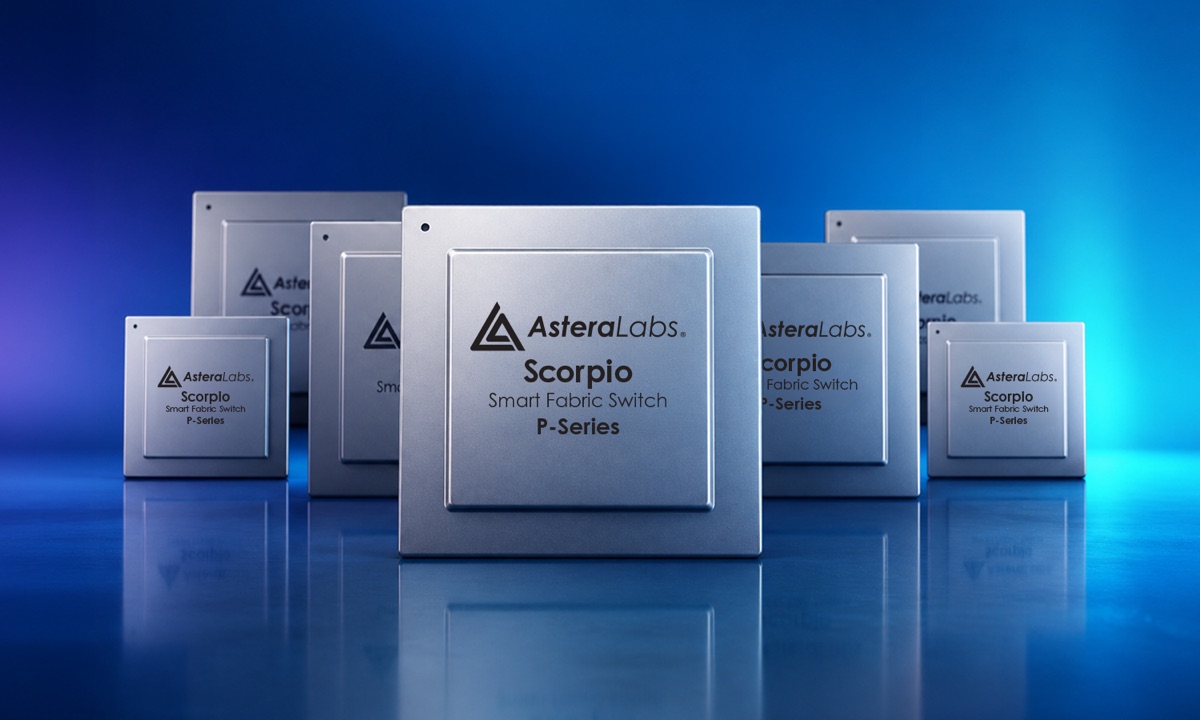
Astera Labs has its next Scorpio update, but the useful way to look at this is not as another AI fabric branding exercise. The important number is 320 PCIe lanes. In today’s PCIe switch market, that is a large switch, and more lanes mean system designers can connect more devices with fewer switch chips and fewer hops.
Astera Labs Scorpio Gets a 320-Lane Update
If you have been following STH, this is not the first time we have looked at Scorpio. We previously covered the family in This is the New Astera Labs Scorpio PCIe Switch Targeting Broadcom in AI Servers, where the big theme was Astera Labs moving beyond retimers and into PCIe switching, a market Broadcom has traditionally dominated in servers. This update moves that story forward with the Scorpio X-Series 320-lane switch and an expanded P-Series family.
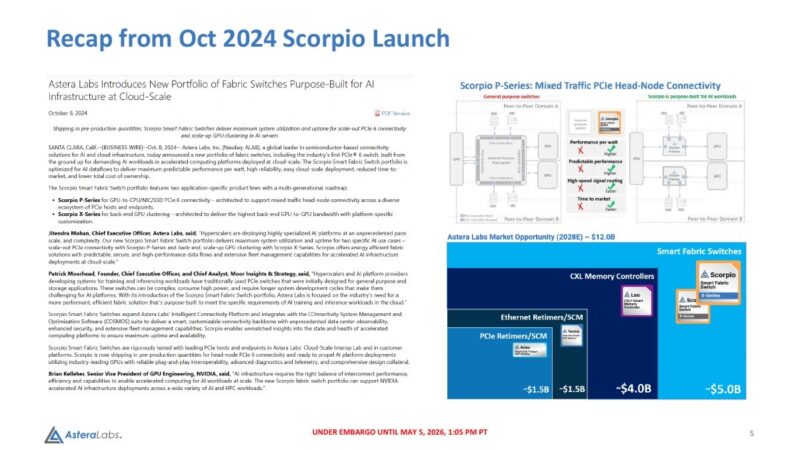
That older Scorpio context matters because PCIe switching is a very practical part of server design. A CPU platform only has so many PCIe lanes. GPUs, NICs, NVMe SSDs, DPUs, and other accelerators all want connectivity. A larger switch gives designers more options for attaching those devices, splitting systems into different topologies, and avoiding awkward cascades of smaller switches.
A 320-lane switch is large for the current market. It is also easy to see why Astera is leading with that number. 16 lanes per PCIe device and 20 devices equals 320.
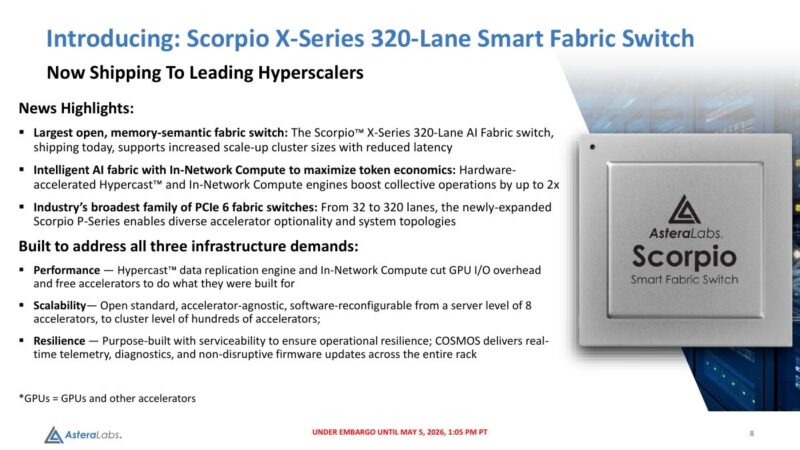
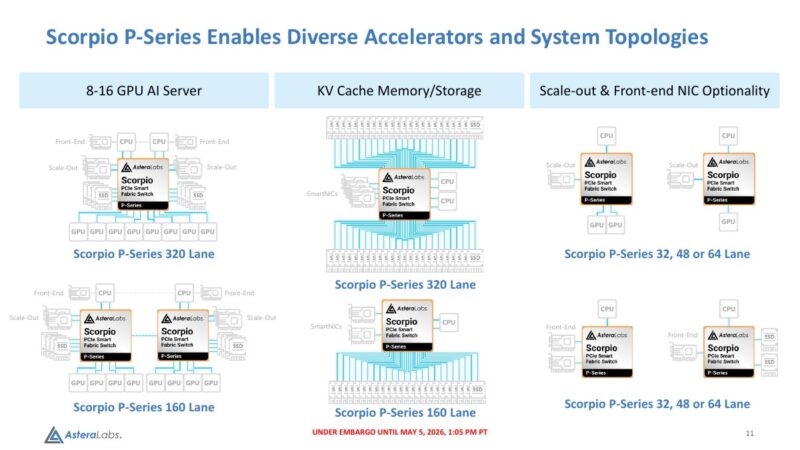
Astera’s slide says the Scorpio X-Series 320-lane AI fabric switch is now shipping to leading hyperscalers. It also says the broader Scorpio P-Series now spans 32 to 320 lanes. That range is important because not every design needs the biggest part. Some systems need a smaller PCIe switch for NIC optionality or SSD expansion. Others need a much larger switch to stitch together many accelerators into a single box or fabric domain.
The most useful slide in the presentation Astera sent us is the comparison between 144 lanes and 320 lanes. Aside from having more bandwidth, having a bigger switch means you need fewer total switches to achieve a large topology. This is just like when we talk about radix in networking switches.
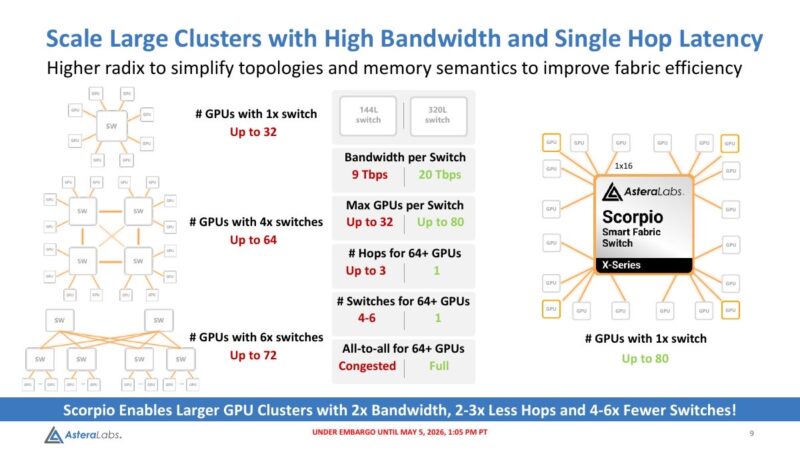
Astera showed a few examples of why the new switches are useful in different types of topologies. Often, if you see it on an Astera Labs slide, it means that some hyper-scaler, AI chip/ system design shop, or that class of customer is looking to deploy that type of system.
Hypercast is Astera’s data replication engine for operations such as all-gather, all-scatter, and all-to-all, while In-Network Compute targets operations such as all-reduce and reduce-scatter. Large GPU systems spend meaningful time moving data, not just computing. If the switch can reduce duplicated traffic or help with collective operations, then the fabric can contribute to tokens per watt. NVIDIA and Broadcom are examples of companies doing this on the networking side.
Final Words
There is an entire silicon segment for the PCIe/ CXL connectivity in servers, and that segment is growing rapidly. Broadcom has dominated this segment for years, but Astera Labs really got a solid foothold with PCIe retimers and has been moving out to other devices. A 320 lane switch is something that would have been a curiosity rather than something folks saw a clear need for a decade ago.




I think it is interesting that astera labs is still working on PCIE switches when the rest of the industry looks like it is moving away from big switches towards smaller switches like CX9 or just a smaller ratio of CPU to GPUS, not to mention the huge number of lanes modern server CPUs have.
With no listed price, no performance data, no applied use presentation, this is just marketing fluff.