

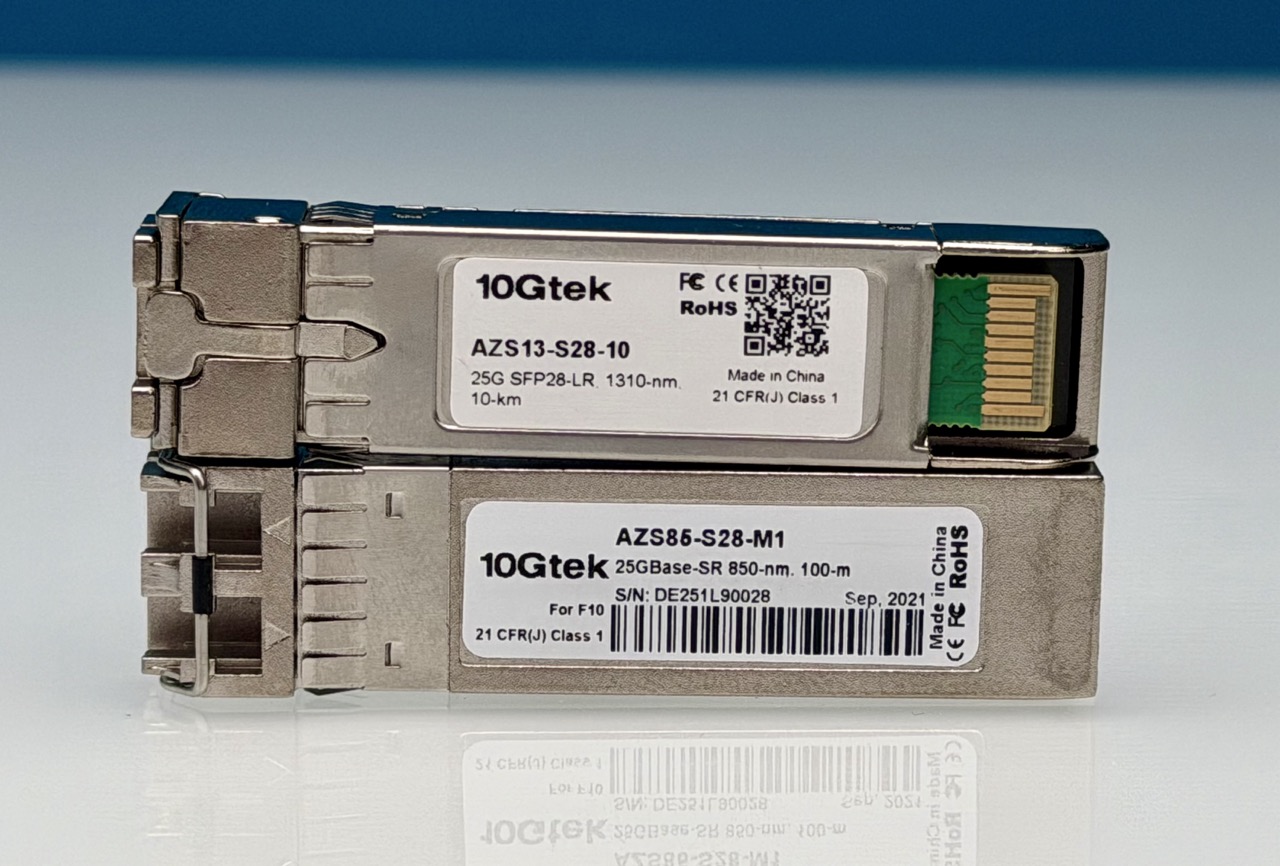
Recently, we received a question that we probably overlooked as fairly basic. At the same time, many newcomers to networking do not understand the difference between LR and SR optics. That is especially so if they have only worked in a copper and DAC/ AOC based environment. We thought, why not do a quick piece explaining why 25G SFP28 LR versus SR optics matter, and what folks often get wrong? Let us get to it.
25G SFP28 LR versus SR Optics: Why it Matters
Here are two modules, both from 10Gtek. On top, you can see a low-cost 25G SFP28-LR optic (we purchased on Amazon and here is an Amazon affiliate link.) 25G is the speed, SFP28 tells us we have a 28G NRZ SFP module (we also purchased this on Amazon and here is an Amazon affiliate link.) 10G would be very similar except it would be SFP+ instead of SFP28. Then we see that we have the LR for long range or long reach. We also see 10km, because that is the long reach distance and the 1310nm wavelength.
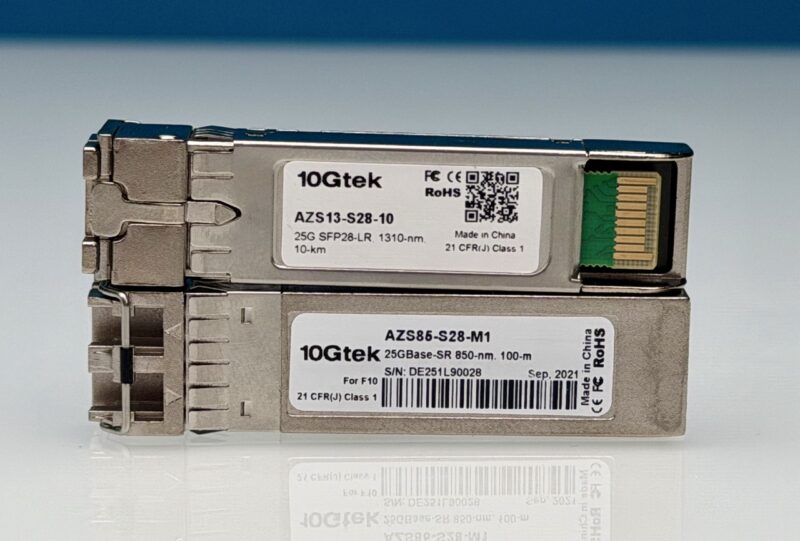
On the bottom SR optic, we see it is a SR for short range or short reach. There you see only 100m as the distance and 850nm as the wavelength.
This piece came about because one of our readers bought two optics a LR and SR and could not get them to work with the cable they purchased.
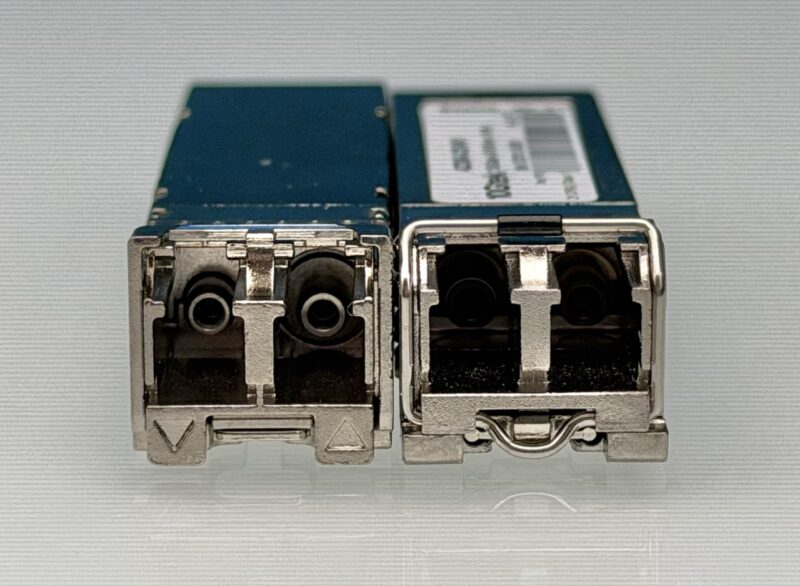
Aside from the obvious distance difference with SR at 100m and LR at 10km, or 10000m, they actually use different types of fiber. The SR optics use multimode fiber, while the LR optics will use single-mode fiber. Fiber is tuned to the wavelengths running through the fiber.
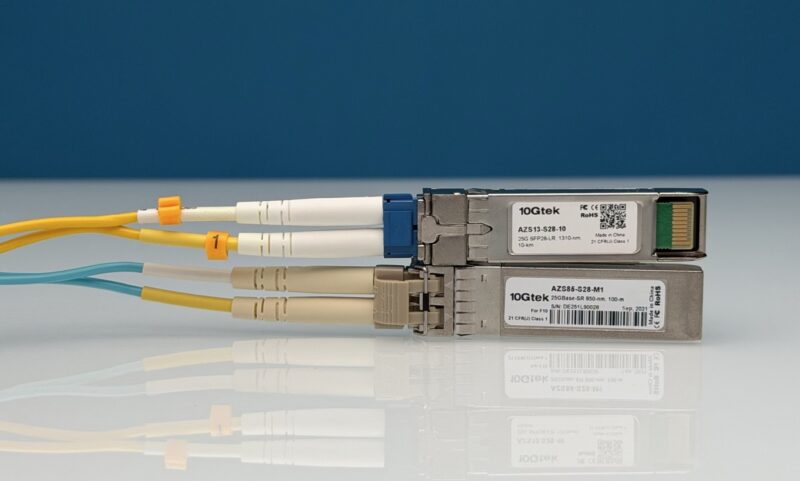
One advantage of multimode is that typically the optics are lower power and less expensive. If you are just connecting short runs in a small office, home, or a data center aisle, you are likely going to be OK with SR optics. For runs that are going to cross a campus or futher, it is likely that you are going to start looking into LR or other longer distance optics. We even looked at Going 800Gbps at up to 1000km with the Marvell COLORZ 800 a few months ago:
We had a video for that one as well.
Final Words
This was a topic we just missed covering on STH previously, but given how much networking we are doing, we probably should have covered it. If you take away nothing else, just know that you cannot use LR and SR optics together on opposite ends of a fiber. You generally want to match the types of optics on both ends. Those optics also can impact the type of fiber you deploy. If the fiber is already run, then the fiber can impact the type of optics you can run. Hopefully this helps some of our readers going forward. The cost difference when we purchased these optics was only $3, but on higher-end optics, it can be much more.

Would have been nice to include the numbers to see the difference in power usage of the two modules.
Most (all?) multimode optics these days use a conditioned or offset launch, basically off-center, as many multimode cables have a dead spot in the center of the core. So they’ll miss the core of single mode entirely. Prior to this, 1000BASE-LX supported both single and multimode fiber.
Might also be useful to mention that using LR on shorter runs will require attenuators to reduce the signal strength to prevent burning out the other end due to the strength of the laser used.
This article should also point out that mutlimode fiber has several variants which can impact range and speed with SR optics. 10 Gbit rates using OM3 cabling can reach upwards of 300 meters and with OM4 cabling go all the way to 400 meters. I would suspect that the 100 meter module in this article is an LED driven unit which may not produce a strong enough signal to reach the full 300/400 meter range permitted in spec. 25 Gbit speeds will work over OM3 cabling but up to 70 meters where as with OM4 you get 100 meters. OM5 cabling is relatively new but supports 100 Gbit upwards of 150 meters.
Another fun fiber spec is the 10GbaseLRM spec which is considered ‘long run’ over OM2 cabling at 10 Gbit speeds. This spec arrived as there was a significant amount of OM2 cabling laid back in the day for campus infrastructure but only supported 10 Gbit up to 30 meters using normal SR optics. 10GbaseLRM supports 10 Gbit data rates over the older OM2 cabling up to 220 meters, which is far more useful for the types of runs OM2 was originally deployed to.
LR optic has basically one cable standard nowadays with OS2 which is ancient. This type of fiber can push lots of data through it with 100 Gbit over a single pair being common place. Using multiple wave lengths, that same fiber can support 400 Gbit and 800 Gbit but at a high optical module cost. Laser power is generally what determines distances as I’ve seen some rated to go upward of 100 km between end points. Again, such modules are expensive. As @mkeus pointed out above, using LR optic at shorter ranges is best done with some attenuators so one modules doesn’t damage another by being too bright.
Personally I see a third fiber standard emerging soon with various hollow core single fiber implementations. The benefits here is that the slight signal itself propagates faster throughout the cable. For reference, light in a fiber cable moves at roughly ~75% of c. Recall that c is the speed of light in a vacuum which fiber is a physical medium. Hollow fibers have propagation rates around ~80% that of c and is on par with electrical signaling over copper. With copackaged optics set to become mainstream, leveraging hollow fiber would provide a solution for companies like nVidia to replace with their copper based DGX spines with fiber. Between added latency of transceivers and the slower propagation rates of the fiber medium, using optics hasn’t been a great alternative for replacing copper in short range scenarios.
A post similar to this one with the caveats on single-lane 50G could be helpful to folks reading the other content here. There have been a couple posts about a new MikroTik switch recently mentioning its eight SFP56 ports, but AFAIK there’s one widely-available NIC family supporting SFP56 (ConnectX) and one other just released (AMD Solarflare). And there’s no low-cost passive breakout to 2x25G or two lanes of QSFP28 because the lane signaling is different. So when used with most NICs, those 50G switch ports are (if the switch can negotiate down) effectively 25G. Hopefully folks sort all of that out before going in for a purchase but it’s the type of thing these posts are good for helping the broader audience understand!
@mkeus, where a shorter run is under 3m. All SFP-based optics adjust the transmit power, so you basically don’t need attenuators on LR and SR optics, provided you have at least 3m of fibre between them. It is part of the specification. Please stop spouting stuff from the days of GBICs that you have heard and don’t understand. Of course, if you are using ER/ZR optics at shorter distances, you do still need attenuators, but given the pricing of ER/ZR optics, you would be bonkers nuts to use them over short distances.
TL;DR: The use of attenuators was not mentioned because they are not needed in normal circumstances.
@Kevin G hollow fibre will only be used on long haul cables and by bottom feeding high frequency traders. The improved latency on a 20km link is measured in nano seconds. Also stop spouting the rubbish about attenuators. They are not needed on LR optics provided you have 3m of cable which is also required with SR optics. The modules adjust transmit power so you don’t burn out the photo diode on the receiving end.
Single mode fiber has no practical speed limit. Multi-mode fiber does. Single mode fiber is also cheaper. The SFP+ LR transceivers are not that much more money than SFP+ SR transceivers. $9 extra per transceiver at fs.com at 10gig. Considering the savings in the fiber using SMF (OS2) instead of MMF (OM4), it’s close to a wash in total cost per run. I don’t see any reason to use MMF instead of SMF for any run that can’t easily be replaced.
Sure, for patching something in a rack, MMF is fine. But if I’m pulling a fiber run through a conduit, or putting it in a wall (new construction) MMF is dead to me.