

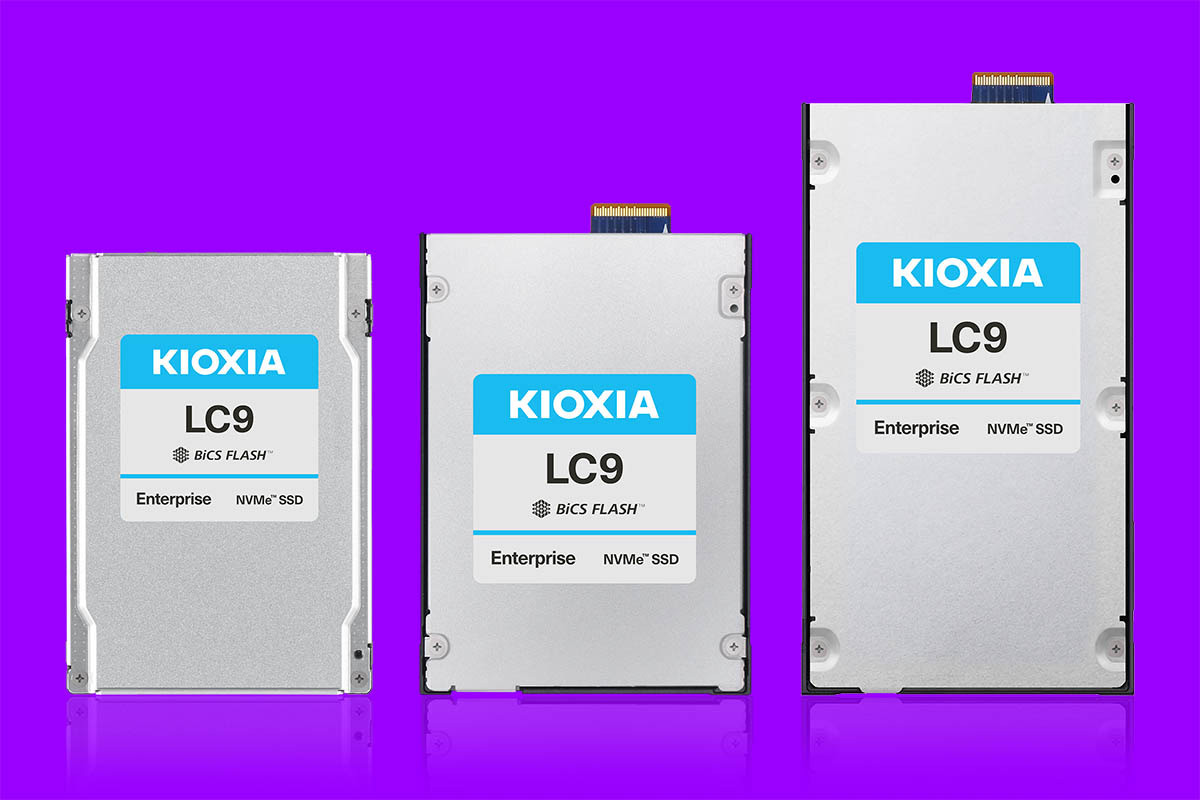
Kioxia is almost just making fun of hard drives at this point. While we covered how Seagate is shipping 30TB HAMR IronWolf Pro and Exos M hard drives last week, Kioxia has something that makes that look like ancient technology. At a whopping 245.76TB in a 2.5″ drive (versus 30TB in 3.5″ drives), the density of the new Kioxia LC9 is awesome.
Kioxia LC9 SSD Hits 245.76TB of Capacity in a Single Drive
The huge 245.76TB capacity Kioxia LC9 is available in either the 2.5″ or the E3.L form factors. The E3.S only scales to the 122.88TB capacity at this point. Given the random write IOPS, this is probably not a PCIe Gen5 NVMe SSD you would want for heavy random write workloads. On the other hand, these higher capacity drives tend to focus on more sequential read/ write patterns.
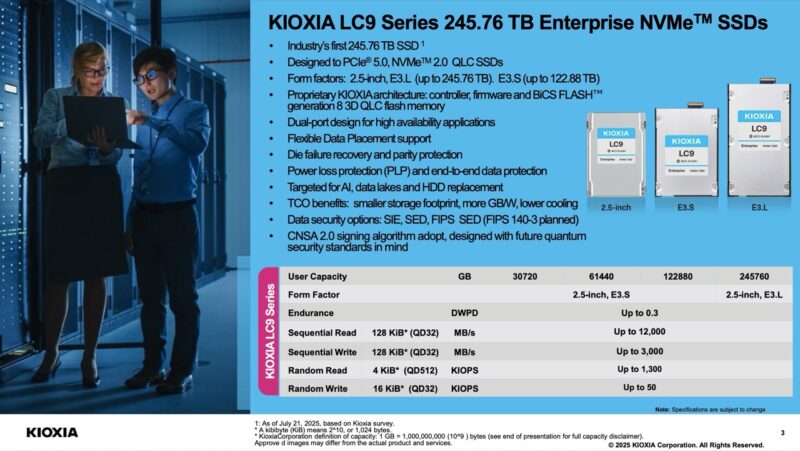
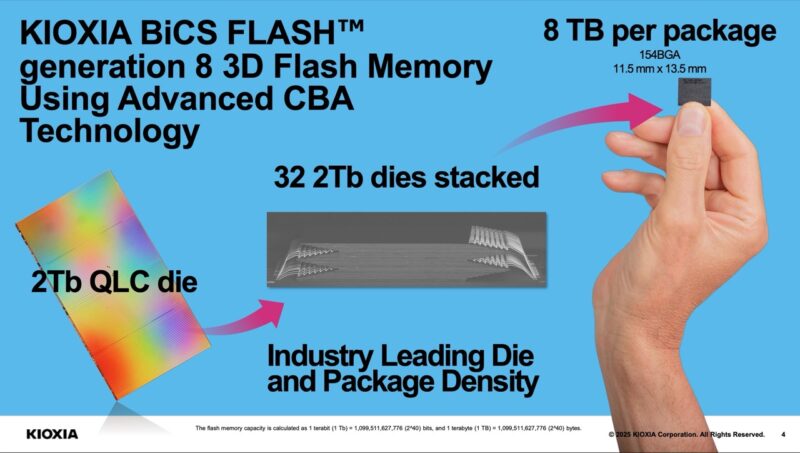
The giant capacity is made using 2Tb QLC NAND dies and the Kioxia BiCS FLASH generation 8 NAND. Those 2Tb dies are stacked 32 high to yield 8TB per package. The move from E3.S to E3.L is most likely to fit enough of these packages. It is odd, but one of the advantages of the 2.5″ form factor is the ability to use multiple PCBs in a 15mm drive to get more density.
That density is really crazy. It would take around eight 3.5″ 30TB drives to have a similar capacity to a 245.76TB LC9 SSD that is only 2.5″. Or in a modern 10-bay 2.5″ chassis, that is almost 2.5PB per U and in a 2U 24-bay system that is almost 6PB or almost 3PB per 1U.
Final Words
These new huge 245.76TB Kioxia LC9 NVMe SSDs offer a lot of capacity and performance for a relatively compact form factor. We have been hinting that while the 122.88TB / 128TB drive class was a big hit at FMS 2024, doubling that capacity would happen quickly. We are already at 244.76TB / 256TB class NVMe SSDs. The other side to this is that due to NAND scaling, SSDs are doubling in capacity every year or two. These large capacity SSDs are really meant to displace hard drives in capacity tiers, and hard drive technologies have been scaling at a drastically slower rate. We are effectively in the four drives per PB now.

Ribbit
Given that these are built from 8TB packages and the price of a single 8TB SSD is more than $500, I think the price of this 245TB SSD will be more than $16000. Likely a lot more.
In my opinion flash storage is a different usage case than a spinning hard disk. It’s also worth pointing out that a modern magnetic tape holds over 500TB. That’s also a different usage case.
At any rate, the 30TB hard disks being sold are definitely not ancient technology but also highly refined and modern.
LTO-10 is 30 TB uncompressed. Where are you seeing 500 TB tape?
lol I literally just finished building a 300TB file server with HDDs where were these 250TB SSD last week when I was ordering drives
Who did the math ?
32 stack of 2Tb is 8Tb ?
I think kioxia has worded the definition of die strangely. On their slide the „2Tb die“ look like it’s cut into 8 – so one die is most likely 250 Gb (2Tb/8). And then it fits ;)
@Pierrick 32 stack of 2 Tb is 8 TB, not 8 Tb.
If the pricing of these follow the 122TB versions per TB then we are looking at drives that are $25k each.
Two of those in RAID 1 would be a perfect NAS. :D
3 for a hot spare/cold spare, but yeah.
Backups would be a B$#*)(& though.
To jord who wrote “LTO-10 is 30 TB uncompressed. Where are you seeing 500 TB tape?”
I see what you mean. A capacity of 580TB is mentioned in
https://techxplore.com/news/2020-12-fujifilm-ibm-unveil-terabyte-magnetic.html
a technology announcement from IBM and Fuji but not a product.
What’s really impressive is the power efficiency of these drives. Sure, E3.L drives can pull between 40-70W, depending on the thickness of the drive, but it’s replacing 8 HDDs which would likely use 10-15W each. And higher capacities don’t necessarily need more power, just more flash dies / packages.
Making it easier to fit prod storage into 1U servers. If you have the datacenter space and cheap power, archival is still cheaper on spinners depending on capacity needs. Say they run $15k/unit for 500TB+ with Raid 1 your looking at $60k, with spinners in the sweet spot price/tb your looking at a fraction of it.
If you’ve got 24 in 2U then that’s 6TB or 200 of those new 30TB hard drives in a bog standard 2U server. You’re comparing that to 200 hard drives. If you go really dense, that’s still going to be 8U of space. If you’re using 24 bay 4Us then that’s 32U of rack space for 192 drives. We do work in some colocation environments that have extremely expensive racks due to the location of the facility.
You’ve also signed yourself up for, on average, over 1 service call per quarter with the hard drives. SSDs you shouldn’t have more than 1 call in 5 year deployments.
Perf it shouldn’t be anywhere close.
It might cost more, but that’s a lot of offsets if you’ve got the needs
An important difference between HDD and SSD (other than access speed and price, now capacity too) is archival data retention length. There are many estimates and advertised numbers given, with HDDs usually able to retain data (with the power off) for over ten years but SSDs are usually half that.
I’ve seen one manufacturer claim that their SSD can only retain data for a couple of months without power.
This is why there is tape, which (due to drive cost) isn’t practical for a small number of tapes.
Comments are closed.