Building on a partnership between NVIDIA and MediaTek that has existed for many years, NVIDIA announced this week that it will forge an even deeper partnership with its fellow fabless semiconductor firm. In a major deal that will tie the companies even closer together both financially and technologically, NVIDIA is going to be making a $3.5 billion investment in MediaTek, all the while the Taiwanese semiconductor firm, in turn, will be adopting NVIDIA’s NVLink Fusion platform in order to offer it to MediaTek’s own customers.
Under the terms of the deal, NVIDIA is investing $3.5B in MediaTek by purchasing convertible bonds issued by the company. Meanwhile, on the technology side of matters, MediaTek will be adopting NVIDIA’s complete NVLink Fusion technology stack, the Fusion chiplet, NVLink-C2C, and NVIDIA’s new NVHBM memory protocol, in order to provide it to its own customers. The significance of this technology licensing is that, as MediaTek’s custom silicon business has grown, NVIDIA wants to make its IP readily available to MediaTek’s customers, particularly those working with MediaTek to develop their own XPU accelerator chips.
NVIDIA and MediaTek Ink $3.5B Investment Deal, Accelerate NVLink Fusion Adoption
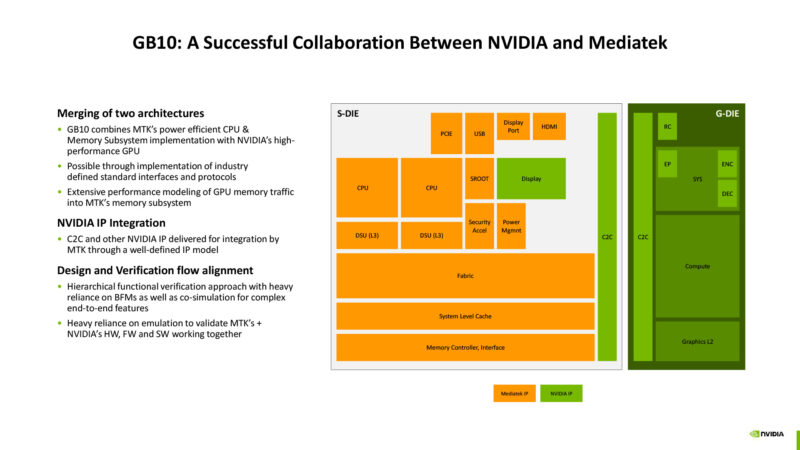
The deal between NVIDIA and MediaTek comes as MediaTek has become an increasingly significant player in NVIDIA’s orbit. Most notably, MediaTek was NVIDIA’s partner in developing the GB10 SoC, the chip at the heart of NVIDIA’s DGX and RTX Spark boxes. Though officially an NVIDIA chip, MediaTek was responsible for the majority of the chip’s development, most notably its CPU cores and memory controller, while NVIDIA contributed the iGPU and the chip-to-chip connectivity that bonded the two. Consequently, it is not too surprising to see MediaTek and NVIDIA working even more closely together, though the additional investment in MediaTek makes it clear that there is more to this deal than just IP licensing.
In some respects, it is surprising that MediaTek did not ink a larger technology deal with NVIDIA sooner given their close collaboration. MediaTek already uses NVLink-C2C for the GB10, for example. This latest deal is about custom chips rather than MediaTek’s in-house designs, so it is far more involved.
The big takeaway here is that NVIDIA is taking a significant interest in MediaTek’s custom chip business and what it means for XPU development. As hyperscalers and other large AI operators are increasingly developing their own chips, as we have seen with hardware such as Google’s TPUs, Meta’s MTIA, and OpenAI’s Jalapeno, the hyperscalers are increasingly preparing to go their own way in the AI world, or at least, are hedging their bets. So NVIDIA is hedging its bets as well, giving hyperscalers and other custom XPU developers more ready access to the technologies needed to interface with NVIDIA’s ecosystem.
On the technology side of matters then, this means making the complete NVLink Fusion ecosystem available to MediaTek’s customers. NVIDIA has been offering this technology directly to chip designers for some time, but MediaTek’s announcement essentially pushes it one level down the stack by enabling it to offer it directly as well.
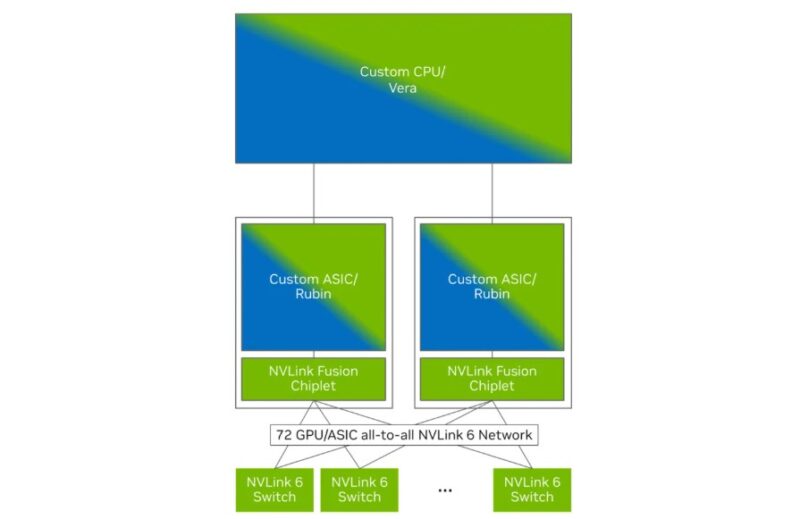
The most significant element of this technology offering is the NVLink Fusion chiplet, which NVIDIA has offered since last year. The fabric bridge chip allows chip designers to integrate NVLink support via a UCIe-attached chiplet that provides full-chip NVLink fabric support (while keeping the central components of NVLink as a black box to be integrated rather than licensing the IP itself). This is the critical part to enabling NVLink support on custom XPUs, and allowing those chips to plug into NVLink networks and NVIDIA’s rackscale hardware ecosystem.
The MediaTek deal also includes NVLink-C2C support, NVIDIA’s short-range chip-to-chip connection technology. This is principally used to connect custom CPUs to NVIDIA GPUs (e.g. GB10), but it can also be used to link up multiple XPUs or other chips. Finally, MediaTek will also be offering NVIDIA’s brand-new NVHBM tech, a custom memory protocol intended to connect processors to future generations of HBM, with the memory controller on the base die itself rather than part of the processor.
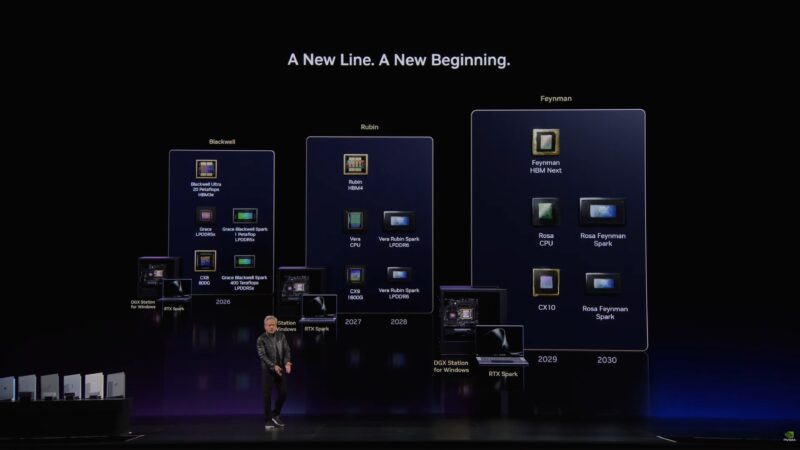
Aside from NVLink Fusion, the deal between the two companies will also see them continue their current collaborations on Spark devices and automotive projects. In particular, the deal confirms that NVIDIA will not bring the development of future Spark chips in-house, and that MediaTek will continue to play a role over the coming generations, including the Vera Rubin Spark and Rosa Feynman Spark, which are part of NVIDIA’s current roadmap out to 2030.
Final Words
The latest in a series of deals involving NVIDIA and its partners and customers, this week’s MediaTek deal is one of the strongest signs yet that NVIDIA is not content to be just a hardware vendor or even an IP vendor, and that it has greater ambitions to be the backbone of the entire AI industry. Though the MediaTek deal does not bring any new significant technologies to the table that NVIDIA has not already unveiled, it marks another step in their efforts to make NVLink Fusion widely available to other chip vendors.
At the same time, NVIDIA’s increasing use of its profits as a war chest to invest in other companies underscores that they are not just developing technologies and forging partnerships, but also putting their money where their (metaphorical) mouth is. With nearly $60B in profits in their most recent quarter alone, NVIDIA has significant financial resources at its disposal. And now, it would seem, a vision on how they want to use them to bootstrap developments at other tech firms.