

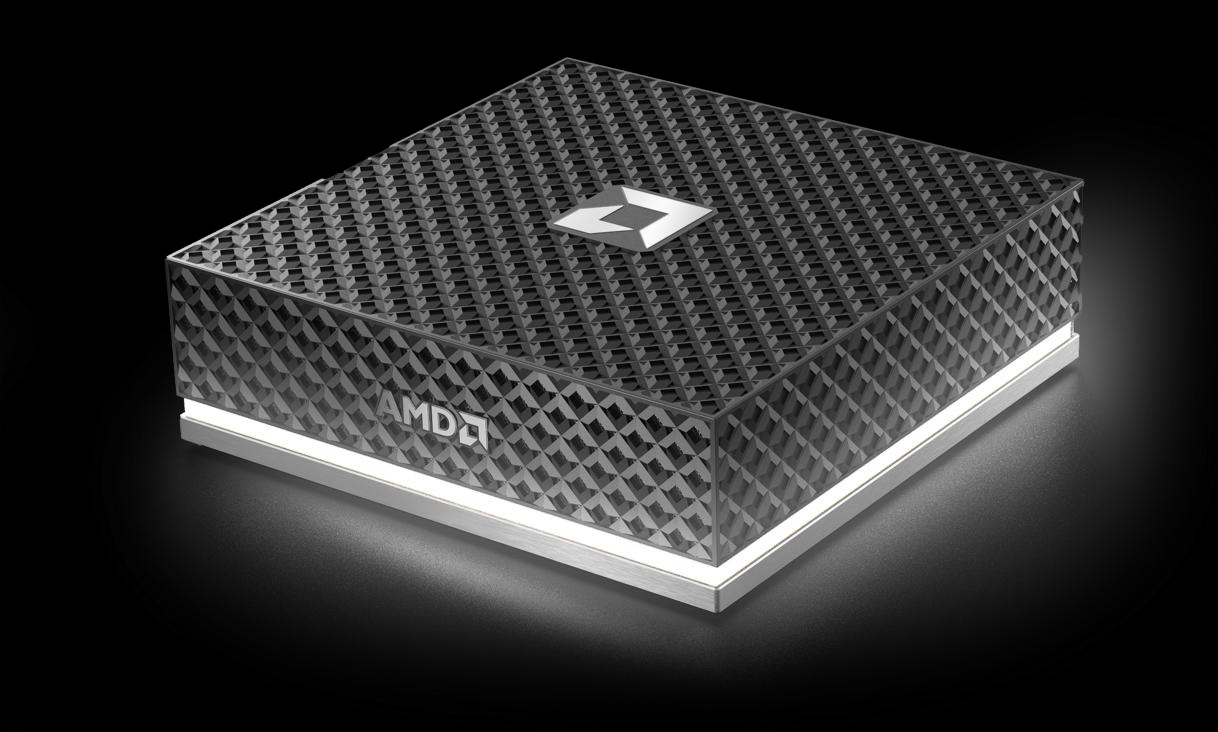
Back at CES 2026, AMD announced that they would be getting into the market for AI mini-PCs with the teaser of a new small form factor box, the Ryzen AI Halo. Powered by AMD’s Strix Halo silicon – the basis of the Ryzen AI Max 300 series of chips – the Ryzen AI Halo would be AMD’s answer to products such as NVIDIA’s DGX Spark, offering a comprehensive local AI inference workstation and development box that combines capable hardware with a customized and optimized software environment.
Essentially pitched as all of AMD’s AI tech in a single box, at the time of the CES announcement AMD stated that the Ryzen AI Halo would be arriving in Q2 of this year. Now, just past the half-way point for the quarter and with Computex quickly approaching, AMD is formally unveiling the Ryzen AI Halo system, as well as announcing that pre-orders will be opening up next month. The AI dev boxes will be available for $3999.
AMD is releasing the Ryzen AI Halo nearly a year after the underlying Ryzen AI Max silicon was released. This puts them in the interesting position of releasing an AI mini-PC based on hardware that their partners/customers have already been shipping for the year. And in that respect, AMD is not bringing anything meaningfully new to the table in terms of hardware. At this point there are numerous other AI-focused Ryzen AI Max small form factor systems on the market, such as from Minisforum.
| AMD Ryzen AI Halo Key Specs | |
| Processors | AMD Ryzen AI Max+ 395 (5.1GHz) |
| Operating Systems | Windows 11 Linux |
| Memory | 128GB LPDDR5X-8000, Soldered |
| Storage | 2TB SSD (PCIe Gen4 x4) |
| GPU | Radeon 8060S Graphics (40 CUs) |
| PSU | TBD |
| Form Factor | Mini-PC |
| Dimensions | 150 x 150 x 43.2 mm (5.9 x 5.9 x 1.7 in) |
| Weight | “Just over” 1kg (2.2lbs) |
| Wireless | Wi-Fi 7 (2×2) + Bluetooth 5.4 |
| Color | Black |
| Ports | Rear: 1x HDMI 2.1, 4x USB-C (Data Rates TBC), 1x 10GbE LAN (RJ45) |
By and large the high-level specs of the Halo box are similar to what we’ve seen with other Ryzen AI Max PCs, fundamentally driven by what hardware is (and is not) available from said SoC. In fact, AMD is barely showing off the hardware right now, only sending out a couple of renders of the box for photos.
SoC aside, AMD will be shipping the box with a 2TB PCIe Gen4 x4 SSD installed, which is right at the mid-point between the smallest and highest capacity AI dev boxes we’ve over the last year. Though in terms of physical size, AMD’s box might be the smallest and lightest implementation yet, with the Halo measuring just 43.2mm tall and “just over” a kilogram in mass.
The Software Stack: Ryzen AI Development Center
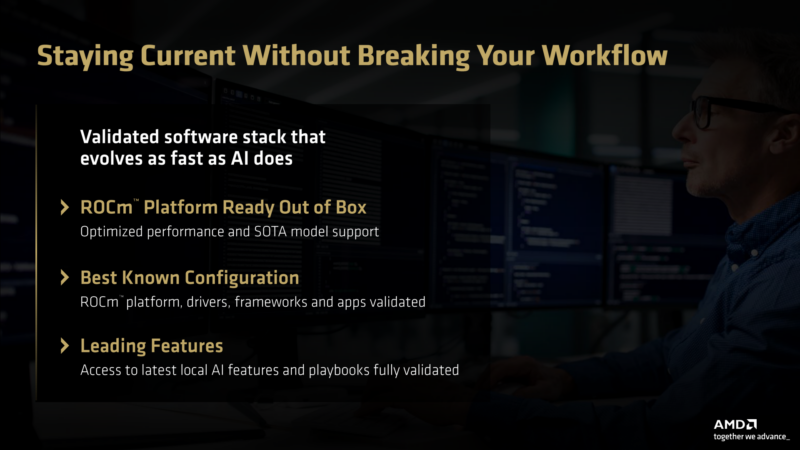
In lieu of novel hardware, what AMD is bringing to the table with the Ryzen AI Halo – and ultimately what drives their value proposition – is the software side of the system. Whereas AMD’s partners have been shipping relatively generic boxes for users to do with as they wish, AMD is very conspicuously taking a page from NVIDIA’s playbook and loading up the Ryzen AI Halo with software, and backstopping all of that with an even larger ecosystem of validated models, frameworks, and playbooks to get new users going right away. In other words, the Halo is meant to be a complete AMD ecosystem box, something they have never done before.
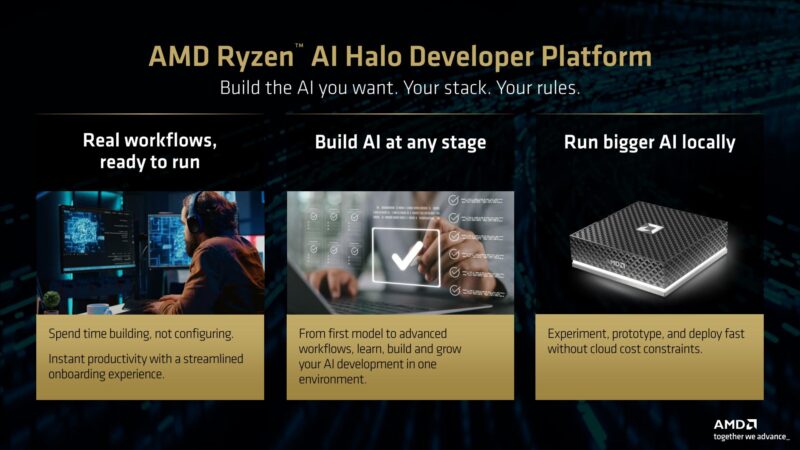
Notably, AMD is going to be supporting box Windows and Linux (distro TBD) out of the box. While the latter does remain the first choice for a lot of AI developers (and the only choice for rival NVIDIA’s DGX Spark boxes), AMD believes there are enough AI developers and users running Windows as their daily driver to warrant supporting both at parity. As such, both OS configurations are going to ship with a similar AMD software stack on top.
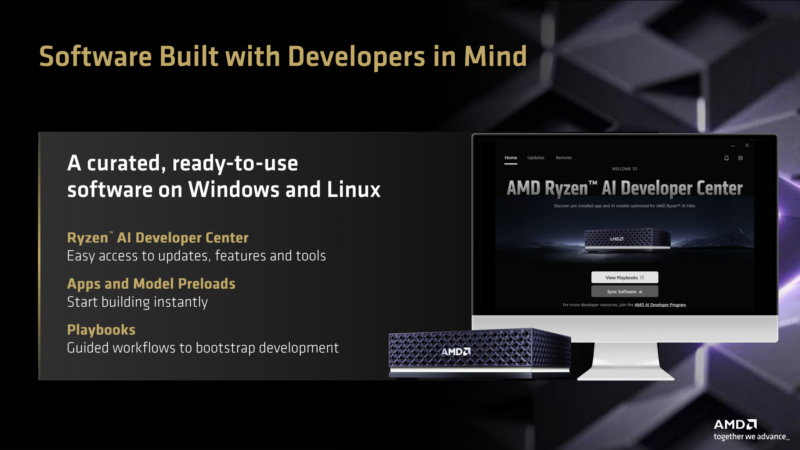
The focal point for this AMD software ecosystem will be the AMD Ryzen AI Development Center. Besides serving as a jumping-off point for new users, this will also be the front-end for installing, managing, and updating all of the AI software on the box. In practice, this will be akin to an AI package manager, with AMD supplying the packages. This is also
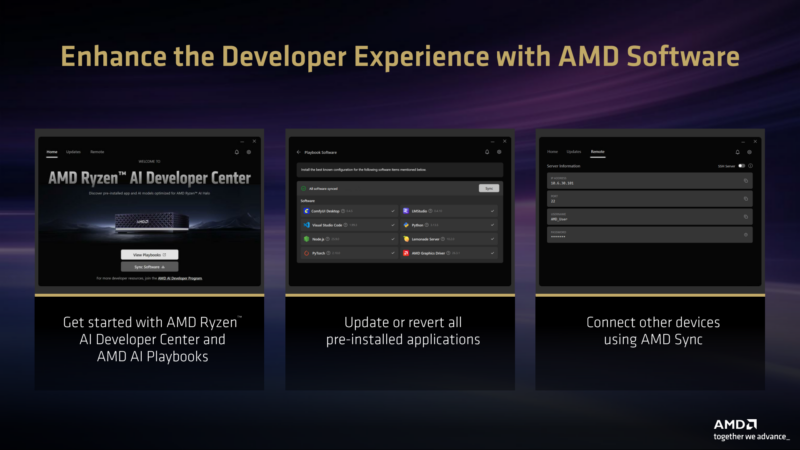
Importantly, this means that AMD will be able to validate everything that will be distributed through the Ryzen AI Development Center as well. Pre-built packages for AMD hardware have become increasingly prevalent over the last year already, but this is perhaps the greatest value that AMD brings to the table by reducing friction and otherwise ensuring things just work.
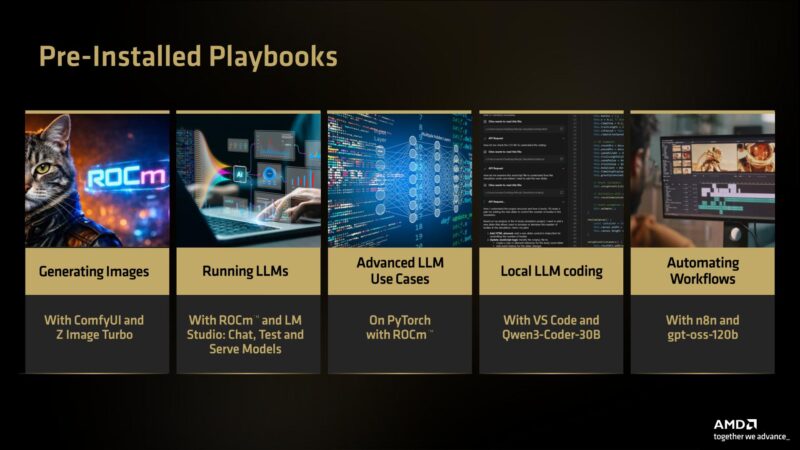
AMD has also been investing heavily in documentation for their ecosystem and Halo box. The company has compiled a series of AI playbooks to instruct users on how to get started with the ROCm ecosystem, models, and various AI-powered tasks. Five of these playbooks will be pre-loaded on the system, while another 10 will be on AMD’s website.
Halo Competitors: Taking Aim at DGX Spark
Software and ecosystems aside, AMD’s other big promotional push for the Ryzen AI Halo will be on the sheer value proposition of the box – be it how it compares to their competitors, or how it compares to the cost of clod computing.
AMD sees their big rival as NVIDIA’s DGX Spark, which is both the frontrunner in this new space for AI dev boxes, but also a product that can be a potentially dangerous comparison for the company. NVIDIA’s software ecosystem is a proverbial moat, and the company’s silicon has dedicated tensor hardware for matmul operations (as well as full hardware support for FP8/F6/FP4 datatypes), something AMD’s RDNA 3.5 architecture lacks. As a result, while the Ryzen AI Max silicon and resulting Ryzen AI Halo hardware has some advantages over the Spark, it also comes into this fight with some disadvantages as well. Nonetheless, AMD is going to be pressing those advantages hard, particularly anything relating to performance.
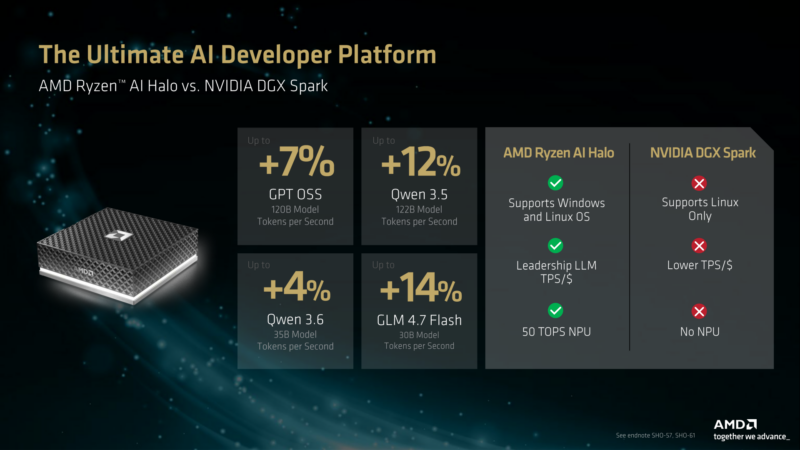
The company also has aims of capturing users who have been buying up Macs for local AI inference. Though in an example of the market moving faster than marketing, Apple has already discontinued all Mac Studios and Mac Minis with more than 96GB of RAM, so Apple and AMD are effectively in different leagues for the moment.
Halo Value Proposition: Operating Costs
AMD’s final marketing platform, then, is operating costs. While running models locally incurs an initial investment cost in the hardware, it means paying far less per token produced or consumed.
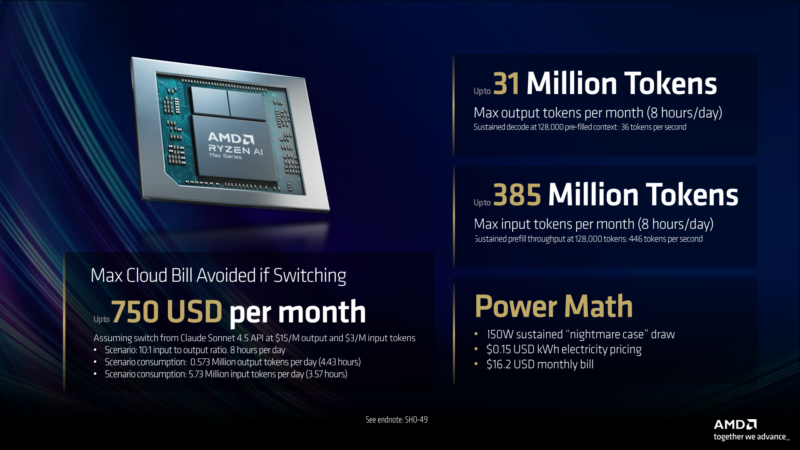
For AMD’s “power math” to work, it does require making pretty heavy use of tokens, as the cost of cloud services scales pretty linearly with the number of tokens used. But for users who are not already staying out of the cloud for privacy or security reasons, AMD reckons it can win those users over on total operating costs.
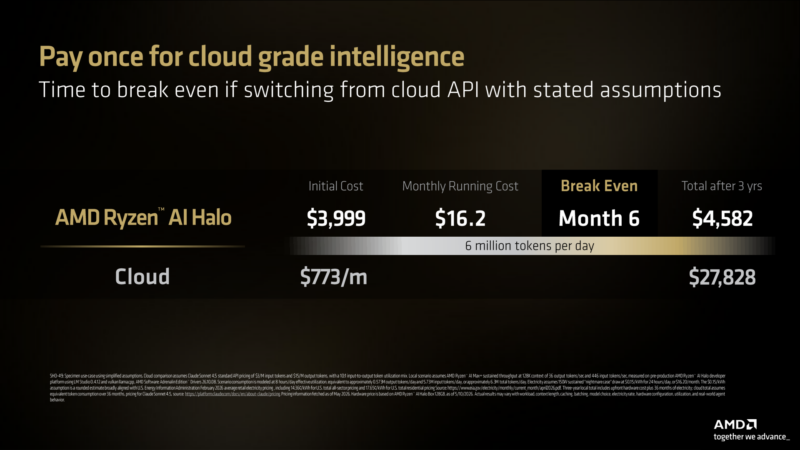
Those initial investment costs will not come cheap, however. AMD will be launching the Ryzen AI Halo at $3,999, which is a significant premium over current ~$3300 pricing for other Ryzen AI Max+ 395 mini-PCs. In practice this means that AMD is going to be banking heavily on their support, vertical integration, and software stack to justify the higher price of AMD’s own system, especially as AMD is not bringing anything extra to the table in regards to hardware.
This pricing also puts AMD in to direct conflict with rival mini-PCs based around NVIDIA’s ecosystem. While the DGX Spark does not have a comparable configuration (NVIDIA only offers it with a 4TB SSD), many of NVIDIA’s partners do offer virtually identical GB10 boxes with 2TB of storage, such as ASUS’s Ascent GX10, which is almost identically priced. As such, AMD is not aim to undercut the Spark/GB10 ecosystem at this pricing. Nor, for that matter, are they doing anything to counter NVIDIA’s included 200GbE networking hardware – if anything, AMD’s pricing treats it as a non-material feature.
The Future: 192GB Halo Systems to Come
Finally, along with the impending launch of the Ryzen AI Max+ 395-based Ryzen AI Halo system, AMD is already planning for the launch of future Halo systems. The company has confirmed that they will be releasing updated Halo systems based on their new Ryzen AI Max PRO 400 chips in short order, taking advantage of the higher performance and memory capacity of the newer chips. So the initial Halo system will be an only child for a very short period of time, as AMD quickly brings an even better system to market.
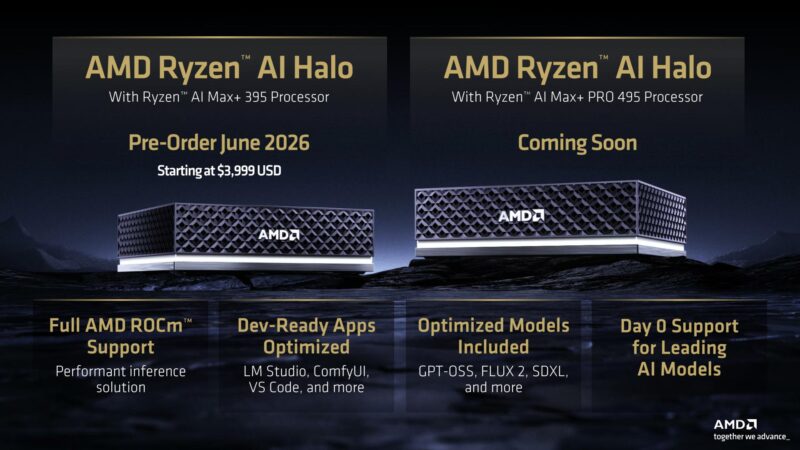
But for now, AI users and developers who are looking to pick up AMD’s first generation Halo box will be able to place their pre-orders next month, when AMD begins taking orders for the system.




No internal high end network that easily to clusters?
What a lost opportunity.
Miss on networking, and honestly 495 is what I would expect this year, not next.
395+ a discrete makes sense only because the 395 alone is slow on token generation. 395 only has 16 lanes, they’ll all go to the GPU. Arguably this gets it done by having so much memory coupled to a limited igpu-like-npu currently, and the added dGPU will help a lot with token gen. It works, but it’s hardly blowing anyone’s hair back vs cloud solutions with vastly faster processing. This is a stopgap product that feels like they tried to fix what was wrong with the 395.
What’s really wrong is that the CPU+GPU design is too heavy on general processing and needs a dedicated gpu with half that x86 general compute (or arm/riscv but that’s not AMD today).
495 I would assume runs fewer or slower x86, and level’s up the iGPU compute, with even more ram. Ideally they add enough pcie to get a 100-400g nic in there to inter-connect them. That system would be pushing the envelope vs Nvidia, today. Build that halo, and then sell lower end 485, 475 etc without the nic or without as much ram…to fill in the lower end field. Get the niches below the halo. 395+GPU is not a halo product, and this is a miss for AMD, sadly because I want to see the competition happen. NV has too much of the market to themselves. VR10? (vera rubin) will make this look terribly slow but maybe it doesn’t exist until 2027.
395 is DOA if it doesn’t have better networking. I don’t see how you buy this over that ms-s1 max if you’re staying AMD. The Spark if it’s close can win handily on decode and it’s got baller network
@Frank T
You buy this if you value support. Minisforum have a track record of poor longevity on the support side as well as just poor customer support.