Qualcomm Elite Gen 6 ISP: More Pixels, More Frames
As the Elite Gen 6 is a smartphone SoC, we would be remiss not to mention its image signal processor capabilities as well.
For the latest iteration of Qualcomm’s flagship SoC, the company has once again improved the performance of the ISP for both still photography as well as video capture. At a high level, this is still a triple ISP setup, with each ISP supporting 20 bits of precision.
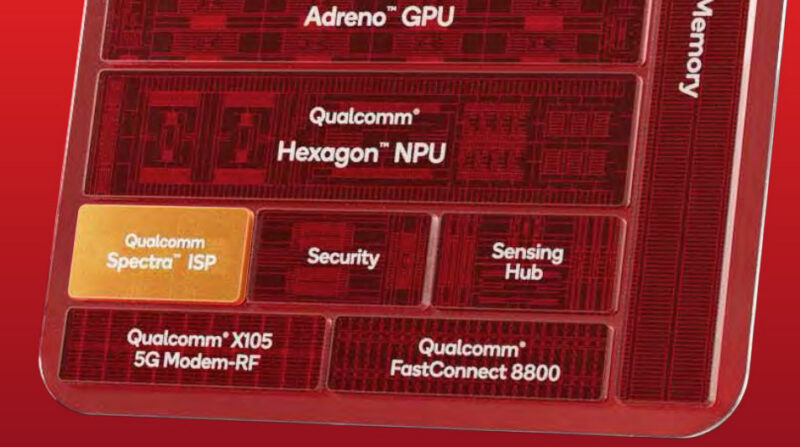
For still photography, the max supported sensor size continues to be 320MP. Or in zero shutter lag mode, the ISP can ingest 108MP images. However, in triple ISP mode, with multiple cameras active at once, the Elite Gen 6 can now ingest three 64MP images, up from 48MP on the Elite Gen 5.
As for video capture, this is another feature that diverges based on the chip SKU. For the vanilla Elite Gen 6, the SoC has gained the ability to record at 8K resolution, quadrupling the highest resolution supported by the Elite Gen 5. In 8K recording mode, the framerate tops out at 30fps. Otherwise, for slow-motion mode at 1080p, the ISP can capture at 480fps.
Meanwhile, the Extreme effectively doubles the video recording performance of the vanilla Elite Gen 6. Here the chip can record 8K video at 60fps, and 1080p slow-motion video can be recorded at up to 960fps. Coupled with the fact that the Extreme is the only one of the two SKUs to get APV support, and you would not be wrong in thinking that Qualcomm is positioning the Extreme as the chip of choice for professional cinematographers/videographers.
Qualcomm Elite Gen 6 Wireless Radio: Wi-Fi 8 and 4 Spatial Streams
Among the blocks receiving a significant overhaul in the Elite Gen 6 series is Qualcomm’s wireless radio block. And in fact, with how much focus the company has placed on the other blocks such as the GPU and NPU, the improvements here are almost deceptively understated.
At a high level, the new FastConnect 8800 block brings Qualcomm’s W-Fi and Bluetooth hardware up to the latest standards. This means supporting Wi-Fi 8 (802.11bn) as well as Bluetooth 6.0. Wi-Fi 8 hardware is still in its very early days. Wi-Fi 8 consumer routers are not even shipping until a bit later this year, so in some respects this is futureproofing the Elite Gen 6 family for what is to come.
Nicknamed “Ultra High Reliability,” Wi-Fi 8’s focus is primarily on improving the real-world performance of the hardware as opposed to improving the top-line theoretical throughput of the specification. It includes better support for base station roaming and multi-AP coordination, and improvements to handling many clients at once so that they do not interfere with each other. Ultimately, the standard’s greatest benefits will generally be seen in large spaces with many Wi-Fi clients, which is where Wi-Fi 7 (and earlier standards) have the most trouble today.
Adding Wi-Fi 8 support in this generation of Snapdragon 8 chips was not unexpected, and regardless of anything else it is a welcome change. However, it is the other major improvement that Qualcomm made that was unexpected: 4×4 MIMO support.
In a first for a Qualcomm Snapdragon mobile SoC, Qualcomm is enabling support for 4×4 MIMO (aka 4 spatial streams) for Wi-Fi, doubling the number of spatial streams supported on earlier Snapdragon chips. Without going too far into the weeds of Wi-Fi, 4×4 MIMO has been available in the specification for several generations now. However, in practice, clients are virtually always 2×2 MIMO devices. Each MIMO stream requires a separate, spatially-distinct antenna, and routing a bunch of antennas through a small device is no easy task.
Consequently, 4×4 MIMO clients are all but unheard of. The only place you would regularly see 4×4 MIMO support is with high-end routers, where the feature would be used for improved antenna diversity and signal-to-noise ratios.
The end result is that Qualcomm’s inclusion of 4×4 MIMO support is a significant change. When paired with a suitable router, it allows for upwards of twice as much bandwidth, in this case allowing for as much as 11.6Gbps. No other Qualcomm Snapdragon 8 SoC going back over a decade has doubled its Wi-Fi bandwidth in a single generation.
In practice, of course, the real-world bandwidth of Wi-Fi will not be nearly this high. And using 4×4 MIMO for a client is mostly going to be useful for networks with few devices since it means an AP cannot use multi-user MIMO at the same time. Still, it will be very interesting to see how well this pans out for Wi-Fi performance in the real world.
Qualcomm Elite Gen 6 Modem: X105 Brings 3GPP Release 19
Last, but certainly not least, no Snapdragon 8 SoC launch is complete without a cutting-edge modem.
Qualcomm’s original claim to fame, the company still works to maintain a technical (and patent) edge in cellular communications. For the Elite Gen 6 series, the chips are getting Qualcomm’s newest X105 modem, replacing the X85 modem in the Elite Gen 5.
The high-level improvement here is that this is a 3GPP Release 19 modem, which is the second generation of 5G Advanced standards. For standard users, there is no one feature of Release 19 that really stands out, and the standard is much like Wi-Fi 8 in that regard, with numerous carrier quality improvements instead. That said, the standard’s improved support for non-terrestrial networks (i.e., satellites) will turn more heads over time.
Though at least for traditional cellular networks, the standard does come with improvements for both upload and download bandwidth. Thanks to the ability to use up to 500MHz of spectrum on the downlink (up from 400MHz for X85), the newest modem can support downlink rates as high as 14.8Gbps. Meanwhile, uplink speeds can now go as high as 4.2Gbps, a modest improvement from X85’s max uplink rate of 3.7Gbps.
Meanwhile, separate from the main SoC itself, Qualcomm has also updated the analog RF transceiver frontend that gets paired with the chip. The new RF transceiver has moved down to being built on a 6nm process, which will net additional energy efficiency improvements for the cellular radio stack.