Qualcomm Elite Gen 6 CPU: Faster Oryon V4 CPU
As for the architecture of the chip, virtually every aspect of the Elite Gen 6 family has been upgraded or overhauled in some fashion versus the Elite Gen 5.
First and foremost, the chips ship with Qualcomm’s next-generation Oryon CPU cores. While the company does not officially name their generations, this now brings us to the fourth generation of Oryon CPU cores (or what we are labeling as Oryon V4), replacing the Oryon V3 cores used in the Elite Gen 5.
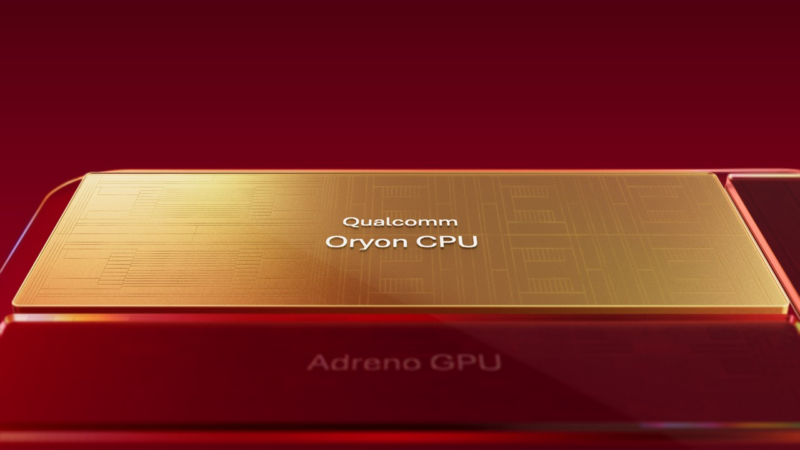
The new Oryon V4 cores are actually one of the smaller improvements to the chip. Qualcomm is touting an overall single-threaded performance improvement of 13% on the Extreme SKU. And about 8.5 percentage points of that come from clockspeed improvements alone (more on this in a second), which means that the contribution of IPC improvements is only going to be around 4-5%. As is more often the case than not, Qualcomm did not go into their new CPU architecture for this year’s Snapdragon Summit, so we do not yet have any technical details on what improvements Qualcomm has made for the Oryon V4 architecture.
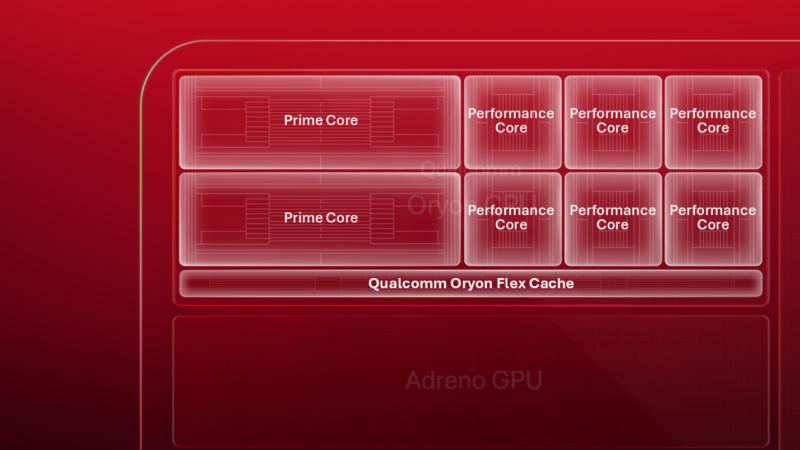
But clock speeds certainly play a big part in that. Qualcomm has cranked up the peak clock speed of the two Oryon “Prime” cores to 5Ghz, an 8.5% improvement over the Elite Gen 5. Meanwhile, the six “Performance” cores are now clocked at 4.0GHz, up 10% from the 3.62GHz clock speed of the past generation.
And these CPU performance improvements apply to both Elite Gen 6 chips. Both the vanilla and Extreme chips feature the exact same number of CPU cores with the exact same clock speeds. It is worth noting, however, that while Qualcomm is touting a 13% improvement for the Extreme SKU, they are saying the average for the vanilla Elite Gen 6 is only 10%. So do not expect the CPU cores of these two SKUs to perform identically.
Meanwhile, the improvements that are letting Qualcomm drive their clock speeds so high, particularly the use of TSMC’s N2P process node, are also able to significantly improve the energy efficiency of the Oryon CPU cores. On an iso-performance basis, the new CPU cores are 37% more energy efficient than the cores on the Elite Gen 5. So, depending on how handset vendors (and where applicable, users) tune their CPU core governors, the Elite Gen 6 can be tweaked to be significantly less power-hungry than the Elite Gen 5.
Finally, the Oryon V4 architecture is introducing a new L2 cache design that Qualcomm is calling its FlexCache. Previous iterations of the Oryon architecture featured separate L2 caches for the Prime and Performance core clusters, so it would seem that Qualcomm has merged them together as a single cache. According to the company, the impetus behind this is that it allows cache to be dynamically allocated between the cores in whatever fashion would best benefit system performance – most often giving the Prime cores full run of the L2 cache, we suspect. This kind of cache allocation is something that Qualcomm could not do before with per-cluster L2 caches. Though it is interesting that given this change, Qualcomm has only made the Flex Cache 16MB in size: this is larger than either 12MB L2 cache pool on the Elite Gen 5, but smaller than their combined size of 24MB.
Qualcomm Elite Gen 6 GPU: Adreno Goes Extreme with Matrix Cores and a GPU Cache
Moving on to the Elite Gen 6’s GPU architecture, this is where Qualcomm’s Elite Gen 6/Elite Extreme Gen 6 chips start diverging in terms of features.
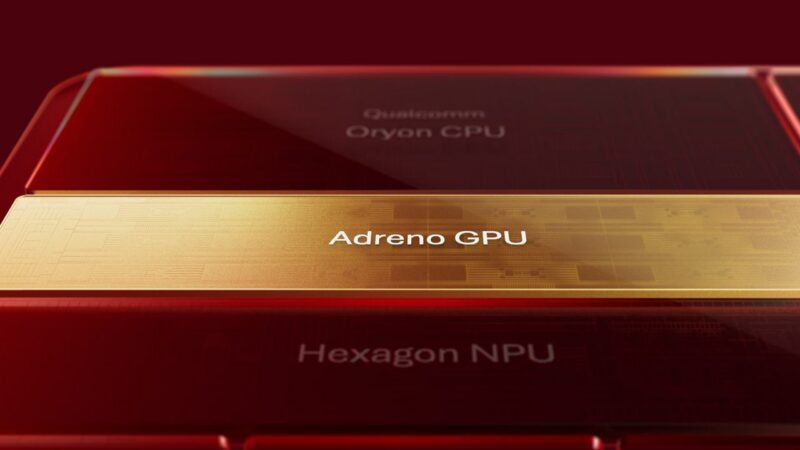
We will start with the vanilla Elite Gen 6. This chip does not get any new high-level features, and all signs are that it is an iteratively improved version of the same GPU architecture that was in the 8 Elite Gen 5 (Adreno 8xx), ray tracing functionality and all. The lack of marquee features aside, Qualcomm is promoting the vanilla Elite Gen 6 to offer 35% better GPU performance over the Gen 5, or in terms of power efficiency, a 40% improvement there. Consequently, the Elite Gen 6 GPU is still significantly improved over the Elite Gen 5.
Instead, the newest and best features are reserved for the Elite Extreme Gen 6. And there are two big things to talk about here.
First and foremost, Qualcomm is bringing dedicated matrix math cores to their GPU architecture, which they are calling Adreno Neural Fusion. The high-density, high-performance systolic array is designed to process matrix math even faster than what the vector units in Qualcomm’s GPU can already do. We have previously seen all of the major PC vendors make this same change (e.g. NVIDIA tensor cores) as well as Apple with the A19 Pro’s neural accelerator cores last year, and now Qualcomm is catching up.
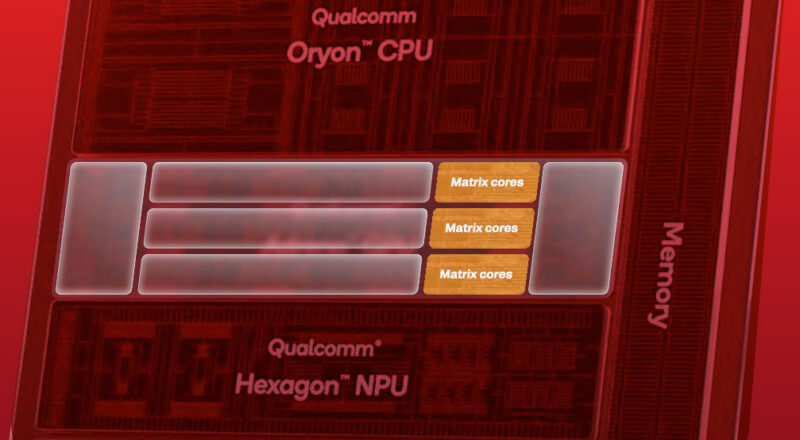
As with the industry’s other GPU vendors, the primary purpose of adding matrix cores to the GPU is to offer a higher performance option for matrix multiplication, be it for AI purposes or graphics purposes. On the graphics side of matters, matrix cores have proven especially useful for temporal image upscaling, along with smoothing out noisy ray-traced images. In effect, this is the piece of hardware Qualcomm needs to offer PC-like high-quality temporal upscaling. Meanwhile, the use of matrix cores for AI inference needs no introduction. On-device AI inference is a major emphasis once again this year for Qualcomm.
It should be noted that Qualcomm’s Hexagon NPU already features matrix cores as well. So the change here is not so much about adding matrix cores overall, but about adding them to the GPU. The NPU is a very efficient compute block, but its peak performance is significantly overshadowed by the GPU. Conversely, adding matrix cores here gives Qualcomm the ability to use the GPU as a faster (if less energy efficient) AI computing resource.
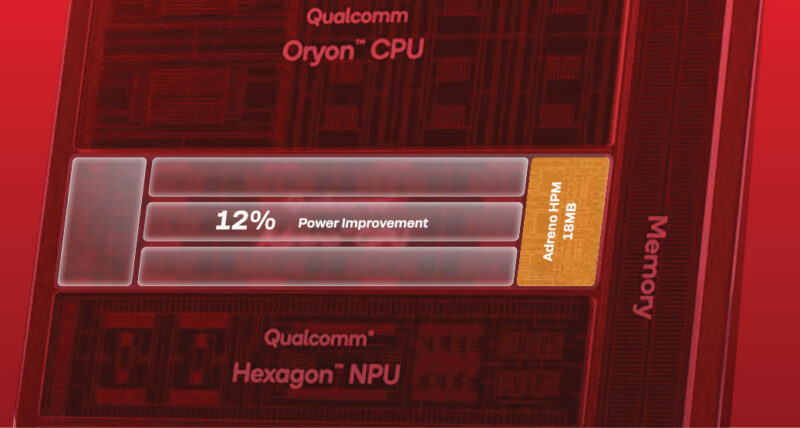
Meanwhile, Qualcomm’s GPU high-performance memory (HPM) GPU cache is also returning from the Elite Gen 5 – but only for the Elite Extreme Gen 6. The 18MB GPU cache was added to the Elite Gen 5 as a power optimization, allowing games to keep a small set of data closer to the GPU rather than having to go to main memory, which is a relatively expensive operation in terms of power consumption. However, as one of the ways that Qualcomm is differentiating the two Elite Gen 6 chips and ensuring that the Extreme delivers better performance and energy efficiency, this cache is now only available on the Extreme.
Overall, Qualcomm says that the HPM cache improves the power efficiency of the Extreme by 12%. Though this point of comparison is versus the HPM-equipped Elite Gen 5.
GPU performance aside, the Elite Gen 6 also comes with an upgraded video processing block, though this again is bifurcated based on SKU.
For the Extreme SKU, Qualcomm is adding H.266 Versatile Video Coding (VVC) support. This is the next-generation video codec from the MPEG working group that will be succeeding H.265/HEVC. And the Elite Extreme Gen 6, in turn, is the first Qualcomm product to get VVC support.
It goes without saying that VVC is in extremely limited use right now since adoption is just starting, but as with every generation of video codec standards, this is laying the groundwork for future versions of the format. Though Qualcomm’s choice to restrict it to the Extreme is something of an odd one in that case, as withholding it from the vanilla Elite Gen 6 just slows down the overall adoption rate. In any case, for now Qualcomm is touting VVC as being chiefly for more power-efficient video rendering.
Meanwhile, the Advanced Professional Video (APV) codec has also become an Extreme-exclusive. This is another Elite Gen 5 feature that is not being carried over to the complete Elite Gen 6 product stack. Chiefly aimed at video production professionals as an intermediate codec for video recording, APV is a visually lossless codec, differentiating it from H.265, which, though very good, does not claim to be visually lossless.