

QNAP TS-h1290FX Power Consumption and Noise
With its 750-Watt power supply, the TS-h1290FX is designed to be able to handle a pretty wide range of hardware with a pretty wide range of power needs. The EPYC Rome 7232P processor is rated for a TDP of 120 Watts, never mind the RDIMMs and SSDs at upwards of a couple of dozen watts each. All of which is to say that the power consumption of the TS-h1290FX varies pretty heavily depending on just what is installed in the NAS, and then whether it is active or idling.
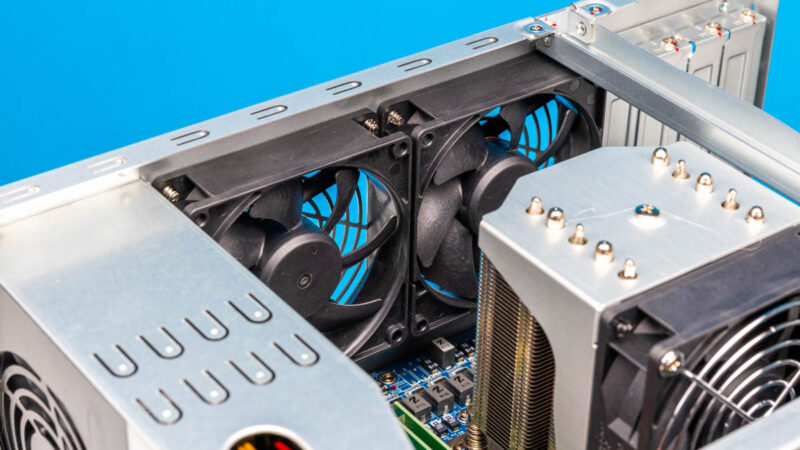
At idle, we clocked it at 88 Watts. Which is not fantastic compared to some NASes built around consumer platforms (the Rome platform is not known for its deep idle power consumption), but it is reasonable for the overall platform. Meanwhile, under load, if you can get the CPU and 12 SSDs all running at full tilt, then it is not too hard to get the NAS up to 400 Watts. We went beyond that when we added the NVIDIA A1000 GPU and higher-end NICs/ optics.
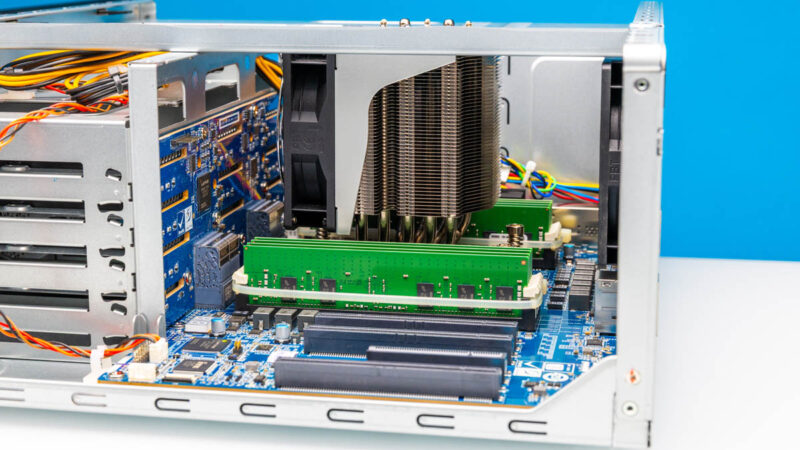
And while the TS-h1290FX is built from server parts, it thankfully does not sound like one. After all, the NAS needs to be able to run in our studio, where on any given day we are also filming and testing hardware components. The idle noise of 37-38 dBA is not whisper quiet by any means, but it is quiet enough. Things do pick up a bit infrequently when it is running at full tilt, but with the stock CPU, it was not often. So QNAP has done their homework in ensuring that their high-end NAS is still reasonably quiet for use in an office environment.
Final Words
It goes without saying that the world of network-attached storage devices is quite varied. By pairing a 12-tray drive bay with an AMD EPYC server platform, QNAP has left nothing to chance on either end of the NAS performance equation. With the ability to accommodate the latest U.2 SSDs, the TS-h1290FX cannot only house an incredible amount of storage in a relatively small chassis – over 737TB fully laden – but it has all the bandwidth necessary to put those SSDs to good use.
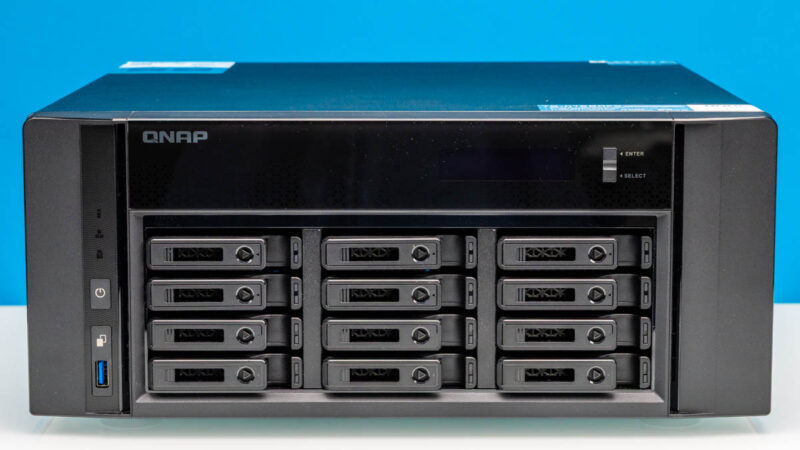
All of which is enabled by the use of a server-grade AMD EPYC 7002 series processor, allowing for ample I/O bandwidth, oodles of memory capacity, and plenty of CPU cores to keep things moving behind the scenes. Not to be forgotten is the inclusion of 25GbE networking, which is key to making all of that drive bandwidth available to networked PCs elsewhere in the building.
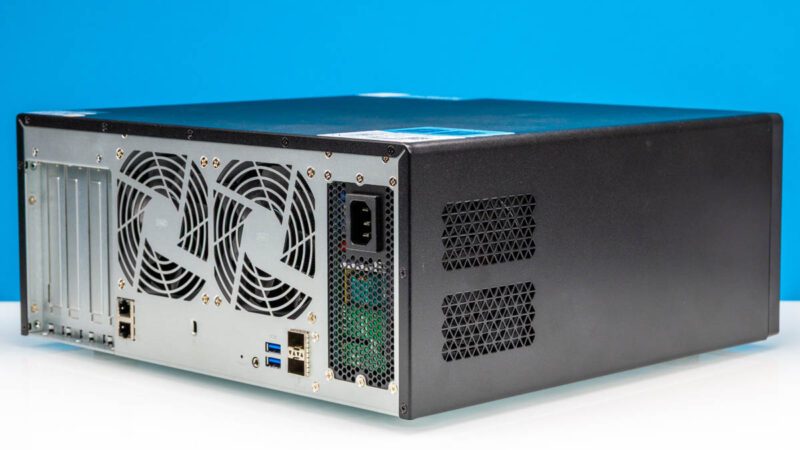
It is no surprise then that we were quickly enamored with the NAS, and eventually used it to build our newest studio storage system. With the capacity to house our extensive video library for our YouTube channel, as well as providing the bandwidth needed to remotely edit it – not to mention covering all of our more mundane storage needs – the TS-h1290FX ticked all of the boxes we needed for a high-performance all-flash NAS. At the end of the day the server-grade NAS not going to be the kind of NAS that most users will need, but for those who do, it is more than up to the challenge of serving as a high-end storage server.
Where To Buy
If you wanted to find the QNAP TS-h1290fx online, here is an Amazon Affiliate link.

Was the ~46Gbps throughput in the file server test achieved with RDMA?
What storage protocol was used in that test – SMB, ISCSI or NFS?
My experience is that performance characteristics of iSCSI, SMB and NSF are different and further depend on protocol version and encryption settings. I would find it useful if someone published results with enough details to be reproducible.
While the hardware seems nice, in lesser models I didn’t see how the QNAP software would support Kerberized NFS or SMB with an existing Active Directory service. Before claiming something is “high-end NAS in the truest sense of the word” it would be nice to verify important enterprise-use test cases.
I’m confident that you mean SFX rather than ATX, and given that you repeatedly mention the P/S standard, it’s probably worh fixing, if it’s incorrect.
I have the 32-core version w/256GB RAM. I installed TrueNAS Scale on it and it works great. I fly it with me to setup fast shared storage for a few editors / DIT on film shoots. Small and hardy enough to put through checked luggage if you get a good thick hard case for it. Hasn’t failed me yet on many, many flights and shoots.
THIRTEEN FU**ING THOUSAND USD – FOR THIS ?!?
Why would one go for this instead assembling it by himself ?
Any chance that you test Real-time SnapSync performance one day ?
(looking for easy realtime replications solutions, there is no test of these anywhere, Synology has another replication setup but no test of this one nowhere either)
Back at the TS-h1290FX, it really lacks some features for the price, especially redundant psu..
@Goose
I have it specifically in my notes that the PSU here is an ATX power supply. But double-checking the QNAP manual, I’m not seeing it mentioned. I recall this info being hard to track down to begin with, so I’m going to have to double-check some other things and get back to you.
More on the QNAP TS-h1290FX Power Supply
Part No. PWR-PSU-750W-CW01
No info on Qnap.com about the PSU Form factor. The only web site listing the PSU as ATX Form factor is Amazon.com
However as usual with Amazon the specs are not always accurate.
As an example, the PSU is listed as QNAP 7500W, Redundant Power Supply…
Amazon.Com: https://www.amazon.com/QNAP-Systems-PWR-PSU-750W-CW01-Hot-pluggable-Plug/dp/B0FC7SQ72Q
Qnap Online Store: https://store.qnap.com/pwr-psu-750w-cw01.html
We’ve finally been able to confirm that it is indeed a SFX power supply, not an ATX power supply. Thank you for pointing that out, Goose. The article has been updated accordingly.