

The PCI-SIG announced this week that it is not going to stop. Targeting a 2028 release, the PCIe 8.0 specification will double the throughput over PCIe 7.0. With the release, the PCI-SIG also shared two neat charts.
PCIe Gen8 Announced by the PCI-SIG Will Double Throughput Again
The PCI-SIG has this graphic to show what is happening to I/O bandwidth. It says that the I/O bandwidth is doubling every three years.
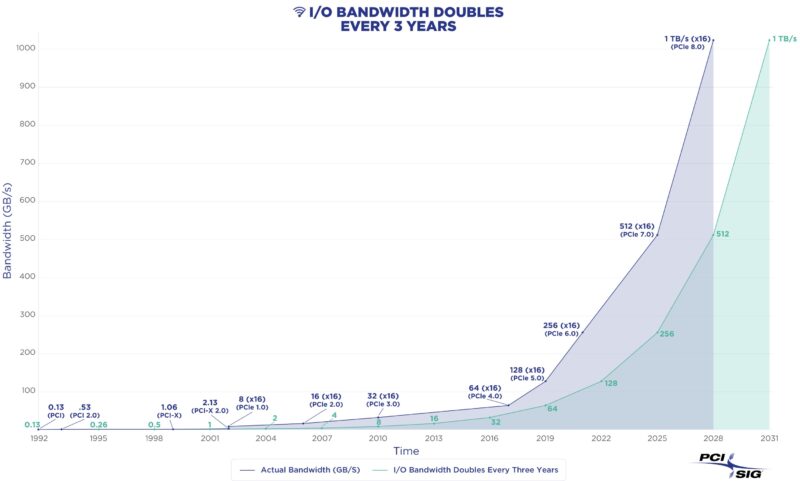
Something to also keep in mind is that this is very device and interface centric. From a processor and system point of view, the number of controllers and lanes is also increasing at the same time the link speeds increase. So from a system standpoint, the cumulative I/O bandwidth is increasing at an even faster rate.
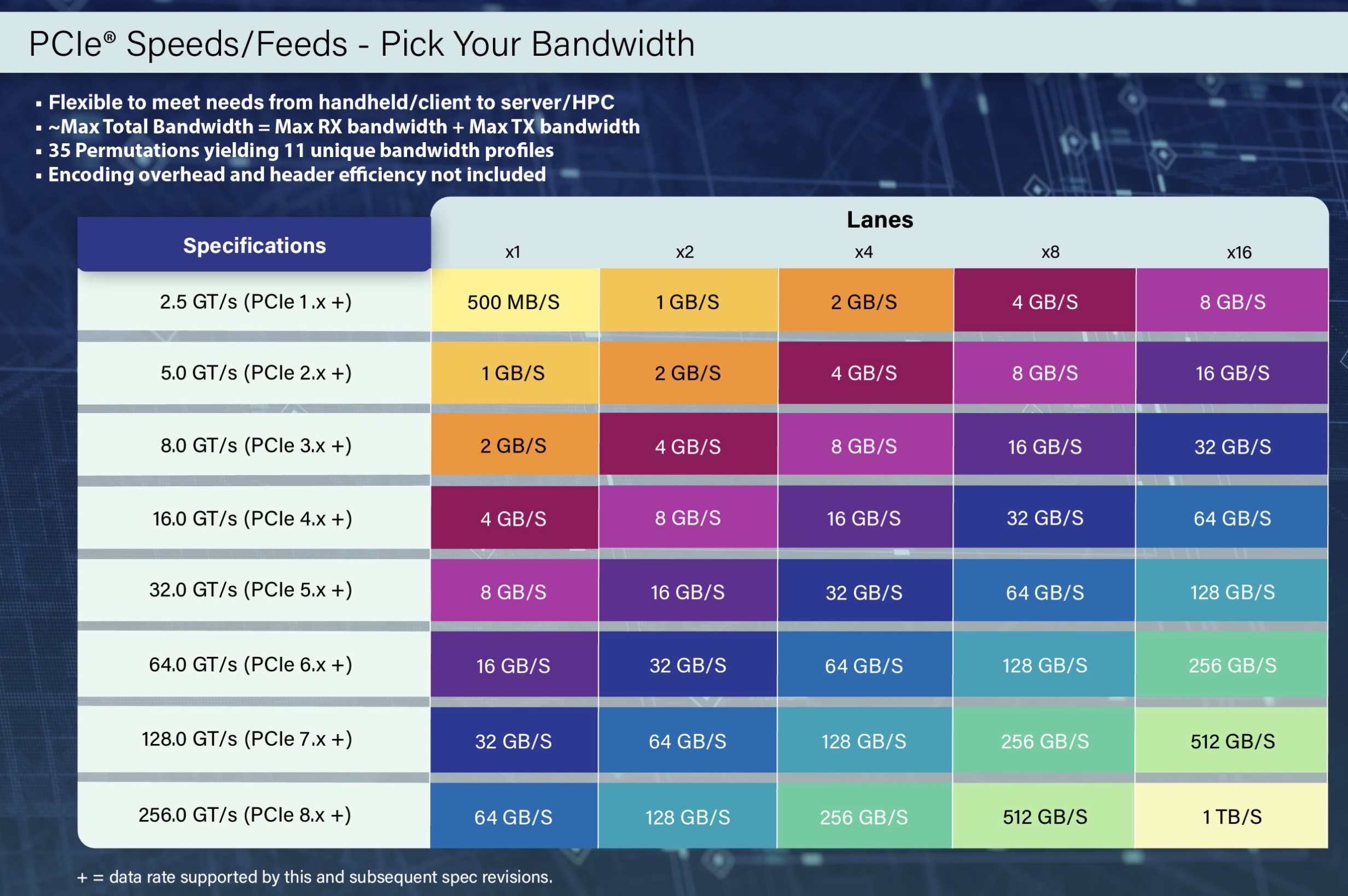
Now for the chart that many of our readers will want to have handy. This shows the PCIe bandwidth by generation and link width. The headline feature is that the PCIe Gen8 x16 link will have 1TB/s of bandwidth available, up from 128GB/s in today’s PCIe Gen5.
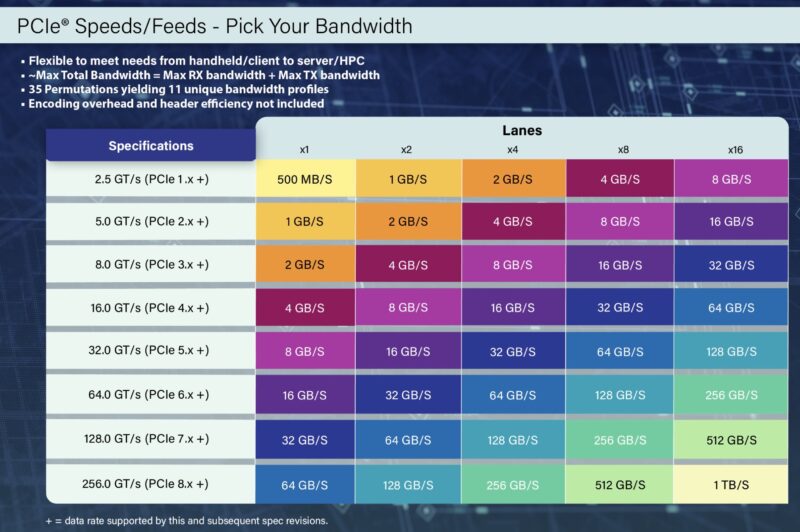
Of course, this is the kind of table that is a good reference for folks who want to compare bandwidth across generations and lane configurations. The best part is that it not only looks back to the original PCIe implementation, but it also goes to the PCIe generation that we will be using at the end of the decade.
Final Words
This is certainly forward-looking. We are on PCIe Gen5 today. PCIe Gen6 is the generation that we are starting to see more often, with some solutions already hitting the market, like the NVIDIA ConnectX-8 NIC and NVIDIA B300 generation. PCIe Gen7 is still a few years off. Still, with so much investment in the AI build-out, there is a major push in the industry to continue to increase the speed of interconnects.



IMO the PCIe bandwidth chart is a bit misleading and confusing, it adds-up Xmit and Recv bandwidth and the resulted number is meaningless. PCIe Gen3 x16 link is usually considered as 16GB/s because it can send 16GB (minus protocol overhead) per second.
The six or seven year reign of pcie 3.0 still cracks me up.
I don’t know what to make of the PCI-SIG, they can’t even update their slide captions for this new generation:
> 35 Permutations yielding 11 unique bandwidth profiles
There are 40 boxes in their chart, and 12 bandwidth options.
@Easy Rhino
pcie 3.0: Was definitely Ground Hog Day for me (working within a modest (by today’s standards) lake of 5K Xeon/Epyc based servers for a financial firm from 2012 – 2021.)
With the newer PCIe generations eventually trickling down to consumer grade solutions, it might be time for a resurgence of the “south bridge” concept.
Take 1-4 of those hyper fast lanes, and downgrade it to a previous generation for things like networking, sound, etc.
It almost sounds like we could ended up with a graphics card that is on PCIe 8.0 x1…except the goldfingers also provide as a reinforcement to hold up the nifty heavy clunk of metal that is a graphics card…