Early Performance Figures: Promising, But Incomplete
With NVIDIA’s ambitions to more directly compete in the data center space with Intel, AMD, and the other Arm vendors, NVIDIA is now also in a position where they need to promote the performance of their CPUs in comparison to the competition.
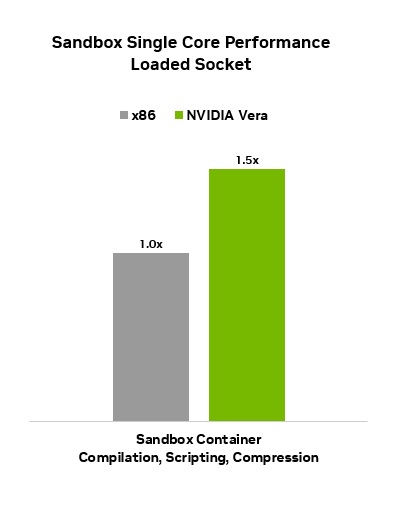
At a high level, NVIDIA is touting Vera as offering 1.5x the “agentic sandbox” performance of an unnamed rival x86 CPU. This is consistent with NVIDIA’s overall marketing pitch for Vera, which is that it is the ideal CPU companion for running numerous agentic AI tasks being spawned by the GPU (and LPU).
More interesting is that NVIDA also gave Redpanda, a streaming data platform company, early access to Vera to benchmark it using their Redpanda Streaming platform. As a result, we also have some third-party (ish) benchmarks of what Vera can do.
The results, as you would expect from an NVIDIA-blessed benchmark, are very favorable for Vera. Compared to both AMD EPYC 9005 (Turin) and Intel Xeon 6 (Granite Rapids) hardware, Vera is significantly ahead in long-tail latencies and SQL performance. Redpanda also provided an additional interesting data point, which is their measured inter-core communication throughput, which has Vera behind at low core counts but pulling well ahead by 64 cores – outlining the advantages of NVIDIA’s single side, single NUMA domain strategy.
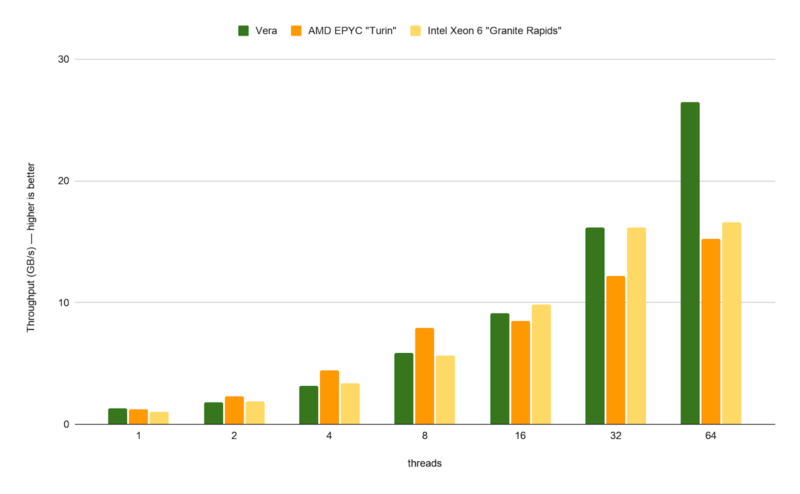
Redpanda’s benchmarks are far from comprehensive, but they are none the less an interesting first look at Vera. If Vera can put up significant data center workload wins once it starts shipping later this year, then that would be a major feather in NVIDIA’s cap following their decade and a half of CPU ambitions.
With that said, however, there’s still a great deal unsaid about Vera. We do not have clockspeeds, power consumption, or most of all pricing information for Vera. There are a great many details that go into making a product competitive in the cutthroat data center market beyond just performance, and how well NVIDIA does at these other factors is going to have a significant impact on how well Vera does outside of NVIDIA’s own Vera Rubin racks.
Expanded Ambitions: Vera CPU Racks, Vera Servers, & Vera in HGX NVL8
Speaking of Vera Rubin racks, one of the cornerstones about NVIDIA’s expanded ambitions with the Vera CPU is that it is not just for NVIDIA’s standard NVL72 racks. For the first time, NVIDIA is going to be offering dedicated Vera CPU racks for Vera Rubin ecosystem customers, allowing them to scale up just the CPU portion of their operations.
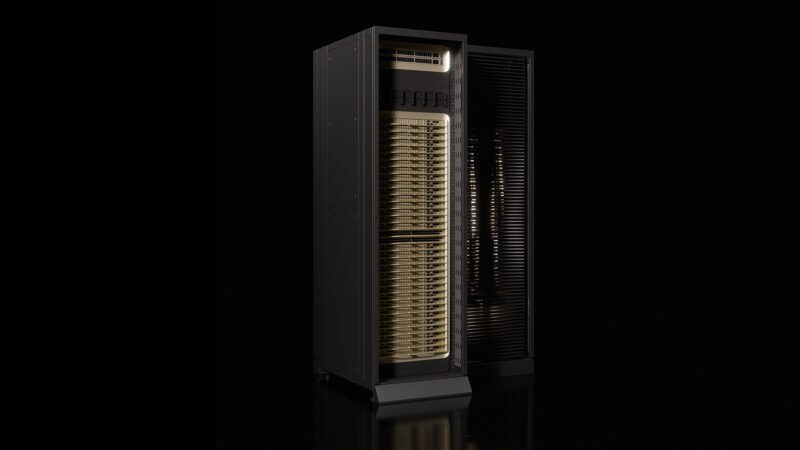
Plainly named the “NVIDIA Vera CPU rack,” these racks will pack 256 Vera CPUs into a single rack of 1U compute trays, with up to 4 nodes (8 CPUs) per tray. A compete rack in turn will contain up to 400TB of LPDDR5X memory, along with a hefty dose of additional NVIDIA technologies, including NVIDIA’s BlueField-4 DPUs. Meanwhile communication between trays in a rack will be provided by NVIDIA’s Spectrum-X Ethernet controllers – NVLink being off the table here as Vera only has an NVLink C2C PHY that’s suitable for talking to adjacent chips.
NVIDIA has not disclosed the power requirements for a Vera CPU rack, but expect it to be a hot item. The full 256 CPU configuration will require liquid cooling, just as with NVIDIA’s other Vera Rubin family racks. Fittingly, the Vera CPU rack is being designed around the same MGX modular rack architecture, so it will fit right in with the rest of the family.
Otherwise, for customers who need something other than a whole rack of Vera, NVIDIA’s other major expansion in this generation is that the company is working closely with its cadre of OEM/ODM partners to offer single and dual socket Vera CPU servers. Dell, HPE, Supermicro, Lenovo, and others are all stepping up participating partners, underscoring the amount of OEM interest and investment NVIDIA has garnered from these server vendors.
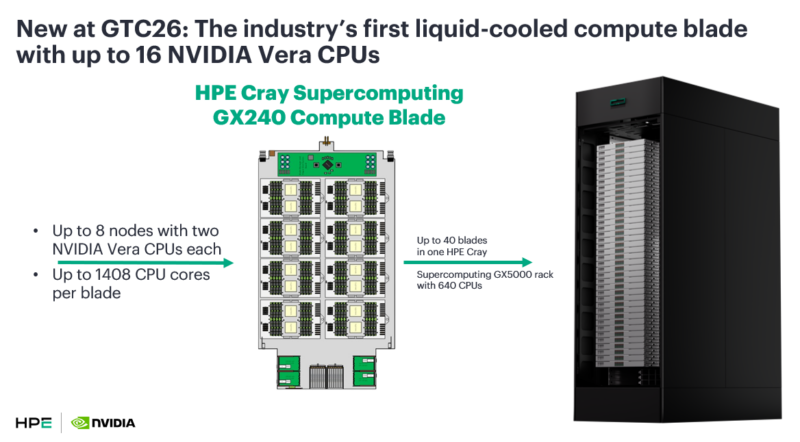
Individual Vera CPU servers are designed to fill the gap both above and below a whole 256 CPU rack of Vera trays, offering server operators more flexibility in how they deploy NVIDIA’s CPU. On the low end will be single and dual socket servers, with one or two Vera CPUs per tray/node respectively. This will be the backbone of air-cooled options. On the other end of the spectrum, some of NVIDIA’s partners such as HPE are going the other direction and will be providing Vera CPU racks that are even more dense, with HPE planning to offer GX240 compute blades with up to 16 CPUs per blade, which in turn can go into the Supercomputing GX5000 compute rack for up to 640 Vera CPUs.
Finally, at the smallest end of the server scale, NVIDIA has confirmed that they and their partners are also going to be offering versions of the HGX Rubin NVL8 tray with Vera CPUs. As a reminder, HGX systems are NVIDIA’s traditional, PCIe-based systems with one or two CPUs wired up to 8 SMX form factor GPUs.
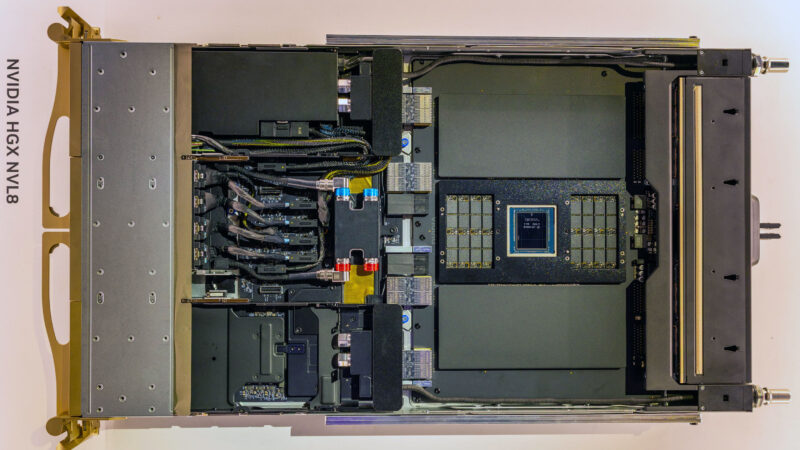
HGX is NVIDIA’s most flexible offering by using the smallest amount of NVIDIA’s proprietary interconnect technologies, and in previous generations it has been the backbone of partners’ x86-based offerings. The inclusion of Vera as a CPU option for the Vera Rubin generation is going to shake things up by offering an Arm host CPU for the first time. As a result, this will be a very interesting case where Vera is going to have to directly compete with chips from NVIDIA’s x86 rivals.
Final Words
With the initial announcement of their Vera CPU at CES 2026, and once again reinforcing it at GTC 2026, NVIDIA has made it clear that they have grand ambitions for their Vera CPU. Their first fully custom CPU design in almost a decade – and their first custom data center CPU design ever – NVIDIA is aiming higher and broader than ever before.
Whereas Grace was a caution first foray into data center CPUs, the forthcoming release of Vera will be when NVIDIA takes their next step and actively starts trying to peel away data center market share from the likes of Intel and AMD. At the end of the day Vera is still a specialized piece of kit and is not going to be a true general-purpose CPU in the same vein as AMD and Intel’s extensive and varied CPU lineups, but with so much CPU demand being fueled by AI compute needs right now, just supplying an even larger portion of the silicon that AI customers are using these days would be a significant win for NVIDIA. And all the better if they can accomplish this while beating out AMD and Intel in single-threaded benchmarks.
As with the rest of the Vera Rubin platform, NVIDIA will begin shipping Vera CPUs in the second half of this year, with the company’s partners expected to ramp up their Vera-based server offerings throughout the next year.