With Intel’s latest-generation Panther Lake silicon (Core Ultra 3 series) being a mobile-only product generation, the task of carrying the torch for Intel’s desktop product lineup falls to the company’s existing Arrow Lake processors (Core Ultra 2 series) for a second year. A technologically solid but overall unexceptional processor lineup, Arrow Lake’s desktop existence has often been overshadowed by Intel’s internal problems as well as competition from stalwart rival AMD. None the less, for the next several months it is the best silicon Intel has on hand for the desktop market, and in order to continue driving sales over that time period Intel is giving Arrow Lake a refresh to improve its performance and competitive positioning.
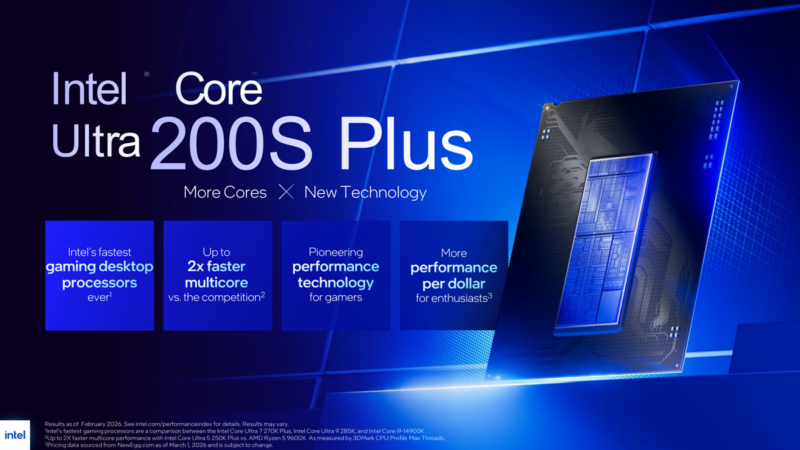
To that end, today Intel is announcing the Core Ultra 200S Plus series of chips for the desktop market. These are a new set of Arrow Lake chip SKUs that join the current Core Ultra 200S family of desktop chips, but come with several tweaks and some new ancillary features in order to boost both the performance of the chips, as well as improve their value proposition. Notably, this is not a top-to-bottom refresh of the entire product stack (ala 14th Gen Core) – so the bulk of the Core Ultra 2 series lineup will be remaining as is – and is instead the Plus chips are a pair of chip SKUs targeted particularly at improving performance for enthusiasts and gamers.
Core Ultra 7 270K Plus & Core Ultra 5 250K Plus: More For The Money
While Intel is no stranger to releasing chips that cater to the enthusiast and gaming markets – the K-suffixed SKUs have long held this role – the new Plus chips are still a new tack for Intel in some respects. In most generations a refresh lineup would just involve bumping clockspeeds a bit and maybe throwing in some extra cores. And while that kind of upgrade is certainly a significantly element to the Plus series, Intel’s configuration changes go a bit deeper than CPU frequencies alone. As a result, these are chips that do not have a complete peer within the existing Core Ultra 2 series lineup.

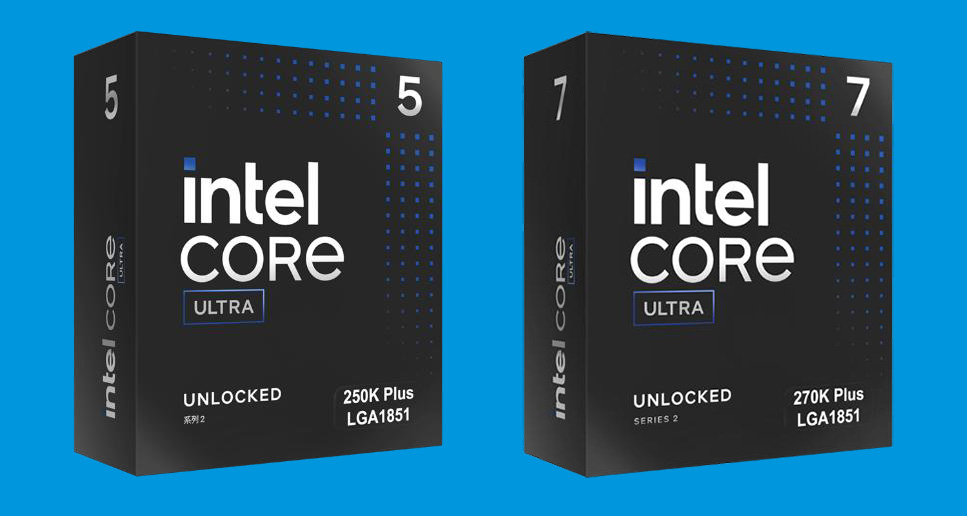
Diving right into the heart of matters, then, the Core Ultra 200S Plus series will be anchored by two new processors: the Core Ultra 7 270K(F) Plus, and the Core Ultra 5 250K(F) Plus. These are, at a high level, enhanced versions of Intel’s existing Core Ultra 7 265K(F) and Core Ultra 5 245K(F) processors, which have been among their most popular chips with enthusiasts.
| Intel Core Ultra 200S Chip SKUs (Selected) | ||||||||
| P Cores | E Cores | Max P Boost | Max E Boost | L3 Cache | DDR5 | TDP | Price | |
| Ultra 7 270K Plus | 8 | 16 | 5.5GHz | 4.7GHz | 36MB | 7200 | 125W | $299 |
| Ultra 7 265K | 8 | 12 | 4.6GHz | 30MB | 6400 | $293 | ||
| Ultra 5 250K Plus | 6 | 12 | 5.3GHz | 4.7GHz | 30MB | 7200 | $199 | |
| Ultra 5 245K | 6 | 8 | 4.6GHz | 24MB | 6400 | $199 | ||
What will be setting these chips apart from their predecessors then is essentially 5 things: more CPU cores, slightly higher clockspeeds, reducing end-to-end memory latency, support for higher memory speeds and capacities, and a new software tool – the Intel Binary Optimization Tool – that seeks to improve the code being fed into Intel’s hardware.
Starting with the high-level changes, the clockspeed and core count increases are pretty straightforward. Compared to their existing Core Ultra counterparts, the 250K Plus and 270K Plus are picking up 4 more E cores each, bringing them to 6P + 12E and 8P + 16E respectively. Furthermore, both are getting a modest boost to their E core peak clockspeed, which is now 4.7GHz for both SKUs. Notably, however, the peak P core frequencies are remaining unchanged, with the 270K Plus topping out at 5.5GHz, while the 250K Plus tops out at 5.3GHz.
This is the straightforward aspect of Intel’s changes. More cores at higher clockspeeds boosts multithreaded performance, which is arguably Arrow Lake’s strongest hand in the current competitive market. And in the case of the 270K Plus in particular, this means that Intel is now selling a fully-enabled 8P + 16E Arrow Lake chip as an Ultra 7 tier part. Previously, that configuration was only available in the far more expensive Ultra 9 tier.
Things are even more interesting under the hood, however. In a move that is unquestionably a reaction to the high memory latencies that handicap Arrow Lake’s gaming performance, Intel is tweaking their internal busses in order to cut down on that latency. Specifically, the clockspeed of the die-to-die (D2D) link between Arrow Lake’s SoC tile (where the memory controller lies) and the compute tile (CPU cores) is being significantly increased, taking it from 2.1GHz on normal Arrow Lake chips to 3.0GHz on the plus chips, a 900MHz (43%) increase.
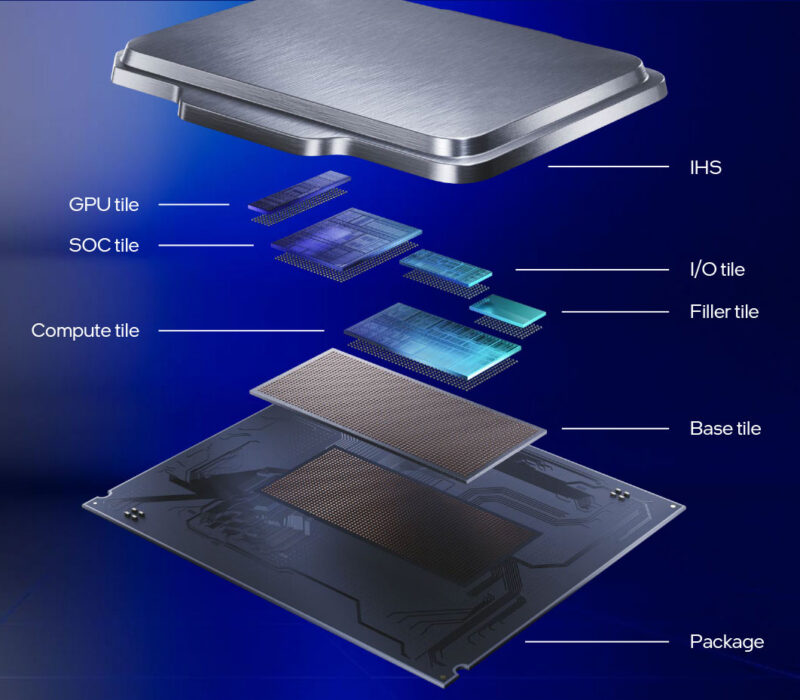
Increasing the frequency of this link primarily serves to cut down on overall CPU-to-DRAM latency by reducing the latency added by the D2D connection itself. It cannot completely mitigate the issue, but it can help. This is something overclockers experimented with after the launch of Arrow Lake, where there was significant evidence that Intel’s D2D link was conservatively clocked. So Intel is taking a page from the world of enthusiasts and overclockers (and their own boost overclocking profile) and applying higher D2D links to the Plus chips out of the box.
Gamers are also getting one more performance boost on the new chips with a feature Intel is calling their Binary Optimization Tool. A software-level feature akin to Intel’s thread-directing Application Optimization (APO) technology, the Binary Optimization Tool is a gaming-focused tool that looks to improve the execution of binaries within a single CPU core. Intel is being relatively mum on how the BOT works ahead of the Plus chip launch later this month, but at a high level the company is aiming to use their extensive compiler experience to develop a binary translator that can improve the effective IPC of the code within game binaries after they have shipped.

Suffice it to say, the devil is in the details and there are a lot of details to this to be disclosed. But with out-of-order execution within a CPU core having a finite window size and other limits to its ability to extract IPC from a stream of instructions, Intel is turning to software to see if they can wring out a bit more performance.
Intel is quick to note that BOT is a complimentary tool to APO and does not replace the thread-organizing feature. But it will be administered using the same control center application, and users will have the ability to turn it off and on at will, just like APO today.
Core Ultra 200S Plus Expected Performance
With this combination of clockspeed, core count, and software-based IPC increases, Intel is touting the new Plus chips as offering up to 15% better performance in games.
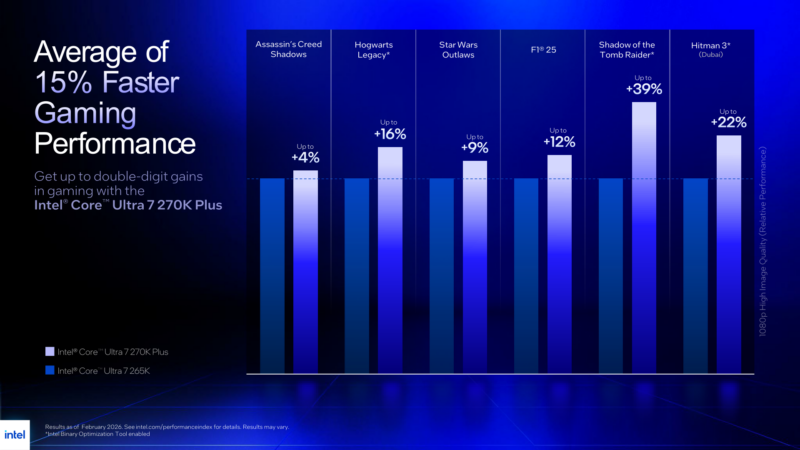
Some early figures released by Intel in a CPU-bound (1080p) scenario showcase performance gains anywhere between 4% and 39%, so it is safe to assume that the performance gains are going to be rather variable from game to game.
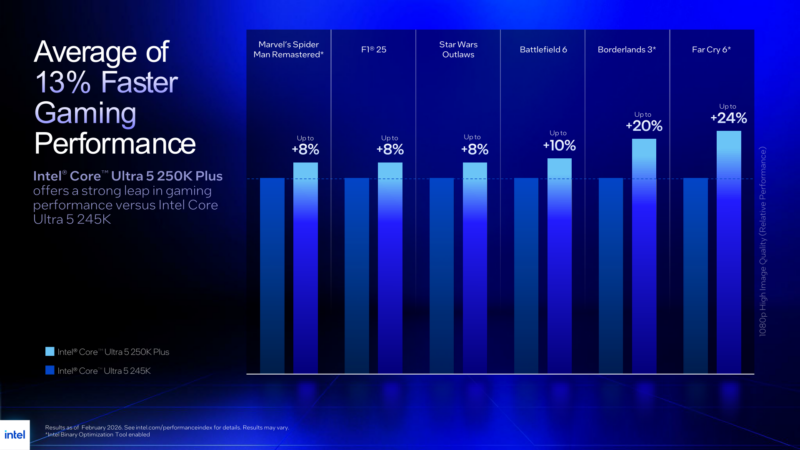
None the less, if Intel can squeeze out a meaningful gaming performance increase from the new Plus chips, then that would be a big win for the company. Especially given Arrow Lake’s weak reputation in the gaming market.
DDR5-7200 Memory, & 128GB DIMM Support via Quad-Rank CUDIMMs
Gaming features aside, the release of the new Plus chips also comes with some notable improvements to DDR5 memory support on the Arrow Lake platform.
First and foremost, the new Plus chips will be officially qualified to run at JEDEC DDR5-7200 memory speeds. This is two speed grades higher than the existing Core Ultra 200S chips, which top out at DDR5-6400. Most enthusiasts will go and overclock their memory anyhow (and the Plus chips will continue warrantying speeds up to DDR5-8000), but for system builders that stick to the spec for stability reasons, this is another modest improvement.
The other memory change is potentially more significant, and that is that Intel is bringing support for CUDIMMs with four memory ranks (quad rank) to the Arrow Lake platform. Which in turn promises to double the amount of memory a single Arrow Lake processor can address to 128GB per DIMM.
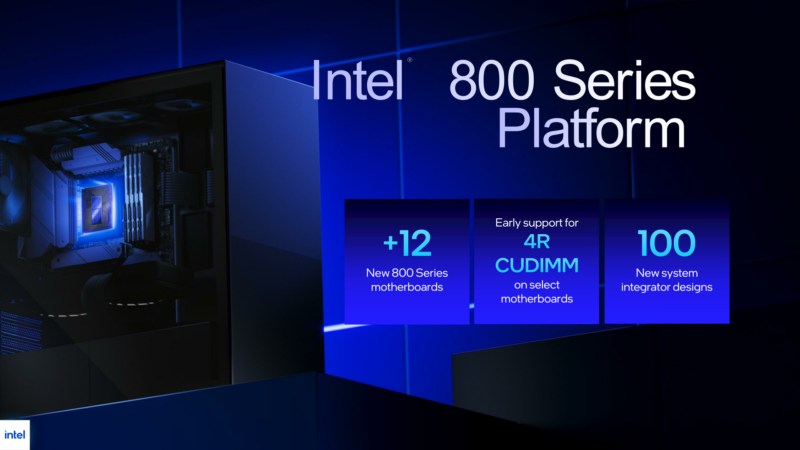
At present, consumer DIMMs are normally either single or dual rank, with the highest capacity quad rank configurations reserved for server DIMMs due to a combination of market demand and the technical challenges in driving four memory ranks. But with the rise of CUDIMMs and their eponymous clock driver, Intel believes that they can make quad rank reliably work with CUDIMMs.
For now, Intel is terming this as “early support” for the technology, and support for quad rank CUDIMMs is going to be limited to a subset of new 800 series motherboards. But the payoff will be that Arrow Lake systems would be able to support 128GB CUDIMMs, allowing a fully-outfitted system to run 256GB of DRAM with just two DIMMs, or 512GB of DRAM with a four DIMM configuration. Ultimately, this would allow for a desktop Arrow Lake system to serve as a viable alternative to an HEDT system for higher memory capacity workloads, shaving off at least a bit of the total system cost at a time when DDR5 memory prices are anything but budget-friendly.
Core Ultra 200S Plus Series: Launching March 26th
Wrapping things up, Intel’s new Core Ultra 200S Plus series chips will be launching later this month on March 26th. Intel will be setting the MSRP of the 250K Plus at $199, while the 270K Plus will be set at $299.
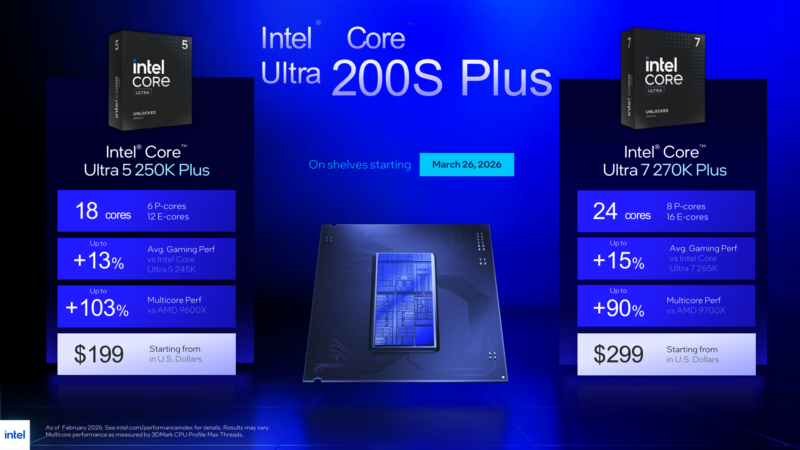
In practice, these prices are almost identical to the current street prices for the 245K and 265K respectively, so the new Plus chips are a straightforward improvement at the same price points. However, the fact that the 265K is a fully enabled Arrow Lake chip with all 24 CPU cores available means that it is going to put a lot of pressure on the 285K – and especially in gaming workloads where the latter doesn’t have the D2D clockspeed improvements. With only 200MHz in CPU clockspeeds separating the two chips, at this point Intel is effectively selling their best desktop Arrow Lake chip for just $300. So it will be interesting to see what this means for 285K sales going forward.
For that matter, it will be interesting to see what the real-world performance impact of Intel’s configuration changes are, as well as just how the Binary Optimization Tool works and its own performance impact. We should have the answer to all of that and more later this month.