

AMD Ryzen AI Max+ 395 Performance
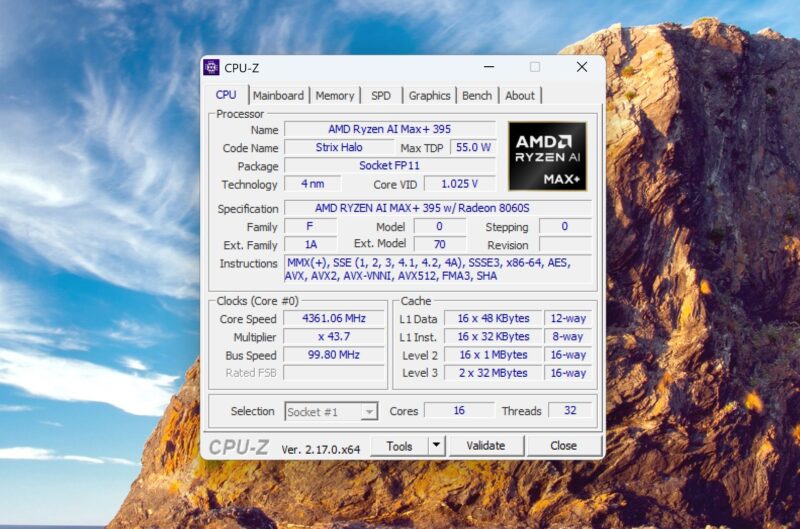
The AMD Ryzen AI Max+ 395 “Strix Halo” has become a favorite because it combines a 16-core/32-thread AMD Zen5 CPU with a 40CU AMD Radeon 8060S GPU onto one APU package. Combine that with 128GB of LPDDR5X memory, and you get a very powerful system.
We covered the AMD Ryzen AI Max+ 395 (Strix Halo) performance in our GMKtec EVO-X2 Review. In that review, we discussed how the gaming performance of that integrated GPU was not just a low-end experience. Instead, it was roughly a NVIDIA RTX 4070 mobile level of performance, which can play many games well. Frankly, it is really challenging to recommend the Framework Desktop, at this price, versus just getting another CPU and a GPU for gaming. Instead, where this excels is running larger models for AI. So we are going to focus a bit on that.
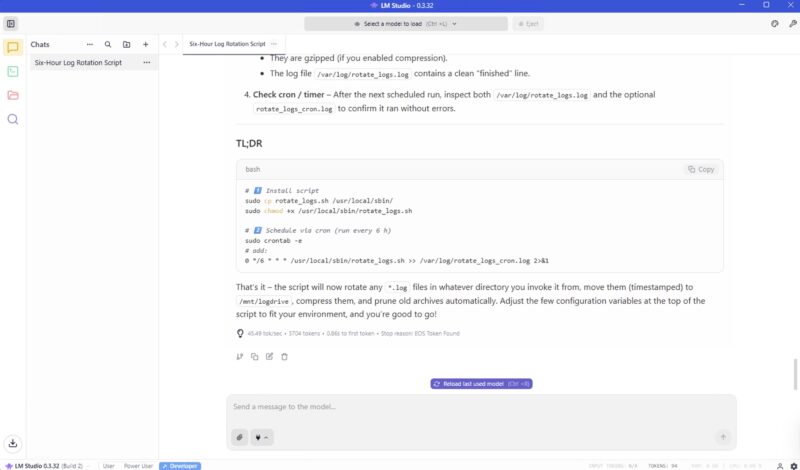
As a quick one, at STH, we have been using OpenAI’s gpt-oss-120b MXFP4 quite a bit as it tends to achieve high accuracy for many of the tasks we need, while also offering solid performance. The 20b version is much faster, but we prefer slower runtimes with higher accuracy. Even using a super-easy LM Studio out-of-the-box experience, this is running at roughly 45 Tokens/ second. The nice aspect about using a model like this is that we can crank up the context window on the desktop device, and it is a solid reasoning model, making it quite useful.
MLPerf Client v1.5
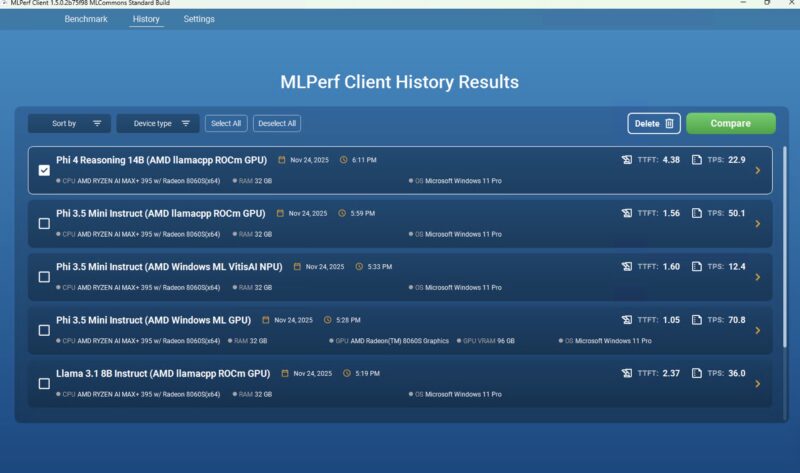
We wanted to use MLPerf Client here. Originally, we benchmarked it using MLPerf Client v1.0, but then v1.5 just came out, and so we re-ran everything using that. Here are some of the raw runs on the GPU and NPU:
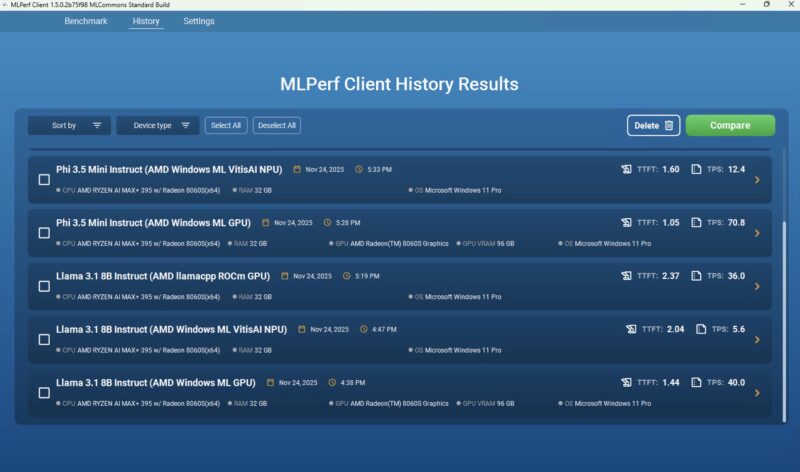
Here are the remaining Llama 3.1 8B results:
Just putting these into a more detailed table, here is what we saw for the GPU and NPU performance:
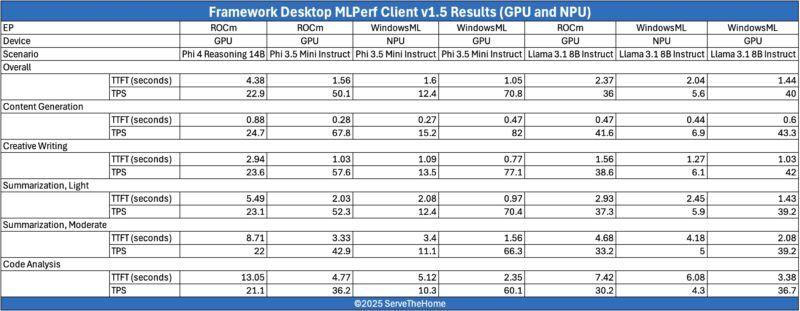
Again, these tend to be smaller models, but they are still quite usable. It also highlights something interesting, just showing the NPU versus GPU performance.
Geekbench 5, Geekbench 6, and Geekbench AI
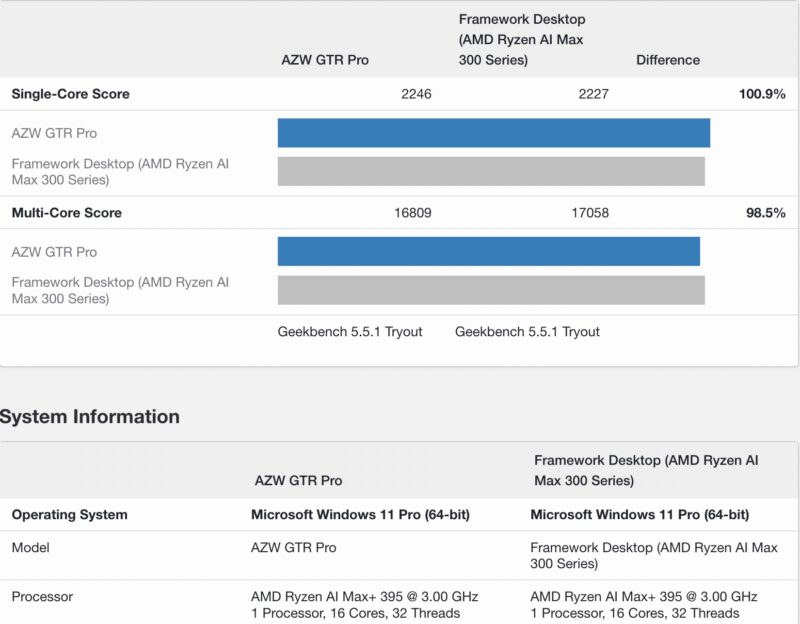
Since we have soldered memory and CPU, the fact of the matter is that competition between the Framework Desktop and others is fierce. We wanted to highlight this, however, versus the Beelink GTR9 Pro and the Minisform S1-Max. Starting with the Beelink GTR9 Pro results, here is a Geekbench 5 CPU comparison:
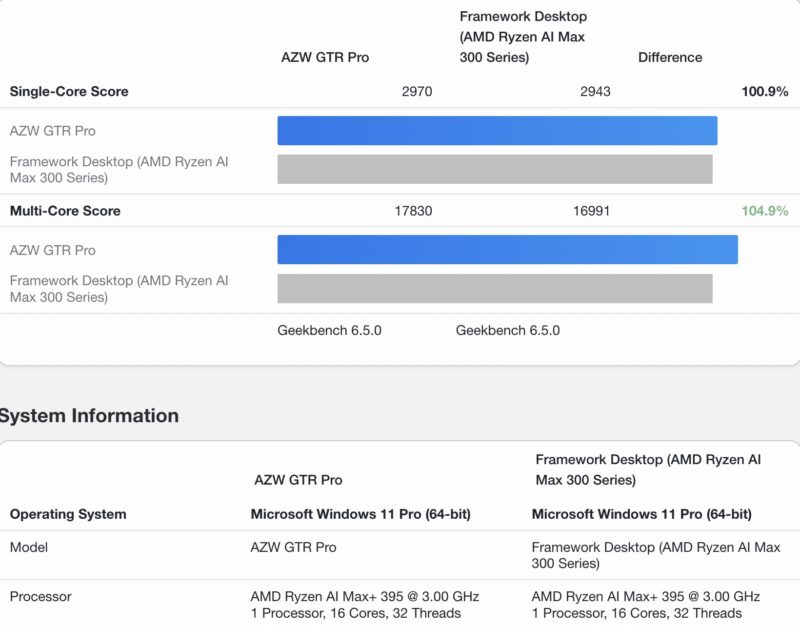
Here is the same for Geekbench 6:
When it came to Geekbench AI, here is what we saw:
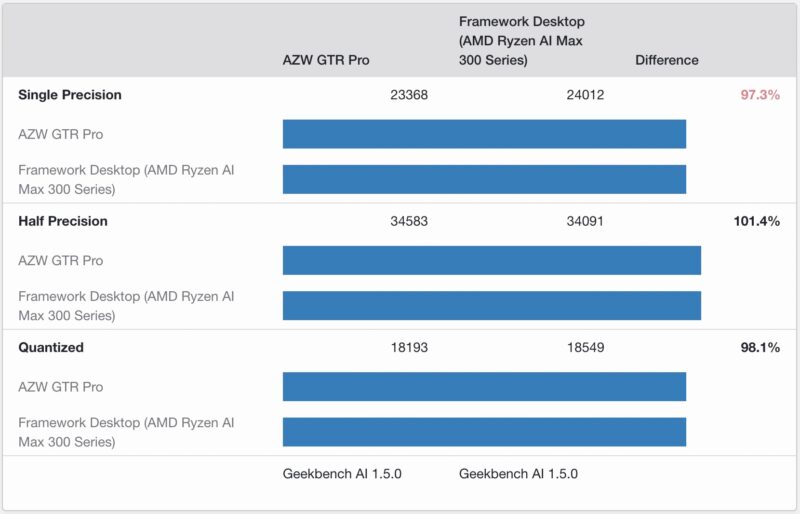
These are all frankly very close to the point where we would discuss differences more in terms of features and pricing rather than performance.
The Minisform S1-Max, however, is on another level. We had this in its default configuration and not in the highest power/ performance setting, but the performance of the Minisforum was really good.
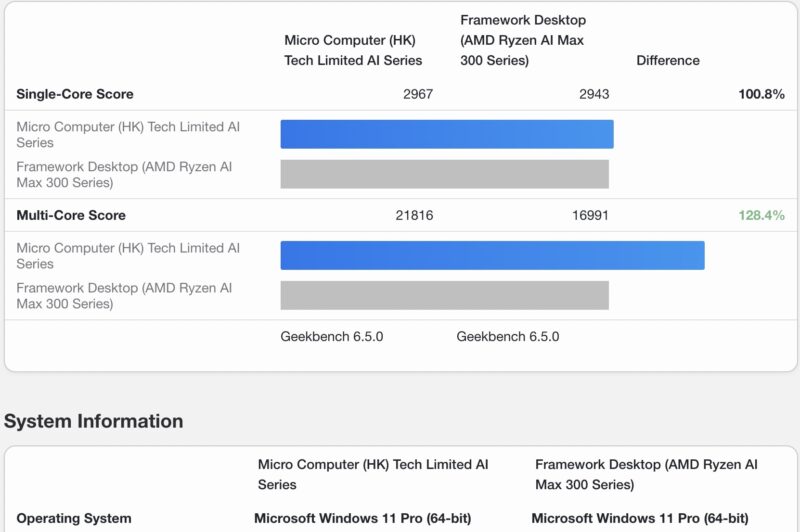
Something we have seen is that when you allocate 96GB for the GPU instead of either 128GB or 96GB for the CPU, the CPU performance suffers. Here is what happens when we swap to a 96GB GPU and 32GB CPU split:
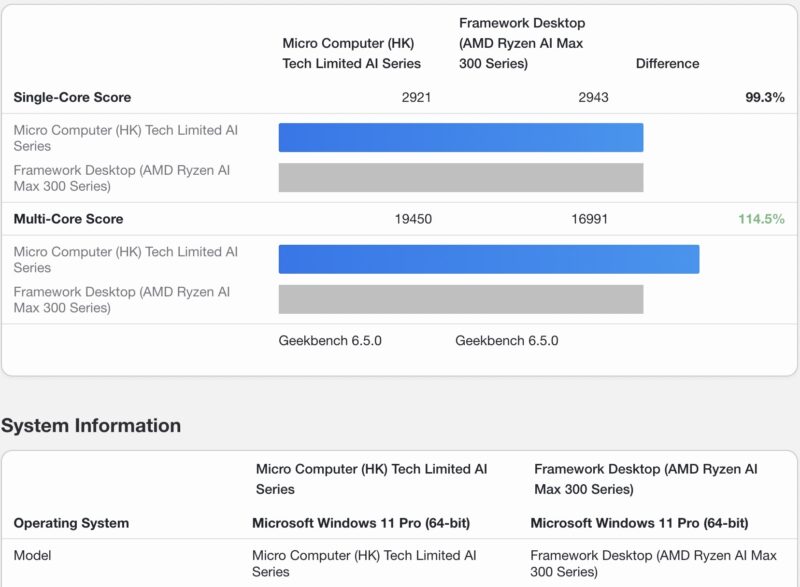
That is still over a 14% difference, where the S1-Max is just flat out faster than the Framework Desktop.
On the Geekbench AI side, and testing with that 96GB GPU memory, we saw consistently better performance on the Minisforum over the Framework.
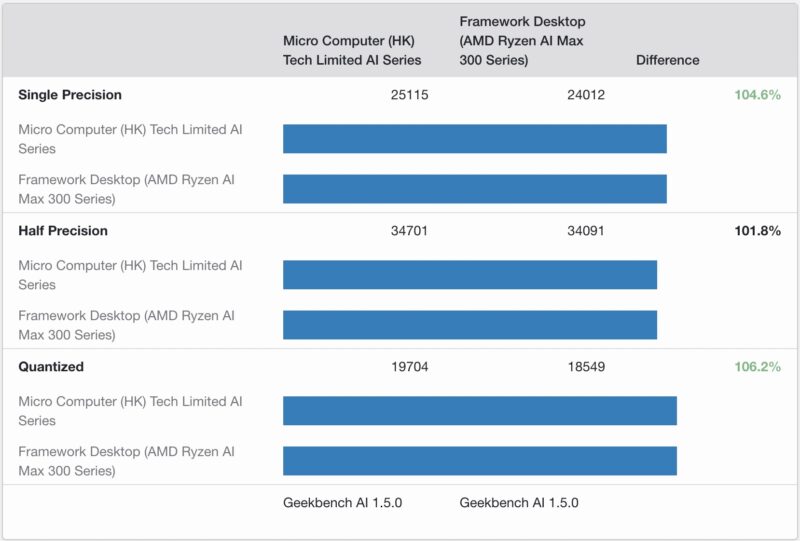
Those are not huge differences, but depending on what we ran Minisforum was between -1% to +28% over the Framework Desktop. That is too big of a delta to be due to test run variations.
Perhaps the takeaway is that the Framework Desktop performs well, but is more like the Beelink performance rather than the Minisforum. The Minisforum also comes pre-assembled with Windows 11 Pro pre-installed so not only is it faster, but it is sold as a complete system.
 performs and compares to others we reviewed)
One thing about the framework desktop that I really appreciated was that it came with the nvme heatsinks/mounting items even if those weren’t populated. My HP system didn’t have the heatsink for the slot that didn’t have a drive, which seemed pretty insulting for a system that was close to 3k USD.
Out of curiosity, and because it seems likely to be important for this ‘size’ of system; how good is the state of TB/USB4 ‘multiple connection’ networking?
Obviously not a good option if you want to throw a real switch in there; but if you only need a quite small cluster and TB networking actually works fairly well there are a variety of systems with deeply underwhelming NICs that become a lot more viable than they appear(mac minis, this and other Strix Halo units); while if TB networking is actually kind of terrible beyond ‘hey, I guess it’s nice that you can do a crossover connection between two devices; and it doesn’t cost extra’ then the NICs on the Nvidia units start to look like a much, much, more compelling feature.
Framework Desktop USB4 and mDP ports have been super flaky for me. It really hates driving 2 monitors where one is HDMI and the other mDP. Under every Linux distribution I’ve tried this combo is unusably flake.
This box also has a very nice BIOS which is all but impossible to access from a boot. USB keyboard handling to BIOS is also very flaky.
#fuzzyfuzzyfungus
TB Networking is good, but it really is just a point-to-point connection at anywhere between 18-25Gbps. You could potentially daisy-chain multiple of them or set them up in a ring topology. However, as you said, there is no proper switching. Perhaps if you had a storage server with Thunderbolt it might make sense.
A other caveat for the Framework Desktop is it’s availability – 90% of the world’s population are unable to buy a Framework, due to their draconic shipping policies (limited shipping + banning parcel forwarders + banning commercial resale). As a result, Frameworks are not an option for most folks unfortunately.
Another really solid and balanced review STH. I’m also liking the new MLPerf Client benchmarks. You didn’t cover it but 1.5 came out just about a week ago so those are recent
Kind of a silly question, but did you enable the 160W profile in windows? It’s not on by default with these. I ask because I did get slightly higher results than you do here.
The new MS-S1 looks appealing but it’s more of a 1-trick pony for the money. By the time you add 128gb of ram and a gpu – it’s way more expensive.
I went and built a custom mini its cube with dual 10gbe using the FW board and it was significantly cheaper.
Happy thanksgiving to STH. I’m dropping in just to say I liked this review. Thanks for using an industry standard MLPerf not just a roll-your-own that we can’t use to compare. I know it doesn’t really use big enough models to stress this with so much memory but it’s nice to see that being included
I think the fact that you can buy just the mainboard and supply the rest on your own makes this one an interessting choice.
The lack of top-tier networking is a bit of a shame though.
“A few weeks ago, many would consider $1999 for the base price of a 128GB memory system to be high. Now given the spike in DDR5 pricing that feels quite reasonable.”
If anything I think it may actually represent tremendous value, though perhaps only at this exact moment in time.
The pricing of future batches will almost definitely be increased at some point to account for the volatility of DDR5 cost/availability, but until that happens- given how severe the RAM shortage is portending to be (eg. with HP going on record as planning to curtail the amount of memory included with their systems, or how Nvidia is requiring some board partners to supply their own VRAM), if those supply issues start to drag from 2026 into 2027 or longer and begin impacting the release timing of the Steam Machine, or PlayStation 6 in the longer-term, etc. then one of the Framework Desktop SKUs with the Radeon 8060 could be a rather shrewd investment.
Full disclosure: I preordered one, and have laid down ~$3600 (Australian/AUD) for a full build of the Ryzen 395+ 128GB RAM model, after I worked out it would cost me ~$3100 to assemble a roughly equivalent SFF gaming PC without compromising too much on build size or the quality of the components.
[CPU] AMD Ryzen 9 9950X ($960)
[HSF] Noctua NH-L9a ($83)
[Case] Lian Li A4-H20 X4 ($199)
[PSU] Cooler Master 650W Gold SFX ($169)
[MB] * ($468)
[RAM] Corsair Vengeance 2x48GB DDR5-6000 CL36 kit ($720)
[GPU] Asus DUAL OC V2 GeForce RTX 4060 ($469)
*here I just picked the median price among the 13 in-stock results on PCPartPicker
To avoid using FSR/DLSS for gaming I would need to double my GPU budget to buy a 9700XT or 5070 Ti, and then also spend ~$220 on a better PSU, to end up with something that costs as much as the Framework anyway and is much worse for AI workloads. And all this is with Black Friday sales factored in.
With the economy the way it is, ie. how the top 10% of earners are now accounting for >50% of consumer spending, it’s likely that gaming PCs will become unaffordable to anyone other than the wealthiest of enthusiasts. And if that happens, I feel the Switch 2, PS5 (with its large install base and the PS6 delayed by the V/RAM shortage) ± the Steam Machine will become the main targets of developers for optimising performance vs. graphical fidelity – and to tie all this together, with where the Strix Halo APU’s performance is situated among those benchmarks it will benefit indirectly and remain relevant for several years.
My experience with FW Desktop is that it suffers from AMD TPM issues. The problem is that TPM becomes unavailable after some sleep&wake cycles forcing you to reboot your PC.
Hoping that guys fix that problem, because it makes this PC very annoying device.
So Patrick&Team please test this device with sleep&wake and Windows Hello / Windows Hello for Business.